

Start here
A few places to begin, from the aircraft’s story to the people who fly it.
Meet the aircraft
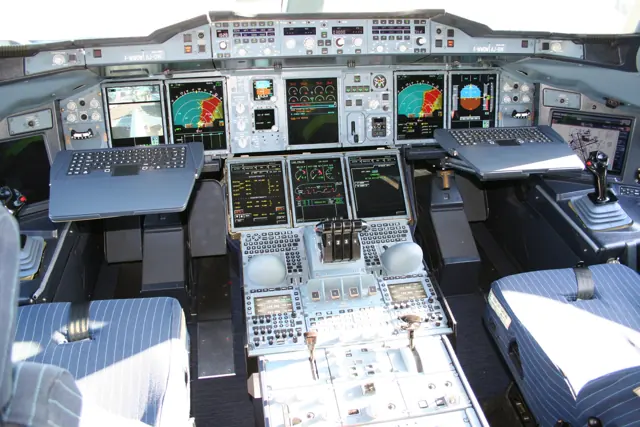
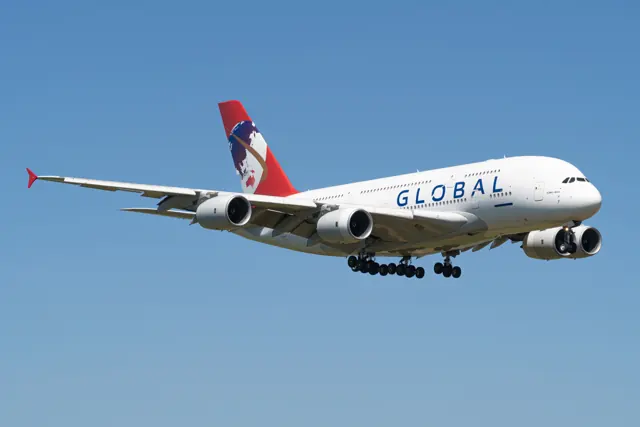
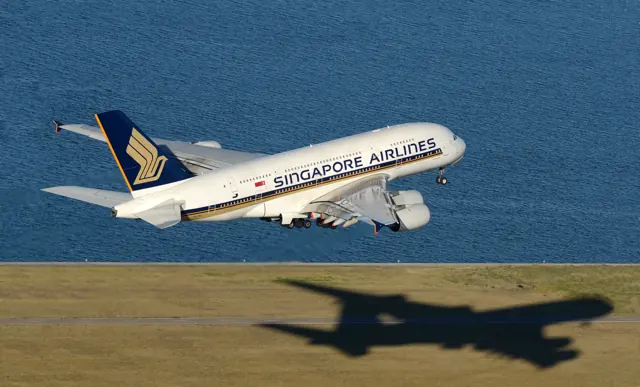
The A380 arranged two passenger decks within a very large four-engine airframe. Its programme targeted heavily travelled routes and major hub airports. The aircraft's wide wing and extensive landing gear reflect the scale of the design. Airline interiors vary substantially, so a single seating figure does not describe every A380. Its simulator implementations likewise have their own cockpit and systems scope.
Aircraft background
Wikipedia contributors · Read more ↗A huge aircraft, a surprisingly light touch
Mark flew an A380 from Toulouse before the 2009 Paris Air Show, joining a demonstration of new braking and traffic-avoidance functions. The cockpit was unusually spacious and quiet, and taxi cameras made keeping the aircraft on the centreline easier than he expected. Takeoff brought an odd mismatch between the speed indicated on the instruments and his muted visual sense of acceleration.
AIN, public reprint at English4aviation, June 2009. Firsthand demonstration flight. Original AIN publication: 17 June 2009; the full report is available in this public reprint.
AIN, public reprint at English4aviation · Read more ↗Fuel trim and flight controls are different systems
FlyByWire's A380X documentation separates trim-tank fuel management from the flight-control checks performed with the sidestick. It also identifies autopilot engagement and hydraulic shutdown procedures. Fuel transfer manages balance, while the sidestick checks concern the flight controls.
A380X · FlyByWire · MSFS 2020 · MSFS 2024
FlyByWire · Read more ↗Into the cockpit
 YouTube
Just Planes · 18 min ·
Piloting AIRBUS A380 from Kuala Lumpur | Cockpit Views
Preparation, walkaround and departure from Kuala Lumpur aboard a Malaysia Airlines A380.
Real aircraft · Airbus A380
Watch on YouTube ↗Preview images are served by AirframeDB. Videos open on YouTube only when you choose to watch.
Meet Airbus A380
The A380 arranged two passenger decks within a very large four-engine airframe. Its programme targeted heavily travelled routes and major hub airports. The aircraft's wide wing and extensive landing gear reflect the scale of the design.
Airline interiors vary substantially, so a single seating figure does not describe every A380. The simulator products also differ in the cockpit functions and systems they model.
Airbus A380
Aircraft type designators
Use the code for the model you are flying. The linked authority lists the applicable aircraft.
History & design
Development milestones
First flight: 27 April 2005 ( 2005-04-27 )
Wikipedia contributors · Airbus A380 ↗Airbus A380 · family/variant named by the source · Wikipedia revision 1374387538
Pilot accounts
A huge aircraft, a surprisingly light touch
Mark flew an A380 from Toulouse before the 2009 Paris Air Show, joining a demonstration of new braking and traffic-avoidance functions. The cockpit was unusually spacious and quiet, and taxi cameras made keeping the aircraft on the centreline easier than he expected. Takeoff brought an odd mismatch between the speed indicated on the instruments and his muted visual sense of acceleration. Once airborne, small movements of his wrist were enough to guide the large aircraft through banked turns.
On his landing, he kept off the brake pedals while the brake-to-vacate system slowed the aircraft for the selected exit. He also watched demonstrations using artificial traffic targets and an artificially shortened runway entry. These were planned tests, not encounters with real conflicting traffic or an actual runway emergency.
AIN, public reprint at English4aviation, June 2009. Firsthand demonstration flight. Original AIN publication: 17 June 2009; the full report is available in this public reprint.
Read the full account · AIN, public reprint at English4aviation ↗An approachable giant, with room to improve the cockpit
After flying the first A380 test aircraft from Toulouse, Gerzanics told Max Kingsley-Jones that its handling felt closer to an A320 than an A340. Taxi cameras helped him position the nose gear accurately, and the cockpit height and landing-gear geometry made ground manoeuvring less daunting than its enormous wingspan suggested. The aircraft was well below its maximum takeoff weight on this particular evaluation flight.
He found the low-speed handling agile around the airport and the touchdown and lowering of the nose notably smooth. He welcomed larger displays and graphical changes to the flight plan, but his assessment was not unqualified praise: separate controls for the flight-management system, aircraft monitoring and information terminal made the integration less satisfactory than in contemporary business jets.
Flight International, 18 September 2006. Interview following Gerzanics’s 14 September 2006 evaluation in MSN001/F-WWOW; early test-aircraft configuration.
Read the full account · Flight International ↗A dream aircraft, and the work behind every departure
Kashwani had wanted to fly the A380 from its launch, and his opportunity arrived in 2008. On his first walk-around, the scale of its wings and engines left a lasting impression. In Airbus's interview, the Emirates captain describes a responsive aircraft that he considered especially stable among the jetliners he had flown. Seeing people photograph it at takeoff or landing continued to bring back that initial sense of occasion.
His working day was more methodical than the spectacle outside suggested. He liked to reach the aircraft an hour before departure so the large crew had time to prepare, check the systems and receive the passengers. Automation provided support in cruise, while the pilots still had to identify and navigate around thunderstorms. Airbus published the interview with Kashwani.
Airbus, April 2019. Manufacturer-published interview with an Emirates A380 captain; individual preferences and impressions are attributed.
Read the full account · Airbus ↗The emergency continued after the landing
Evans was the supervising check captain in an observer seat when QF32 suffered an uncontained engine failure after departing Singapore on 4 November 2010. He describes a flood of warnings that required the five pilots to establish what still worked, discuss conflicting indications and judge which actions were appropriate. While Richard de Crespigny flew the aircraft and the operating crew worked through the problems, Evans also helped keep passengers informed. The assessment took nearly two hours before the crew returned to land.
For Evans, the period after stopping was particularly worrying. One engine continued running, fuel was leaking and the brakes were hot. The crew weighed an immediate slide evacuation against keeping passengers aboard with the cabin crew ready to act. They eventually disembarked through stairs. He emphasises shared judgement, communication and cabin-crew work during the emergency.
Royal Aeronautical Society, 8 December 2010. Firsthand interview with the supervising check captain; Tim Robinson, Royal Aeronautical Society. Evans was not the pilot flying.
Read the full account · Royal Aeronautical Society ↗In your simulator
Systems, equipment and documentation for each developer’s aircraft.
Compare simulator versions →MSFS 2020 · MSFS 2024A380X
FlyByWire · Early Access
A380X
FlyByWire · Early Access
MSFS 2024A380-800
iniBuilds · Released
A380-800
iniBuilds · Released
Manuals & resources
Find your next read
Choose a topic for a short introduction and a link to the original source. Simulator references identify the developer and edition they cover.
Simulator documentation
Fuel trim and flight controls are different systemsA380X · FlyByWire · MSFS 2020 · MSFS 2024
FlyByWire's A380X documentation separates trim-tank fuel management from the flight-control checks performed with the sidestick. It also identifies autopilot engagement and hydraulic shutdown procedures. Fuel transfer manages balance, while the sidestick checks concern the flight controls.
SOP snapshot; dated pages; installed aircraft build not observed · PDF pp13,29,40,83; after-start control check and climb
FlyByWire · Read the source ↗Released product and variantsA380X · FlyByWire · MSFS 2020 · MSFS 2024
The free A380X is publicly available through the FlyByWire installer for both MSFS generations, including a native 2024 version. FlyByWire still describes it as an open alpha and maintains a list of unimplemented systems; several systems remain unimplemented.
Official developer / designated-store reference · checked 2026-09-14
FlyByWire Simulations · Read the source ↗Pilot account
A huge aircraft, a surprisingly light touchAIN, public reprint at English4aviation, June 2009. Firsthand demonstration flight. Original AIN publication: 17 June 2009; the full report is available in this public reprint.
Mark flew an A380 from Toulouse before the 2009 Paris Air Show, joining a demonstration of new braking and traffic-avoidance functions. The cockpit was unusually spacious and quiet, and taxi cameras made keeping the aircraft on the centreline easier than he expected. Takeoff brought an odd mismatch between the speed indicated on the instruments and his muted visual sense of acceleration. Once airborne, small movements of his wrist were enough to guide the large aircraft through banked turns.
Robert P. Mark
AIN, public reprint at English4aviation · Read the source ↗An approachable giant, with room to improve the cockpitFlight International, 18 September 2006. Interview following Gerzanics’s 14 September 2006 evaluation in MSN001/F-WWOW; early test-aircraft configuration.
After flying the first A380 test aircraft from Toulouse, Gerzanics told Max Kingsley-Jones that its handling felt closer to an A320 than an A340. Taxi cameras helped him position the nose gear accurately, and the cockpit height and landing-gear geometry made ground manoeuvring less daunting than its enormous wingspan suggested. The aircraft was well below its maximum takeoff weight on this particular evaluation flight.
Mike Gerzanics
Flight International · Read the source ↗Developer documentation
A380-800 — product listingA380-800 · MSFS 2024
Product listing captured 2026-09-30; edition scope from the reviewed catalogue
iniBuilds Store · Read the source ↗Read the original documentation from the people who created it. Manuals open on their publisher’s website.
Manual
A380X SOPFlyByWire Microsoft Flight Simulator aircraft manualsMicrosoft / aircraft developersAircraft background
Airbus A380Wikipedia contributors · Research background · Wikipedia revision 1374387538 · retrieved 2026-09-12Product
A380 Airliner for MSFS-2024iniBuilds · Official developer / designated store catalogue · checked 2026-09-12 iniBuilds A380 Airliner for MSFS – iniBuilds StoreiniBuilds Store · Product listing captured 2026-09-30; edition scope from the reviewed catalogueDeveloper documentation
Installer Guide - FlyByWire Simulations DocumentationFlyByWire Simulations · Official developer / designated-store reference · checked 2026-09-14 INOP System - FlyByWire Simulations DocumentationFlyByWire Simulations · Official developer / designated-store reference · checked 2026-09-14Type designator
ICAO Doc 8643 — aircraft type designatorsInternational Civil Aviation Organization · Public search data retrieved 2026-09-14; authority update 2026-09-03Built-in force-feedback profiles
Read the documentary basis, editable starting settings and remaining questions for the aircraft you fly. Each explanation refers to the exact profile revision shown.
Catalogue programme-20261022-v1 · 3 profile choices
FlyByWire A380X
FlyByWire · Free and Pro · Revision 3 · Inherited starting point
MSFS 2020 · MSFS 2024
FlyByWire A380X: Fixed spring centering represents the passive A380 sidestick; hydraulic/electric surface redundancy does not imply stick backdrive.
iniBuilds A380-800
iniBuilds · Free and Pro · Revision 2 · Inherited starting point
MSFS 2024
iniBuilds A380-800: Fixed spring centering represents the passive A380 sidestick; hydraulic/electric surface redundancy does not imply stick backdrive.
Airbus A380
Free and Pro · Revision 3 · Partial review
MSFS 2024 · MSFS 2020
Airbus A380: Fixed spring centering represents the passive A380 sidestick; hydraulic/electric surface redundancy does not imply stick backdrive.
Discuss this aircraft (0)
Questions, observations and useful sources from the community.
No published discussions yet. Bring a question or share a useful source.
Open aircraft discussions →Content expanded · What’s new
Something missing or a source that needs attention?
Suggest a correction ↗