
Start here
A few places to begin, from the aircraft’s story to the people who fly it.
Meet the aircraft
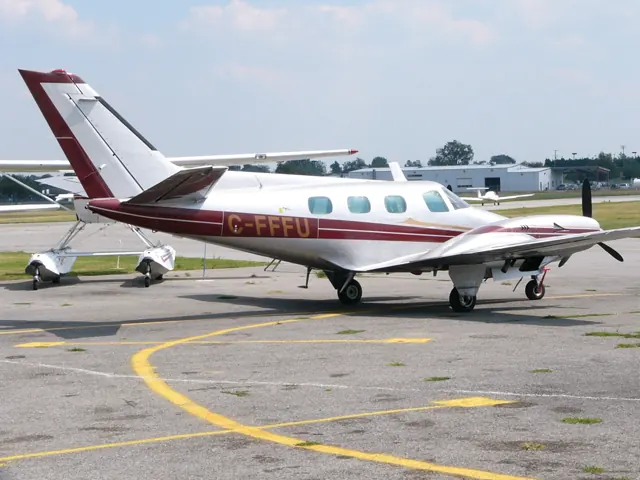
The Beechcraft Duke combined turbocharged piston engines with a pressurised cabin and retractable landing gear. Its swept-looking tail and compact low-wing airframe give it a distinctive outline. It entered the market between smaller touring twins and turbine-powered business aircraft. Royal Turbine conversions replace the piston engines with PT6 turboprops, creating a materially different aircraft.
Aircraft background
Wikipedia contributors · Read more ↗A piston Duke and time with friends
Rankin's first Duke flight formed part of his 2017 project to experience 52 aircraft in 52 weeks. The Navy pilot joined owner Chris Phillips and fellow pilot Brett Taylor for an outing from Gulf Shores, Alabama. The aircraft's appearance had attracted him before boarding, and he found the piston-powered, pressurised twin smooth and comfortable once they were airborne.
SRQ Daily, 23 March 2017. Ryan Rankin’s first flight in Chris Phillips’ piston Beechcraft 60 Duke.
SRQ Daily · Read more ↗The turbine conversion changes the engine story
Black Square's Turbine Duke models the Royal Turbine conversion with PT6A-35 engines, a different propulsion system from the piston Duke's turbocharged Lycomings. The manual describes persistent wear and failures, pressurisation and environmental systems, and a broad choice of navigation equipment. Period radios, the Century IV autopilot and optional modern GPS installations form distinct cockpit configurations.
Beechcraft Duke · Black Square · Black Square · MSFS 2020 · MSFS 2024
Black Square / Just Flight · Read more ↗Into the cockpit
 YouTube
twotonemurphy · 186 min ·
Vertical Cockpit Cam LIVE | BlackSquare Piston Duke | Oregon to Lake County🛩️
A Black Square piston Duke flight across Oregon in MSFS 2024.
Simulator · Black Square piston Duke · MSFS 2024
Watch on YouTube ↗Preview images are served by AirframeDB. Videos open on YouTube only when you choose to watch.
Meet Beechcraft Duke
The Beechcraft Duke combined turbocharged piston engines with a pressurised cabin and retractable landing gear. Its swept-looking tail and compact low-wing airframe give it a distinctive outline. It entered the market between smaller touring twins and turbine-powered business aircraft.
Royal Turbine conversions replace the piston engines with PT6 turboprops, creating a materially different aircraft. Black Square models both branches with different engine behaviour while sharing a broad selection of period and modern navigation equipment. Its systems and performance differ between the piston and turbine versions.
Beechcraft Duke
Beechcraft → · Explore the family →
Beechcraft Duke
Wikipedia contributors · Beechcraft Duke ↗Black Square · MSFS 2020 · MSFS 2024 →Aircraft type designators
Use the code for the model you are flying. The linked authority lists the applicable aircraft.
History & design
Development milestones
First flight: December 29, 1966
Wikipedia contributors · Beechcraft Duke ↗Beechcraft Duke · family/variant named by the source · Wikipedia revision 1342466818
Pilot accounts
A piston Duke and time with friends
Rankin's first Duke flight formed part of his 2017 project to experience 52 aircraft in 52 weeks. The Navy pilot joined owner Chris Phillips and fellow pilot Brett Taylor for an outing from Gulf Shores, Alabama. The aircraft's appearance had attracted him before boarding, and he found the piston-powered, pressurised twin smooth and comfortable once they were airborne. The equipped cockpit and passenger cabin suited the relaxed transport role he describes.
What stayed with him most was the company. Rankin knew Phillips through another interest: turning discarded aircraft parts into furniture. Taylor helped with that work, but the Duke outing was their first flight together. Rankin felt the aeroplane left them enough attention to enjoy talking and spending time together.
SRQ Daily, 23 March 2017. Ryan Rankin’s first flight in Chris Phillips’ piston Beechcraft 60 Duke.
Read the full account · SRQ Daily ↗The prototype turbine conversion climbs away from Truckee
Cox flew the Royal Turbine development aircraft with Darwin Conrad from Truckee-Tahoe, a high-elevation airport in California. With three people and approximately half fuel aboard, the climb was the immediate surprise. He reported reaching 23,000 feet only minutes after departure, then allowing the aeroplane to accelerate in smooth air until its indicated speed and temperature gave a calculated 301 knots true airspeed. These were observations of the prototype before the conversion's anticipated certification.
During the descent, Conrad suggested evaluating it with the right engine shut down and its propeller feathered. Cox describes trimming the aircraft and finding considerable remaining speed on the operating engine. The flight made the increase in performance tangible, while the existing Duke cabin and pressurisation system still defined its accommodation at altitude. It should be read as a flight in that early conversion, with the later approved configuration considered separately.
Plane + Pilot, 1 July 2005. Royal Turbine prototype demonstration with Darwin Conrad; conversion certification still described as forthcoming.
Read the full account · Plane + Pilot ↗Fast acceleration, a rapid climb and a manageable arrival
Bedell flew two Royal Turbine sorties from Spokane's Felts Field. The first supported air-to-air photography, after which Darwin Conrad demonstrated the conversion's asymmetric handling. Bedell took the left seat for a second flight to check its high-altitude performance. The takeoff demanded attention: the engines did not accelerate identically, power needed careful setting and the aircraft gathered speed very quickly. A continuous climb then carried them to 28,000 feet in twelve minutes.
He found the descent and approach more manageable than that initial rush might suggest. The aircraft could slow using its landing gear and flaps with relatively small trim changes, and his own first landing used little runway, although he did not match Conrad's earlier demonstration. He also noted the limits of the original pressurisation system at high altitude and the difficulty of remaining below the indicated-speed limit down low. His enthusiasm for the turbine Duke includes those practical constraints, alongside its climb, quietness and responsive handling.
AOPA Pilot, 5 August 2007. Northwest Turbine Royal Turbine conversion, two demonstration flights from Felts Field.
Read the full account · AOPA Pilot ↗In your simulator
Systems, equipment and documentation for each developer’s aircraft.
MSFS 2020 · MSFS 2024Beechcraft Duke · Black Square
Black Square · Released
Beechcraft Duke · Black Square
Black Square · Released
Aircraft specifications
Published figures for the named real-aircraft variant. Simulator equipment and performance can differ.
| Specification | Published value |
|---|---|
| Length | 33 ft 10 in (10.31 m) |
| Wingspan | 39 ft 3 + 1 ⁄ 3 in (11.972 m) |
| Height | 12 ft 4 in (3.76 m) |
| Wing area | 212.9 sq ft (19.78 m² ) |
| Empty weight | 4,275 lb (1,939 kg) |
| Max takeoff weight | 6,775 lb (3,073 kg) |
| Powerplant | 2 × Lycoming TIO-541-E1C4 turbocharged six-cylinder, horizontally opposed direct drive engines, 380 hp (280 kW) each |
| Propellers | 3-bladed Hartzell constant speed |
| Maximum speed | 248 kn (285 mph, 459 km/h) at 23,000 ft (7,000 m) |
| Cruise speed | 178 kn (205 mph, 330 km/h) at 20,000 ft (6,100 m), 45% power |
| Stall speed | 73 kn (84 mph, 135 km/h) ( IAS ), wheels and flaps down, power off |
| Range | 1,227 nmi (1,412 mi, 2,272 km) at 20,000 ft (6,100 m), 45% power, 45 min reserves, max optional fuel |
| Service ceiling | 30,000 ft (9,100 m) |
| Rate of climb | 1,601 ft/min (8.13 m/s) |
Manuals & resources
Find your next read
Choose a topic for a short introduction and a link to the original source. Simulator references identify the developer and edition they cover.
Simulator documentation
The turbine conversion changes the engine storyBeechcraft Duke · Black Square · Black Square · MSFS 2020 · MSFS 2024
Black Square's Turbine Duke models the Royal Turbine conversion with PT6A-35 engines, a different propulsion system from the piston Duke's turbocharged Lycomings. The manual describes persistent wear and failures, pressurisation and environmental systems, and a broad choice of navigation equipment. Period radios, the Century IV autopilot and optional modern GPS installations form distinct cockpit configurations.
Black Square Turbine Duke · PDF p.9; introduction and feature overview
Black Square / Just Flight · Read the source ↗Pilot account
A piston Duke and time with friendsSRQ Daily, 23 March 2017. Ryan Rankin’s first flight in Chris Phillips’ piston Beechcraft 60 Duke.
Rankin's first Duke flight formed part of his 2017 project to experience 52 aircraft in 52 weeks. The Navy pilot joined owner Chris Phillips and fellow pilot Brett Taylor for an outing from Gulf Shores, Alabama. The aircraft's appearance had attracted him before boarding, and he found the piston-powered, pressurised twin smooth and comfortable once they were airborne. The equipped cockpit and passenger cabin suited the relaxed transport role he describes.
Ryan Rankin, interviewed by Philip Lederer
SRQ Daily · Read the source ↗The prototype turbine conversion climbs away from TruckeePlane + Pilot, 1 July 2005. Royal Turbine prototype demonstration with Darwin Conrad; conversion certification still described as forthcoming.
Cox flew the Royal Turbine development aircraft with Darwin Conrad from Truckee-Tahoe, a high-elevation airport in California. With three people and approximately half fuel aboard, the climb was the immediate surprise. He reported reaching 23,000 feet only minutes after departure, then allowing the aeroplane to accelerate in smooth air until its indicated speed and temperature gave a calculated 301 knots true airspeed.
Bill Cox
Plane + Pilot · Read the source ↗Read the original documentation from the people who created it. Manuals open on their publisher’s website.
Manual
Microsoft Flight Simulator aircraft manualsMicrosoft / aircraft developers Piston Duke manualBlack Square / Just Flight Turbine Duke manualBlack Square / Just FlightAircraft background
Beechcraft DukeWikipedia contributors · Research background · Wikipedia revision 1342466818 · retrieved 2026-09-12Product
Piston DukeBlack Square · Official developer / designated store catalogue · checked 2026-09-12 Turbine DukeBlack Square · Official developer / designated store catalogue · checked 2026-09-12Type designator
ICAO Doc 8643 — aircraft type designatorsInternational Civil Aviation Organization · Public search data retrieved 2026-09-14; authority update 2026-09-03Built-in force-feedback profiles
Read the documentary basis, editable starting settings and remaining questions for the aircraft you fly. Each explanation refers to the exact profile revision shown.
Catalogue programme-20261022-v1 · 4 profile choices
Black Square Piston Duke
Black Square · Free and Pro · Revision 5 · Inherited starting point
MSFS 2020 · MSFS 2024
Black Square Piston Duke: The named Duke's yoke response is independent of its piston or turbine engine cues; conversion identity does not calibrate control force.
Black Square Turbine Duke
Black Square · Free and Pro · Revision 5 · Inherited starting point
MSFS 2020 · MSFS 2024
Black Square Turbine Duke: The named Duke's yoke response is independent of its piston or turbine engine cues; conversion identity does not calibrate control force.
Beechcraft B60 Piston Duke
Free and Pro · Revision 2 · Partial review
MSFS 2024 · MSFS 2020
Beechcraft B60 Piston Duke: The named Duke's yoke response is independent of its piston or turbine engine cues; conversion identity does not calibrate control force.
Beechcraft Turbine Duke
Free and Pro · Revision 1 · Partial review
MSFS 2024 · MSFS 2020
Beechcraft Turbine Duke: The named Duke's yoke response is independent of its piston or turbine engine cues; conversion identity does not calibrate control force.
Beechcraft Turbine Duke
Beechcraft Turbine Duke: The named Duke's yoke response is independent of its piston or turbine engine cues; conversion identity does not calibrate control force.
Aircraft and simulator scope
- Beechcraft Turbine Duke · MSFS 2024 · Variant starting point
- Beechcraft Turbine Duke · MSFS 2020 · Variant starting point
Black Square Piston and Turbine Duke manuals; engine conversions and avionics options retain separate applicability. · Selected choice: Beechcraft Turbine Duke. Documentary scope does not establish every variant, add-on revision or simulator binding.
The simulator model and controls
The Beechcraft Duke combined turbocharged piston engines with a pressurised cabin and retractable landing gear. Its swept-looking tail and compact low-wing airframe give it a distinctive outline. It entered the market between smaller touring twins and turbine-powered business aircraft.
This starting point selects Beechcraft Turbine Duke. Its aircraft-level settings do not select a particular developer’s custom systems.
How this profile feels
Spring resistance builds with the selected airspeed response. A separate aerodynamic term adds speed-dependent control load.
Valid trim provides the configured pressure relief. Autopilot following is enabled for supported control references.
Controls and trim
Black Square publishes separate Piston and Turbine Duke manuals. The piston B60 and Grand Duke performance package differ from the PT6 turbine conversion and its propeller systems. Both guides describe Century IV installations, including a pitch-attitude roller. Trim power affects servo operation; a pitch-attitude command is not a hardware-neutral position, and the flight director can remain active after autopilot disconnection.
About the values
The gains are normalized profile settings. They describe the chosen effect balance; hand force depends on the device and its output limits. IAS references are tuning values rather than operating limits. Physical acceptance of this revision remains pending.
What the documentation establishes
The Turbine Duke manual documents its Century IV and altitude-selector equipment; the Piston manual is a separate installation.
Century IV is described in the Piston manual and separately in the Turbine manual; servo following is not thereby qualified.
The source distinguishes avionics installations between the two manuals; the aircraft's piston/turbine identity must retain its individual configuration.
Documentary review and sources
These decisions describe the documentary basis and remaining gaps for this revision. Aircraft documentation and a starting setting describe different kinds of evidence.
Aircraft and variant
ReviewedThis starting point selects Beechcraft Turbine Duke. Its aircraft-level settings do not select a particular developer’s custom systems.
Flight controls
Not yet reviewedBlack Square publishes separate Piston and Turbine Duke manuals. The piston B60 and Grand Duke performance package differ from the PT6 turbine conversion and its propeller systems. Both guides describe Century IV installations, including a pitch-attitude roller. Trim power affects servo operation; a pitch-attitude command is not a hardware-neutral position, and the flight director can remain active after autopilot disconnection.
Trim
Not yet reviewedPitch-trim relief follows valid trim input as a chosen approximation; Century IV attitude commands are a separate control quantity. Pitch authority 0.3 provides load relief and permitted centre movement; roll authority is 0.14.
Autopilot and stability
ReviewedFollowing is on at 0.1 authority when a supported, valid autopilot control reference is available.
Equipment
ReviewedGear, flap and ground cues follow the selected settings and available simulator-reported states.
Speeds and limits
Not yet reviewedThe indicated-speed references set the profile response scale; they are separate from aircraft operating limits.
Simulator integration
Not yet reviewedThe profile targets msfs2024, msfs2020. Add-on-specific controls use only the supported references configured by this profile.
Force-feedback settings
Not yet reviewedThe settings define the profile’s effect balance. Device output limits affect physical hand force.
Starting settings and their rationale
These configured values are starting estimates. The explanations describe what each setting controls; physical validation appears separately below.
| Setting | Starting value | What it controls and why |
|---|---|---|
| Spring strength | Starting value0.74 | What it controls and whyThe named Duke's yoke response is independent of its piston or turbine engine cues; conversion identity does not calibrate control force. The baseline spring is 0.74. Its low-speed blend reaches baseline strength at 90 KIAS. |
| Master force gain | Starting value0.85 | What it controls and whyScales overall profile strength while preserving effect balance, subject to device and output limits. |
| Profile force gain | Starting value0.68 | What it controls and whyThe aerodynamic-load gain is 0.68 with an indicated-speed reference of 210 KIAS. This supplies speed-dependent loading alongside the spring. |
| Force tuning speed/reference | Starting value210.0 kt | What it controls and whySets the IAS reference for aerodynamic loading. It is an estimate, not published cruise TAS or a flight limit. |
| Spring response reference speed | Starting value90 kt | What it controls and whySets the IAS where the low-speed blend reaches baseline strength; high-speed stiffening also uses it. |
| Aileron force scale | Starting value0.72 | What it controls and whyRoll and pitch aerodynamic scales are 0.72 and 1, respectively. They set the aerodynamic axis balance. No custom spring-travel curve is enabled. |
| Elevator force scale | Starting value1.0 | What it controls and whyScales pitch aerodynamic loading; pitch spring travel and trim responses are separate settings. |
| Trim feel | Starting valueEnabled | What it controls and whyRetained for compatibility and group membership. Trim relief, rather than this flag, controls centre movement. |
| Trim relief | Starting valueEnabled | What it controls and whyAllows trim relief with supported control law and valid telemetry. Axis authorities set its amount. |
| Autopilot follow | Starting valueEnabled | What it controls and whyFollowing is on at 0.1 authority when a supported, valid autopilot control reference is available. |
| Autopilot neutral hold | Starting valueDisabled | What it controls and whyPermits centering hold during a supported AP state, separate from following a moving target. |
| Output force limit | Starting value0.55 | What it controls and whyCaps directed-force output. Native spring effects and device limits remain separate. |
All 44 starting settings and their rationale
The settings define the profile’s effect balance. Device output limits affect physical hand force.
| Setting | Starting value | What it controls and why |
|---|---|---|
| Spring strength | Starting value0.74 | What it controls and whyThe named Duke's yoke response is independent of its piston or turbine engine cues; conversion identity does not calibrate control force. The baseline spring is 0.74. Its low-speed blend reaches baseline strength at 90 KIAS. |
| Spring deadband | Starting value0.05 | What it controls and whySets travel around the centre before the baseline spring resists. Smaller values engage it sooner. |
| Profile force gain | Starting value0.68 | What it controls and whyThe aerodynamic-load gain is 0.68 with an indicated-speed reference of 210 KIAS. This supplies speed-dependent loading alongside the spring. |
| Master force gain | Starting value0.85 | What it controls and whyScales overall profile strength while preserving effect balance, subject to device and output limits. |
| QBlend Enabled | Starting valueEnabled | What it controls and whyAllows baseline spring strength to rise with indicated airspeed where the control law permits it. |
| QSpring Minimum Factor | Starting value0.55 | What it controls and whySets low-speed spring strength as a fraction of baseline when blending is enabled. One keeps full strength. |
| QSpring Start Knots | Starting value20 kt | What it controls and whySets the IAS where the low-speed spring blend starts rising. This is a feel threshold, not a flight limit. |
| Spring response reference speed | Starting value90 kt | What it controls and whySets the IAS where the low-speed blend reaches baseline strength; high-speed stiffening also uses it. |
| Force tuning speed/reference | Starting value210.0 kt | What it controls and whySets the IAS reference for aerodynamic loading. It is an estimate, not published cruise TAS or a flight limit. |
| Airspeed spring stiffening gain | Starting value0.1 | What it controls and whyThe high-speed spring-stiffening gain is 0.1. It strengthens the permitted spring response above 90 KIAS, with the squared-speed ratio capped at 5. |
| Airspeed spring stiffening limit | Starting value5 | What it controls and whyLimits the squared airspeed ratio used for high-speed spring stiffening; it is not a device-force cap. |
| Aileron force scale | Starting value0.72 | What it controls and whyRoll and pitch aerodynamic scales are 0.72 and 1, respectively. They set the aerodynamic axis balance. No custom spring-travel curve is enabled. |
| Elevator force scale | Starting value1.0 | What it controls and whyScales pitch aerodynamic loading; pitch spring travel and trim responses are separate settings. |
| Output force limit | Starting value0.55 | What it controls and whyCaps directed-force output. Native spring effects and device limits remain separate. |
| Trim feel | Starting valueEnabled | What it controls and whyRetained for compatibility and group membership. Trim relief, rather than this flag, controls centre movement. |
| Trim relief | Starting valueEnabled | What it controls and whyAllows trim relief with supported control law and valid telemetry. Axis authorities set its amount. |
| Elevator Authority | Starting value0.3 | What it controls and whyPitch-trim relief follows valid trim input as a chosen approximation; Century IV attitude commands are a separate control quantity. Pitch authority 0.3 provides load relief and permitted centre movement; roll authority is 0.14. |
| Aileron Authority | Starting value0.14 | What it controls and whyScales supported roll-trim relief and permitted centre movement. Zero removes roll response. |
| Force Trim Enabled | Starting valueDisabled | What it controls and whyEnables local force trim, separate from aircraft-owned trim and add-on integration qualification. |
| GLoad Enabled | Starting valueEnabled | What it controls and whyAllows load-factor changes to modify permitted spring laws. Passive fly-by-wire feel can suppress it. |
| Rate Damping Enabled | Starting valueEnabled | What it controls and whyEnables rate damping with the configured coefficients and control law. |
| Autopilot follow | Starting valueEnabled | What it controls and whyFollowing is on at 0.1 authority when a supported, valid autopilot control reference is available. |
| Autopilot follow authority | Starting value0.1 | What it controls and whySets admitted AP-follow gain, not a percentage of travel. Runtime ownership and input limits still apply. |
| Autopilot neutral hold | Starting valueDisabled | What it controls and whyPermits centering hold during a supported AP state, separate from following a moving target. |
| Autopilot neutral hold strength | Starting value0.6 | What it controls and whySets admitted AP neutral-hold strength; inactive while neutral hold is disabled. |
| Enabled | Starting valueEnabled | What it controls and whyEnables aerodynamic cues; each still needs nonzero strength and its simulator conditions. |
| Gain | Starting value0.28 | What it controls and whySets stall-buffet strength. Zero removes the cue without changing simulator stalls or warnings. |
| Gain | Starting value0 | What it controls and whySets high-Mach buffet strength; onset and full-strength thresholds are separate. |
| Gain | Starting value0.14 | What it controls and whySets flap buffet at the configured position and speed gates. Flap movement texture is separate. |
| Maximum flap index | Starting value2 | What it controls and whySets the final flap index for detent normalization. UP plus three detents uses maximum index3. |
| Minimum flap index | Starting value2 | What it controls and whySets the first flap detent that admits buffet; this is a handle index, not degrees. |
| Gain | Starting value0.1 | What it controls and whySets gear aerodynamic buffet; movement and ground-contact cues are separate. |
| Shaker Enabled | Starting valueDisabled | What it controls and whyPermits shaker at supported warning conditions; the switch does not establish aircraft equipment. |
| Stick shaker amplitude | Starting value0.5 | What it controls and whySets triggered shaker strength; inactive while the shaker feature is disabled. |
| Enabled | Starting valueEnabled | What it controls and whyEnables ground effects; each still needs its own strength and contact or motion telemetry. |
| Gain | Starting value0.42 | What it controls and whySets rolling texture strength, modified by speed, surface and undercarriage configuration. |
| Gain | Starting value0.32 | What it controls and whySets gear-bump texture during ground motion, separate from touchdown impact. |
| Gain | Starting value0.82 | What it controls and whySets landing-impact strength; landing telemetry and response shape determine the pulse. |
| Gain | Starting value0.48 | What it controls and whySets reverse-thrust vibration with valid reverser and engine conditions. Zero removes the cue. |
| Enabled | Starting valueEnabled | What it controls and whyEnables engine cues with nonzero settings and valid running-engine telemetry. |
| Gain | Starting value0.06 | What it controls and whySets estimated engine vibration using configured telemetry and response, not measured cockpit vibration. |
| Enabled | Starting valueEnabled | What it controls and whyEnables accessory cues with configured strengths and observed accessory movement. |
| Gain | Starting value0.12 | What it controls and whySets texture from observed flap movement; a command without movement does not establish the cue. |
| Gain | Starting value0.12 | What it controls and whySets texture from observed gear movement, separate from aerodynamic and touchdown effects. |
Limits and open questions
- Autopilot equipment descriptions do not establish piston or turbine Duke primary-control load transmission.
- Century IV documentation alone does not establish trim-tab geometry or the preset's trim authority.
- The cited systems material does not derive a shared indicated-speed force reference for the two Duke installations.
- Custom autopilot and altitude-selector equipment requires a documented telemetry/ownership check.
- The Duke manuals' cited avionics details do not calibrate control forces, idle effects or propwash magnitude.
Physical validation
No physical force validation is recorded in this public catalogue for this revision. Documentary review and software checks do not establish how a particular device feels.
Documented interfaces
Source-documented identifiers. Documentation does not prove that every add-on populates a value correctly.
L:var_PilotCws
Pilot CWS button; aircraft-specific behavior.
- Units
- Boolean
- Access
- hardware control input; explicit readback contract unknown
Archived manual revision
Black Square / Just Flight · PDF page 140 ↗K:SYNC_FLIGHT_DIRECTOR_PITCH
Requires Control AP Pitch with Hardware Events tablet option.
- Units
- button/event
- Access
- send
v1.1 / SU15 notes
Black Square / Just Flight · PDF page 161 ↗Discuss this aircraft (0)
Questions, observations and useful sources from the community.
No published discussions yet. Bring a question or share a useful source.
Open aircraft discussions →Content expanded · What’s new
Something missing or a source that needs attention?
Suggest a correction ↗