
Start here
A few places to begin, from the aircraft’s story to the people who fly it.
Meet the aircraft
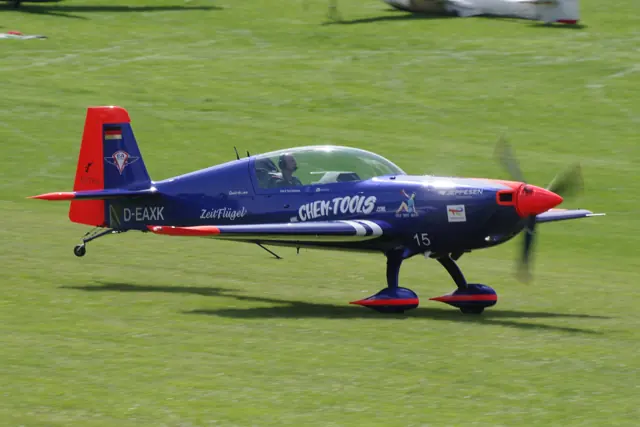
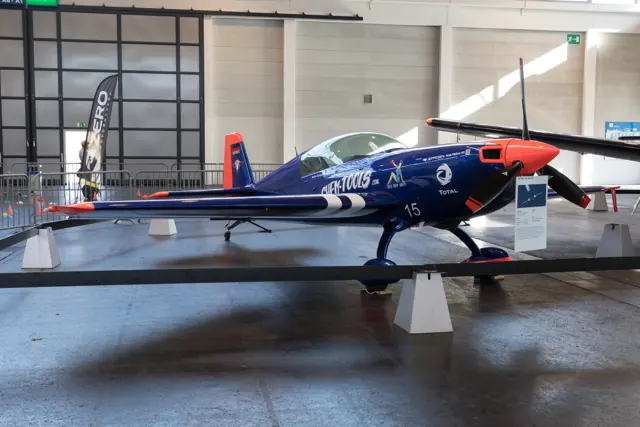
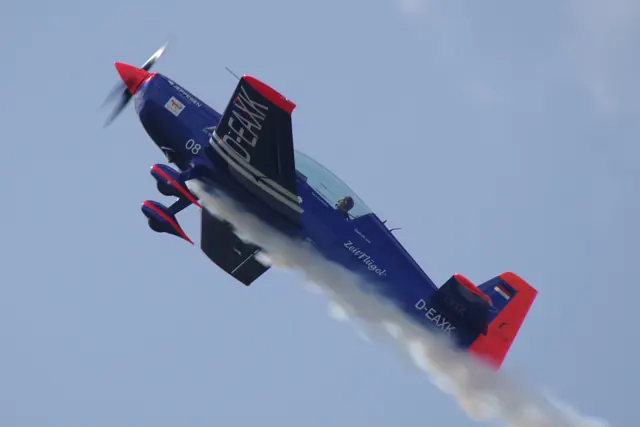
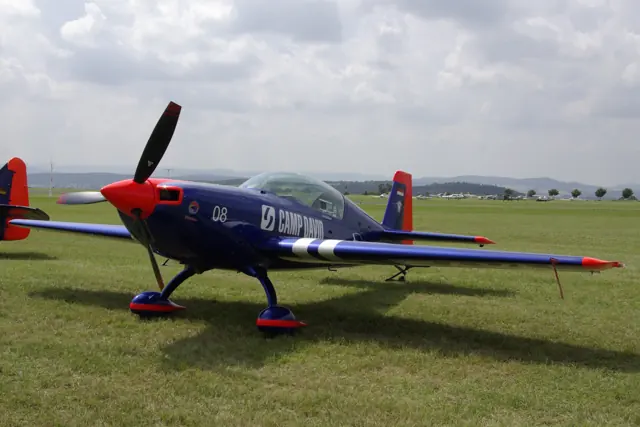
The Extra 300 brought a powerful piston engine, a compact fuselage and a competition-oriented wing together in a modern aerobatic aircraft. The family includes two-seat and single-seat developments with different arrangements and intended uses. The Extra 330LT represented in this catalogue is a later touring-oriented member of the broader Extra line.
Aircraft background
Wikipedia contributors · Read more ↗A photo flight becomes a more demanding introduction
Bloom’s opportunity to try the Extra depended on a brief opening in the weather and its delivery schedule. Once airborne, he enjoyed the precise, progressive controls while manoeuvring for the camera aircraft. The flying felt rewarding, and the prospect of trying some aerobatics added to the attraction. Jefferies’s demonstrations soon introduced a less comfortable side of the experience.
Pilot · July 2014 web publication; also reprinted by Mark Jefferies in January 2014. Bloom flew from the front seat with Jefferies behind him in an Extra 330LT.
Pilot · Read more ↗Into the cockpit
 YouTube
Peter Ashwood-Smith · 39 min ·
Extra 330lt - first flight of the season, just a quick shake-down looking for problems.
A complete Extra 330LT shakedown flight, including rolls, circuits and shutdown.
Real aircraft · Extra 330LT
Watch on YouTube ↗Preview images are served by AirframeDB. Videos open on YouTube only when you choose to watch.
Meet Extra 330LT
The Extra 300 brought a powerful piston engine, a compact fuselage and a competition-oriented wing together in a modern aerobatic aircraft. The family includes two-seat and single-seat developments with different arrangements and intended uses.
The Extra 330LT is a later touring-oriented member of the broader Extra line. Photographs and specifications identify their model, including the earlier 300L. The simulator documentation describes the 330LT's modelled equipment.
Extra 330LT
Aircraft type designators
Use the code for the model you are flying. The linked authority lists the applicable aircraft.
History & design
Development milestones
Designer: Walter Extra
First flight: May 1988
Wikipedia contributors · Extra EA-300 ↗Extra EA-300 · family/variant named by the source · Wikipedia revision 1319923389
Pilot accounts
A photo flight becomes a more demanding introduction
Bloom’s opportunity to try the Extra depended on a brief opening in the weather and its delivery schedule. Once airborne, he enjoyed the precise, progressive controls while manoeuvring for the camera aircraft. The flying felt rewarding, and the prospect of trying some aerobatics added to the attraction.
Jefferies’s demonstrations soon introduced a less comfortable side of the experience. Sustained manoeuvring left Bloom feeling queasy, even though taking the controls again restored his enthusiasm. Back at the airfield, Jefferies’s prompts helped him judge the landing on soft grass from the front cockpit. A mug of tea and a walk afterwards gave him time to recover from an aircraft that had both delighted and challenged him.
Pilot · July 2014 web publication; also reprinted by Mark Jefferies in January 2014. Bloom flew from the front seat with Jefferies behind him in an Extra 330LT.
Read the full account · Pilot ↗Learning the navigation equipment on a delivery flight
Jefferies used a delivery flight from Germany to Britain to become acquainted with a new cockpit arrangement. The Aspen display was familiar, but the Garmin navigator needed some attention before departure. Learning enough to enter his route was part of bringing this particular Extra home.
For a while he followed the RV-6 that had brought him to collect it. Repeated turns to remain behind the slower aircraft became tedious, and he continued directly towards Belgium and then England. Before landing, he tried the LT’s aerobatic qualities. Its controls felt heavier than the SC and LX he knew, but he still enjoyed the manoeuvres. The trip combined ordinary delivery work with the pleasure of exploring a new aircraft.
Personal flight report · April 2014. Extra 330LT from Dinslaken to Little Gransden; first flight in this mostly glass-cockpit configuration, not his first-ever LT flight.
Read the full account · Mark Jefferies Air Displays ↗A touring cockpit still leaves room for aerobatics
Hayes climbed into the rear seat at Reno Stead with a useful point of comparison: he already knew the Extra 300L. The LT’s smooth engine and pleasant control response made a favourable impression, while the lower nose attitude and steadier cruise suggested an aircraft suited to going somewhere as well as turning upside down.
Trying it inverted brought an amusing correction to his expectations. Anticipating a stronger forward push, he overdid the input and began climbing while upside down. He also missed the aerobatic sight that was absent from this aircraft. Vayda demonstrated knife-edge flight before they returned, leaving Hayes with an impression of a touring-oriented Extra that remained enjoyable through aerobatic manoeuvres.
Plane & Pilot · February 2014. Extra 330LT demonstration from Reno Stead with Southeast Aero’s Doug Vayda; Hayes had previous Extra 300L experience.
Read the full account · Plane & Pilot ↗In your simulator
Systems, equipment and documentation for each developer’s aircraft.
Compare simulator versions →MSFS 2024EXTRA-330LT
Microsoft Flight Simulator · Released
EXTRA-330LT
Microsoft Flight Simulator · Released
MSFS 2020EXTRA 330LT
Microsoft Flight Simulator · Released
EXTRA 330LT
Microsoft Flight Simulator · Released
Aircraft specifications
Published figures for the named real-aircraft variant. Simulator equipment and performance can differ.
| Specification | Published value |
|---|---|
| Length | 7.01 m (23 ft 0 in) |
| Wingspan | 8 m (26 ft 3 in) |
| Height | 2.6 m (8 ft 6 in) |
| Wing area | 10.84 m² (116.7 sq ft) |
| Empty weight | 677 kg (1,493 lb) typ. equipped |
| Gross weight | 950 kg (2,094 lb) normal category (+6/-3g) |
| Max takeoff weight | 820 kg (1,808 lb) single-pilot acro (+10/-10g) |
| Powerplant | 1 × Lycoming AEIO-580 -B1A 6-cylinder air-cooled horizontally-opposed piston engine, 235 kW (315 hp) |
| Propellers | 3-bladed Muehlbauer MTV 9-B-C/C198-25 |
| Cruise speed | 380 km/h (236 mph, 205 kn) TAS |
| Stall speed | 110 km/h (69 mph, 60 kn) at 820 kg / 1,808 lbs |
Manuals & resources
Find your next read
Choose a topic for a short introduction and a link to the original source. Simulator references identify the developer and edition they cover.
Pilot account
A photo flight becomes a more demanding introductionPilot · July 2014 web publication; also reprinted by Mark Jefferies in January 2014. Bloom flew from the front seat with Jefferies behind him in an Extra 330LT.
Bloom’s opportunity to try the Extra depended on a brief opening in the weather and its delivery schedule. Once airborne, he enjoyed the precise, progressive controls while manoeuvring for the camera aircraft. The flying felt rewarding, and the prospect of trying some aerobatics added to the attraction. Jefferies’s demonstrations soon introduced a less comfortable side of the experience.
Nick Bloom
Pilot · Read the source ↗Learning the navigation equipment on a delivery flightPersonal flight report · April 2014. Extra 330LT from Dinslaken to Little Gransden; first flight in this mostly glass-cockpit configuration, not his first-ever LT flight.
Jefferies used a delivery flight from Germany to Britain to become acquainted with a new cockpit arrangement. The Aspen display was familiar, but the Garmin navigator needed some attention before departure. Learning enough to enter his route was part of bringing this particular Extra home. For a while he followed the RV-6 that had brought him to collect it. Repeated turns to remain behind the slower aircraft became tedious, and he continued directly towards Belgium and then England.
Mark Jefferies
Mark Jefferies Air Displays · Read the source ↗Read the original documentation from the people who created it. Manuals open on their publisher’s website.
Manual
Microsoft Flight Simulator aircraft manualsMicrosoft / aircraft developersAircraft background
Extra EA-300Wikipedia contributors · Research background · Wikipedia revision 1319923389 · retrieved 2026-09-12Resource
MSFS 2024 FAQ and edition aircraft inventoryMicrosoft MSFS 2020 FAQ and edition aircraft inventoryMicrosoftType designator
ICAO Doc 8643 — aircraft type designatorsInternational Civil Aviation Organization · Public search data retrieved 2026-09-14; authority update 2026-09-03Built-in force-feedback profiles
Read the documentary basis, editable starting settings and remaining questions for the aircraft you fly. Each explanation refers to the exact profile revision shown.
Catalogue programme-20261022-v1 · 3 profile choices
Extra 330LT
Free and Pro · Revision 2 · Partial review
MSFS 2024 · MSFS 2020
Extra 330LT: The profile supplies its chosen responsive stick resistance.
Vertigo Design Extra 330 SC
Vertigo Design · Free and Pro · Revision 2 · Inherited starting point
X-Plane 12
A purpose-built aerobatic monoplane family developed by pilot and designer Walter Extra.
Extra 330 SC
Free and Pro · Revision 1 · Partial review
MSFS 2020 · MSFS 2024 · X-Plane 12
A purpose-built aerobatic monoplane family developed by pilot and designer Walter Extra.
Discuss this aircraft (0)
Questions, observations and useful sources from the community.
No published discussions yet. Bring a question or share a useful source.
Open aircraft discussions →Content expanded · What’s new
Something missing or a source that needs attention?
Suggest a correction ↗