
Start here
A few places to begin, from the aircraft’s story to the people who fly it.
Meet the aircraft
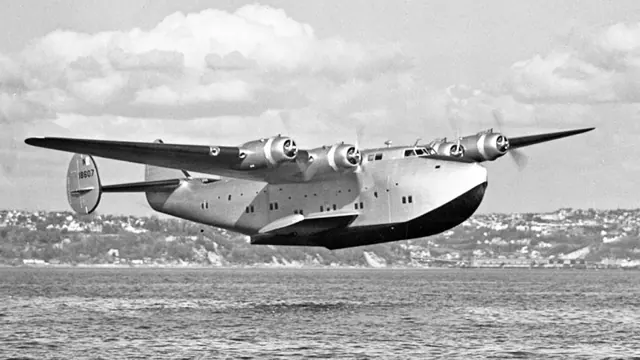
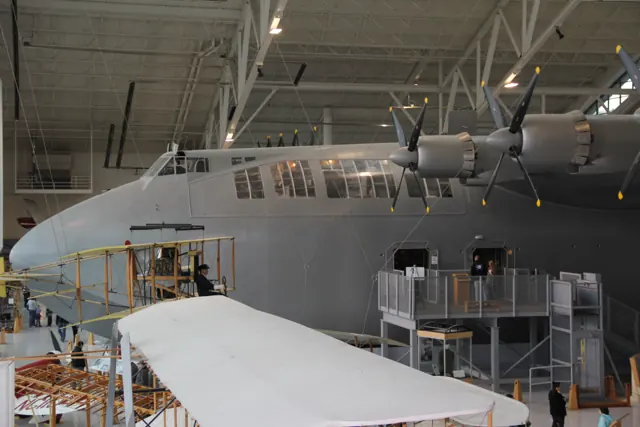
The H-4 Hercules was conceived as a wartime transatlantic transport and completed after the war. Eight engines and an immense wing surrounded its flying-boat hull. The prototype made one brief flight on 2 November 1947 and never entered operational transport service.
Aircraft background
Wikipedia contributors · Read more ↗Hughes describes the brief flight over a crowded harbour
Hughes told reporters that the decision to leave the water came only as he made it. Once the aircraft was moving on the step, it felt good enough to take off. He described the controls favourably and was pleased with the landing, explaining that the confined harbour left little room for a longer flight. The setting had been awkward even before that moment.
Statements to reporters immediately after the 2 November 1947 flight. Later accounts dispute his explanation of the takeoff; they are discussed separately below. Flight distance and height differ across sources.
United Press / John Von Der Heide · Read more ↗Into the cockpit
 YouTube
CriticalPast · 3 min ·
Hughes H-4 Hercules ("Spruce Goose") during a test flight in United States HD Stock Footage
Archival film of the Hughes H-4's test flight.
Real aircraft · Hughes H-4 Hercules
Watch on YouTube ↗Preview images are served by AirframeDB. Videos open on YouTube only when you choose to watch.
Meet Hughes H-4 Hercules
The H-4 Hercules was conceived as a wartime transatlantic transport and completed after the war. Eight engines and an immense wing surrounded its flying-boat hull. The prototype made one brief flight on 2 November 1947 and never entered operational transport service.
The familiar Spruce Goose nickname conceals a construction detail: birch was a major material in the wooden airframe. The simulator represents this single experimental aircraft.
Hughes H-4 Hercules
Aircraft type designators
A model-specific ICAO or FAA designator has not been confirmed in the references reviewed for this aircraft.
History & design
Different memories of the decision to take off
In AOPA’s 2000 article, Jack Real relays a different explanation he said Hughes had given him privately: the aircraft became airborne while Hughes was exploring the effect of additional flap. Marsh also discusses recollections suggesting deliberate intent. These later versions conflict with one another and with parts of the immediate reporting; the article does not establish a single uncontested account.
AOPA Pilot / Alton K. Marsh · Caution: Goose Crossing ↗Real’s reported conversation with Hughes; not Real’s own flight in the H-4
The person in the copilot’s seat was an engineer
Norman Polmar identifies Dave Grant as the project’s chief hydraulic engineer and explicitly says he was not a pilot. Accounts that call Grant the copilot describe his position aboard the aircraft. His presence does not provide evidence of another person piloting the H-4.
Naval History / Norman Polmar · Spruce Goose ↗Historical identification in Naval History, February 2002
The crew remembers crowded workspaces and ordinary pleasures
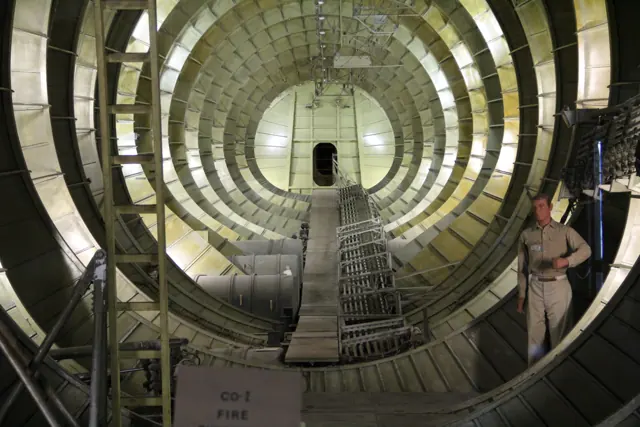
At the fiftieth-anniversary reunion, flight engineer Don Smith remembered a remarkably crowded flight deck. Systems mechanic Van Storm discussed the care taken over glued joints, while engine mechanic Mel Glaser recalled fishing beneath the wing during shift work. These brief recollections connect the enormous aircraft with the everyday lives of the people who built and tended it.
AAFO · Spruce Goose: 50th Anniversary Update ↗AAFO’s contemporary reunion report; the announced interview video has not been reviewed
A wartime transport built around a demanding material choice
Henry Kaiser’s proposal aimed to move people and supplies across the Atlantic while avoiding submarine attacks. Restrictions on materials needed for the war helped shape the wooden structure. The museum describes Duramold, a laminated material made primarily from birch. Kaiser withdrew during development, leaving Hughes to continue the project that became the H-4 Hercules.
North American Aerospace Museum · The Spruce Goose ↗Museum history; the popular Spruce Goose name does not identify the principal timber
An enormous move makes preservation possible
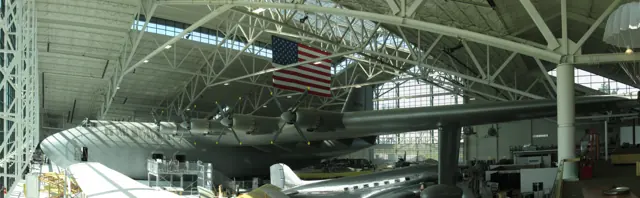
The aircraft’s move to Oregon required disassembly and transport by barge along the coast and inland waterways. Water levels affected the journey, and trucks carried the final sections to McMinnville in February 1993. Volunteers worked on restoration in temporary accommodation before reassembly and the museum’s opening in 2001.
North American Aerospace Museum · The Spruce Goose ↗Museum’s account of its own preservation project
Published performance figures describe estimates
AOPA explicitly labels its H-4 performance table as estimated. A single brief flight over the harbour could not demonstrate a transport’s operational range, cruising performance or service ceiling. The dimensions describe the built aircraft; the performance figures are estimates.
AOPA Pilot / Alton K. Marsh · Caution: Goose Crossing ↗The historical flight and projected transport performance are different kinds of evidence
Development milestones
Designer: Howard Hughes
First flight: November 2, 1947 (78 years ago)
Wikipedia contributors · Hughes H-4 Hercules ↗Hughes H-4 Hercules · family/variant named by the source · Wikipedia revision 1372049545
Pilot accounts
Hughes describes the brief flight over a crowded harbour
Hughes told reporters that the decision to leave the water came only as he made it. Once the aircraft was moving on the step, it felt good enough to take off. He described the controls favourably and was pleased with the landing, explaining that the confined harbour left little room for a longer flight.
The setting had been awkward even before that moment. Shifting winds and pleasure boats disrupted attempts to clear a usable course. Afterwards, Hughes spoke to the press over coffee and credited the people who had helped build the aircraft. He still described further flying as something planned for the following spring. These were his immediate public remarks, rather than a settled explanation of everything that happened.
Statements to reporters immediately after the 2 November 1947 flight. Later accounts dispute his explanation of the takeoff; they are discussed separately below. Flight distance and height differ across sources.
Read the full account · United Press / John Von Der Heide ↗In your simulator
Systems, equipment and documentation for each developer’s aircraft.
Compare simulator versions →MSFS 2024H-4 Hercules (Spruce Goose)
Microsoft Flight Simulator · Released
H-4 Hercules (Spruce Goose)
Microsoft Flight Simulator · Released
MSFS 2020H-4 Hercules (Spruce Goose)
Microsoft Flight Simulator · Released
H-4 Hercules (Spruce Goose)
Microsoft Flight Simulator · Released
Aircraft specifications
Published figures for the named real-aircraft variant. Simulator equipment and performance can differ.
| Specification | Published value |
|---|---|
| Length | 218 ft 8 in (66.65 m) |
| Wingspan | 319 ft 11 in (97.51 m) |
| Height | 79 ft 4 in (24.18 m) |
| Empty weight | 250,000 lb (113,398 kg) |
| Powerplant | 8 × Pratt & Whitney R-4360 Wasp Major 28-cylinder air-cooled radial piston engines, 3,000 hp (2,200 kW) each |
| Propellers | 4-bladed Hamilton Standard , 17 ft 2 in (5.23 m) diameter constant-speed propellers |
| Cruise speed | 250 mph (400 km/h, 220 kn) Reported estimate; not demonstrated by the brief 1947 flight |
| Range | 3,000 mi (4,800 km, 2,600 nmi) Reported estimate; not demonstrated by the brief 1947 flight |
| Service ceiling | 20,900 ft (6,400 m) Reported estimate; not demonstrated by the brief 1947 flight |
Manuals & resources
Find your next read
Choose a topic for a short introduction and a link to the original source. Simulator references identify the developer and edition they cover.
Pilot account
Hughes describes the brief flight over a crowded harbourStatements to reporters immediately after the 2 November 1947 flight. Later accounts dispute his explanation of the takeoff; they are discussed separately below. Flight distance and height differ across sources.
Hughes told reporters that the decision to leave the water came only as he made it. Once the aircraft was moving on the step, it felt good enough to take off. He described the controls favourably and was pleased with the landing, explaining that the confined harbour left little room for a longer flight. The setting had been awkward even before that moment. Shifting winds and pleasure boats disrupted attempts to clear a usable course.
Howard Hughes
United Press / John Von Der Heide · Read the source ↗Read the original documentation from the people who created it. Manuals open on their publisher’s website.
Manual
Microsoft Flight Simulator aircraft manualsMicrosoft / aircraft developersAircraft background
Hughes H-4 HerculesWikipedia contributors · Research background · Wikipedia revision 1372049545 · retrieved 2026-09-12 Caution: Goose CrossingAOPA Pilot / Alton K. Marsh · 5 December 2000 · interview with Jack Real and discussion of competing recollections Spruce GooseNaval History / Norman Polmar · February 2002 · identifies the engineer in the copilot’s seat Spruce Goose: 50th Anniversary UpdateAAFO · 1 November 1997 · reporter’s notes from the crew reunion The Spruce GooseNorth American Aerospace Museum · Museum collection history and construction description · retrieved September 2026Resource
MSFS 2024 FAQ and edition aircraft inventoryMicrosoft MSFS 2020 FAQ and edition aircraft inventoryMicrosoftBuilt-in force-feedback profiles
Read the documentary basis, editable starting settings and remaining questions for the aircraft you fly. Each explanation refers to the exact profile revision shown.
Catalogue programme-20261022-v1 · 1 profile choice
Hughes H-4 Hercules
Free and Pro · Revision 1 · Partial review
MSFS 2024 · MSFS 2020
Hughes H-4 Hercules: The profile supplies selected control resistance for the large prototype.
Discuss this aircraft (0)
Questions, observations and useful sources from the community.
No published discussions yet. Bring a question or share a useful source.
Open aircraft discussions →Content expanded · What’s new
Something missing or a source that needs attention?
Suggest a correction ↗