
Start here
A few places to begin, from the aircraft’s story to the people who fly it.
Meet the aircraft
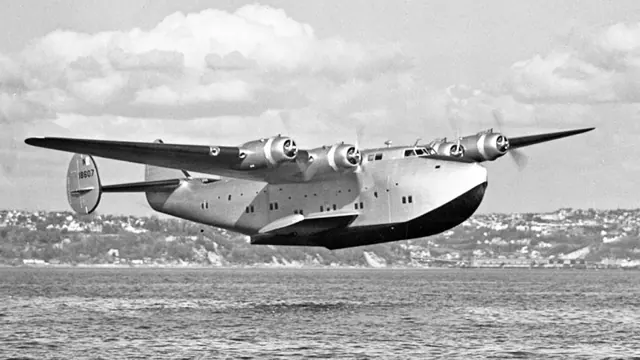
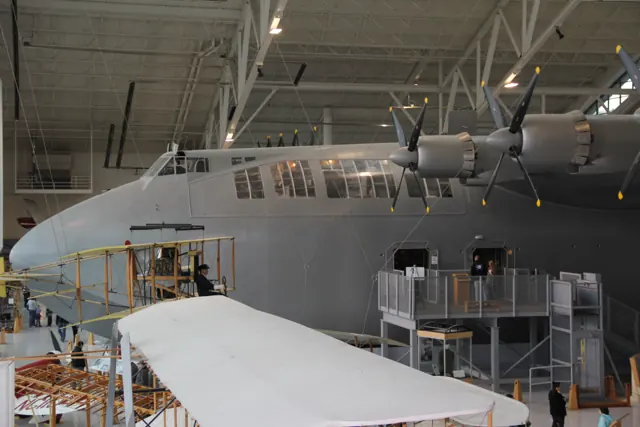
The H-4 Hercules was conceived as a wartime transatlantic transport and completed after the war. Eight engines and an immense wing surrounded its flying-boat hull. The prototype made one brief flight on 2 November 1947 and never entered operational transport service.
Aircraft background
Wikipedia contributors · Read more ↗Hughes describes the brief flight over a crowded harbour
Hughes told reporters that the decision to leave the water came only as he made it. Once the aircraft was moving on the step, it felt good enough to take off. He described the controls favourably and was pleased with the landing, explaining that the confined harbour left little room for a longer flight. The setting had been awkward even before that moment.
Statements to reporters immediately after the 2 November 1947 flight. Later accounts dispute his explanation of the takeoff; they are discussed separately below. Flight distance and height differ across sources.
United Press / John Von Der Heide · Read more ↗Into the cockpit
 YouTube
CriticalPast · 3 min ·
Hughes H-4 Hercules ("Spruce Goose") during a test flight in United States HD Stock Footage
Archival film of the Hughes H-4's test flight.
Real aircraft · Hughes H-4 Hercules
Watch on YouTube ↗Preview images are served by AirframeDB. Videos open on YouTube only when you choose to watch.
Meet Hughes H-4 Hercules
The H-4 Hercules was conceived as a wartime transatlantic transport and completed after the war. Eight engines and an immense wing surrounded its flying-boat hull. The prototype made one brief flight on 2 November 1947 and never entered operational transport service.
The familiar Spruce Goose nickname conceals a construction detail: birch was a major material in the wooden airframe. The simulator represents this single experimental aircraft.
Hughes H-4 Hercules
Aircraft type designators
A model-specific ICAO or FAA designator has not been confirmed in the references reviewed for this aircraft.
History & design
Different memories of the decision to take off
In AOPA’s 2000 article, Jack Real relays a different explanation he said Hughes had given him privately: the aircraft became airborne while Hughes was exploring the effect of additional flap. Marsh also discusses recollections suggesting deliberate intent. These later versions conflict with one another and with parts of the immediate reporting; the article does not establish a single uncontested account.
AOPA Pilot / Alton K. Marsh · Caution: Goose Crossing ↗Real’s reported conversation with Hughes; not Real’s own flight in the H-4
The person in the copilot’s seat was an engineer
Norman Polmar identifies Dave Grant as the project’s chief hydraulic engineer and explicitly says he was not a pilot. Accounts that call Grant the copilot describe his position aboard the aircraft. His presence does not provide evidence of another person piloting the H-4.
Naval History / Norman Polmar · Spruce Goose ↗Historical identification in Naval History, February 2002
The crew remembers crowded workspaces and ordinary pleasures
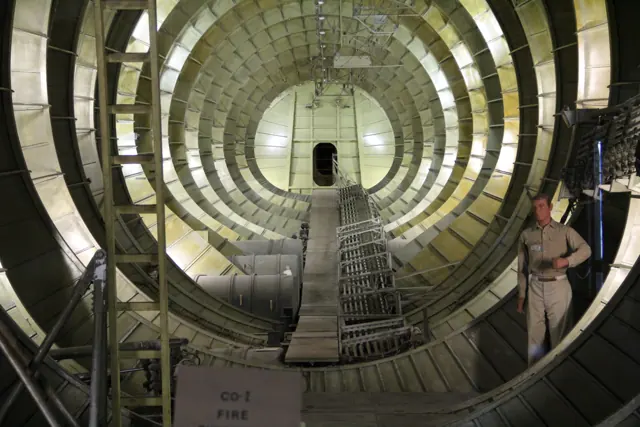
At the fiftieth-anniversary reunion, flight engineer Don Smith remembered a remarkably crowded flight deck. Systems mechanic Van Storm discussed the care taken over glued joints, while engine mechanic Mel Glaser recalled fishing beneath the wing during shift work. These brief recollections connect the enormous aircraft with the everyday lives of the people who built and tended it.
AAFO · Spruce Goose: 50th Anniversary Update ↗AAFO’s contemporary reunion report; the announced interview video has not been reviewed
A wartime transport built around a demanding material choice
Henry Kaiser’s proposal aimed to move people and supplies across the Atlantic while avoiding submarine attacks. Restrictions on materials needed for the war helped shape the wooden structure. The museum describes Duramold, a laminated material made primarily from birch. Kaiser withdrew during development, leaving Hughes to continue the project that became the H-4 Hercules.
North American Aerospace Museum · The Spruce Goose ↗Museum history; the popular Spruce Goose name does not identify the principal timber
An enormous move makes preservation possible
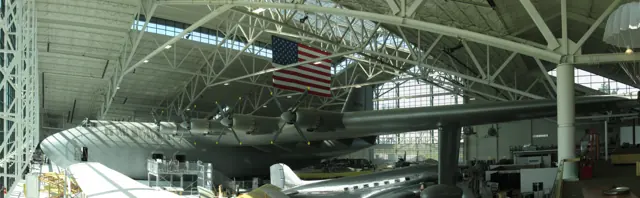
The aircraft’s move to Oregon required disassembly and transport by barge along the coast and inland waterways. Water levels affected the journey, and trucks carried the final sections to McMinnville in February 1993. Volunteers worked on restoration in temporary accommodation before reassembly and the museum’s opening in 2001.
North American Aerospace Museum · The Spruce Goose ↗Museum’s account of its own preservation project
Published performance figures describe estimates
AOPA explicitly labels its H-4 performance table as estimated. A single brief flight over the harbour could not demonstrate a transport’s operational range, cruising performance or service ceiling. The dimensions describe the built aircraft; the performance figures are estimates.
AOPA Pilot / Alton K. Marsh · Caution: Goose Crossing ↗The historical flight and projected transport performance are different kinds of evidence
Development milestones
Designer: Howard Hughes
First flight: November 2, 1947 (78 years ago)
Wikipedia contributors · Hughes H-4 Hercules ↗Hughes H-4 Hercules · family/variant named by the source · Wikipedia revision 1372049545
Pilot accounts
Hughes describes the brief flight over a crowded harbour
Hughes told reporters that the decision to leave the water came only as he made it. Once the aircraft was moving on the step, it felt good enough to take off. He described the controls favourably and was pleased with the landing, explaining that the confined harbour left little room for a longer flight.
The setting had been awkward even before that moment. Shifting winds and pleasure boats disrupted attempts to clear a usable course. Afterwards, Hughes spoke to the press over coffee and credited the people who had helped build the aircraft. He still described further flying as something planned for the following spring. These were his immediate public remarks, rather than a settled explanation of everything that happened.
Statements to reporters immediately after the 2 November 1947 flight. Later accounts dispute his explanation of the takeoff; they are discussed separately below. Flight distance and height differ across sources.
Read the full account · United Press / John Von Der Heide ↗In your simulator
Systems, equipment and documentation for each developer’s aircraft.
Compare simulator versions →MSFS 2024H-4 Hercules (Spruce Goose)
Microsoft Flight Simulator · Released
H-4 Hercules (Spruce Goose)
Microsoft Flight Simulator · Released
MSFS 2020H-4 Hercules (Spruce Goose)
Microsoft Flight Simulator · Released
H-4 Hercules (Spruce Goose)
Microsoft Flight Simulator · Released
Aircraft specifications
Published figures for the named real-aircraft variant. Simulator equipment and performance can differ.
| Specification | Published value |
|---|---|
| Length | 218 ft 8 in (66.65 m) |
| Wingspan | 319 ft 11 in (97.51 m) |
| Height | 79 ft 4 in (24.18 m) |
| Empty weight | 250,000 lb (113,398 kg) |
| Powerplant | 8 × Pratt & Whitney R-4360 Wasp Major 28-cylinder air-cooled radial piston engines, 3,000 hp (2,200 kW) each |
| Propellers | 4-bladed Hamilton Standard , 17 ft 2 in (5.23 m) diameter constant-speed propellers |
| Cruise speed | 250 mph (400 km/h, 220 kn) Reported estimate; not demonstrated by the brief 1947 flight |
| Range | 3,000 mi (4,800 km, 2,600 nmi) Reported estimate; not demonstrated by the brief 1947 flight |
| Service ceiling | 20,900 ft (6,400 m) Reported estimate; not demonstrated by the brief 1947 flight |
Manuals & resources
Find your next read
Choose a topic for a short introduction and a link to the original source. Simulator references identify the developer and edition they cover.
Pilot account
Hughes describes the brief flight over a crowded harbourStatements to reporters immediately after the 2 November 1947 flight. Later accounts dispute his explanation of the takeoff; they are discussed separately below. Flight distance and height differ across sources.
Hughes told reporters that the decision to leave the water came only as he made it. Once the aircraft was moving on the step, it felt good enough to take off. He described the controls favourably and was pleased with the landing, explaining that the confined harbour left little room for a longer flight. The setting had been awkward even before that moment. Shifting winds and pleasure boats disrupted attempts to clear a usable course.
Howard Hughes
United Press / John Von Der Heide · Read the source ↗Read the original documentation from the people who created it. Manuals open on their publisher’s website.
Manual
Microsoft Flight Simulator aircraft manualsMicrosoft / aircraft developersAircraft background
Hughes H-4 HerculesWikipedia contributors · Research background · Wikipedia revision 1372049545 · retrieved 2026-09-12 Caution: Goose CrossingAOPA Pilot / Alton K. Marsh · 5 December 2000 · interview with Jack Real and discussion of competing recollections Spruce GooseNaval History / Norman Polmar · February 2002 · identifies the engineer in the copilot’s seat Spruce Goose: 50th Anniversary UpdateAAFO · 1 November 1997 · reporter’s notes from the crew reunion The Spruce GooseNorth American Aerospace Museum · Museum collection history and construction description · retrieved September 2026Resource
MSFS 2024 FAQ and edition aircraft inventoryMicrosoft MSFS 2020 FAQ and edition aircraft inventoryMicrosoftBuilt-in force-feedback profiles
Read the documentary basis, editable starting settings and remaining questions for the aircraft you fly. Each explanation refers to the exact profile revision shown.
Catalogue programme-20261022-v1 · 1 profile choice
Hughes H-4 Hercules
Free and Pro · Revision 1 · Partial review
MSFS 2024 · MSFS 2020
Hughes H-4 Hercules: The profile supplies selected control resistance for the large prototype.
Hughes H-4 Hercules
Hughes H-4 Hercules: The profile supplies selected control resistance for the large prototype.
Aircraft and simulator scope
- Hughes H-4 Hercules · MSFS 2024 · family starting point
- Hughes H-4 Hercules · MSFS 2020 · family starting point
Hughes H-4 Hercules · The museum identifies the unique H-4 Hercules prototype and its only brief 1947 flight.
The simulator model and controls
The H-4 Hercules was conceived as a wartime transatlantic transport and completed after the war. Eight engines and an immense wing surrounded its flying-boat hull. The prototype made one brief flight on 2 November 1947 and never entered operational transport service.
This starting point selects Hughes H-4 Hercules. Its aircraft-level settings do not select a particular developer’s custom systems.
How this profile feels
The profile supplies selected control resistance for the large prototype. Spring resistance builds with the selected airspeed response. A separate aerodynamic term adds speed-dependent control load.
Trim response accompanies the simulator rendition of that one aircraft programme. Valid trim provides the configured pressure relief. Autopilot following is off.
Controls and trim
The H-4 was an eight-engine wooden flying-boat transport conceived during wartime and completed afterwards. Its sole brief flight on 2 November 1947 made it a singular experimental aircraft rather than an operational fleet.
About the values
The gains are normalized profile settings. They describe the chosen effect balance; hand force depends on the device and its output limits. IAS references are tuning values rather than operating limits. Physical acceptance of this revision remains pending.
What the documentation establishes
The museum identifies the unique H-4 Hercules prototype and its only brief 1947 flight.
The physical description identifies a high-wing flying boat with eight R-4360 radial engines and wingtip pontoons. Flap mechanics and detents are not described.
The museum lists 150 mph cruise. Given the brief prototype flight, that figure cannot be treated as a measured 130-knot IAS loading reference.
Documentary review and sources
These decisions describe the documentary basis and remaining gaps for this revision. Aircraft documentation and a starting setting describe different kinds of evidence.
Aircraft and variant
ReviewedThis starting point selects Hughes H-4 Hercules. Its aircraft-level settings do not select a particular developer’s custom systems.
Flight controls
Not yet reviewedThe H-4 was an eight-engine wooden flying-boat transport conceived during wartime and completed afterwards. Its sole brief flight on 2 November 1947 made it a singular experimental aircraft rather than an operational fleet.
Trim
Not yet reviewedTrim response accompanies the simulator rendition of that one aircraft programme. Pitch authority 0.3 relieves permitted loading; hydraulic centre movement is off. Roll authority is 0.09.
Autopilot and stability
Not yet reviewedAutopilot following is off; the configured spring and load retain the hardware feel.
Equipment
ReviewedGear, flap and ground cues follow the selected settings and available simulator-reported states.
Speeds and limits
ReviewedThe indicated-speed references set the profile response scale; they are separate from aircraft operating limits.
Simulator integration
Not yet reviewedThe profile targets msfs2024, msfs2020. Add-on-specific controls use only the supported references configured by this profile.
Force-feedback settings
Not yet reviewedThe settings define the profile’s effect balance. Device output limits affect physical hand force.
Starting settings and their rationale
These configured values are starting estimates. The explanations describe what each setting controls; physical validation appears separately below.
| Setting | Starting value | What it controls and why |
|---|---|---|
| Spring strength | Starting value0.8 | What it controls and whyThe profile supplies selected control resistance for the large prototype. The baseline spring is 0.8. Its low-speed blend reaches baseline strength at 65 KIAS. |
| Master force gain | Starting value0.85 | What it controls and whyScales overall profile strength while preserving effect balance, subject to device and output limits. |
| Profile force gain | Starting value0.25 | What it controls and whyThe aerodynamic-load gain is 0.25 with an indicated-speed reference of 130 KIAS. The hydraulic-load factor of 0.35 scales that modeled term; it is a selected artificial-feel approximation. |
| Force tuning speed/reference | Starting value130.0 kt | What it controls and whySets the IAS reference for aerodynamic loading. It is an estimate, not published cruise TAS or a flight limit. |
| Spring response reference speed | Starting value65.0 kt | What it controls and whySets the IAS where the low-speed blend reaches baseline strength; high-speed stiffening also uses it. |
| Aileron force scale | Starting value0.65 | What it controls and whyRoll and pitch aerodynamic scales are 0.65 and 0.65, respectively. They set the aerodynamic axis balance. No custom spring-travel curve is enabled. |
| Elevator force scale | Starting value0.65 | What it controls and whyScales pitch aerodynamic loading; pitch spring travel and trim responses are separate settings. |
| Trim feel | Starting valueEnabled | What it controls and whyRetained for compatibility and group membership. Trim relief, rather than this flag, controls centre movement. |
| Trim relief | Starting valueEnabled | What it controls and whyAllows trim relief with supported control law and valid telemetry. Axis authorities set its amount. |
| Autopilot follow | Starting valueDisabled | What it controls and whyAutopilot following is off; the configured spring and load retain the hardware feel. |
| Autopilot neutral hold | Starting valueDisabled | What it controls and whyPermits centering hold during a supported AP state, separate from following a moving target. |
| Output force limit | Starting value0.55 | What it controls and whyCaps directed-force output. Native spring effects and device limits remain separate. |
All 44 starting settings and their rationale
The settings define the profile’s effect balance. Device output limits affect physical hand force.
| Setting | Starting value | What it controls and why |
|---|---|---|
| Spring strength | Starting value0.8 | What it controls and whyThe profile supplies selected control resistance for the large prototype. The baseline spring is 0.8. Its low-speed blend reaches baseline strength at 65 KIAS. |
| Spring deadband | Starting value0.035 | What it controls and whySets travel around the centre before the baseline spring resists. Smaller values engage it sooner. |
| Profile force gain | Starting value0.25 | What it controls and whyThe aerodynamic-load gain is 0.25 with an indicated-speed reference of 130 KIAS. The hydraulic-load factor of 0.35 scales that modeled term; it is a selected artificial-feel approximation. |
| Master force gain | Starting value0.85 | What it controls and whyScales overall profile strength while preserving effect balance, subject to device and output limits. |
| QBlend Enabled | Starting valueEnabled | What it controls and whyAllows baseline spring strength to rise with indicated airspeed where the control law permits it. |
| QSpring Minimum Factor | Starting value0.55 | What it controls and whySets low-speed spring strength as a fraction of baseline when blending is enabled. One keeps full strength. |
| QSpring Start Knots | Starting value18.2 kt | What it controls and whySets the IAS where the low-speed spring blend starts rising. This is a feel threshold, not a flight limit. |
| Spring response reference speed | Starting value65.0 kt | What it controls and whySets the IAS where the low-speed blend reaches baseline strength; high-speed stiffening also uses it. |
| Force tuning speed/reference | Starting value130.0 kt | What it controls and whySets the IAS reference for aerodynamic loading. It is an estimate, not published cruise TAS or a flight limit. |
| Airspeed spring stiffening gain | Starting value0 | What it controls and whyThe high-speed spring-stiffening gain is 0. No additional speed-driven stiffening is added; this does not disable independent aerodynamic loading. |
| Airspeed spring stiffening limit | Starting value5 | What it controls and whyLimits the squared airspeed ratio used for high-speed spring stiffening; it is not a device-force cap. |
| Aileron force scale | Starting value0.65 | What it controls and whyRoll and pitch aerodynamic scales are 0.65 and 0.65, respectively. They set the aerodynamic axis balance. No custom spring-travel curve is enabled. |
| Elevator force scale | Starting value0.65 | What it controls and whyScales pitch aerodynamic loading; pitch spring travel and trim responses are separate settings. |
| Output force limit | Starting value0.55 | What it controls and whyCaps directed-force output. Native spring effects and device limits remain separate. |
| Trim feel | Starting valueEnabled | What it controls and whyRetained for compatibility and group membership. Trim relief, rather than this flag, controls centre movement. |
| Trim relief | Starting valueEnabled | What it controls and whyAllows trim relief with supported control law and valid telemetry. Axis authorities set its amount. |
| Elevator Authority | Starting value0.3 | What it controls and whyTrim response accompanies the simulator rendition of that one aircraft programme. Pitch authority 0.3 relieves permitted loading; hydraulic centre movement is off. Roll authority is 0.09. |
| Aileron Authority | Starting value0.09 | What it controls and whyScales supported roll-trim relief and permitted centre movement. Zero removes roll response. |
| Force Trim Enabled | Starting valueDisabled | What it controls and whyEnables local force trim, separate from aircraft-owned trim and add-on integration qualification. |
| GLoad Enabled | Starting valueEnabled | What it controls and whyAllows load-factor changes to modify permitted spring laws. Passive fly-by-wire feel can suppress it. |
| Rate Damping Enabled | Starting valueEnabled | What it controls and whyEnables rate damping with the configured coefficients and control law. |
| Autopilot follow | Starting valueDisabled | What it controls and whyAutopilot following is off; the configured spring and load retain the hardware feel. |
| Autopilot follow authority | Starting value0.1 | What it controls and whySets admitted AP-follow gain, not a percentage of travel. Runtime ownership and input limits still apply. |
| Autopilot neutral hold | Starting valueDisabled | What it controls and whyPermits centering hold during a supported AP state, separate from following a moving target. |
| Autopilot neutral hold strength | Starting value0.6 | What it controls and whySets admitted AP neutral-hold strength; inactive while neutral hold is disabled. |
| Enabled | Starting valueEnabled | What it controls and whyEnables aerodynamic cues; each still needs nonzero strength and its simulator conditions. |
| Gain | Starting value0.3 | What it controls and whySets stall-buffet strength. Zero removes the cue without changing simulator stalls or warnings. |
| Gain | Starting value0 | What it controls and whySets high-Mach buffet strength; onset and full-strength thresholds are separate. |
| Gain | Starting value0.14 | What it controls and whySets flap buffet at the configured position and speed gates. Flap movement texture is separate. |
| Maximum flap index | Starting value3 | What it controls and whySets the final flap index for detent normalization. UP plus three detents uses maximum index3. |
| Minimum flap index | Starting value2 | What it controls and whySets the first flap detent that admits buffet; this is a handle index, not degrees. |
| Gain | Starting value0 | What it controls and whySets gear aerodynamic buffet; movement and ground-contact cues are separate. |
| Shaker Enabled | Starting valueEnabled | What it controls and whyPermits shaker at supported warning conditions; the switch does not establish aircraft equipment. |
| Stick shaker amplitude | Starting value0.9 | What it controls and whySets triggered shaker strength; inactive while the shaker feature is disabled. |
| Enabled | Starting valueEnabled | What it controls and whyEnables ground effects; each still needs its own strength and contact or motion telemetry. |
| Gain | Starting value0.4 | What it controls and whySets rolling texture strength, modified by speed, surface and undercarriage configuration. |
| Gain | Starting value0.32 | What it controls and whySets gear-bump texture during ground motion, separate from touchdown impact. |
| Gain | Starting value0.9 | What it controls and whySets landing-impact strength; landing telemetry and response shape determine the pulse. |
| Gain | Starting value0 | What it controls and whySets reverse-thrust vibration with valid reverser and engine conditions. Zero removes the cue. |
| Enabled | Starting valueEnabled | What it controls and whyEnables engine cues with nonzero settings and valid running-engine telemetry. |
| Gain | Starting value0.12 | What it controls and whySets estimated engine vibration using configured telemetry and response, not measured cockpit vibration. |
| Enabled | Starting valueEnabled | What it controls and whyEnables accessory cues with configured strengths and observed accessory movement. |
| Gain | Starting value0.12 | What it controls and whySets texture from observed flap movement; a command without movement does not establish the cue. |
| Gain | Starting value0 | What it controls and whySets texture from observed gear movement, separate from aerodynamic and touchdown effects. |
Limits and open questions
- The museum history does not substantiate hydraulic boost or artificial control feel.
- Trim mechanism is not documented.
- Automatic-flight equipment is not documented.
- The museum page supplies no simulator equipment or integration definition.
- Size, engine count and prototype history do not establish boosted-control force gradients or water-contact cue amplitude.
- Hughes H-4 Hercules documentary evidence does not establish force-feedback hardware acceptance.
Physical validation
No physical force validation is recorded in this public catalogue for this revision. Documentary review and software checks do not establish how a particular device feels.
Discuss this aircraft (0)
Questions, observations and useful sources from the community.
No published discussions yet. Bring a question or share a useful source.
Open aircraft discussions →Content expanded · What’s new
Something missing or a source that needs attention?
Suggest a correction ↗