
Start here
A few places to begin, from the aircraft’s story to the people who fly it.
Meet the aircraft
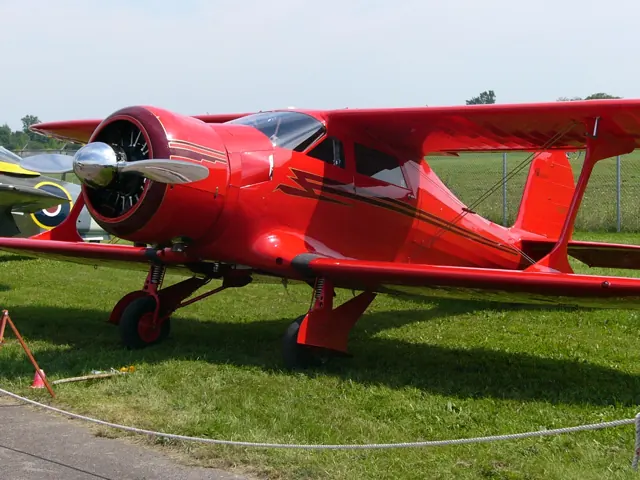
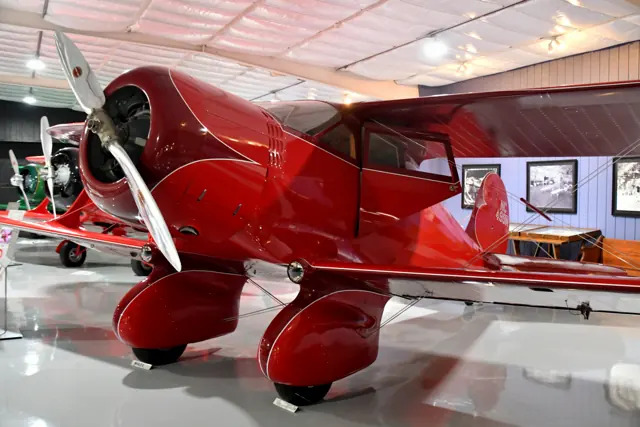
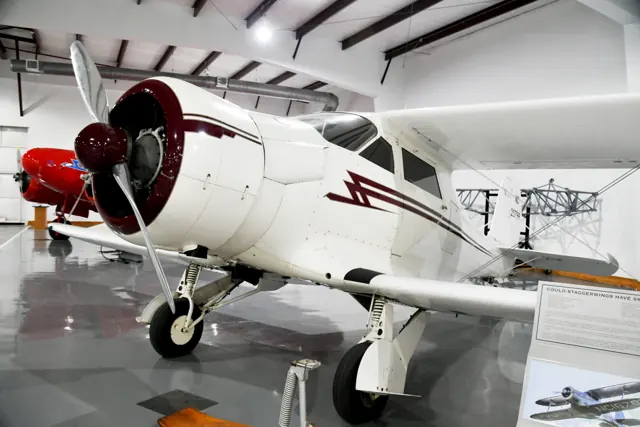
The Model 17's negative wing stagger gives it its name and its distinctive profile. First flown in 1932, it combined a radial engine with an enclosed cabin and retractable landing gear. It served business transport and racing as well as wartime military duties. The Staggerwing belongs to the era when a fast executive aircraft could still be a biplane.
Aircraft background
Wikipedia contributors · Read more ↗A classic that became his travelling aircraft
McConnel came to the Staggerwing through gliding, Tiger Moths and earlier biplanes. Seeing one at a California airshow prompted a visit to the owners’ convention in Tennessee, where experienced members helped him find an aircraft. He loved its appearance and power immediately, but its poor forward view on the ground was equally memorable.
Pilot magazine · June 2018. Ownership of 1937 D17S NC18028, ferried to Britain in 1990.
Pilot magazine · Read more ↗The first Famous Flyer
Microsoft’s March 2022 announcement identifies Carenado as its development partner for the Staggerwing and places it at the start of the Famous Flyers series. It documents the original PC and Xbox Marketplace release; the separate MSFS 2024 edition listing records its later Aviator inclusion.
Model 17 Staggerwing · Microsoft Flight Simulator · MSFS 2024
Microsoft Flight Simulator · Read more ↗Into the cockpit
 YouTube
Warbirds · 11 min ·
Beechcraft Model 17 Staggerwing Flight Demonstration
A flight demonstration of the distinctive Beech Staggerwing biplane.
Real aircraft · Beechcraft Model 17 Staggerwing
Watch on YouTube ↗Preview images are served by AirframeDB. Videos open on YouTube only when you choose to watch.
Meet Beechcraft Model 17 Staggerwing
The Model 17's negative wing stagger gives it its name and its distinctive profile. First flown in 1932, it combined a radial engine with an enclosed cabin and retractable landing gear. It served business transport and racing as well as wartime military duties.
The Staggerwing belongs to the era when a fast executive aircraft could still be a biplane. Its enclosed passenger cabin and fabric-covered lifting surfaces combined business transport with biplane construction.
Beechcraft Model 17 Staggerwing
Beechcraft → · Explore the family →
Beechcraft Model 17 Staggerwing
Wikipedia contributors · Beechcraft Model 17 Staggerwing ↗Microsoft Flight Simulator · MSFS 2024 →Microsoft Flight Simulator · MSFS 2020 →Aircraft type designators
Use the code for the model you are flying. The linked authority lists the applicable aircraft.
History & design
An ambitious business aircraft in the Depression
The Model 17 was the new Beech company’s first aircraft, designed by Ted Wells for fast, comfortable business travel. Its upper wing sat behind the lower one, producing the distinctive outline and name. Early examples had fixed landing gear; the B17 introduced retractable gear and other changes intended to reduce weight and improve its appeal to buyers.
Smithsonian National Air and Space Museum · Beechcraft C17L Staggerwing ↗Smithsonian collection history · early Model 17 and B17 development
Refinement, racing and wartime service
The D17 lengthened the fuselage, moved the ailerons to the upper wings and revised the braking arrangement. The family also found a place in air racing: Louise Thaden and Blanche Noyes won the 1936 Bendix race in a C17R. During the Second World War, D17S aircraft served as personnel transports. These variants explain why surviving Staggerwings can differ substantially in engines, controls and equipment.
Smithsonian National Air and Space Museum · Beechcraft C17L Staggerwing ↗Smithsonian collection history · C17R, D17 and D17S; variant distinctions
Development milestones
First flight: November 4, 1932
Wikipedia contributors · Beechcraft Model 17 Staggerwing ↗Beechcraft Model 17 Staggerwing · family/variant named by the source · Wikipedia revision 1359203133
Pilot accounts
A classic that became his travelling aircraft
McConnel came to the Staggerwing through gliding, Tiger Moths and earlier biplanes. Seeing one at a California airshow prompted a visit to the owners’ convention in Tennessee, where experienced members helped him find an aircraft. He loved its appearance and power immediately, but its poor forward view on the ground was equally memorable. Learning to operate it proved a larger step than its resemblance to his previous Waco suggested.
In regular use, he valued its comfortable cabin and usefulness for travel. The work continued throughout a flight: oil temperature needed attention, fuel use affected the balance, and trim and rudder demanded small corrections. He sometimes flew alone with his side window open, enjoying a little of the open-cockpit feeling. Sharing the aircraft with other people, and discovering how much practical travel it could still do, became central pleasures of ownership.
Pilot magazine · June 2018. Ownership of 1937 D17S NC18028, ferried to Britain in 1990.
Read the full account · Pilot magazine ↗Learning its two personalities before a solo trip
Hirschman’s introduction began with an unusually direct briefing. Because this aircraft had no controls on the right side, Mike Toman could coach him but could not simply take over. Learning the fuel arrangement and the slow-moving landing gear was part of becoming comfortable with the machine. In cruise, Hirschman enjoyed its balanced controls, close-fitting mechanism and the view of the wings through the side windows.
The approach revealed a different character: extending the gear and flaps brought more noise, heavier controls and much greater drag. After several landings with Toman beside him, Hirschman flew south alone. Gusty conditions at a narrow destination runway made him consider an alternate and left him thoroughly tense during the arrival. He landed successfully, but remembers the sweat and concentration as clearly as the pleasure of watching the Everglades through the open windows.
AOPA Pilot · November 2023. Flying a restored 1944 D17S with coaching from Mike Toman, followed by a solo Florida Keys trip.
Read the full account · AOPA Pilot ↗Restoring an E17B, then learning to fly it
Parish funded the restoration because he wanted people to experience the atmosphere of an old aircraft at airshows and informal fly-ins. Pike and his team rebuilt the Staggerwing with that aim in mind, retaining its appearance while incorporating selected modern equipment. When it flew again in September 2007, Pike found that getting it airborne was only the start: small mechanical problems still needed patient attention.
For Parish, moving from his usual Cirrus to the restored biplane meant learning a very different cockpit. He described slow, heavy ailerons, a light elevator, cramped seating and little forward view on the ground. Landings and ground handling required particular concentration. The article’s editor added that a subsequent landing accident seriously damaged the aircraft, although neither man was hurt.
Ken Scott’s AOPA Pilot report · December 2008. Joint restoration and flying account concerning former Indian National Airways E17B VT-AKK, later N233EB.
Read the full account · AOPA Pilot ↗In your simulator
Systems, equipment and documentation for each developer’s aircraft.
Compare simulator versions →MSFS 2024Model 17 Staggerwing
Microsoft Flight Simulator · Released
Model 17 Staggerwing
Microsoft Flight Simulator · Released
MSFS 2020Model 17 Staggerwing
Microsoft Flight Simulator · Released
Model 17 Staggerwing
Microsoft Flight Simulator · Released
Aircraft specifications
Published figures for the named real-aircraft variant. Simulator equipment and performance can differ.
| Specification | Published value |
|---|---|
| Length | 26 ft 10 in (8.18 m) |
| Wingspan | 32 ft (9.8 m) |
| Height | 8 ft (2.4 m) |
| Wing area | 296.5 sq ft (27.55 m² ) |
| Empty weight | 2,540 lb (1,152 kg) |
| Gross weight | 4,250 lb (1,928 kg) |
| Powerplant | 1 × Pratt & Whitney R-985 -AN-1 "Wasp Junior" radial engine , 450 hp (340 kW) at 2,300 rpm |
| Maximum speed | 212 mph (341 km/h, 184 kn) |
| Cruise speed | 202 mph (325 km/h, 176 kn) |
| Range | 670 mi (1,078 km, 582 nmi) |
| Service ceiling | 25,000 ft (7,600 m) |
| Rate of climb | 1,500 ft/min (7.6 m/s) |
Manuals & resources
Find your next read
Choose a topic for a short introduction and a link to the original source. Simulator references identify the developer and edition they cover.
Simulator documentation
The first Famous FlyerModel 17 Staggerwing · Microsoft Flight Simulator · MSFS 2024
Microsoft’s March 2022 announcement identifies Carenado as its development partner for the Staggerwing and places it at the start of the Famous Flyers series. It documents the original PC and Xbox Marketplace release; the separate MSFS 2024 edition listing records its later Aviator inclusion.
Original MSFS release context, 2022; current MSFS 2024 inclusion is sourced separately.
Microsoft Flight Simulator · Read the source ↗The original MSFS 2020 releaseModel 17 Staggerwing · Microsoft Flight Simulator · MSFS 2020
Microsoft’s March 2022 release names Carenado as its development partner and offers the Model 17 for PC and Xbox through the Marketplace.
2022-03-01 · release and package scope
Microsoft Flight Simulator Team · Read the source ↗Pilot account
A classic that became his travelling aircraftPilot magazine · June 2018. Ownership of 1937 D17S NC18028, ferried to Britain in 1990.
McConnel came to the Staggerwing through gliding, Tiger Moths and earlier biplanes. Seeing one at a California airshow prompted a visit to the owners’ convention in Tennessee, where experienced members helped him find an aircraft. He loved its appearance and power immediately, but its poor forward view on the ground was equally memorable. Learning to operate it proved a larger step than its resemblance to his previous Waco suggested.
Paul McConnel
Pilot magazine · Read the source ↗Learning its two personalities before a solo tripAOPA Pilot · November 2023. Flying a restored 1944 D17S with coaching from Mike Toman, followed by a solo Florida Keys trip.
Hirschman’s introduction began with an unusually direct briefing. Because this aircraft had no controls on the right side, Mike Toman could coach him but could not simply take over. Learning the fuel arrangement and the slow-moving landing gear was part of becoming comfortable with the machine. In cruise, Hirschman enjoyed its balanced controls, close-fitting mechanism and the view of the wings through the side windows.
Dave Hirschman
AOPA Pilot · Read the source ↗Read the original documentation from the people who created it. Manuals open on their publisher’s website.
Manual
Microsoft Flight Simulator aircraft manualsMicrosoft / aircraft developersAircraft background
Beechcraft Model 17 StaggerwingWikipedia contributors · Research background · Wikipedia revision 1359203133 · retrieved 2026-09-12 Beechcraft C17L StaggerwingSmithsonian National Air and Space Museum · Collection A19810023000 · Model 17 development and NC15840 historyResource
MSFS 2024 FAQ and edition aircraft inventoryMicrosoftDeveloper documentation
Famous Flyer I: Beechcraft Model 17 StaggerwingMicrosoft Flight Simulator Team · 2022-03-01 · release and package scopeType designator
ICAO Doc 8643 — aircraft type designatorsInternational Civil Aviation Organization · Public search data retrieved 2026-09-14; authority update 2026-09-03Built-in force-feedback profiles
Read the documentary basis, editable starting settings and remaining questions for the aircraft you fly. Each explanation refers to the exact profile revision shown.
Catalogue programme-20261022-v1 · 1 profile choice
Beechcraft Model 17 Staggerwing
Free and Pro · Revision 2 · Partial review
MSFS 2024 · MSFS 2020
Beechcraft Model 17 Staggerwing: The selected mechanical-control law supplies nominal resistance; negative wing stagger alone does not define cockpit control force.
Discuss this aircraft (0)
Questions, observations and useful sources from the community.
No published discussions yet. Bring a question or share a useful source.
Open aircraft discussions →Content expanded · What’s new
Something missing or a source that needs attention?
Suggest a correction ↗