



Start here
A few places to begin, from the aircraft’s story to the people who fly it.
Meet the aircraft
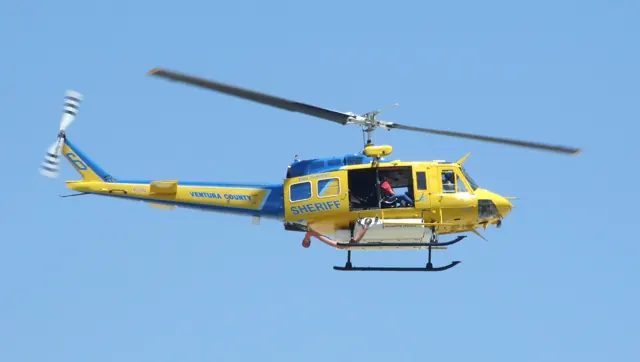
The UH-1 brought turbine power to US military helicopter service and became the foundation of a large Huey family. Its cabin, sliding side doors and utility layout supported troop transport, medical evacuation and many other roles. The Iroquois name covers a development history with different engines, fuselage lengths and equipment.
Aircraft background
Wikipedia contributors · Read more ↗An introduction to a preserved gunship
Schiff joined museum pilot Pat Rodgers to fly a Huey whose earlier service was still visible in patched bullet holes and preserved markings. The start brought enough shaking to make small instruments difficult to read, before the helicopter settled down. Even inside the cockpit, the familiar sound of the rotor remained part of the experience.
AOPA Pilot · February 2014. Instruction with Pat Rodgers in restored UH-1B N832M at the Wings and Rotors Air Museum; a short-body Huey, not the later UH-1H.
AOPA Pilot · Read more ↗The tablet controls comfort and damage options
Taog’s documented options include adjustable instrument-panel shaking and a main-gearbox damage simulation. The tablet can repair simulated damage or disable that feature. These choices change the package’s visual feedback and consequences of misuse.
UH-1H / B205A-1 · Taog's Hangar · MSFS 2020
Taog's Hangar · Read more ↗Into the cockpit
 YouTube
History Collectors Forum · 7 min ·
Bell UH-1 Iroquois "Huey" Helicopter || Cockpit View & Controls Explained
A crew chief explains the Huey's cockpit layout and controls.
Real aircraft · Bell UH-1 Huey
Watch on YouTube ↗Preview images are served by AirframeDB. Videos open on YouTube only when you choose to watch.
Meet Bell UH-1 Huey
The UH-1 brought turbine power to US military helicopter service and became the foundation of a large Huey family. Its cabin, sliding side doors and utility layout supported troop transport, medical evacuation and many other roles.
The Iroquois name covers a development history with different engines, fuselage lengths and equipment. The simulator catalogue includes independently developed aircraft as well as a themed first-party package. Each product has its own systems documentation.
Bell UH-1 Huey
Aircraft type designators
Use the code for the model you are flying. The linked authority lists the applicable aircraft.
History & design
A restored aircraft retains evidence of earlier service
N832M’s restoration preserved graffiti found inside its tail boom. Schiff also describes signatures and a memorial plaque associated with Navy Seawolves, showing how one surviving Huey carries several layers of remembrance.
AOPA Pilot · The Bell UH-1B Huey: a flying symbol ↗Restored UH-1B as described in 2014
Development milestones
First flight: 20 October 1956 (XH-40)
Wikipedia contributors · Bell UH-1 Iroquois ↗Bell UH-1 Iroquois · family/variant named by the source · Wikipedia revision 1371762250
Pilot accounts
An introduction to a preserved gunship
Schiff joined museum pilot Pat Rodgers to fly a Huey whose earlier service was still visible in patched bullet holes and preserved markings. The start brought enough shaking to make small instruments difficult to read, before the helicopter settled down. Even inside the cockpit, the familiar sound of the rotor remained part of the experience.
Hovering in a crosswind was still a challenge for Schiff, whose helicopter time had been spread over decades, but he found himself doing better than expected. The aircraft’s stable feel and its response during the supervised flight left him delighted. Rodgers’s wider work taking the preserved helicopter to veterans’ events gave the outing another dimension: learning the machine also meant meeting people for whom its sound and appearance carried much older memories.
AOPA Pilot · February 2014. Instruction with Pat Rodgers in restored UH-1B N832M at the Wings and Rotors Air Museum; a short-body Huey, not the later UH-1H.
Read the full account · AOPA Pilot ↗A Huey connection that continues into police work
Perriguey arrived in Vietnam after training on other helicopters and took the opportunity to join a UH-1 squadron. He had wanted to fly the Huey, and the transition happened in-country. His recollections include a support mission in which his gunship collected the people on the ground because no other helicopter was there to take them out.
Years later, his military background helped make him one of the command pilots for the Los Angeles Police Department’s surplus Huey, used with specialist police teams. In the interview he still named the aircraft as a personal favourite because of that earlier experience. Other parts of his police career involved different helicopter types; they are not reassigned to the Huey simply because it was the aircraft he remembered most affectionately.
AVweb interview · November 2000. Marine Corps Huey service in Vietnam followed by an LAPD military-surplus Huey assignment; exact variants and registrations are not specified.
Read the full account · AVweb ↗Remembering the unit as much as the helicopter
Peterson first learned helicopter work through crew-chief training before later becoming a pilot. After flight school in Texas and Alabama, he arrived in Vietnam to fly Hueys carrying troops on scouting and assault missions. The museum’s summary of his oral history describes both that work and the path that brought him into the cockpit.
Looking back, Peterson placed particular value on the closeness of his unit. His later career took him through other Army assignments and a return to active service, yet the camaraderie of Vietnam remained a high point in his memory. He also stayed involved with veterans after retirement. The published page is an edited account of his interview.
Pritzker Military Museum & Library oral-history summary · interview recorded April 2018. Army Huey service with the 1st Cavalry Division in Vietnam from March 1970; variant unspecified.
Read the full account · Pritzker Military Museum & Library ↗In your simulator
Systems, equipment and documentation for each developer’s aircraft.
Compare simulator versions →MSFS 2024UH-1H Huey (free Stranger Things package)
Microsoft Flight Simulator · Released
UH-1H Huey (free Stranger Things package)
Microsoft Flight Simulator · Released
MSFS 2020UH-1H / B205A-1
Taog's Hangar · Released
UH-1H / B205A-1
Taog's Hangar · Released
X-Plane 12UH-1 XP12/11
Nimbus · Released
UH-1 XP12/11
Nimbus · Released
Aircraft specifications
Published figures for the named real-aircraft variant. Simulator equipment and performance can differ.
| Specification | Published value |
|---|---|
| Length | 57 ft 9 + 5 ⁄ 8 in (17.618 m) with rotors |
| Height | 14 ft 5 + 1 ⁄ 2 in (4.407 m) (tail rotor turning) |
| Empty weight | 5,210 lb (2,363 kg) |
| Gross weight | 9,039 lb (4,100 kg) (mission weight) |
| Max takeoff weight | 9,500 lb (4,309 kg) |
| Powerplant | 1 × Lycoming T53-L-13 turboshaft , 1,400 shp (1,000 kW) (limited to 1,100 shp (820 kW) by transmission) |
| Main rotor diameter | 48 ft 0 in (14.63 m) |
| Main rotor area | 1,809.56 sq ft (168.114 m² ) |
| Maximum speed | 127 mph (204 km/h, 110 kn) (at maximum takeoff weight; also Vne at this weight) |
| Cruise speed | 127 mph (204 km/h, 110 kn) (at 5,700 ft (1,700 m) at maximum takeoff weight) |
| Range | 318 mi (511 km, 276 nmi) (with maximum fuel, no reserves, at sea level) |
| Service ceiling | 12,600 ft (3,800 m) (at maximum takeoff weight) |
| Rate of climb | 1,600 ft/min (8.1 m/s) at sea level (at maximum takeoff weight) |
Manuals & resources
Find your next read
Choose a topic for a short introduction and a link to the original source. Simulator references identify the developer and edition they cover.
Simulator documentation
The tablet controls comfort and damage optionsUH-1H / B205A-1 · Taog's Hangar · MSFS 2020
Taog’s documented options include adjustable instrument-panel shaking and a main-gearbox damage simulation. The tablet can repair simulated damage or disable that feature. These choices change the package’s visual feedback and consequences of misuse.
UH-1H/B205A-1 manual v1.0.6 · PDF pp.15,20–21
Taog's Hangar · Read the source ↗Read the simulation notes beside the real-system descriptionUH-1H / B205A-1 · Taog's Hangar · MSFS 2020
Taog's v1.0.6 manual explains the Huey's hydraulic assistance and magnetic/spring force-trim devices, then explicitly marks hydraulic-control and force-trim support as not simulated in that documented release. The limitation applies to the v1.0.6 Taog release; the first-party Huey has separate documentation.
UH-1H/B205A-1 manual v1.0.6 · PDF p.27; HYD CONT and FORCE TRIM rows
Taog's Hangar · Read the source ↗Optional GPS integration has its own requirementsUH-1H / B205A-1 · Taog's Hangar · MSFS 2020
The guide describes PMS50 GTN750/650 integration through a separate download and the included WTT compatibility module. It also notes that the Tablet GPS option is then unavailable because it is incompatible with WTT in this documented setup.
UH-1H/B205A-1 manual v1.0.6 · PDF p.22
Taog's Hangar · Read the source ↗Pilot account
An introduction to a preserved gunshipAOPA Pilot · February 2014. Instruction with Pat Rodgers in restored UH-1B N832M at the Wings and Rotors Air Museum; a short-body Huey, not the later UH-1H.
Schiff joined museum pilot Pat Rodgers to fly a Huey whose earlier service was still visible in patched bullet holes and preserved markings. The start brought enough shaking to make small instruments difficult to read, before the helicopter settled down. Even inside the cockpit, the familiar sound of the rotor remained part of the experience.
Barry Schiff
AOPA Pilot · Read the source ↗A Huey connection that continues into police workAVweb interview · November 2000. Marine Corps Huey service in Vietnam followed by an LAPD military-surplus Huey assignment; exact variants and registrations are not specified.
Perriguey arrived in Vietnam after training on other helicopters and took the opportunity to join a UH-1 squadron. He had wanted to fly the Huey, and the transition happened in-country. His recollections include a support mission in which his gunship collected the people on the ground because no other helicopter was there to take them out.
Charles Perriguey
AVweb · Read the source ↗Developer documentation
UH-1 XP12/11 — product listingUH-1 XP12/11 · X-Plane 12
Product listing captured 2026-09-24; edition scope from the reviewed catalogue
Nimbus · Read the source ↗Read the original documentation from the people who created it. Manuals open on their publisher’s website.
Manual
Microsoft Flight Simulator aircraft manualsMicrosoft / aircraft developers Download manualTaog's Hangar Taog aircraft manualsTaog's HangarAircraft background
Bell UH-1 IroquoisWikipedia contributors · Research background · Wikipedia revision 1371762250 · retrieved 2026-09-12Resource
XB1 and UH1H free additionsMicrosoftProduct
UH-1H / B205A-1 HueyTaog’s Hangar · Official developer / designated store catalogue · checked 2026-09-12 store.x-plane.orgNimbus · Product listing captured 2026-09-24; edition scope from the reviewed catalogueType designator
ICAO Doc 8643 — aircraft type designatorsInternational Civil Aviation Organization · Public search data retrieved 2026-09-14; authority update 2026-09-03Built-in force-feedback profiles
Read the documentary basis, editable starting settings and remaining questions for the aircraft you fly. Each explanation refers to the exact profile revision shown.
Catalogue programme-20261022-v1 · 3 profile choices
Nimbus UH-1 Huey
Nimbus · Free and Pro · Revision 2 · Inherited starting point
X-Plane 12
Nimbus UH-1 Huey: The configured cyclic spring is a selected approximation; Taog's not-simulated hydraulic and force-trim controls do not command hardware resistance.
Taog's Hangar UH-1H / B205 Huey
Taog's Hangar · Free and Pro · Revision 2 · Inherited starting point
MSFS 2020 · MSFS 2024
Taog's Hangar UH-1H / B205 Huey: The configured cyclic spring is a selected approximation; Taog's not-simulated hydraulic and force-trim controls do not command hardware resistance.
Bell UH-1 Huey
Free and Pro · Revision 1 · Partial review
MSFS 2024 · MSFS 2020
Bell UH-1 Huey: The configured cyclic spring is a selected approximation; Taog's not-simulated hydraulic and force-trim controls do not command hardware resistance.
Bell UH-1 Huey
Bell UH-1 Huey: The configured cyclic spring is a selected approximation; Taog's not-simulated hydraulic and force-trim controls do not command hardware resistance.
Aircraft and simulator scope
- Bell UH-1 Huey · MSFS 2024 · family starting point
- Bell UH-1 Huey · MSFS 2020 · family starting point
Taog UH-1 MSFS user manual version 1.0.6; local preset force trim is not newly validated by unrelated engine/damage descriptions. · Selected choice: Bell UH-1 Huey. Documentary scope does not establish every variant, add-on revision or simulator binding.
The simulator model and controls
The UH-1 brought turbine power to US military helicopter service and became the foundation of a large Huey family. Its cabin, sliding side doors and utility layout supported troop transport, medical evacuation and many other roles.
This starting point selects Bell UH-1 Huey. Its aircraft-level settings do not select a particular developer’s custom systems.
How this profile feels
Spring resistance builds with the selected airspeed response. A separate aerodynamic term adds speed-dependent control load.
Local force trim holds the selected hardware centre. Autopilot following is off.
Cyclic damping is on. Its configured gain is 0.35; it resists hardware motion separately from the spring and aircraft stabilization.
Controls and trim
Taog's UH-1H/B205 guide describes hydraulic assistance and force-centering devices in the aircraft, but labels HYD CONT and FORCE TRIM as not simulated in that package. Its governor and gearbox damage systems have their own behavior. Nimbus's X-Plane 12 Huey uses separate maintenance, SASL and copilot-control systems. A seat change or virtual switch does not establish a physical force target.
About the values
The gains are normalized profile settings. They describe the chosen effect balance; hand force depends on the device and its output limits. IAS references are tuning values rather than operating limits. Physical acceptance of this revision remains pending.
What the documentation establishes
The Taog manual identifies the UH-1 implementation and its published maximum/cruise performance.
Taog documents gearbox damage, rotor-RPM consequences, tablet repair and governor initialization behavior.
The stated maximum and cruise speeds are 125 and 115 knots; the preset reference remains a selected indicated-speed approximation.
Documentary review and sources
These decisions describe the documentary basis and remaining gaps for this revision. Aircraft documentation and a starting setting describe different kinds of evidence.
Aircraft and variant
ReviewedThis starting point selects Bell UH-1 Huey. Its aircraft-level settings do not select a particular developer’s custom systems.
Flight controls
Not yet reviewedTaog's UH-1H/B205 guide describes hydraulic assistance and force-centering devices in the aircraft, but labels HYD CONT and FORCE TRIM as not simulated in that package. Its governor and gearbox damage systems have their own behavior. Nimbus's X-Plane 12 Huey uses separate maintenance, SASL and copilot-control systems. A seat change or virtual switch does not establish a physical force target.
Trim
Not yet reviewedCyclic damping is on. Its configured gain is 0.35; it resists hardware motion separately from the spring and aircraft stabilization.
Autopilot and stability
Not yet reviewedAutopilot following is off; the configured spring and load retain the hardware feel.
Equipment
ReviewedGear, flap and ground cues follow the selected settings and available simulator-reported states.
Speeds and limits
ReviewedThe indicated-speed references set the profile response scale; they are separate from aircraft operating limits.
Simulator integration
ReviewedThe profile targets msfs2024, msfs2020. Add-on-specific controls use only the supported references configured by this profile.
Force-feedback settings
Not yet reviewedThe settings define the profile’s effect balance. Device output limits affect physical hand force.
Starting settings and their rationale
These configured values are starting estimates. The explanations describe what each setting controls; physical validation appears separately below.
| Setting | Starting value | What it controls and why |
|---|---|---|
| Spring strength | Starting value0 | What it controls and whyThe configured cyclic spring is a selected approximation; Taog's not-simulated hydraulic and force-trim controls do not command hardware resistance. The baseline spring is 0. Its low-speed blend reaches baseline strength at 52.5 KIAS. |
| Master force gain | Starting value0.85 | What it controls and whyScales overall profile strength while preserving effect balance, subject to device and output limits. |
| Profile force gain | Starting value0.35 | What it controls and whyThe aerodynamic-load gain is 0.35 with an indicated-speed reference of 105 KIAS. This supplies speed-dependent loading alongside the spring. |
| Force tuning speed/reference | Starting value105.0 kt | What it controls and whySets the IAS reference for aerodynamic loading. It is an estimate, not published cruise TAS or a flight limit. |
| Spring response reference speed | Starting value52.5 kt | What it controls and whySets the IAS where the low-speed blend reaches baseline strength; high-speed stiffening also uses it. |
| Aileron force scale | Starting value1 | What it controls and whyRoll and pitch aerodynamic scales are 1 and 1, respectively. They set the aerodynamic axis balance. No custom spring-travel curve is enabled. |
| Elevator force scale | Starting value1 | What it controls and whyScales pitch aerodynamic loading; pitch spring travel and trim responses are separate settings. |
| Trim feel | Starting valueDisabled | What it controls and whyRetained for compatibility and group membership. Trim relief, rather than this flag, controls centre movement. |
| Trim relief | Starting valueDisabled | What it controls and whyAllows trim relief with supported control law and valid telemetry. Axis authorities set its amount. |
| Autopilot follow | Starting valueDisabled | What it controls and whyAutopilot following is off; the configured spring and load retain the hardware feel. |
| Autopilot neutral hold | Starting valueDisabled | What it controls and whyPermits centering hold during a supported AP state, separate from following a moving target. |
| Output force limit | Starting value0.55 | What it controls and whyCaps directed-force output. Native spring effects and device limits remain separate. |
All 44 starting settings and their rationale
The settings define the profile’s effect balance. Device output limits affect physical hand force.
| Setting | Starting value | What it controls and why |
|---|---|---|
| Spring strength | Starting value0 | What it controls and whyThe configured cyclic spring is a selected approximation; Taog's not-simulated hydraulic and force-trim controls do not command hardware resistance. The baseline spring is 0. Its low-speed blend reaches baseline strength at 52.5 KIAS. |
| Spring deadband | Starting value0.02 | What it controls and whySets travel around the centre before the baseline spring resists. Smaller values engage it sooner. |
| Profile force gain | Starting value0.35 | What it controls and whyThe aerodynamic-load gain is 0.35 with an indicated-speed reference of 105 KIAS. This supplies speed-dependent loading alongside the spring. |
| Master force gain | Starting value0.85 | What it controls and whyScales overall profile strength while preserving effect balance, subject to device and output limits. |
| QBlend Enabled | Starting valueEnabled | What it controls and whyAllows baseline spring strength to rise with indicated airspeed where the control law permits it. |
| QSpring Minimum Factor | Starting value1 | What it controls and whySets low-speed spring strength as a fraction of baseline when blending is enabled. One keeps full strength. |
| QSpring Start Knots | Starting value14.7 kt | What it controls and whySets the IAS where the low-speed spring blend starts rising. This is a feel threshold, not a flight limit. |
| Spring response reference speed | Starting value52.5 kt | What it controls and whySets the IAS where the low-speed blend reaches baseline strength; high-speed stiffening also uses it. |
| Force tuning speed/reference | Starting value105.0 kt | What it controls and whySets the IAS reference for aerodynamic loading. It is an estimate, not published cruise TAS or a flight limit. |
| Airspeed spring stiffening gain | Starting value0 | What it controls and whyAdds permitted spring resistance above the full-blend speed. Zero removes this high-speed increase. |
| Airspeed spring stiffening limit | Starting value5 | What it controls and whyLimits the squared airspeed ratio used for high-speed spring stiffening; it is not a device-force cap. |
| Aileron force scale | Starting value1 | What it controls and whyRoll and pitch aerodynamic scales are 1 and 1, respectively. They set the aerodynamic axis balance. No custom spring-travel curve is enabled. |
| Elevator force scale | Starting value1 | What it controls and whyScales pitch aerodynamic loading; pitch spring travel and trim responses are separate settings. |
| Output force limit | Starting value0.55 | What it controls and whyCaps directed-force output. Native spring effects and device limits remain separate. |
| Trim feel | Starting valueDisabled | What it controls and whyRetained for compatibility and group membership. Trim relief, rather than this flag, controls centre movement. |
| Trim relief | Starting valueDisabled | What it controls and whyAllows trim relief with supported control law and valid telemetry. Axis authorities set its amount. |
| Elevator Authority | Starting value0.3 | What it controls and whyScales supported pitch-trim relief and permitted centre movement. Zero removes pitch response. |
| Aileron Authority | Starting value0.3 | What it controls and whyScales supported roll-trim relief and permitted centre movement. Zero removes roll response. |
| Force Trim Enabled | Starting valueEnabled | What it controls and whyLocal Bridge force trim is separate from the package's unimplemented FORCE TRIM switch and from Nimbus's aircraft systems. Local force trim is on. It holds a selected spring centre with strength 0.55. |
| GLoad Enabled | Starting valueDisabled | What it controls and whyAllows load-factor changes to modify permitted spring laws. Passive fly-by-wire feel can suppress it. |
| Rate Damping Enabled | Starting valueEnabled | What it controls and whyEnables rate damping with the configured coefficients and control law. |
| Autopilot follow | Starting valueDisabled | What it controls and whyAutopilot following is off; the configured spring and load retain the hardware feel. |
| Autopilot follow authority | Starting value0.05 | What it controls and whySets admitted AP-follow gain, not a percentage of travel. Runtime ownership and input limits still apply. |
| Autopilot neutral hold | Starting valueDisabled | What it controls and whyPermits centering hold during a supported AP state, separate from following a moving target. |
| Autopilot neutral hold strength | Starting value0.6 | What it controls and whySets admitted AP neutral-hold strength; inactive while neutral hold is disabled. |
| Enabled | Starting valueEnabled | What it controls and whyEnables aerodynamic cues; each still needs nonzero strength and its simulator conditions. |
| Gain | Starting value0 | What it controls and whySets stall-buffet strength. Zero removes the cue without changing simulator stalls or warnings. |
| Gain | Starting value0 | What it controls and whySets high-Mach buffet strength; onset and full-strength thresholds are separate. |
| Gain | Starting value0 | What it controls and whySets flap buffet at the configured position and speed gates. Flap movement texture is separate. |
| Maximum flap index | Starting value1 | What it controls and whySets the final flap index for detent normalization. UP plus three detents uses maximum index3. |
| Minimum flap index | Starting value1 | What it controls and whySets the first flap detent that admits buffet; this is a handle index, not degrees. |
| Gain | Starting value0 | What it controls and whySets gear aerodynamic buffet; movement and ground-contact cues are separate. |
| Shaker Enabled | Starting valueDisabled | What it controls and whyPermits shaker at supported warning conditions; the switch does not establish aircraft equipment. |
| Stick shaker amplitude | Starting value0.5 | What it controls and whySets triggered shaker strength; inactive while the shaker feature is disabled. |
| Enabled | Starting valueEnabled | What it controls and whyEnables ground effects; each still needs its own strength and contact or motion telemetry. |
| Gain | Starting value0 | What it controls and whySets rolling texture strength, modified by speed, surface and undercarriage configuration. |
| Gain | Starting value0 | What it controls and whySets gear-bump texture during ground motion, separate from touchdown impact. |
| Gain | Starting value0.5 | What it controls and whySets landing-impact strength; landing telemetry and response shape determine the pulse. |
| Gain | Starting value0 | What it controls and whySets reverse-thrust vibration with valid reverser and engine conditions. Zero removes the cue. |
| Enabled | Starting valueEnabled | What it controls and whyEnables engine cues with nonzero settings and valid running-engine telemetry. |
| Gain | Starting value0.06 | What it controls and whySets estimated engine vibration using configured telemetry and response, not measured cockpit vibration. |
| Enabled | Starting valueEnabled | What it controls and whyEnables accessory cues with configured strengths and observed accessory movement. |
| Gain | Starting value0 | What it controls and whySets texture from observed flap movement; a command without movement does not establish the cue. |
| Gain | Starting value0 | What it controls and whySets texture from observed gear movement, separate from aerodynamic and touchdown effects. |
Limits and open questions
- Gearbox/governor implementation notes do not establish UH-1 cyclic force transmission.
- The examined implementation passages do not establish the release/anchoring contract needed to qualify the enabled local force-trim latch.
- The cited damage/governor notes do not establish an autopilot or cyclic servo-following interface.
- Documented damage behavior does not calibrate cyclic trim-latch resistance, damping or rotor cues.
Physical validation
No physical force validation is recorded in this public catalogue for this revision. Documentary review and software checks do not establish how a particular device feels.
Discuss this aircraft (0)
Questions, observations and useful sources from the community.
No published discussions yet. Bring a question or share a useful source.
Open aircraft discussions →Content expanded · What’s new
Something missing or a source that needs attention?
Suggest a correction ↗