

Start here
A few places to begin, from the aircraft’s story to the people who fly it.
Meet the aircraft
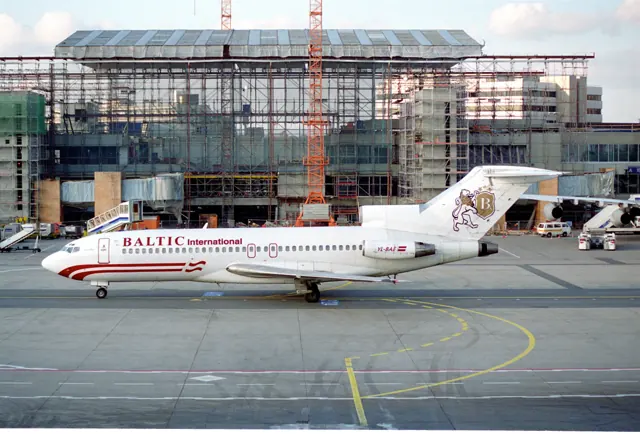
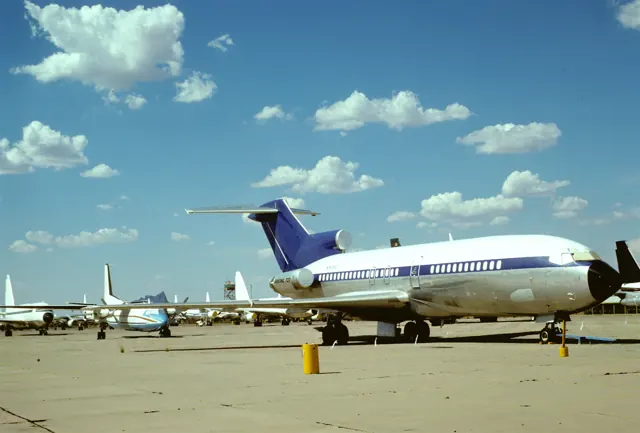
Boeing developed the 727 after the 707, arranging three engines around the rear fuselage and a high T-tail. The first flight took place in 1963, with service following in 1964. Its elaborate high-lift wing supported the programme's airport-access ambitions. The -100 and longer -200 have different proportions, while freighter conversions add another role.
Aircraft background
Wikipedia contributors · Read more ↗Charter work from all three cockpit seats
Armstrong remembers the 727 through the varied people and places that filled its charter schedule. Her flying included sports teams, professional wrestlers, firefighters and unusual destinations where the aircraft’s independence from extensive ground services was useful. Having worked in all three cockpit positions, she valued the flight engineer’s seat as a place to learn the aircraft and observe how a crew worked together.
High Sierra Pilots · April 2016. Retrospective 727-200 charter experience as flight engineer, first officer and captain.
High Sierra Pilots · Read more ↗Period autopilots and hydraulic flight controls
FlyJSim distinguishes the independent FD-108 flight director from the SP-150 autopilot, including their mode interlocks. Custom control-surface behaviour accounts for hydraulic pressure, blow-down and standby operation. The FD-108 is a flight director, not another autopilot installation.
727 Series Professional · FlyJSim · X-Plane 11
FlyJSim · Read more ↗Into the cockpit
 YouTube
 Sam Chui · 6 min ·
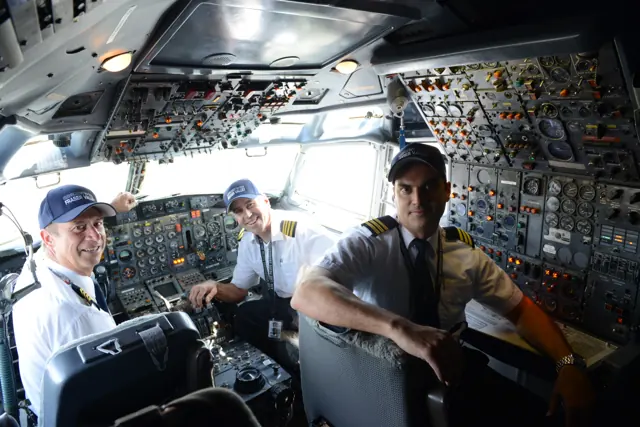
Boeing 727 complete cockpit landing footage (Iran Aseman Airlines)
Cockpit footage of an Iran Aseman Boeing 727 landing at Mashhad.
Real aircraft · Boeing 727
Watch on YouTube ↗Preview images are served by AirframeDB. Videos open on YouTube only when you choose to watch.
Meet Boeing 727
Boeing developed the 727 after the 707, arranging three engines around the rear fuselage and a high T-tail. The first flight took place in 1963, with service following in 1964. Its elaborate high-lift wing supported the programme's airport-access ambitions.
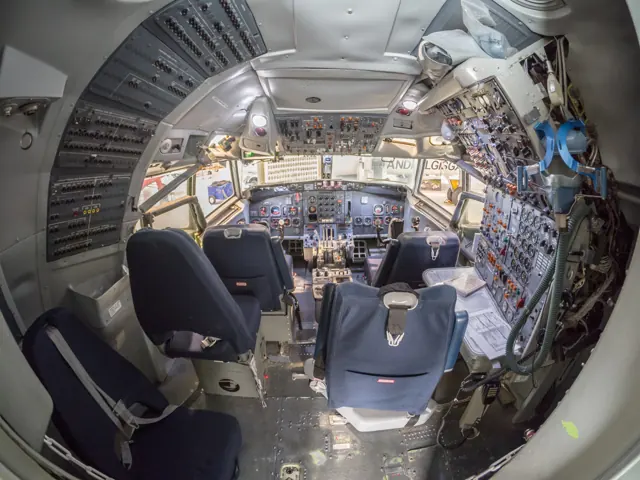
The -100 and longer -200 have different proportions, while freighter conversions add another role. In the cockpit, a flight engineer and period autopilot installations create a very different workflow from a modern 737. The simulator manuals identify the installed flight-guidance systems.
Boeing 727
Boeing → · Explore the family →
Boeing 727
Wikipedia contributors · Boeing 727 ↗FlyJSim · X-Plane 11 →727-100
FlightSim Studio · 727 Series ↗FlightSim Studio · MSFS 2020 · MSFS 2024 →727-100 Freighter
FlightSim Studio · 727 Series ↗FlightSim Studio · MSFS 2020 · MSFS 2024 →Super27-100
FlightSim Studio · 727 Series ↗FlightSim Studio · MSFS 2020 · MSFS 2024 →727-200 Passenger
FlightSim Studio · 727 Series ↗FlightSim Studio · MSFS 2020 · MSFS 2024 →727-200 Freighter
FlightSim Studio · 727 Series ↗FlightSim Studio · MSFS 2020 · MSFS 2024 →Super27-200
FlightSim Studio · 727 Series ↗FlightSim Studio · MSFS 2020 · MSFS 2024 →727 Zero-G
FlightSim Studio · 727 Series ↗FlightSim Studio · MSFS 2020 · MSFS 2024 →727 Oil Spill Response
FlightSim Studio · 727 Series ↗FlightSim Studio · MSFS 2020 · MSFS 2024 →Aircraft type designators
Use the code for the model you are flying. The linked authority lists the applicable aircraft.
History & design
Development milestones
First flight: February 9, 1963 ( 1963-02-09 )
Wikipedia contributors · Boeing 727 ↗Boeing 727 · family/variant named by the source · Wikipedia revision 1372643650
Pilot accounts
Charter work from all three cockpit seats
Armstrong remembers the 727 through the varied people and places that filled its charter schedule. Her flying included sports teams, professional wrestlers, firefighters and unusual destinations where the aircraft’s independence from extensive ground services was useful. Having worked in all three cockpit positions, she valued the flight engineer’s seat as a place to learn the aircraft and observe how a crew worked together.
The physical setting is just as vivid in her recollection: noisy engines, a trim wheel close to her knee and, on one aircraft with defective heating ducts, winter coats and hot coffee in a very cold cockpit. Simulator sessions explored failures that were uncomfortable to practise but valuable to understand. She remembers the aircraft as demanding familiarity and respect, then rewarding that effort with an unusually direct connection between pilot and machine.
High Sierra Pilots · April 2016. Retrospective 727-200 charter experience as flight engineer, first officer and captain.
Read the full account · High Sierra Pilots ↗Preparing to bring the first 727 home
Powell volunteered for the first 727’s final delivery because he still flew the type regularly and had accumulated more than ten thousand hours in it. His connection went back to eight years as a Western Airlines flight engineer, after which returning to a forward-facing pilot’s seat had been a particular pleasure. Above all, he enjoyed the aircraft’s hand-flying qualities.
For the planned flight to Seattle’s Museum of Flight, he expected to work with colleagues he already knew well and wanted an additional observer watching from the jump seat. He trusted the restoration team’s preparation and described the prospect as bittersweet. Even his intended clothes carried a connection to the past: a flight jacket, white shirt and tie would echo first-flight pilot Lew Wallick. His aim for the occasion was a straightforward, careful delivery of an aircraft that had already done its work.
AirlineReporter · February 2016 interview before the prototype’s planned museum delivery. Powell was then actively flying a private 727-100.
Read the full account · AirlineReporter ↗A gift from his father, remembered at the final landing
Tarsa’s first 727 flight came at thirteen, when his father bought him a short sightseeing trip from Chicago Midway. The acceleration, the view of the lakeshore and the realisation that only air supported the aircraft made him want to become a pilot. Decades later, starting with UPS as a 727 second officer, he saw the Chicago skyline again and remembered that first ride with his father.
His last flight on the type brought another sequence of personal landmarks. Ferrying an aircraft back from Europe in November 2003, he landed in Iceland and shared the Atlantic crossing duties with his first officer. On the final leg from Bangor to Louisville, the landscape below recalled his childhood home, meeting his wife and her family’s hometown. As he approached Louisville, he could see his own neighbourhood. His farewell to the aircraft became a quiet expression of gratitude to his father.
Air & Space reader contribution · August/September 2021, p.14. Childhood sightseeing, UPS second-officer experience and a final 727 flight in November 2003.
Read the full account · Air & Space / Smithsonian ↗In your simulator
Systems, equipment and documentation for each developer’s aircraft.
Compare simulator versions →X-Plane 11727 Series Professional
FlyJSim · Released
727 Series Professional
FlyJSim · Released
MSFS 2020 · MSFS 2024727 Series
FlightSim Studio · Released
727 Series
FlightSim Studio · Released
Aircraft specifications
Published figures for the named real-aircraft variant. Simulator equipment and performance can differ.
| Specification | Published value |
|---|---|
| Length | 133 ft 2 in (40.59 m) |
| Wingspan | 108 ft 0 in (32.92 m) |
| Height | 34 ft 3 in (10.44 m) |
| Wing area | 1,650 sq ft (153 m² ) |
| Empty weight | 87,696 lb (39,778 kg) |
| Max takeoff weight | 169,000 lb (76,657 kg) |
| Powerplant | 3 × Pratt & Whitney JT8D-7 turbofan engine, 14,000 lbf (62 kN) thrust each |
| Maximum speed | 632 mph (1,017 km/h, 549 kn) |
| Maximum speed | Mach 0.9 |
| Cruise speed | 600 mph (960 km/h, 518 kn) |
| Range | 2,590 mi (4,170 km, 2,250 nmi) |
Manuals & resources
Find your next read
Choose a topic for a short introduction and a link to the original source. Simulator references identify the developer and edition they cover.
Simulator documentation
Period autopilots and hydraulic flight controls727 Series Professional · FlyJSim · X-Plane 11
FlyJSim distinguishes the independent FD-108 flight director from the SP-150 autopilot, including their mode interlocks. Custom control-surface behaviour accounts for hydraulic pressure, blow-down and standby operation. The FD-108 is a flight director, not another autopilot installation.
727 Series Professional v3 · Study Level Systems and Dynamics
FlyJSim · Read the source ↗Wear that continues into the next flight727 Series Professional · FlyJSim · X-Plane 11
The optional maintenance system carries equipment wear between flights, including engines, the APU, generators and airframe. The developer also describes annunciator bulbs that can burn out, making condition checks part of the simulated operation.
727 v3 · Maintenance System; Study Level Systems
FlyJSim · Read the source ↗Choosing navigation and keeping notes in the cockpit727 Series Professional · FlyJSim · X-Plane 11
The package includes Laminar’s default FMC; the CIVA navigation integration requires a separate purchase. The scalable menu provides loading controls and a configurable checklist-and-notes window, allowing reference material to stay available during a flight.
727 v3 · introduction; Comprehensive Menu System; Third Party Integrations
FlyJSim · Read the source ↗Released product and variants727 Series · FlightSim Studio · MSFS 2020 · MSFS 2024
The released range includes 727-200 Passenger and Freighter products, a Super27 expansion that requires either 727-200 base, and a 727-100 package containing Passenger, Freighter and Super27-100 variants. The freighter also includes Zero-G and Oil Spill Response mission configurations.
Official developer / designated-store reference · checked 2026-09-14
FlightSim Studio · Read the source ↗Pilot account
Charter work from all three cockpit seatsHigh Sierra Pilots · April 2016. Retrospective 727-200 charter experience as flight engineer, first officer and captain.
Armstrong remembers the 727 through the varied people and places that filled its charter schedule. Her flying included sports teams, professional wrestlers, firefighters and unusual destinations where the aircraft’s independence from extensive ground services was useful. Having worked in all three cockpit positions, she valued the flight engineer’s seat as a place to learn the aircraft and observe how a crew worked together.
Erika Armstrong
High Sierra Pilots · Read the source ↗Preparing to bring the first 727 homeAirlineReporter · February 2016 interview before the prototype’s planned museum delivery. Powell was then actively flying a private 727-100.
Powell volunteered for the first 727’s final delivery because he still flew the type regularly and had accumulated more than ten thousand hours in it. His connection went back to eight years as a Western Airlines flight engineer, after which returning to a forward-facing pilot’s seat had been a particular pleasure. Above all, he enjoyed the aircraft’s hand-flying qualities.
Tim Powell
AirlineReporter · Read the source ↗Read the original documentation from the people who created it. Manuals open on their publisher’s website.
Manual
X-Plane aircraft and avionics manualsLaminar ResearchAircraft background
Boeing 727Wikipedia contributors · Research background · Wikipedia revision 1372643650 · retrieved 2026-09-12Resource
727 productFlyJSimDeveloper documentation
727 SeriesFlightSim Studio · Official developer / designated-store reference · checked 2026-09-14Type designator
ICAO Doc 8643 — aircraft type designatorsInternational Civil Aviation Organization · Public search data retrieved 2026-09-14; authority update 2026-09-03Built-in force-feedback profiles
Read the documentary basis, editable starting settings and remaining questions for the aircraft you fly. Each explanation refers to the exact profile revision shown.
Catalogue programme-20261022-v1 · 12 profile choices
FlightSim Studio 727-200 Passenger
FlightSim Studio · Free and Pro · Revision 5 · Inherited starting point
MSFS 2020 · MSFS 2024
FlightSim Studio 727-200 Passenger: The selected spring approximates artificial feel for powered controls, without treating direct surface loading as a mechanical return path.
FlightSim Studio 727-100 Passenger / Freighter
FlightSim Studio · Free and Pro · Revision 4 · Inherited starting point
MSFS 2020 · MSFS 2024
FlightSim Studio 727-100 Passenger / Freighter: The selected spring approximates artificial feel for powered controls, without treating direct surface loading as a mechanical return path.
FlightSim Studio 727-200 Freighter
FlightSim Studio · Free and Pro · Revision 4 · Inherited starting point
MSFS 2020 · MSFS 2024
FlightSim Studio 727-200 Freighter: The selected spring approximates artificial feel for powered controls, without treating direct surface loading as a mechanical return path.
FlightSim Studio Super 27-100 Passenger
FlightSim Studio · Free and Pro · Revision 3 · Inherited starting point
MSFS 2020 · MSFS 2024
FlightSim Studio Super 27-100 Passenger: The selected spring approximates artificial feel for powered controls, without treating direct surface loading as a mechanical return path.
FlightSim Studio Super27 727-200RE Freighter
FlightSim Studio · Free and Pro · Revision 3 · Inherited starting point
MSFS 2020 · MSFS 2024
FlightSim Studio Super27 727-200RE Freighter: The selected spring approximates artificial feel for powered controls, without treating direct surface loading as a mechanical return path.
FlightSim Studio Super27 727-200REP Passenger
FlightSim Studio · Free and Pro · Revision 3 · Inherited starting point
MSFS 2020 · MSFS 2024
FlightSim Studio Super27 727-200REP Passenger: The selected spring approximates artificial feel for powered controls, without treating direct surface loading as a mechanical return path.
Boeing 727-200
Free and Pro · Revision 3 · Partial review
MSFS 2020 · MSFS 2024 · X-Plane 11
Boeing 727-200: The selected spring approximates artificial feel for powered controls, without treating direct surface loading as a mechanical return path.
Boeing 727-100
Free and Pro · Revision 1 · Partial review
MSFS 2020 · MSFS 2024 · X-Plane 11
Boeing 727-100: The selected spring approximates artificial feel for powered controls, without treating direct surface loading as a mechanical return path.
Boeing 727-100F
Free and Pro · Revision 1 · Partial review
MSFS 2020 · MSFS 2024 · X-Plane 11
Boeing 727-100F: The selected spring approximates artificial feel for powered controls, without treating direct surface loading as a mechanical return path.
Boeing 727-200F
Free and Pro · Revision 1 · Partial review
MSFS 2020 · MSFS 2024 · X-Plane 11
Boeing 727-200F: The selected spring approximates artificial feel for powered controls, without treating direct surface loading as a mechanical return path.
Boeing Super 27-100
Free and Pro · Revision 1 · Partial review
MSFS 2020 · MSFS 2024 · X-Plane 12
A rear-engined trijet built to bring jet service to shorter routes and smaller airports.
Boeing Super 27-200RE
Free and Pro · Revision 1 · Partial review
MSFS 2020 · MSFS 2024 · X-Plane 12
A rear-engined trijet built to bring jet service to shorter routes and smaller airports.
Discuss this aircraft (0)
Questions, observations and useful sources from the community.
No published discussions yet. Bring a question or share a useful source.
Open aircraft discussions →Content expanded · What’s new
Something missing or a source that needs attention?
Suggest a correction ↗