


Start here
A few places to begin, from the aircraft’s story to the people who fly it.
Meet the aircraft
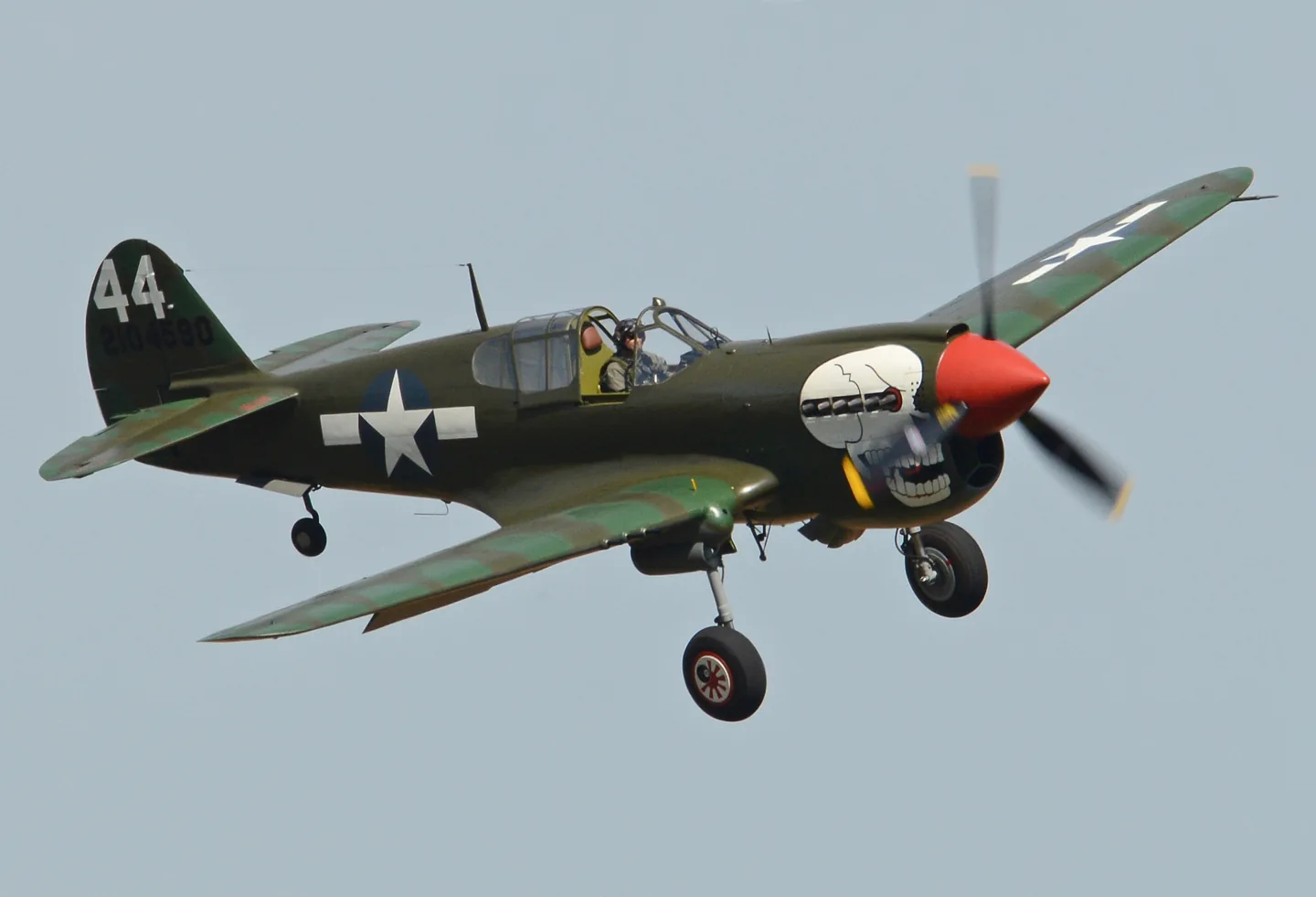
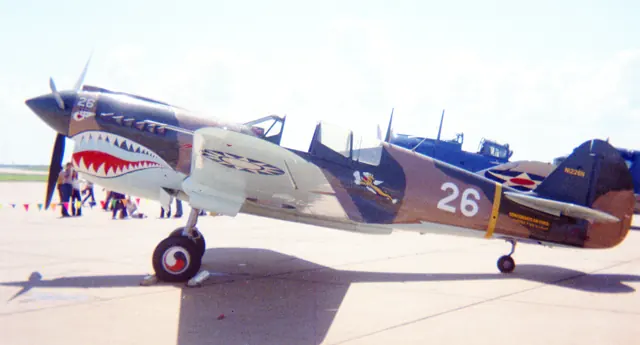
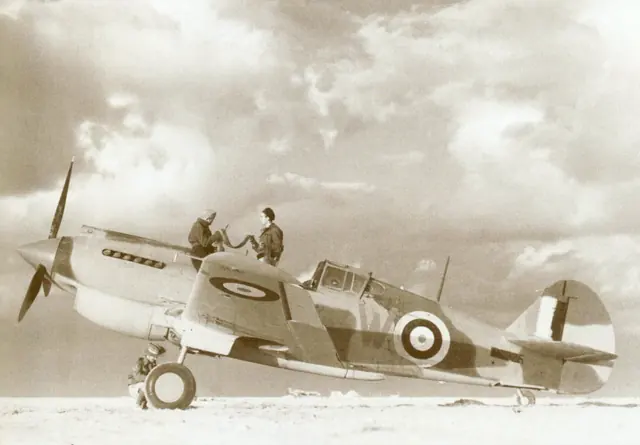
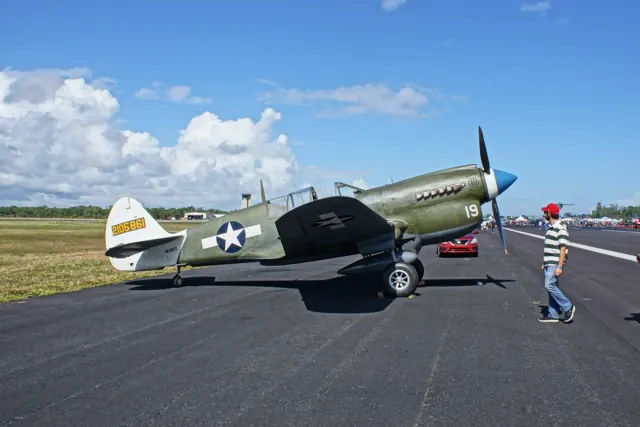
Curtiss adapted the P-36 design into the P-40, which first flew in 1938. The resulting all-metal fighter-bomber served numerous Allied air forces throughout the Second World War. Production ended in 1944. The simulator product represents the P-40F. Photographs and accounts identify the other Warhawk variants they depict.
Aircraft background
Wikipedia contributors · Read more ↗A coveted fighter becomes a difficult aircraft to part with
Teichman’s interest became a firm ambition when Stephen Grey brought a P-40 to the Isle of Wight in 2005. A later ride at Duxford impressed him with its roll response, and his Beech Staggerwing eventually became part of the purchase deal. His first solo in January 2006 began years of display flying, overseas trips and film work on Red Tails.
Pilot · February 2018. Hangar 11’s Allison-powered P-40, acquired in 2005 and sold in 2017; this is not an evaluation of the Merlin-powered P-40F simulator add-on.
Pilot · Read more ↗The optional EFB includes maintenance and navigation information
iniBuilds lists an EFB with maintenance, moving-map, radio and weather pages. It can be hidden for a cockpit presentation without the tablet.
Curtiss P-40 Warhawk · iniBuilds · MSFS 2020
iniBuilds · Read more ↗Into the cockpit
 YouTube
AOPA: Your Freedom to Fly · 6 min ·
What it's like to fly the Curtiss P-40 Warhawk
AOPA joins Barry Schiff for a flight in a restored P-40.
Real aircraft · Curtiss P-40 Warhawk
Watch on YouTube ↗Preview images are served by AirframeDB. Videos open on YouTube only when you choose to watch.
Meet Curtiss P-40 Warhawk
Curtiss adapted the P-36 design into the P-40, which first flew in 1938. The resulting all-metal fighter-bomber served numerous Allied air forces throughout the Second World War. Production ended in 1944. The simulator product represents the P-40F. Photographs and accounts identify the other Warhawk variants they depict.
Curtiss P-40 Warhawk
Curtiss → · Explore the family →
Curtiss P-40 Warhawk
Wikipedia contributors · Curtiss P-40 Warhawk ↗iniBuilds · MSFS 2020 →Aircraft type designators
Use the code for the model you are flying. The linked authority lists the applicable aircraft.
History & design
A restored N-model returns to flight in New Zealand
Vintage Wings records Frank Parker making the restored P-40N-1’s first flight on 23 April 2009 at Ardmore. Its markings honour Stocky Edwards, while the underlying airframe has a separate history with the RAAF in New Guinea.
Vintage Wings of Canada · Born Again Kittyhawk ↗Restoration report distinguishes commemorative markings from airframe service
Development milestones
First flight: 14 October 1938
Developed from: Curtiss P-36 Hawk
Wikipedia contributors · Curtiss P-40 Warhawk ↗Curtiss P-40 Warhawk · family/variant named by the source · Wikipedia revision 1371699045
Pilot accounts
A coveted fighter becomes a difficult aircraft to part with
Teichman’s interest became a firm ambition when Stephen Grey brought a P-40 to the Isle of Wight in 2005. A later ride at Duxford impressed him with its roll response, and his Beech Staggerwing eventually became part of the purchase deal. His first solo in January 2006 began years of display flying, overseas trips and film work on Red Tails.
Selling it was an emotional decision shaped by time away from his family and the demands of the air-show season. His final flight to Sywell in June 2017 ended with the aircraft being prepared for shipment to Oregon. The recollection makes room for his wife Karen’s support and the personal cost of sustaining an ambition he had enjoyed so much.
Pilot · February 2018. Hangar 11’s Allison-powered P-40, acquired in 2005 and sold in 2017; this is not an evaluation of the Merlin-powered P-40F simulator add-on.
Read the full account · Pilot ↗A hoped-for display of skill meets an unfamiliar landing
Schiff entered the front cockpit with experience in other warbirds and the hope of impressing Thom Richard. The fit was cramped and some controls awkward to reach, while the Allison’s sound promised an exciting flight. Once airborne, the aircraft proved more nimble than he had expected, with control forces that required attention as he adjusted to it.
Landing challenged his expectations more sharply. Keeping near the runway centreline was difficult, and his intended demonstration of experience became a reminder of how much an unfamiliar aircraft can demand. He still found the Warhawk a pleasure to fly. Richard’s obvious enjoyment of teaching supplied a welcoming setting for the lessons and for sharing an aircraft that meant so much to him.
AOPA · October 2019. Dual-control American Dream with Thom Richard; restored Allison-powered P-40, distinct from the P-40F.
Read the full account · AOPA ↗Careful preparation leads to a first solo at Gatineau
Cook’s preparation started before he reached Canada, with manuals and a recorded briefing from Garth Hogan to study. At Gatineau, Tim Leslie first introduced him to the aircraft from the front seat while Cook occupied the rear. Ground familiarisation and the eventual move into the pilot’s cockpit turned that preparation into a much anticipated opportunity to fly solo.
The P-40 surprised him with its lively aileron response, while the Allison seemed pleasantly quiet in cruise. He took time over the return, choosing a more gradual approach than his familiar Hurricane arrival. A smooth wheel landing completed the outing. His account retains the limits of the flight too: high oil temperature ruled out the loops he had considered trying.
Historic Aircraft Association · 2010. August 2009 flying in Vintage Wings of Canada’s P-40N-1 C-FVWC at Gatineau, with Tim Leslie; the Allison-powered N differs from the simulated F.
Read the full account · Historic Aircraft Association ↗In your simulator
Systems, equipment and documentation for each developer’s aircraft.
Compare simulator versions →MSFS 2020Curtiss P-40 Warhawk
iniBuilds · Released
Curtiss P-40 Warhawk
iniBuilds · Released
MSFS 2020P-40B Tomahawk
Big Radials · Released
P-40B Tomahawk
Big Radials · Released
MSFS 2020P-40N
Flight Replicas · Released
P-40N
Flight Replicas · Released
Aircraft specifications
Published figures for the named real-aircraft variant. Simulator equipment and performance can differ.
| Specification | Published value |
|---|---|
| Length | 31 ft 8.5 in (9.665 m) |
| Wingspan | 37 ft 3.5 in (11.367 m) |
| Height | 10 ft 8 in (3.25 m) |
| Wing area | 236 sq ft (21.9 m² ) |
| Empty weight | 5,922 lb (2,686 kg) |
| Gross weight | 8,515 lb (3,862 kg) |
| Powerplant | 1 × Allison V-1710-39 V-12 liquid-cooled piston engine , 1,240 hp (920 kW) |
| Propellers | 3-bladed Curtiss-Wright electric constant-speed propeller |
| Maximum speed | 361 mph (581 km/h, 314 kn) at 15,000 ft (4,600 m) |
| Cruise speed | 308 mph (496 km/h, 268 kn) |
| Range | 716 mi (1,152 km, 622 nmi) at 70% power |
| Service ceiling | 29,100 ft (8,900 m) |
Manuals & resources
Find your next read
Choose a topic for a short introduction and a link to the original source. Simulator references identify the developer and edition they cover.
Simulator documentation
The optional EFB includes maintenance and navigation informationCurtiss P-40 Warhawk · iniBuilds · MSFS 2020
iniBuilds lists an EFB with maintenance, moving-map, radio and weather pages. It can be hidden for a cockpit presentation without the tablet.
P-40F v1.0.6 product description, MSFS 2020
iniBuilds · Read the source ↗The P-40F has a Merlin engineCurtiss P-40 Warhawk · iniBuilds · MSFS 2020
The developer specifically describes a Merlin-powered P-40F and recordings from an operational example. The Allison-powered aircraft in these pilot accounts are related variants.
iniBuilds P-40F feature list
iniBuilds · Read the source ↗Removable covers expose different areas of the aircraftCurtiss P-40 Warhawk · iniBuilds · MSFS 2020
The model includes removable gun-bay covers or baggage compartments depending on the selected variant, alongside a detailed Merlin engine model.
iniBuilds P-40F product features
iniBuilds · Read the source ↗Pilot account
A coveted fighter becomes a difficult aircraft to part withPilot · February 2018. Hangar 11’s Allison-powered P-40, acquired in 2005 and sold in 2017; this is not an evaluation of the Merlin-powered P-40F simulator add-on.
Teichman’s interest became a firm ambition when Stephen Grey brought a P-40 to the Isle of Wight in 2005. A later ride at Duxford impressed him with its roll response, and his Beech Staggerwing eventually became part of the purchase deal. His first solo in January 2006 began years of display flying, overseas trips and film work on Red Tails. Selling it was an emotional decision shaped by time away from his family and the demands of the air-show season.
Peter Teichman
Pilot · Read the source ↗A hoped-for display of skill meets an unfamiliar landingAOPA · October 2019. Dual-control American Dream with Thom Richard; restored Allison-powered P-40, distinct from the P-40F.
Schiff entered the front cockpit with experience in other warbirds and the hope of impressing Thom Richard. The fit was cramped and some controls awkward to reach, while the Allison’s sound promised an exciting flight. Once airborne, the aircraft proved more nimble than he had expected, with control forces that required attention as he adjusted to it. Landing challenged his expectations more sharply.
Barry Schiff
AOPA · Read the source ↗Developer documentation
P-40B Tomahawk — product listingP-40B Tomahawk · MSFS 2020
Product listing captured 2026-09-30; edition scope from the reviewed catalogue
bigradials.com · Read the source ↗P-40N — product listingP-40N · MSFS 2020
Product listing captured 2026-09-30; edition scope from the reviewed catalogue
flight-replicas.com · Read the source ↗Read the original documentation from the people who created it. Manuals open on their publisher’s website.
Aircraft background
Curtiss P-40 WarhawkWikipedia contributors · Research background · retrieved 2026-09-12 Born Again KittyhawkVintage Wings of Canada · Restoration report · April 2009Product
P-40F WarHawk for MSFS-2020iniBuilds · Official developer / designated store catalogue · checked 2026-09-12 Big Radials P-40B Tomahawkbigradials.com · Product listing captured 2026-09-30; edition scope from the reviewed catalogue P-40N Warhawk / Kittyhawk IV | Flight Replicasflight-replicas.com · Product listing captured 2026-09-30; edition scope from the reviewed catalogueType designator
ICAO Doc 8643 — aircraft type designatorsInternational Civil Aviation Organization · Public search data retrieved 2026-09-14; authority update 2026-09-03Built-in force-feedback profiles
Read the documentary basis, editable starting settings and remaining questions for the aircraft you fly. Each explanation refers to the exact profile revision shown.
Catalogue programme-20261022-v1 · 4 profile choices
Big Radials P-40B Tomahawk
Big Radials · Free and Pro · Revision 3 · Inherited starting point
MSFS 2020
Big Radials P-40B Tomahawk: Reversible controls motivate resistance that changes with airspeed.
Flight Replicas P-40N Warhawk / Kittyhawk IV
Flight Replicas · Free and Pro · Revision 3 · Inherited starting point
MSFS 2020
Flight Replicas P-40N Warhawk / Kittyhawk IV: Reversible controls motivate resistance that changes with airspeed.
iniBuilds P-40F WarHawk
iniBuilds · Free and Pro · Revision 2 · Inherited starting point
MSFS 2020
iniBuilds P-40F WarHawk: Reversible controls motivate resistance that changes with airspeed.
Curtiss P-40 Warhawk
Free and Pro · Revision 1 · Partial review
MSFS 2020
Curtiss P-40 Warhawk: Reversible controls motivate resistance that changes with airspeed.
Big Radials P-40B Tomahawk
Big Radials P-40B Tomahawk: Reversible controls motivate resistance that changes with airspeed.
Aircraft and simulator scope
- Big Radials P-40B Tomahawk · Big Radials · MSFS 2020 · Add-on starting point
The simulator model and controls
Curtiss adapted the P-36 design into the P-40, which first flew in 1938. The resulting all-metal fighter-bomber served numerous Allied air forces throughout the Second World War. Production ended in 1944. The simulator product represents the P-40F. Photographs and accounts identify the other Warhawk variants they depict.
This profile selects Big Radials P-40B Tomahawk for MSFS 2020.
How this profile feels
Reversible controls motivate resistance that changes with airspeed. Spring resistance builds with the selected airspeed response. A separate aerodynamic term adds speed-dependent control load.
Elevator-tab trim supports pitch relief; rudder trim belongs to yaw. Valid trim provides the configured pressure relief. Autopilot following is off.
Controls and trim
The P-40’s primary controls are unboosted. Hydraulic gear and flaps belong to the accessory system, while elevator and rudder trim act on the manually controlled aircraft. Big Radials’ RTDM option uses continuous gear/flap selectors; other developer renditions retain their own engines, flap presentation and equipment.
The selected implementation
RTDM selects continuous HOLD/NEUTRAL gear/flap operation; the default control mode uses notches in the same P-40B rendition.
About the values
The gains are normalized profile settings. They describe the chosen effect balance; hand force depends on the device and its output limits. IAS references are tuning values rather than operating limits. Physical acceptance of this revision remains pending.
Documentary review and sources
These decisions describe the documentary basis and remaining gaps for this revision. Aircraft documentation and a starting setting describe different kinds of evidence.
Aircraft and variant
InheritedThis profile selects Big Radials P-40B Tomahawk for MSFS 2020.
Flight controls
InheritedThe P-40’s primary controls are unboosted. Hydraulic gear and flaps belong to the accessory system, while elevator and rudder trim act on the manually controlled aircraft. Big Radials’ RTDM option uses continuous gear/flap selectors; other developer renditions retain their own engines, flap presentation and equipment.
Trim
InheritedElevator-tab trim supports pitch relief; rudder trim belongs to yaw. Pitch authority 0.3 provides load relief and permitted centre movement; roll authority is 0.
Autopilot and stability
InheritedAutopilot following is off; the configured spring and load retain the hardware feel.
Equipment
InheritedRTDM selects continuous HOLD/NEUTRAL gear/flap operation; the default control mode uses notches in the same P-40B rendition.
Speeds and limits
InheritedThe indicated-speed references set the profile response scale; they are separate from aircraft operating limits.
Simulator integration
InheritedThe profile targets msfs2020. Add-on-specific controls use only the supported references configured by this profile.
Force-feedback settings
InheritedThe settings define the profile’s effect balance. Device output limits affect physical hand force.
Starting settings and their rationale
These configured values are starting estimates. The explanations describe what each setting controls; physical validation appears separately below.
| Setting | Starting value | What it controls and why |
|---|---|---|
| Spring strength | Starting value0.74 | What it controls and whyReversible controls motivate resistance that changes with airspeed. The baseline spring is 0.74. Its low-speed blend reaches baseline strength at 45 KIAS. |
| Master force gain | Starting value0.85 | What it controls and whyScales overall profile strength while preserving effect balance, subject to device and output limits. |
| Profile force gain | Starting value0.8 | What it controls and whyThe aerodynamic-load gain is 0.8 with an indicated-speed reference of 200 KIAS. This supplies speed-dependent loading alongside the spring. |
| Force tuning speed/reference | Starting value200 kt | What it controls and whySets the IAS reference for aerodynamic loading. It is an estimate, not published cruise TAS or a flight limit. |
| Spring response reference speed | Starting value45 kt | What it controls and whySets the IAS where the low-speed blend reaches baseline strength; high-speed stiffening also uses it. |
| Aileron force scale | Starting value0.73 | What it controls and whyRoll and pitch aerodynamic scales are 0.73 and 1, respectively. They set the aerodynamic axis balance. No custom spring-travel curve is enabled. |
| Elevator force scale | Starting value1.0 | What it controls and whyScales pitch aerodynamic loading; pitch spring travel and trim responses are separate settings. |
| Trim feel | Starting valueDisabled | What it controls and whyRetained for compatibility and group membership. Trim relief, rather than this flag, controls centre movement. |
| Trim relief | Starting valueEnabled | What it controls and whyAllows trim relief with supported control law and valid telemetry. Axis authorities set its amount. |
| Autopilot follow | Starting valueDisabled | What it controls and whyAutopilot following is off; the configured spring and load retain the hardware feel. |
| Autopilot neutral hold | Starting valueDisabled | What it controls and whyPermits centering hold during a supported AP state, separate from following a moving target. |
| Output force limit | Starting value0.55 | What it controls and whyCaps directed-force output. Native spring effects and device limits remain separate. |
All 44 starting settings and their rationale
The settings define the profile’s effect balance. Device output limits affect physical hand force.
| Setting | Starting value | What it controls and why |
|---|---|---|
| Spring strength | Starting value0.74 | What it controls and whyReversible controls motivate resistance that changes with airspeed. The baseline spring is 0.74. Its low-speed blend reaches baseline strength at 45 KIAS. |
| Spring deadband | Starting value0.04 | What it controls and whySets travel around the centre before the baseline spring resists. Smaller values engage it sooner. |
| Profile force gain | Starting value0.8 | What it controls and whyThe aerodynamic-load gain is 0.8 with an indicated-speed reference of 200 KIAS. This supplies speed-dependent loading alongside the spring. |
| Master force gain | Starting value0.85 | What it controls and whyScales overall profile strength while preserving effect balance, subject to device and output limits. |
| QBlend Enabled | Starting valueEnabled | What it controls and whyAllows baseline spring strength to rise with indicated airspeed where the control law permits it. |
| QSpring Minimum Factor | Starting value0.55 | What it controls and whySets low-speed spring strength as a fraction of baseline when blending is enabled. One keeps full strength. |
| QSpring Start Knots | Starting value10 kt | What it controls and whySets the IAS where the low-speed spring blend starts rising. This is a feel threshold, not a flight limit. |
| Spring response reference speed | Starting value45 kt | What it controls and whySets the IAS where the low-speed blend reaches baseline strength; high-speed stiffening also uses it. |
| Force tuning speed/reference | Starting value200 kt | What it controls and whySets the IAS reference for aerodynamic loading. It is an estimate, not published cruise TAS or a flight limit. |
| Airspeed spring stiffening gain | Starting value0.15 | What it controls and whyThe high-speed spring-stiffening gain is 0.15. It strengthens the permitted spring response above 45 KIAS, with the squared-speed ratio capped at 5. |
| Airspeed spring stiffening limit | Starting value5 | What it controls and whyLimits the squared airspeed ratio used for high-speed spring stiffening; it is not a device-force cap. |
| Aileron force scale | Starting value0.73 | What it controls and whyRoll and pitch aerodynamic scales are 0.73 and 1, respectively. They set the aerodynamic axis balance. No custom spring-travel curve is enabled. |
| Elevator force scale | Starting value1.0 | What it controls and whyScales pitch aerodynamic loading; pitch spring travel and trim responses are separate settings. |
| Output force limit | Starting value0.55 | What it controls and whyCaps directed-force output. Native spring effects and device limits remain separate. |
| Trim feel | Starting valueDisabled | What it controls and whyRetained for compatibility and group membership. Trim relief, rather than this flag, controls centre movement. |
| Trim relief | Starting valueEnabled | What it controls and whyAllows trim relief with supported control law and valid telemetry. Axis authorities set its amount. |
| Elevator Authority | Starting value0.3 | What it controls and whyElevator-tab trim supports pitch relief; rudder trim belongs to yaw. Pitch authority 0.3 provides load relief and permitted centre movement; roll authority is 0. |
| Aileron Authority | Starting value0 | What it controls and whyScales supported roll-trim relief and permitted centre movement. Zero removes roll response. |
| Force Trim Enabled | Starting valueDisabled | What it controls and whyEnables local force trim, separate from aircraft-owned trim and add-on integration qualification. |
| GLoad Enabled | Starting valueEnabled | What it controls and whyAllows load-factor changes to modify permitted spring laws. Passive fly-by-wire feel can suppress it. |
| Rate Damping Enabled | Starting valueEnabled | What it controls and whyEnables rate damping with the configured coefficients and control law. |
| Autopilot follow | Starting valueDisabled | What it controls and whyAutopilot following is off; the configured spring and load retain the hardware feel. |
| Autopilot follow authority | Starting value0.1 | What it controls and whySets admitted AP-follow gain, not a percentage of travel. Runtime ownership and input limits still apply. |
| Autopilot neutral hold | Starting valueDisabled | What it controls and whyPermits centering hold during a supported AP state, separate from following a moving target. |
| Autopilot neutral hold strength | Starting value0.6 | What it controls and whySets admitted AP neutral-hold strength; inactive while neutral hold is disabled. |
| Enabled | Starting valueEnabled | What it controls and whyEnables aerodynamic cues; each still needs nonzero strength and its simulator conditions. |
| Gain | Starting value0.35 | What it controls and whySets stall-buffet strength. Zero removes the cue without changing simulator stalls or warnings. |
| Gain | Starting value0 | What it controls and whySets high-Mach buffet strength; onset and full-strength thresholds are separate. |
| Gain | Starting value0 | What it controls and whySets flap buffet at the configured position and speed gates. Flap movement texture is separate. |
| Maximum flap index | Starting value3 | What it controls and whySets the final flap index for detent normalization. UP plus three detents uses maximum index3. |
| Minimum flap index | Starting value2 | What it controls and whySets the first flap detent that admits buffet; this is a handle index, not degrees. |
| Gain | Starting value0 | What it controls and whySets gear aerodynamic buffet; movement and ground-contact cues are separate. |
| Shaker Enabled | Starting valueDisabled | What it controls and whyPermits shaker at supported warning conditions; the switch does not establish aircraft equipment. |
| Stick shaker amplitude | Starting value0.5 | What it controls and whySets triggered shaker strength; inactive while the shaker feature is disabled. |
| Enabled | Starting valueEnabled | What it controls and whyEnables ground effects; each still needs its own strength and contact or motion telemetry. |
| Gain | Starting value0.4 | What it controls and whySets rolling texture strength, modified by speed, surface and undercarriage configuration. |
| Gain | Starting value0.25 | What it controls and whySets gear-bump texture during ground motion, separate from touchdown impact. |
| Gain | Starting value0.65 | What it controls and whySets landing-impact strength; landing telemetry and response shape determine the pulse. |
| Gain | Starting value0 | What it controls and whySets reverse-thrust vibration with valid reverser and engine conditions. Zero removes the cue. |
| Enabled | Starting valueEnabled | What it controls and whyEnables engine cues with nonzero settings and valid running-engine telemetry. |
| Gain | Starting value0.12 | What it controls and whySets estimated engine vibration using configured telemetry and response, not measured cockpit vibration. |
| Enabled | Starting valueEnabled | What it controls and whyEnables accessory cues with configured strengths and observed accessory movement. |
| Gain | Starting value0.12 | What it controls and whySets texture from observed flap movement; a command without movement does not establish the cue. |
| Gain | Starting value0.025 | What it controls and whySets texture from observed gear movement, separate from aerodynamic and touchdown effects. |
Limits and open questions
- Manual MPH values are not KIAS. Optional RTDM selector states cannot be treated as actual surface position. Historical CG/bush-trip limitations remain version-specific; no canopy or weapons force events.
- Nominal forces, damping and speed references are estimates. Physical and installed-aircraft acceptance deferred.
- Custom failures, mixed-axis gearing and AP servo following remain unqualified.
Physical validation
No physical force validation is recorded in this public catalogue for this revision. Documentary review and software checks do not establish how a particular device feels.
Discuss this aircraft (0)
Questions, observations and useful sources from the community.
No published discussions yet. Bring a question or share a useful source.
Open aircraft discussions →Content expanded · What’s new
Something missing or a source that needs attention?
Suggest a correction ↗