


Start here
A few places to begin, from the aircraft’s story to the people who fly it.
Meet the aircraft
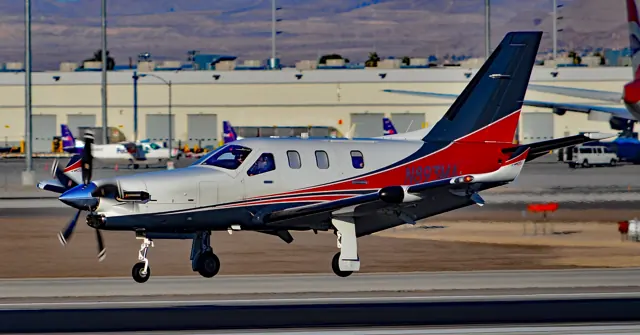
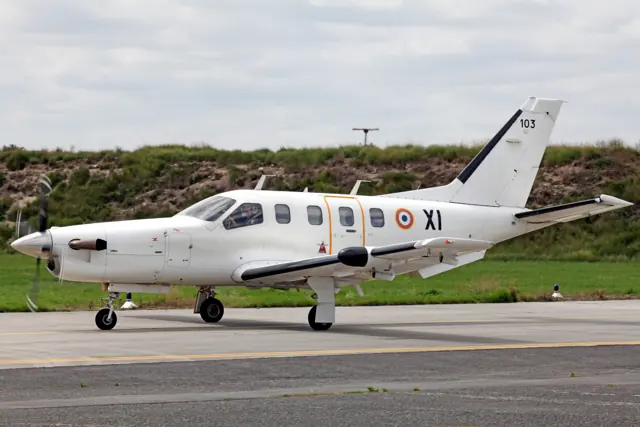
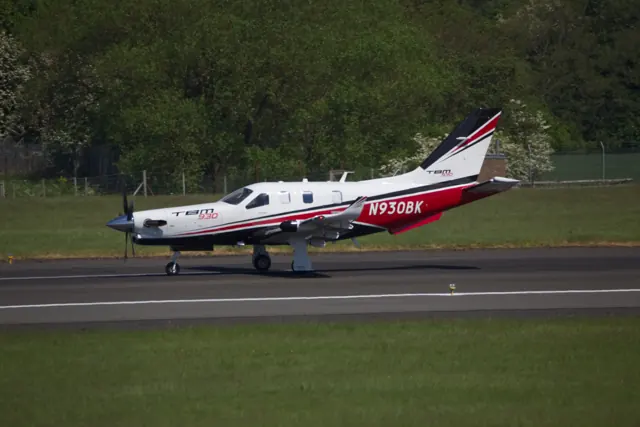
The TBM programme began as a collaboration between SOCATA and Mooney and continued under Daher. The low-wing airframe carries one nose-mounted turboprop and a pressurised cabin. Successive versions developed the engines, aerodynamics, avionics and pilot interface. The analogue-panel TBM 850, glass-cockpit TBM 900 and TBM 930 occupy different points in that progression.
Aircraft background
Wikipedia contributors · Read more ↗Demonstrating the 930’s emergency descent and learning its menus
Horne flew the TBM 930 at Tarbes with chief test pilot Stéphane Jacques in March 2016. Their demonstration deliberately explored the aircraft's response to a depressurisation scenario: at 20,000 feet they put on oxygen masks and shut off the bleed-air supply. Horne watched the emergency-descent function turn the aircraft and bring it down to a selected safe level, with terrain affecting the altitude used for the exercise.
AOPA Pilot, June 2016. TBM 930 demonstration at Tarbes with Stéphane Jacques in March 2016.
AOPA Pilot · Read more ↗Why the flap lever also selects 850 mode
Black Square documents a gated fourth flap-lever position that becomes available with the flaps retracted. Selecting 850 mode changes the power available for climb and cruise, allowing torque above the instrument’s 100-percent reference. The guide distinguishes that mode from the torque limiter used outside it. This unusual shared control is one of the details separating the 850 cockpit from later TBM generations.
TBM 850 · MSFS 2020 · MSFS 2024
Black Square / Just Flight · Read more ↗Into the cockpit
 YouTube
FlyEurope TV - Aviation & Aerospace Media
The best aircraft of the month we like; Daher TBM 930, the magic touch
An introduction to the TBM 930 and its cockpit.
Real TBM 930; G3000 cockpit
Watch on YouTube ↗Preview images are served by AirframeDB. Videos open on YouTube only when you choose to watch.
Meet Daher TBM family
The TBM programme began as a collaboration between SOCATA and Mooney and continued under Daher. The low-wing airframe carries one nose-mounted turboprop and a pressurised cabin. Successive versions developed the engines, aerodynamics, avionics and pilot interface.
The analogue-panel TBM 850, glass-cockpit TBM 900 and TBM 930 occupy different points in that progression. Simulator developers model these panel generations and different levels of persistent system behaviour, documented for each product.
Daher TBM
Aircraft type designators
Use the code for the model you are flying. The linked authority lists the applicable aircraft.
TBM 900-series aircraft, including 900, 910, 930, 940 and 960
ICAO Doc 8643 — aircraft type designators ↗Checked 2026-09-14History & design
Development milestones
First flight: 14 July 1988
Developed from: Mooney 301
Wikipedia contributors · SOCATA TBM ↗SOCATA TBM · family/variant named by the source · Wikipedia revision 1363498428
Pilot accounts
Demonstrating the 930’s emergency descent and learning its menus
Horne flew the TBM 930 at Tarbes with chief test pilot Stéphane Jacques in March 2016. Their demonstration deliberately explored the aircraft's response to a depressurisation scenario: at 20,000 feet they put on oxygen masks and shut off the bleed-air supply. Horne watched the emergency-descent function turn the aircraft and bring it down to a selected safe level, with terrain affecting the altitude used for the exercise. It was a planned demonstration with a test pilot, rather than an account of an in-service emergency.
He also explored the electronic stability protection and the new G3000 interface. The protective servo forces became noticeable as he pushed toward the system's limits. Meanwhile, the touchscreen menus introduced a learning task even for a pilot familiar with earlier TBMs: finding the right page and returning through layers of selections required practice.
AOPA Pilot, June 2016. TBM 930 demonstration at Tarbes with Stéphane Jacques in March 2016.
Read the full account · AOPA Pilot ↗A 960 on a real trip through busy airspace
Boatman joined owner-pilot Malte Lorenz on flights between Hagerstown and Republic Airport in his 2024 TBM 960. The trip put the aircraft into the congested Northeast airspace in which Lorenz regularly used it. A complicated initial clearance and relatively low assigned altitudes reinforced his preference for a turboprop on shorter journeys. At Republic, they made an instrument approach beneath a coastal cloud layer. Another practical moment came when extra passengers wanted to join: the on-board loading calculation showed the proposed load exceeded limits, and they declined the request.
Returning to Hagerstown brought strong southerly winds and a choice of the shorter runway with a more favourable alignment. Lorenz disconnected the autopilot early and controlled the approach speed carefully. Boatman describes a gentle touchdown and ample room remaining, while acknowledging how short the runway looked from the approaching aircraft.
AOPA Pilot, November 2024. Julie Boatman accompanies Malte Lorenz in his 2024 TBM 960.
Read the full account · AOPA Pilot ↗Crisp handling, a coupled go-around and a simulated engine failure
Gerzanics evaluated TBM 940 F-HGDA with Daher demonstration pilot Wayman Luy at Pompano Beach. He found the ground steering precise and the yoke forces light during takeoff. In a fast descent the aircraft responded crisply in all three axes. His stall demonstrations were more varied: the clean stall produced a wings-level pitch break, while flap-extended stalls included a left wing drop that he arrested during recovery. Luy suggested the left-wing radar installation as a possible explanation for that asymmetry.
The flight also contrasted automation with hands-on flying. Gerzanics watched the autopilot and autothrottle manage an instrument approach and coupled go-around, then handled a simulated engine failure toward Belle Glade. They arrived a little high and touched down long, using braking and reverse to slow. He particularly enjoyed manoeuvring the aircraft through tight turns on the narrow runway afterward. The engine remained available during the simulated failure.
Flight International, 15–21 October 2019, pages 26–29. F-HGDA with Wayman Luy; manufacturer-hosted publisher reprint.
Read the full account · Flight International ↗Pilot Report: Daher’s New TBM 930
A 2016 real-aircraft pilot report. Publisher access restrictions may apply.
In your simulator
Systems, equipment and documentation for each developer’s aircraft.
Compare simulator versions →MSFS 2024TBM 930
Microsoft Flight Simulator · Released
TBM 930
Microsoft Flight Simulator · Released
MSFS 2020TBM 930
Microsoft Flight Simulator · Released
TBM 930
Microsoft Flight Simulator · Released
MSFS 2020 · MSFS 2024TBM 850
Black Square · Released
TBM 850
Black Square · Released
X-Plane 11TBM 900
Hot Start · Released
TBM 900
Hot Start · Released
Aircraft specifications
Published figures for the named real-aircraft variant. Simulator equipment and performance can differ.
| Specification | Published value |
|---|---|
| Length | 10.72 m (35 ft 2 in) |
| Wingspan | 12.83 m (42 ft 1 in) |
| Height | 4.355 m (14 ft 3 in) |
| Wing area | 18.0 m² (194 sq ft) |
| Empty weight | 2,097 kg (4,623 lb) |
| Max takeoff weight | 3,354 kg (7,394 lb) |
| Powerplant | 1 × Pratt & Whitney Canada PT6A-66D turboprop engine, 630 kW (850 shp) |
| Propellers | 5-bladed Hartzell constant-speed propeller |
| Maximum speed | 611 km/h (380 mph, 330 kn) maximum cruise at 8,534 m (28,000 ft) |
| Cruise speed | 467 km/h (290 mph, 252 kn) long-range cruise at 9,449 m (31,001 ft) |
| Range | 3,304 km (2,053 mi, 1,784 nmi) with max fuel at long-range cruise and 9,449 m (31,001 ft) |
| Service ceiling | 9,449 m (31,001 ft) |
Manuals & resources
Find your next read
Choose a topic for a short introduction and a link to the original source. Simulator references identify the developer and edition they cover.
Simulator documentation
Why the flap lever also selects 850 modeTBM 850 · Black Square · MSFS 2020 · MSFS 2024
Black Square documents a gated fourth flap-lever position that becomes available with the flaps retracted. Selecting 850 mode changes the power available for climb and cruise, allowing torque above the instrument’s 100-percent reference. The guide distinguishes that mode from the torque limiter used outside it. This unusual shared control is one of the details separating the 850 cockpit from later TBM generations.
Black Square TBM 850 User Guide (2024) · PDF p.62 · torque limiter and 850 mode
Black Square / Just Flight · Read the source ↗Heat and intake airflow affect the simulated engineTBM 850 · Black Square · MSFS 2020 · MSFS 2024
The inertial separator redirects intake air to remove particles, with a corresponding performance cost. The developer also models foreign-object damage, residual engine heat after shutdown and bleed-air valve failures that can restrict available power. Those systems can change what the pilot sees during a turnaround or climb, while the tablet provides visualisations of the engine and its condition.
Black Square TBM 850 User Guide (2024) · PDF pp.61–63 · engine simulation
Black Square / Just Flight · Read the source ↗An analogue-panel TBM with detailed supporting systemsTBM 850 · Black Square · MSFS 2020 · MSFS 2024
Black Square's TBM 850 pairs EFS40 electronic flight instruments with conventional panel equipment and selectable navigation installations. The manual describes persistent failures, generator and governor behaviour, fuel systems and environmental controls. Later TBM variants use integrated glass flight decks.
Black Square TBM 850 · PDF p.9; introduction and feature overview
Black Square / Just Flight · Read the source ↗Multiple persistent airframes and a maintenance managerTBM 900 · Hot Start · X-Plane 11
Hot Start's TBM 900 retains switch, fuel and aircraft-condition state between flights. The published model includes component wear, a maintenance manager and separately tracked airframes. Its G1000-based cockpit adds synthetic vision, engine and system pages, while the PT6, electrical and environmental systems have custom models. The reviewed product page still specifies X-Plane 11; its advertised future X-Plane 12 update is a separate statement.
Hot Start TBM 900 · X-Plane 11 · Product description; persistence, maintenance and highlighted features; checked 2026-09-12
Hot Start / X-Aviation · Read the source ↗Pilot account
Demonstrating the 930’s emergency descent and learning its menusAOPA Pilot, June 2016. TBM 930 demonstration at Tarbes with Stéphane Jacques in March 2016.
Horne flew the TBM 930 at Tarbes with chief test pilot Stéphane Jacques in March 2016. Their demonstration deliberately explored the aircraft's response to a depressurisation scenario: at 20,000 feet they put on oxygen masks and shut off the bleed-air supply. Horne watched the emergency-descent function turn the aircraft and bring it down to a selected safe level, with terrain affecting the altitude used for the exercise.
Thomas A. Horne
AOPA Pilot · Read the source ↗A 960 on a real trip through busy airspaceAOPA Pilot, November 2024. Julie Boatman accompanies Malte Lorenz in his 2024 TBM 960.
Boatman joined owner-pilot Malte Lorenz on flights between Hagerstown and Republic Airport in his 2024 TBM 960. The trip put the aircraft into the congested Northeast airspace in which Lorenz regularly used it. A complicated initial clearance and relatively low assigned altitudes reinforced his preference for a turboprop on shorter journeys. At Republic, they made an instrument approach beneath a coastal cloud layer.
Julie Boatman, flying with Malte Lorenz
AOPA Pilot · Read the source ↗Read the original documentation from the people who created it. Manuals open on their publisher’s website.
Manual
Microsoft Flight Simulator aircraft manualsMicrosoft / aircraft developers TBM 850 manualBlack Square / Just Flight X-Plane aircraft and avionics manualsLaminar ResearchAircraft background
SOCATA TBMWikipedia contributors · Research background · Wikipedia revision 1363498428 · retrieved 2026-09-12Resource
MSFS 2024 FAQ and edition aircraft inventoryMicrosoft MSFS 2020 FAQ and edition aircraft inventoryMicrosoft TBM 900 productHot Start / X-AviationProduct
TBM 850Black Square · Official developer / designated store catalogue · checked 2026-09-12Type designator
ICAO Doc 8643 — aircraft type designatorsInternational Civil Aviation Organization · Public search data retrieved 2026-09-14; authority update 2026-09-03Built-in force-feedback profiles
Read the documentary basis, editable starting settings and remaining questions for the aircraft you fly. Each explanation refers to the exact profile revision shown.
Catalogue programme-20261022-v1 · 5 profile choices
Black Square TBM 850
Black Square · Free and Pro · Revision 5 · Inherited starting point
MSFS 2020 · MSFS 2024
Black Square TBM 850: The powered-control profile provides its selected yoke centering.
Daher TBM 930
Free and Pro · Revision 2 · Review pending
MSFS 2020 · MSFS 2024 · X-Plane 11
Daher TBM 930: The powered-control profile provides its selected yoke centering.
Daher TBM 850
Free and Pro · Revision 1 · Partial review
MSFS 2020 · MSFS 2024 · X-Plane 11
Daher TBM 850: The powered-control profile provides its selected yoke centering.
Daher TBM 900
Free and Pro · Revision 1 · Review pending
MSFS 2020 · MSFS 2024 · X-Plane 11
Daher TBM 900: The powered-control profile provides its selected yoke centering.
Daher TBM 930
Free and Pro · Revision 3 · Partial review
MSFS 2024 · MSFS 2020 · X-Plane 11
Manual yoke loading and aerodynamic pitch-trim relief, with separate propeller, gear and flap cues.
Documented interfaces
Source-documented identifiers. Documentation does not prove that every add-on populates a value correctly.
L:var_PilotCws
Pilot CWS button; aircraft-specific behavior.
- Units
- Boolean
- Access
- hardware control input; explicit readback contract unknown
Archived manual revision
Black Square / Just Flight · PDF page 132 ↗Discuss this aircraft (0)
Questions, observations and useful sources from the community.
No published discussions yet. Bring a question or share a useful source.
Open aircraft discussions →Content expanded · What’s new
Something missing or a source that needs attention?
Suggest a correction ↗