
Start here
A few places to begin, from the aircraft’s story to the people who fly it.
Meet the aircraft
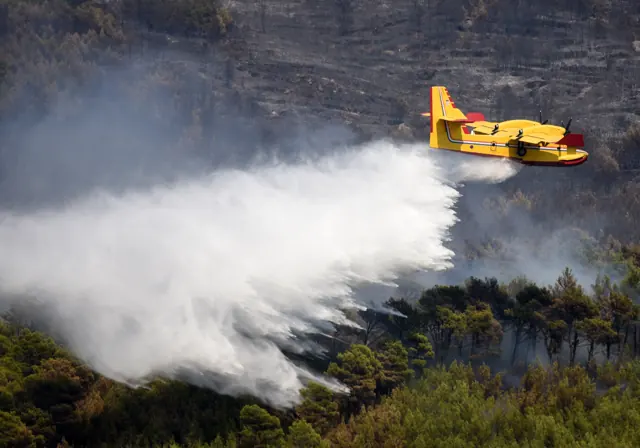
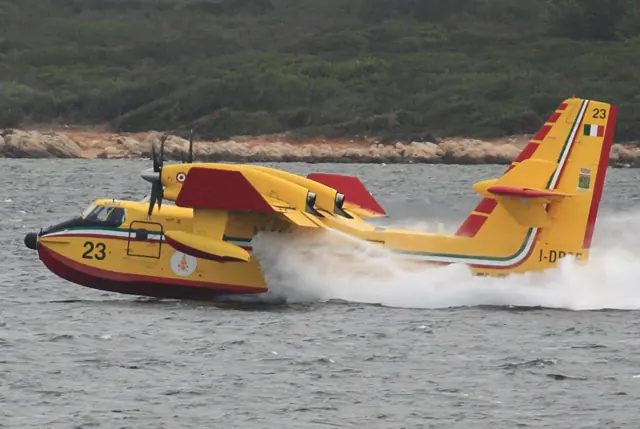
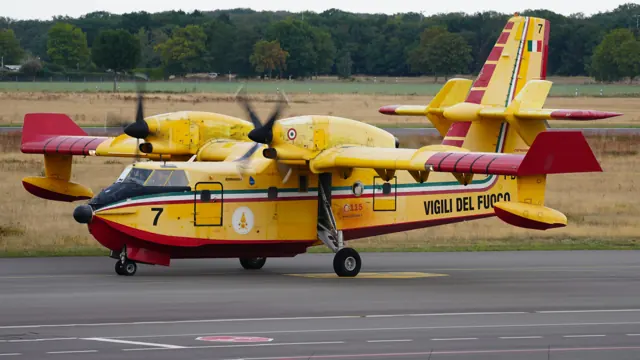
The CL-415 developed from Canadair's piston-engined CL-215. Turboprops and updated equipment retained the flying-boat layout: a boat hull, high wing and retractable landing gear. It was designed for aerial firefighting, with other utility and rescue roles also possible. Water collection and release equipment are fundamental parts of the aircraft rather than optional scenery.
Aircraft background
Wikipedia contributors · Read more ↗The intense flying she loved, and the waiting between calls
Crombez first watched CL-415s while training in Thunder Bay and set her sights on flying one. Bush flying and two seasons transporting firefighters in a Twin Otter preceded the opportunity. She remembered the water bomber’s intense flying with enthusiasm, but found the long periods on standby much harder: a quiet season could wear down a crew’s morale. The interview also describes the prejudice she encountered.
AeroTime interview · September 2022. Ontario CL-415 work beginning in 2014; earlier Twin Otter support flying is a separate assignment.
AeroTime · Read more ↗The original MSFS 2020 release
Microsoft’s September 2024 announcement offered the CL-415 for immediate use in MSFS 2020 as an MSFS 2024 preorder bonus. That dated entitlement does not establish a current standalone purchase option.
CL-415 · Microsoft Flight Simulator · MSFS 2020
Microsoft Flight Simulator Team · Read more ↗Into the cockpit
 YouTube
Cow Town · 26 min ·
Microsoft Flight Simulator | First flight in the De Havilland Canada CL-415!
A first flight with the CL-415 in Microsoft Flight Simulator.
Simulator · CL-415 · MSFS
Watch on YouTube ↗Preview images are served by AirframeDB. Videos open on YouTube only when you choose to watch.
Meet De Havilland Canada CL-415
The CL-415 developed from Canadair's piston-engined CL-215. Turboprops and updated equipment retained the flying-boat layout: a boat hull, high wing and retractable landing gear. It was designed for aerial firefighting, with other utility and rescue roles also possible.
The simulator combines the aircraft's systems with water collection, release and firefighting mission tools. The later DHC-515 is a separate development.
De Havilland Canada CL-415
De Havilland Canada → · Explore the family →
De Havilland Canada CL-415
Wikipedia contributors · Canadair CL-415 ↗Microsoft Flight Simulator · MSFS 2024 →Microsoft Flight Simulator · MSFS 2020 →Aircraft type designators
Use the code for the model you are flying. The linked authority lists the applicable aircraft.
History & design
A newer flight deck begins its test programme
De Havilland Canada reported a CL-415 flight with the Collins Pro Line Fusion upgrade at Abbotsford on 30 May 2022. Certification was still ahead in that announcement. The optional upgrade programme covered several firefighting variants; it does not establish that every CL-415 has the same cockpit.
De Havilland Canada · First flight of the CL-415 avionics upgrade ↗Manufacturer announcement · June 2022
Development milestones
First flight: 6 December 1993
Developed from: Canadair CL-215
Wikipedia contributors · Canadair CL-415 ↗Canadair CL-415 · family/variant named by the source · Wikipedia revision 1371109884
Pilot accounts
The intense flying she loved, and the waiting between calls
Crombez first watched CL-415s while training in Thunder Bay and set her sights on flying one. Bush flying and two seasons transporting firefighters in a Twin Otter preceded the opportunity. She remembered the water bomber’s intense flying with enthusiasm, but found the long periods on standby much harder: a quiet season could wear down a crew’s morale.
The interview also describes the prejudice she encountered. She said most colleagues treated her respectfully, while a few made the job difficult enough that she eventually moved to the airlines. She still valued what firefighting had taught her about handling an aircraft and making decisions quickly.
AeroTime interview · September 2022. Ontario CL-415 work beginning in 2014; earlier Twin Otter support flying is a separate assignment.
Read the full account · AeroTime ↗Seeing the people beneath the fire
During private-pilot training, Duclos would taxi past the water bombers and imagine flying them one day. Years later, the Palisades fires gave that ambition an unusually difficult setting. After an early drop, he saw roads crowded with people trying to leave and realised how many lives were caught beneath the smoke.
He described having little time to dwell on those thoughts while approaching rough water or preparing the next drop. The emotions returned afterwards, together with uncertainty about exactly whom the crews had helped. His account credits the firefighters on the ground and explains why fresh crews mattered during demanding missions.
The Pilot Project Podcast, episode 49 · 2025. CL-415 operations during the Palisades fires; selected passages from the publicly indexed automatic transcript.
Read the full account · The Pilot Project Podcast / Metacast ↗Reading a stretch of water before returning to it again
Chicha’s explanation to boaters makes the water surface part of the crew’s working environment. Before a pickup, pilots look over the area and signal their intended path. The aircraft may then return repeatedly, so a single pass does not mean that its work nearby is finished. The account focuses on the people sharing that space as much as the aircraft itself.
Crews train through the seasons and learn the characteristics of different lakes, rivers and coastal locations. The interview also describes the unwelcome complication of fast boats or jet skis trying to race an aircraft. Those encounters add an avoidable distraction to work already shaped by changing water conditions and the demands of the fire.
BoatNews interview with the Canadair sector manager at Nîmes. Page dated July 2026; a crew-work explanation, without a claimed personal flight date.
Read the full account · BoatNews ↗In your simulator
Systems, equipment and documentation for each developer’s aircraft.
Compare simulator versions →MSFS 2024CL-415
Microsoft Flight Simulator · Released
CL-415
Microsoft Flight Simulator · Released
MSFS 2020CL-415
Microsoft Flight Simulator · Released
CL-415
Microsoft Flight Simulator · Released
Aircraft specifications
Published figures for the named real-aircraft variant. Simulator equipment and performance can differ.
| Specification | Published value |
|---|---|
| Length | 20.4 m (66 ft 11 in) |
| Wingspan | 28.38 m (93.11 ft) |
| Height | 9.01 m (29.55 ft) |
| Wing area | 100 m² (1,080 sq ft) |
| Empty weight | 13,608 kg (30,000 lb) |
| Gross weight | 21,319 kg (47,000 lb) Maximum After-scooping Weight |
| Max takeoff weight | 19,890 kg (43,850 lb) Firefighting, Land |
| Powerplant | 2 × Pratt & Whitney Canada PW123AF turboprop , 1,775 kW (2,380 hp) each ISA+20 °C Flat rated |
| Propellers | 4-bladed Hamilton Sundstrand 14SF-19, 3.97 m (13 ft 0 in) diameter Fully reversible, feathering blades |
| Maximum speed | 359 km/h (223 mph, 194 kn) Max Cruise |
| Cruise speed | 333 km/h (207 mph, 180 kn) Normal Cruise |
| Stall speed | 126 km/h (78 mph, 68 kn) MLW, Landing Configuration |
| Rate of climb | 5.9 m/s (1,170 ft/min) (ISA, MTOW) |
Manuals & resources
Find your next read
Choose a topic for a short introduction and a link to the original source. Simulator references identify the developer and edition they cover.
Simulator documentation
The original MSFS 2020 releaseCL-415 · Microsoft Flight Simulator · MSFS 2020
Microsoft’s September 2024 announcement offered the CL-415 for immediate use in MSFS 2020 as an MSFS 2024 preorder bonus. That dated entitlement does not establish a current standalone purchase option.
2024-09-19 · release and package scope
Microsoft Flight Simulator Team · Read the source ↗Pilot account
The intense flying she loved, and the waiting between callsAeroTime interview · September 2022. Ontario CL-415 work beginning in 2014; earlier Twin Otter support flying is a separate assignment.
Crombez first watched CL-415s while training in Thunder Bay and set her sights on flying one. Bush flying and two seasons transporting firefighters in a Twin Otter preceded the opportunity. She remembered the water bomber’s intense flying with enthusiasm, but found the long periods on standby much harder: a quiet season could wear down a crew’s morale. The interview also describes the prejudice she encountered.
Emily Crombez
AeroTime · Read the source ↗Seeing the people beneath the fireThe Pilot Project Podcast, episode 49 · 2025. CL-415 operations during the Palisades fires; selected passages from the publicly indexed automatic transcript.
During private-pilot training, Duclos would taxi past the water bombers and imagine flying them one day. Years later, the Palisades fires gave that ambition an unusually difficult setting. After an early drop, he saw roads crowded with people trying to leave and realised how many lives were caught beneath the smoke. He described having little time to dwell on those thoughts while approaching rough water or preparing the next drop.
Pascal Duclos
The Pilot Project Podcast / Metacast · Read the source ↗Read the original documentation from the people who created it. Manuals open on their publisher’s website.
Manual
Microsoft Flight Simulator aircraft manualsMicrosoft / aircraft developersAircraft background
Canadair CL-415Wikipedia contributors · Research background · Wikipedia revision 1371109884 · retrieved 2026-09-12 First flight of the CL-415 avionics upgradeDe Havilland Canada · 1 June 2022Resource
MSFS 2024 FAQ and edition aircraft inventoryMicrosoftDeveloper documentation
Microsoft Flight Simulator 2024: The Many Enhancements That Make This the Most Ambitious Flight Sim EverMicrosoft Flight Simulator Team · 2024-09-19 · release and package scopeType designator
ICAO Doc 8643 — aircraft type designatorsInternational Civil Aviation Organization · Public search data retrieved 2026-09-14; authority update 2026-09-03Built-in force-feedback profiles
Read the documentary basis, editable starting settings and remaining questions for the aircraft you fly. Each explanation refers to the exact profile revision shown.
Catalogue programme-20261022-v1 · 1 profile choice
De Havilland Canada CL-415
Free and Pro · Revision 2 · Partial review
MSFS 2024 · MSFS 2020
De Havilland Canada CL-415: The chosen resistance supports the amphibious transport’s control input.
De Havilland Canada CL-415
De Havilland Canada CL-415: The chosen resistance supports the amphibious transport’s control input.
Aircraft and simulator scope
- De Havilland Canada CL-415 · MSFS 2024 · family starting point
- De Havilland Canada CL-415 · MSFS 2020 · family starting point
De Havilland Canada CL-415 · The 2006 Kelowna supplement concerns CL-415 autopilot/FMS installation K126-102-001-012. Microsoft's preorder page separately identifies a simulator CL-415.
The simulator model and controls
The CL-415 developed from Canadair's piston-engined CL-215. Turboprops and updated equipment retained the flying-boat layout: a boat hull, high wing and retractable landing gear. It was designed for aerial firefighting, with other utility and rescue roles also possible.
This starting point selects De Havilland Canada CL-415. Its aircraft-level settings do not select a particular developer’s custom systems.
How this profile feels
The chosen resistance supports the amphibious transport’s control input. Spring resistance builds with the selected airspeed response. A separate aerodynamic term adds speed-dependent control load.
Pitch relief responds to configured trim, separately from water-load changes. Valid trim provides the configured pressure relief. Autopilot following is enabled for supported control references.
Controls and trim
The CL-415 combines turboprops with the flying-boat hull and firefighting mission of the earlier CL-215 line. Water collection and release systems are part of its working configuration. Retractable landing gear allows runway operation alongside water-based work.
About the values
The gains are normalized profile settings. They describe the chosen effect balance; hand force depends on the device and its output limits. IAS references are tuning values rather than operating limits. Physical acceptance of this revision remains pending.
What the documentation establishes
The 2006 Kelowna supplement concerns CL-415 autopilot/FMS installation K126-102-001-012. Microsoft's preorder page separately identifies a simulator CL-415.
The supplement describes pitch-trim control of autopilot attitude and trim indications. It does not establish the simulator's manual-trim response.
The installation has elevator, aileron and rudder servos, an AFCS computer and touch-control-steering switches.
Documentary review and sources
These decisions describe the documentary basis and remaining gaps for this revision. Aircraft documentation and a starting setting describe different kinds of evidence.
Aircraft and variant
ReviewedThis starting point selects De Havilland Canada CL-415. Its aircraft-level settings do not select a particular developer’s custom systems.
Flight controls
Not yet reviewedThe CL-415 combines turboprops with the flying-boat hull and firefighting mission of the earlier CL-215 line. Water collection and release systems are part of its working configuration. Retractable landing gear allows runway operation alongside water-based work.
Trim
ReviewedPitch relief responds to configured trim, separately from water-load changes. Pitch authority 0.3 relieves permitted loading; hydraulic centre movement is off. Roll authority is 0.09.
Autopilot and stability
ReviewedFollowing is on at 0.1 authority when a supported, valid autopilot control reference is available.
Equipment
Not yet reviewedGear, flap and ground cues follow the selected settings and available simulator-reported states.
Speeds and limits
Not yet reviewedThe indicated-speed references set the profile response scale; they are separate from aircraft operating limits.
Simulator integration
Not yet reviewedThe profile targets msfs2024, msfs2020. Add-on-specific controls use only the supported references configured by this profile.
Force-feedback settings
Not yet reviewedThe settings define the profile’s effect balance. Device output limits affect physical hand force.
Starting settings and their rationale
These configured values are starting estimates. The explanations describe what each setting controls; physical validation appears separately below.
| Setting | Starting value | What it controls and why |
|---|---|---|
| Spring strength | Starting value0.8 | What it controls and whyThe chosen resistance supports the amphibious transport’s control input. The baseline spring is 0.8. Its low-speed blend reaches baseline strength at 82.5 KIAS. |
| Master force gain | Starting value0.85 | What it controls and whyScales overall profile strength while preserving effect balance, subject to device and output limits. |
| Profile force gain | Starting value0.25 | What it controls and whyThe aerodynamic-load gain is 0.25 with an indicated-speed reference of 165 KIAS. The hydraulic-load factor of 0.35 scales that modeled term; it is a selected artificial-feel approximation. |
| Force tuning speed/reference | Starting value165.0 kt | What it controls and whySets the IAS reference for aerodynamic loading. It is an estimate, not published cruise TAS or a flight limit. |
| Spring response reference speed | Starting value82.5 kt | What it controls and whySets the IAS where the low-speed blend reaches baseline strength; high-speed stiffening also uses it. |
| Aileron force scale | Starting value0.65 | What it controls and whyRoll and pitch aerodynamic scales are 0.65 and 0.65, respectively. They set the aerodynamic axis balance. No custom spring-travel curve is enabled. |
| Elevator force scale | Starting value0.65 | What it controls and whyScales pitch aerodynamic loading; pitch spring travel and trim responses are separate settings. |
| Trim feel | Starting valueEnabled | What it controls and whyRetained for compatibility and group membership. Trim relief, rather than this flag, controls centre movement. |
| Trim relief | Starting valueEnabled | What it controls and whyAllows trim relief with supported control law and valid telemetry. Axis authorities set its amount. |
| Autopilot follow | Starting valueEnabled | What it controls and whyFollowing is on at 0.1 authority when a supported, valid autopilot control reference is available. |
| Autopilot neutral hold | Starting valueDisabled | What it controls and whyPermits centering hold during a supported AP state, separate from following a moving target. |
| Output force limit | Starting value0.55 | What it controls and whyCaps directed-force output. Native spring effects and device limits remain separate. |
All 44 starting settings and their rationale
The settings define the profile’s effect balance. Device output limits affect physical hand force.
| Setting | Starting value | What it controls and why |
|---|---|---|
| Spring strength | Starting value0.8 | What it controls and whyThe chosen resistance supports the amphibious transport’s control input. The baseline spring is 0.8. Its low-speed blend reaches baseline strength at 82.5 KIAS. |
| Spring deadband | Starting value0.035 | What it controls and whySets travel around the centre before the baseline spring resists. Smaller values engage it sooner. |
| Profile force gain | Starting value0.25 | What it controls and whyThe aerodynamic-load gain is 0.25 with an indicated-speed reference of 165 KIAS. The hydraulic-load factor of 0.35 scales that modeled term; it is a selected artificial-feel approximation. |
| Master force gain | Starting value0.85 | What it controls and whyScales overall profile strength while preserving effect balance, subject to device and output limits. |
| QBlend Enabled | Starting valueEnabled | What it controls and whyAllows baseline spring strength to rise with indicated airspeed where the control law permits it. |
| QSpring Minimum Factor | Starting value0.55 | What it controls and whySets low-speed spring strength as a fraction of baseline when blending is enabled. One keeps full strength. |
| QSpring Start Knots | Starting value20 kt | What it controls and whySets the IAS where the low-speed spring blend starts rising. This is a feel threshold, not a flight limit. |
| Spring response reference speed | Starting value82.5 kt | What it controls and whySets the IAS where the low-speed blend reaches baseline strength; high-speed stiffening also uses it. |
| Force tuning speed/reference | Starting value165.0 kt | What it controls and whySets the IAS reference for aerodynamic loading. It is an estimate, not published cruise TAS or a flight limit. |
| Airspeed spring stiffening gain | Starting value0 | What it controls and whyThe high-speed spring-stiffening gain is 0. No additional speed-driven stiffening is added; this does not disable independent aerodynamic loading. |
| Airspeed spring stiffening limit | Starting value5 | What it controls and whyLimits the squared airspeed ratio used for high-speed spring stiffening; it is not a device-force cap. |
| Aileron force scale | Starting value0.65 | What it controls and whyRoll and pitch aerodynamic scales are 0.65 and 0.65, respectively. They set the aerodynamic axis balance. No custom spring-travel curve is enabled. |
| Elevator force scale | Starting value0.65 | What it controls and whyScales pitch aerodynamic loading; pitch spring travel and trim responses are separate settings. |
| Output force limit | Starting value0.55 | What it controls and whyCaps directed-force output. Native spring effects and device limits remain separate. |
| Trim feel | Starting valueEnabled | What it controls and whyRetained for compatibility and group membership. Trim relief, rather than this flag, controls centre movement. |
| Trim relief | Starting valueEnabled | What it controls and whyAllows trim relief with supported control law and valid telemetry. Axis authorities set its amount. |
| Elevator Authority | Starting value0.3 | What it controls and whyPitch relief responds to configured trim, separately from water-load changes. Pitch authority 0.3 relieves permitted loading; hydraulic centre movement is off. Roll authority is 0.09. |
| Aileron Authority | Starting value0.09 | What it controls and whyScales supported roll-trim relief and permitted centre movement. Zero removes roll response. |
| Force Trim Enabled | Starting valueDisabled | What it controls and whyEnables local force trim, separate from aircraft-owned trim and add-on integration qualification. |
| GLoad Enabled | Starting valueEnabled | What it controls and whyAllows load-factor changes to modify permitted spring laws. Passive fly-by-wire feel can suppress it. |
| Rate Damping Enabled | Starting valueEnabled | What it controls and whyEnables rate damping with the configured coefficients and control law. |
| Autopilot follow | Starting valueEnabled | What it controls and whyFollowing is on at 0.1 authority when a supported, valid autopilot control reference is available. |
| Autopilot follow authority | Starting value0.1 | What it controls and whySets admitted AP-follow gain, not a percentage of travel. Runtime ownership and input limits still apply. |
| Autopilot neutral hold | Starting valueDisabled | What it controls and whyPermits centering hold during a supported AP state, separate from following a moving target. |
| Autopilot neutral hold strength | Starting value0.6 | What it controls and whySets admitted AP neutral-hold strength; inactive while neutral hold is disabled. |
| Enabled | Starting valueEnabled | What it controls and whyEnables aerodynamic cues; each still needs nonzero strength and its simulator conditions. |
| Gain | Starting value0.3 | What it controls and whySets stall-buffet strength. Zero removes the cue without changing simulator stalls or warnings. |
| Gain | Starting value0 | What it controls and whySets high-Mach buffet strength; onset and full-strength thresholds are separate. |
| Gain | Starting value0.14 | What it controls and whySets flap buffet at the configured position and speed gates. Flap movement texture is separate. |
| Maximum flap index | Starting value3 | What it controls and whySets the final flap index for detent normalization. UP plus three detents uses maximum index3. |
| Minimum flap index | Starting value2 | What it controls and whySets the first flap detent that admits buffet; this is a handle index, not degrees. |
| Gain | Starting value0.1 | What it controls and whySets gear aerodynamic buffet; movement and ground-contact cues are separate. |
| Shaker Enabled | Starting valueEnabled | What it controls and whyPermits shaker at supported warning conditions; the switch does not establish aircraft equipment. |
| Stick shaker amplitude | Starting value0.9 | What it controls and whySets triggered shaker strength; inactive while the shaker feature is disabled. |
| Enabled | Starting valueEnabled | What it controls and whyEnables ground effects; each still needs its own strength and contact or motion telemetry. |
| Gain | Starting value0.4 | What it controls and whySets rolling texture strength, modified by speed, surface and undercarriage configuration. |
| Gain | Starting value0.32 | What it controls and whySets gear-bump texture during ground motion, separate from touchdown impact. |
| Gain | Starting value0.9 | What it controls and whySets landing-impact strength; landing telemetry and response shape determine the pulse. |
| Gain | Starting value0.5 | What it controls and whySets reverse-thrust vibration with valid reverser and engine conditions. Zero removes the cue. |
| Enabled | Starting valueEnabled | What it controls and whyEnables engine cues with nonzero settings and valid running-engine telemetry. |
| Gain | Starting value0.06 | What it controls and whySets estimated engine vibration using configured telemetry and response, not measured cockpit vibration. |
| Enabled | Starting valueEnabled | What it controls and whyEnables accessory cues with configured strengths and observed accessory movement. |
| Gain | Starting value0.12 | What it controls and whySets texture from observed flap movement; a command without movement does not establish the cue. |
| Gain | Starting value0.12 | What it controls and whySets texture from observed gear movement, separate from aerodynamic and touchdown effects. |
Limits and open questions
- Autopilot servos in the supplement do not establish the complete manual flight-control architecture or loading law.
- An autopilot-installation supplement does not establish wing-flap detents, wheel gear or propulsion cue details.
- Sample FMS display values are illustrative indications, not CL-415 speed limits or a tuning reference.
- Neither the maintenance supplement nor Microsoft's preorder announcement supplies simulator telemetry semantics.
- The installed AFCS architecture provides no wheel-force curve or water-contact vibration calibration.
- De Havilland Canada CL-415 documentary evidence does not establish force-feedback hardware acceptance.
Physical validation
No physical force validation is recorded in this public catalogue for this revision. Documentary review and software checks do not establish how a particular device feels.
Discuss this aircraft (0)
Questions, observations and useful sources from the community.
No published discussions yet. Bring a question or share a useful source.
Open aircraft discussions →Content expanded · What’s new
Something missing or a source that needs attention?
Suggest a correction ↗