

Start here
A few places to begin, from the aircraft’s story to the people who fly it.
Meet the aircraft
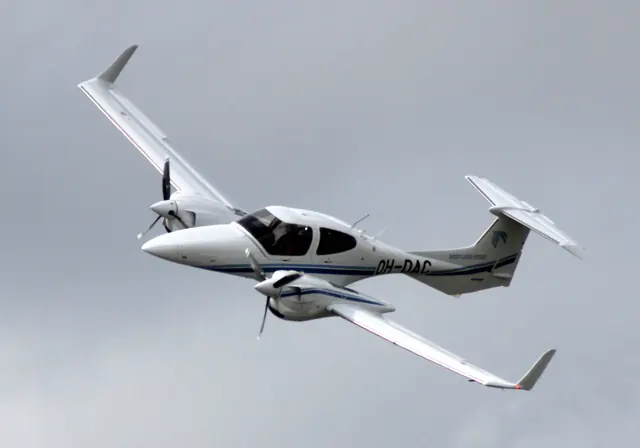
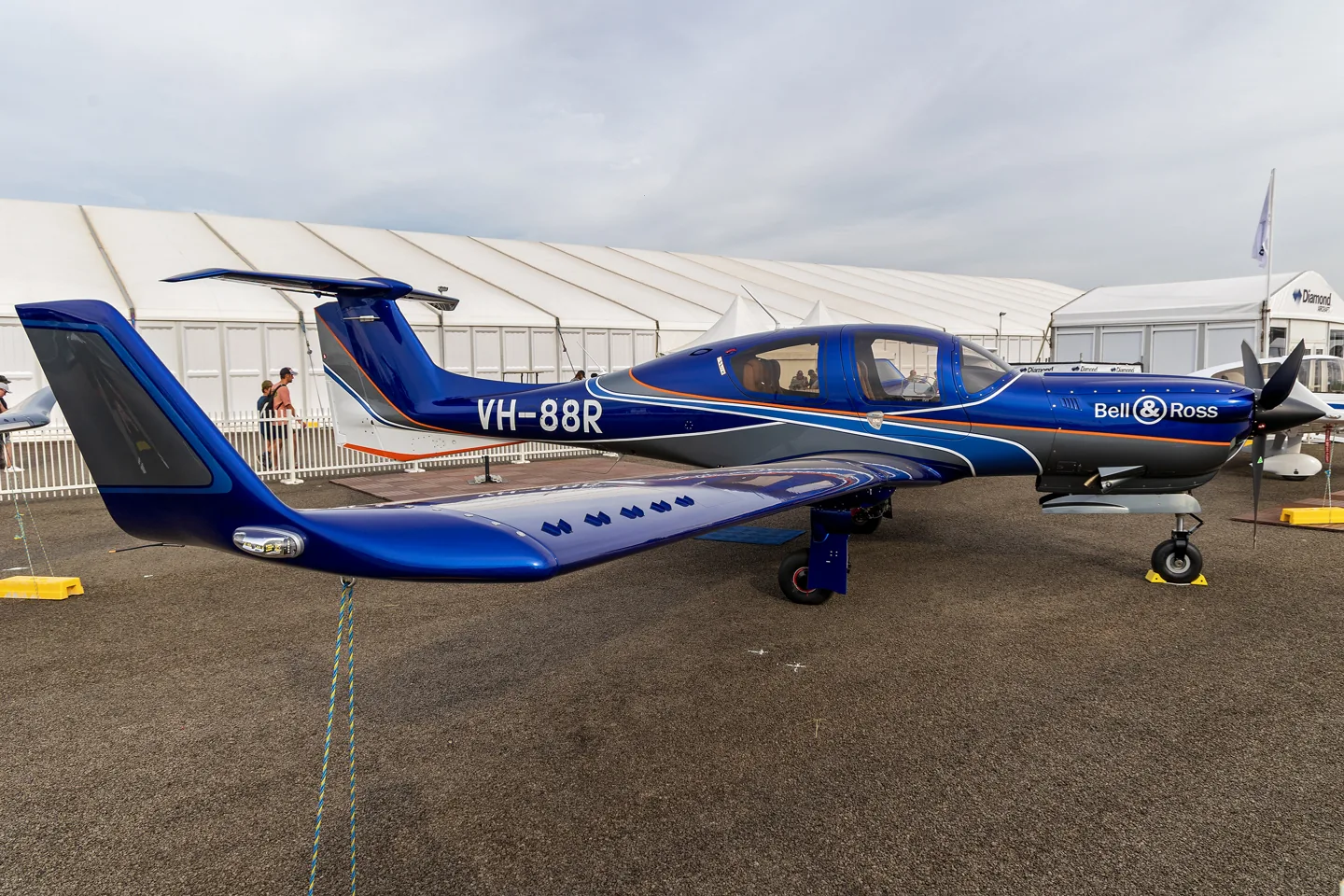
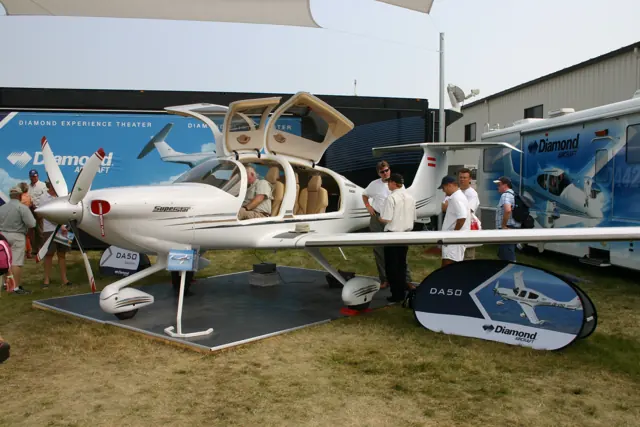
Diamond first presented the DA50 project in 2006 and flew it in April 2007. Several engine proposals formed part of its development history. Certification followed in 2020 with the Continental CD-300 diesel installation. The historical specifications distinguish the earlier prototypes from this later production configuration.
Aircraft background
Wikipedia contributors · Read more ↗A full cabin on the way back from Friedrichshafen
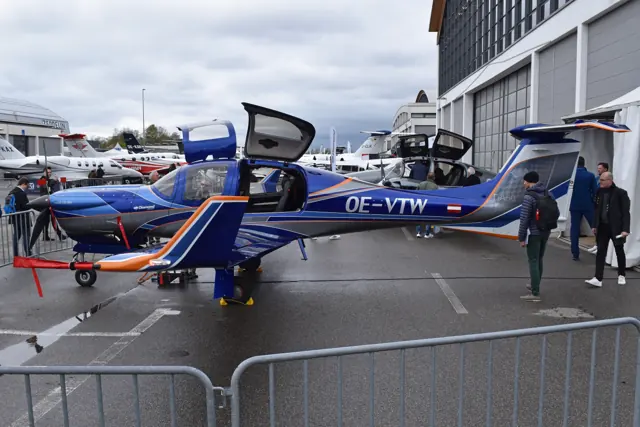
With four people and a large load of luggage aboard, Horne wondered how energetic the DA50 RG would feel leaving Friedrichshafen. The departure answered that question positively. Once airborne, the trip demanded attention to cloud layers, temperature and possible icing along the northern side of the Alps, with the autopilot carrying much of the climb and cruise workload.
AOPA Pilot · July 2022. Display aircraft OE-VTW flown to Wiener Neustadt with Martin Scherrer, two rear-seat passengers and luggage.
AOPA Pilot · Read more ↗The retractable single’s simulated systems
Aerobask’s DA50 RG models the Continental CD-300 configuration, with customised FADEC/ECU testing, oxygen, ice protection and functioning circuit breakers whose reliability can be configured. The cockpit combines an enhanced Laminar G1000 with custom engine displays, annunciations and a separately coded MD302 standby module.
Diamond DA50 · Aerobask · X-Plane 12
Aerobask · Read more ↗Into the cockpit
 YouTube
DiamondAircraftInd · 19 min ·
Flying the Diamond Aircraft DA50 RG
Diamond's demonstration pilots introduce the DA50 RG in flight.
Real aircraft · Diamond DA50
Watch on YouTube ↗Preview images are served by AirframeDB. Videos open on YouTube only when you choose to watch.
Meet Diamond DA50
Diamond first presented the DA50 project in 2006 and flew it in April 2007. Several engine proposals formed part of its development history. Certification followed in 2020 with the Continental CD-300 diesel installation. The historical specifications distinguish the earlier prototypes from this later production configuration.
Diamond DA50
Diamond Aircraft → · Explore the family →
Diamond DA50
Wikipedia contributors · Diamond DA50 ↗Aerobask · X-Plane 12 →Aircraft type designators
Use the code for the model you are flying. The linked authority lists the applicable aircraft.
History & design
A new engine direction in 2019
After reassessing the DA50 programme, Diamond selected Continental’s CD-300 diesel engine. The aircraft with that powerplant first flew on 22 March 2019, following ground tests earlier that month. This milestone belongs to that engine configuration, rather than the much earlier DA50 prototype.
Diamond Aircraft · Diamond Aircraft DA50 Program Changes and New Engine ↗Manufacturer’s April 2019 programme announcement
The retractable-gear version reaches the market
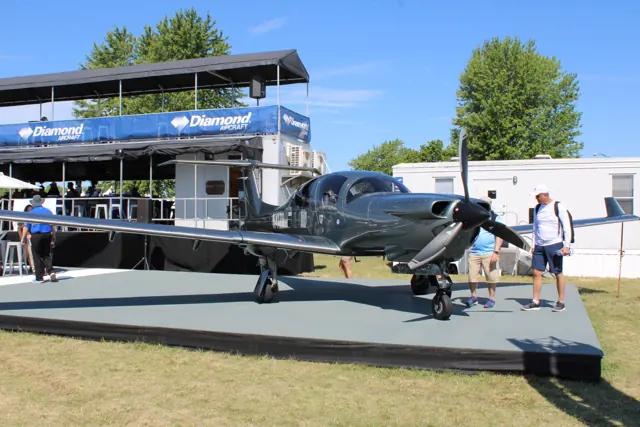
Diamond’s timeline places the five-seat DA50 RG and its type-certification milestone in 2020. Its retractable landing gear and later development history distinguish it from the earlier DA50 designs that carried different powerplants.
Diamond Aircraft · History: Unwavering Commitment to Innovation ↗Manufacturer’s 2020 timeline entry
Development milestones
First flight: 4 April 2007
Wikipedia contributors · Diamond DA50 ↗Diamond DA50 · family/variant named by the source · Wikipedia revision 1306006507
Pilot accounts
A full cabin on the way back from Friedrichshafen
With four people and a large load of luggage aboard, Horne wondered how energetic the DA50 RG would feel leaving Friedrichshafen. The departure answered that question positively. Once airborne, the trip demanded attention to cloud layers, temperature and possible icing along the northern side of the Alps, with the autopilot carrying much of the climb and cruise workload.
He compared power settings during level flight and watched the fuel flow change, then encountered traces of ice nearer the destination. The descent passed through snow and rain before a gentle landing at the factory airfield. The spacious cabin was a strong part of his favourable impression.
AOPA Pilot · July 2022. Display aircraft OE-VTW flown to Wiener Neustadt with Martin Scherrer, two rear-seat passengers and luggage.
Read the full account · AOPA Pilot ↗The ferry that connected his engineering work with the ocean
Wimmer had crossed the Atlantic repeatedly in Diamond twins, but this was his first crossing in a single-engine aircraft. His connection with the DA50 programme made the assignment personal. Preparations ranged from aircraft checks and survival equipment to weather, fuel stops and the additional travel restrictions of the pandemic. He approached the trip primarily as a ferry to be completed carefully.
The scenery at Vágar remained one of its highlights. He describes the Faroe Islands approach as both demanding and beautiful, even after earlier visits. The significance of the flight became especially tangible on arrival in London, Ontario, where factory staff gathered to welcome the aircraft. That reception was an emotional conclusion for someone who had first admired an earlier DA50 at Oshkosh years before joining Diamond.
Diamond Aircraft interview · August 2021. Company chief flight test engineer and test pilot describing the DA50 RG’s first North Atlantic ferry.
Read the full account · Diamond Aircraft / DiamondDiary ↗Long ocean legs and a Hawaiian pause
Niederhäuser describes a Pacific crossing shaped by islands, pandemic restrictions and the weather. Ground support sent updates while the crew managed long stretches over water, including a diversion around reported thunderstorm activity. Crossing the date line produced the unusual pleasure of seeing a second sunrise on the same calendar date. A mistaken helicopter call from Honolulu controllers briefly lightened the mood.
Hawaii brought a welcome change of pace. Short island flights let the pilots enjoy hand-flying, coastal scenery and volcanic landscapes while they waited for conditions for the final ocean leg. Additional fuel was loaded for the departure to California, and survival suits stayed on as the water below grew colder.
Pilot’s account hosted by Diamond Aircraft · March 2022. Diamondo Earthrounding’s HB-RTT, flown with Robin and equipped with additional ferry fuel tanks.
Read the full account · Diamond Aircraft / DiamondDiary ↗In your simulator
Systems, equipment and documentation for each developer’s aircraft.
Compare simulator versions →X-Plane 12Diamond DA50
Aerobask · Released
Diamond DA50
Aerobask · Released
MSFS 2020 · MSFS 2024 (retailer-listed compatibility)Diamond DA50 RG
Skyward Simulations · Released
Diamond DA50 RG
Skyward Simulations · Released
Aircraft specifications
Published figures for the named real-aircraft variant. Simulator equipment and performance can differ.
| Specification | Published value |
|---|---|
| Length | 9.23 m (30 ft 3 in) |
| Wingspan | 13.41 m (44 ft 0 in) |
| Height | 2.88 m (9 ft 5 in) |
| Empty weight | 1,440 kg (3,175 lb) |
| Max takeoff weight | 2,000 kg (4,409 lb) |
| Powerplant | 1 × Continental CD-300 turbocharged, FADEC controlled jet fuel engine, 224 kW (300 hp) |
| Propellers | 3-bladed MT-Propeller MTV-12-D/210-56 |
| Maximum speed | 335 km/h (208 mph, 181 kn) (ISA, 16,000 ft, 1,700 kg, MCP) |
| Stall speed | 106 km/h (66 mph, 57 kn) landing configuration |
| Range | 1,389 km (863 mi, 750 nmi) incl. 30 min. reserve |
| Service ceiling | 6,096 m (20,000 ft) |
| Rate of climb | 5.3 m/s (1,040 ft/min) |
Manuals & resources
Find your next read
Choose a topic for a short introduction and a link to the original source. Simulator references identify the developer and edition they cover.
Simulator documentation
The retractable single’s simulated systemsDiamond DA50 · Aerobask · X-Plane 12
Aerobask’s DA50 RG models the Continental CD-300 configuration, with customised FADEC/ECU testing, oxygen, ice protection and functioning circuit breakers whose reliability can be configured. The cockpit combines an enhanced Laminar G1000 with custom engine displays, annunciations and a separately coded MD302 standby module.
Gathered developer page · X-Plane 12 listing; revision not stated
Aerobask · Read the source ↗Personalise the cabin and follow the weatherDiamond DA50 · Aerobask · X-Plane 12
Pilots, passengers and luggage can be configured, and the package saves many settings between flights. The developer specifies wing icing visuals and windshield reflections, with rain and frost limited to the X-Plane 12 version. Synthetic vision is credited to OscarPilote and the FMOD sound environment to Daniela Rodriguez Careri.
Aerobask’s documented package features
Aerobask · Read the source ↗Pilot account
A full cabin on the way back from FriedrichshafenAOPA Pilot · July 2022. Display aircraft OE-VTW flown to Wiener Neustadt with Martin Scherrer, two rear-seat passengers and luggage.
With four people and a large load of luggage aboard, Horne wondered how energetic the DA50 RG would feel leaving Friedrichshafen. The departure answered that question positively. Once airborne, the trip demanded attention to cloud layers, temperature and possible icing along the northern side of the Alps, with the autopilot carrying much of the climb and cruise workload.
Thomas A. Horne
AOPA Pilot · Read the source ↗The ferry that connected his engineering work with the oceanDiamond Aircraft interview · August 2021. Company chief flight test engineer and test pilot describing the DA50 RG’s first North Atlantic ferry.
Wimmer had crossed the Atlantic repeatedly in Diamond twins, but this was his first crossing in a single-engine aircraft. His connection with the DA50 programme made the assignment personal. Preparations ranged from aircraft checks and survival equipment to weather, fuel stops and the additional travel restrictions of the pandemic. He approached the trip primarily as a ferry to be completed carefully. The scenery at Vágar remained one of its highlights.
Thomas Wimmer
Diamond Aircraft / DiamondDiary · Read the source ↗Developer documentation
Diamond DA50 RG — product listingDiamond DA50 RG · MSFS 2020 · MSFS 2024 (retailer-listed compatibility)
Product listing captured 2026-09-30; edition scope from the reviewed catalogue
Orbx · Read the source ↗Read the original documentation from the people who created it. Manuals open on their publisher’s website.
Aircraft background
Diamond DA50Wikipedia contributors · Research background · retrieved 2026-09-12 Diamond Aircraft DA50 Program Changes and New EngineDiamond Aircraft · 10 April 2019 · CD-300 development programme History: Unwavering Commitment to InnovationDiamond Aircraft · Manufacturer’s historical timeline · retrieved September 2026Product
DA50 RGAerobask · Official developer / designated store catalogue · checked 2026-09-12 Skyward Simulations DA-50RG - OrbxOrbx · Product listing captured 2026-09-30; edition scope from the reviewed catalogueType designator
ICAO Doc 8643 — aircraft type designatorsInternational Civil Aviation Organization · Public search data retrieved 2026-09-14; authority update 2026-09-03Built-in force-feedback profiles
Read the documentary basis, editable starting settings and remaining questions for the aircraft you fly. Each explanation refers to the exact profile revision shown.
Catalogue programme-20261022-v1 · 3 profile choices
Aerobask DA50 RG
Aerobask · Free and Pro · Revision 4 · Inherited starting point
X-Plane 12
Aerobask DA50 RG: Pushrod controls motivate reversible aircraft loading.
Skyward Simulations Diamond DA50 RG
Skyward Simulations · Free and Pro · Revision 3 · Inherited starting point
MSFS 2020 · MSFS 2024
Skyward Simulations Diamond DA50 RG: Pushrod controls motivate reversible aircraft loading.
Diamond DA50
Free and Pro · Revision 2 · Partial review
X-Plane 12
Diamond DA50: Pushrod controls motivate reversible aircraft loading.
Skyward Simulations Diamond DA50 RG
Skyward Simulations Diamond DA50 RG: Pushrod controls motivate reversible aircraft loading.
Aircraft and simulator scope
- Skyward Simulations Diamond DA50 RG · Skyward Simulations · MSFS 2020 · Add-on starting point
- Skyward Simulations Diamond DA50 RG · Skyward Simulations · MSFS 2024 · Add-on starting point
The simulator model and controls
Diamond first presented the DA50 project in 2006 and flew it in April 2007. Several engine proposals formed part of its development history. Certification followed in 2020 with the Continental CD-300 diesel installation. The historical specifications distinguish the earlier prototypes from this later production configuration.
This profile selects Skyward Simulations Diamond DA50 RG for MSFS 2020, MSFS 2024.
How this profile feels
Pushrod controls motivate reversible aircraft loading. Spring resistance builds with the selected airspeed response. A separate aerodynamic term adds speed-dependent control load.
The trim wheel supplies pitch context; rudder trim belongs to the yaw axis. Valid trim provides the configured pressure relief. Autopilot following is off.
Controls and trim
The DA50 RG uses a CD300 diesel piston engine and retractable landing gear. The flight manual identifies elevator pushrods, a pitch-trim wheel and separate rudder trim. Aerobask and MSFS products document their own FADEC, display and equipment fits.
The selected implementation
Skyward’s DA50 RG documents the 300-hp diesel, custom ECU/TKS and G1000 NXi equipment.
About the values
The gains are normalized profile settings. They describe the chosen effect balance; hand force depends on the device and its output limits. IAS references are tuning values rather than operating limits. Physical acceptance of this revision remains pending.
Documentary review and sources
These decisions describe the documentary basis and remaining gaps for this revision. Aircraft documentation and a starting setting describe different kinds of evidence.
Aircraft and variant
InheritedThis profile selects Skyward Simulations Diamond DA50 RG for MSFS 2020, MSFS 2024.
Flight controls
InheritedThe DA50 RG uses a CD300 diesel piston engine and retractable landing gear. The flight manual identifies elevator pushrods, a pitch-trim wheel and separate rudder trim. Aerobask and MSFS products document their own FADEC, display and equipment fits.
Trim
InheritedThe trim wheel supplies pitch context; rudder trim belongs to the yaw axis. Pitch authority 0.3 provides load relief and permitted centre movement; roll authority is 0.
Autopilot and stability
InheritedAutopilot following is off; the configured spring and load retain the hardware feel.
Equipment
InheritedSkyward’s DA50 RG documents the 300-hp diesel, custom ECU/TKS and G1000 NXi equipment.
Speeds and limits
InheritedThe indicated-speed references set the profile response scale; they are separate from aircraft operating limits.
Simulator integration
InheritedThe profile targets msfs2020, msfs2024. Add-on-specific controls use only the supported references configured by this profile.
Force-feedback settings
InheritedThe settings define the profile’s effect balance. Device output limits affect physical hand force.
Starting settings and their rationale
These configured values are starting estimates. The explanations describe what each setting controls; physical validation appears separately below.
| Setting | Starting value | What it controls and why |
|---|---|---|
| Spring strength | Starting value0.74 | What it controls and whyPushrod controls motivate reversible aircraft loading. The baseline spring is 0.74. Low-speed spring blending is off. |
| Master force gain | Starting value0.85 | What it controls and whyScales overall profile strength while preserving effect balance, subject to device and output limits. |
| Profile force gain | Starting value0.8 | What it controls and whyThe aerodynamic-load gain is 0.8 with an indicated-speed reference of 150 KIAS. This supplies speed-dependent loading alongside the spring. |
| Force tuning speed/reference | Starting value150 kt | What it controls and whySets the IAS reference for aerodynamic loading. It is an estimate, not published cruise TAS or a flight limit. |
| Spring response reference speed | Starting value65 kt | What it controls and whySets the IAS where the low-speed blend reaches baseline strength; high-speed stiffening also uses it. |
| Aileron force scale | Starting value0.8 | What it controls and whyRoll and pitch aerodynamic scales are 0.8 and 1, respectively. They set the aerodynamic axis balance. No custom spring-travel curve is enabled. |
| Elevator force scale | Starting value1 | What it controls and whyScales pitch aerodynamic loading; pitch spring travel and trim responses are separate settings. |
| Trim feel | Starting valueDisabled | What it controls and whyRetained for compatibility and group membership. Trim relief, rather than this flag, controls centre movement. |
| Trim relief | Starting valueEnabled | What it controls and whyAllows trim relief with supported control law and valid telemetry. Axis authorities set its amount. |
| Autopilot follow | Starting valueDisabled | What it controls and whyAutopilot following is off; the configured spring and load retain the hardware feel. |
| Autopilot neutral hold | Starting valueDisabled | What it controls and whyPermits centering hold during a supported AP state, separate from following a moving target. |
| Output force limit | Starting value0.55 | What it controls and whyCaps directed-force output. Native spring effects and device limits remain separate. |
All 44 starting settings and their rationale
The settings define the profile’s effect balance. Device output limits affect physical hand force.
| Setting | Starting value | What it controls and why |
|---|---|---|
| Spring strength | Starting value0.74 | What it controls and whyPushrod controls motivate reversible aircraft loading. The baseline spring is 0.74. Low-speed spring blending is off. |
| Spring deadband | Starting value0.04 | What it controls and whySets travel around the centre before the baseline spring resists. Smaller values engage it sooner. |
| Profile force gain | Starting value0.8 | What it controls and whyThe aerodynamic-load gain is 0.8 with an indicated-speed reference of 150 KIAS. This supplies speed-dependent loading alongside the spring. |
| Master force gain | Starting value0.85 | What it controls and whyScales overall profile strength while preserving effect balance, subject to device and output limits. |
| QBlend Enabled | Starting valueDisabled | What it controls and whyAllows baseline spring strength to rise with indicated airspeed where the control law permits it. |
| QSpring Minimum Factor | Starting value0.55 | What it controls and whySets low-speed spring strength as a fraction of baseline when blending is enabled. One keeps full strength. |
| QSpring Start Knots | Starting value8 kt | What it controls and whySets the IAS where the low-speed spring blend starts rising. This is a feel threshold, not a flight limit. |
| Spring response reference speed | Starting value65 kt | What it controls and whySets the IAS where the low-speed blend reaches baseline strength; high-speed stiffening also uses it. |
| Force tuning speed/reference | Starting value150 kt | What it controls and whySets the IAS reference for aerodynamic loading. It is an estimate, not published cruise TAS or a flight limit. |
| Airspeed spring stiffening gain | Starting value0.15 | What it controls and whyThe high-speed spring-stiffening gain is 0.15. It strengthens the permitted spring response above 65 KIAS, with the squared-speed ratio capped at 5. |
| Airspeed spring stiffening limit | Starting value5 | What it controls and whyLimits the squared airspeed ratio used for high-speed spring stiffening; it is not a device-force cap. |
| Aileron force scale | Starting value0.8 | What it controls and whyRoll and pitch aerodynamic scales are 0.8 and 1, respectively. They set the aerodynamic axis balance. No custom spring-travel curve is enabled. |
| Elevator force scale | Starting value1 | What it controls and whyScales pitch aerodynamic loading; pitch spring travel and trim responses are separate settings. |
| Output force limit | Starting value0.55 | What it controls and whyCaps directed-force output. Native spring effects and device limits remain separate. |
| Trim feel | Starting valueDisabled | What it controls and whyRetained for compatibility and group membership. Trim relief, rather than this flag, controls centre movement. |
| Trim relief | Starting valueEnabled | What it controls and whyAllows trim relief with supported control law and valid telemetry. Axis authorities set its amount. |
| Elevator Authority | Starting value0.3 | What it controls and whyThe trim wheel supplies pitch context; rudder trim belongs to the yaw axis. Pitch authority 0.3 provides load relief and permitted centre movement; roll authority is 0. |
| Aileron Authority | Starting value0 | What it controls and whyScales supported roll-trim relief and permitted centre movement. Zero removes roll response. |
| Force Trim Enabled | Starting valueDisabled | What it controls and whyEnables local force trim, separate from aircraft-owned trim and add-on integration qualification. |
| GLoad Enabled | Starting valueEnabled | What it controls and whyAllows load-factor changes to modify permitted spring laws. Passive fly-by-wire feel can suppress it. |
| Rate Damping Enabled | Starting valueEnabled | What it controls and whyEnables rate damping with the configured coefficients and control law. |
| Autopilot follow | Starting valueDisabled | What it controls and whyAutopilot following is off; the configured spring and load retain the hardware feel. |
| Autopilot follow authority | Starting value0.1 | What it controls and whySets admitted AP-follow gain, not a percentage of travel. Runtime ownership and input limits still apply. |
| Autopilot neutral hold | Starting valueDisabled | What it controls and whyPermits centering hold during a supported AP state, separate from following a moving target. |
| Autopilot neutral hold strength | Starting value0.6 | What it controls and whySets admitted AP neutral-hold strength; inactive while neutral hold is disabled. |
| Enabled | Starting valueEnabled | What it controls and whyEnables aerodynamic cues; each still needs nonzero strength and its simulator conditions. |
| Gain | Starting value0.35 | What it controls and whySets stall-buffet strength. Zero removes the cue without changing simulator stalls or warnings. |
| Gain | Starting value0 | What it controls and whySets high-Mach buffet strength; onset and full-strength thresholds are separate. |
| Gain | Starting value0 | What it controls and whySets flap buffet at the configured position and speed gates. Flap movement texture is separate. |
| Maximum flap index | Starting value3 | What it controls and whySets the final flap index for detent normalization. UP plus three detents uses maximum index3. |
| Minimum flap index | Starting value2 | What it controls and whySets the first flap detent that admits buffet; this is a handle index, not degrees. |
| Gain | Starting value0 | What it controls and whySets gear aerodynamic buffet; movement and ground-contact cues are separate. |
| Shaker Enabled | Starting valueDisabled | What it controls and whyPermits shaker at supported warning conditions; the switch does not establish aircraft equipment. |
| Stick shaker amplitude | Starting value0.5 | What it controls and whySets triggered shaker strength; inactive while the shaker feature is disabled. |
| Enabled | Starting valueEnabled | What it controls and whyEnables ground effects; each still needs its own strength and contact or motion telemetry. |
| Gain | Starting value0.4 | What it controls and whySets rolling texture strength, modified by speed, surface and undercarriage configuration. |
| Gain | Starting value0.25 | What it controls and whySets gear-bump texture during ground motion, separate from touchdown impact. |
| Gain | Starting value0.65 | What it controls and whySets landing-impact strength; landing telemetry and response shape determine the pulse. |
| Gain | Starting value0 | What it controls and whySets reverse-thrust vibration with valid reverser and engine conditions. Zero removes the cue. |
| Enabled | Starting valueEnabled | What it controls and whyEnables engine cues with nonzero settings and valid running-engine telemetry. |
| Gain | Starting value0.12 | What it controls and whySets estimated engine vibration using configured telemetry and response, not measured cockpit vibration. |
| Enabled | Starting valueEnabled | What it controls and whyEnables accessory cues with configured strengths and observed accessory movement. |
| Gain | Starting value0.12 | What it controls and whySets texture from observed flap movement; a command without movement does not establish the cue. |
| Gain | Starting value0.025 | What it controls and whySets texture from observed gear movement, separate from aerodynamic and touchdown effects. |
Limits and open questions
- Mechanical stick with centering retained at zero airspeed. Modest q-loading is an estimate; the one-sided elevator pull-spring is not represented as a measured asymmetric force.
- Estimated pitch-only trim-tab relief. Rudder trim controls yaw, not roll; no aileron-trim neutral invented.
- G1000NXi integration does not establish calibrated Skyward GFC700 servo demand. Follow/hold disabled.
- Standard telemetry only; no customECU/TKS/failure variables inferred. ManufacturerAFM mirror review is labelled separately from original downloaded documents.
- 150 KIAS is an estimated control-feel reference, not cruise TAS, V-speeds or an operating limit.
- Spring 0.74, lateral scale 0.8, trim relief 0.18/0; editable estimates, not measured hand forces.
- Physical and installed-aircraft checks are deferred. Save this profile as the aircraft default if telemetry omits its developer or configuration.
- Only actual accessory-position changes drive movement textures. No pressure-dependent failures, guessed servo outputs or input compensation.
Physical validation
No physical force validation is recorded in this public catalogue for this revision. Documentary review and software checks do not establish how a particular device feels.
Discuss this aircraft (0)
Questions, observations and useful sources from the community.
No published discussions yet. Bring a question or share a useful source.
Open aircraft discussions →Content expanded · What’s new
Something missing or a source that needs attention?
Suggest a correction ↗