
Start here
A few places to begin, from the aircraft’s story to the people who fly it.
Meet the aircraft
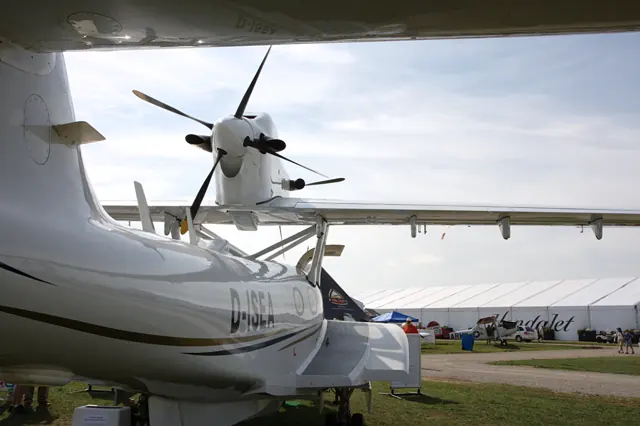
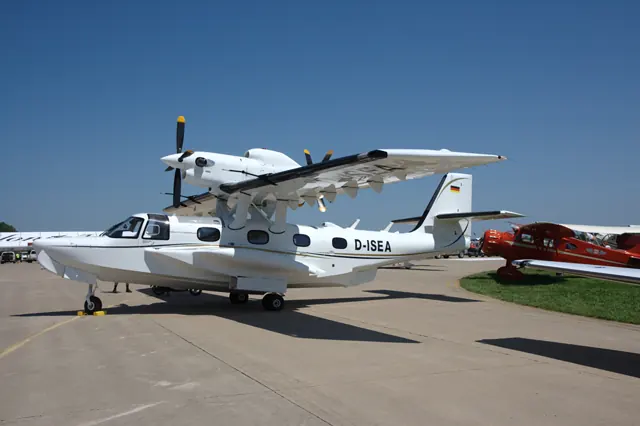
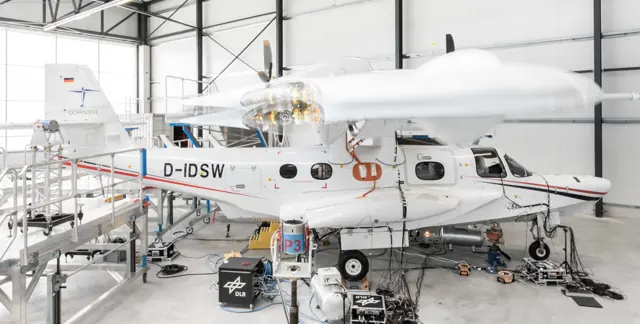
The Seastar uses two turboprops in a tandem tractor-and-pusher installation above the fuselage. Its boat hull and stabilising sponsons follow a recognisable Dornier flying-boat tradition, while retractable landing gear allows runway operations as well. The programme has had a long development history since its first flight in the 1980s. Its layout is a useful contrast with aircraft that place one engine on each wing.
Aircraft background
Wikipedia contributors · Read more ↗A landing offshore becomes a conversation with the chairman
McClellan’s introduction to the Seastar included landing a few miles off Florida in the Gulf of Mexico. With the engines shut down, the group sat above the cabin enjoying the view and wishing they had brought a fishing rod. The aircraft had become a place to spend time on the water. Company chief Joe Walker telephoned chairman Conrado Dornier, who answered from Europe and remarked on the boat beneath them.
FLYING · January 2010. Earlier Seastar off Florida; summary uses the publicly accessible opening of his report, not the restricted remainder.
FLYING · Read more ↗Into the cockpit
 YouTube
Dornier Seawings · 2 min ·
First Flight of MSN1004 Seastar Prototype
Dornier Seawings shares the first flight of its MSN1004 Seastar prototype.
Real aircraft · Dornier Seastar
Watch on YouTube ↗Preview images are served by AirframeDB. Videos open on YouTube only when you choose to watch.
Meet Dornier Seastar
The Seastar uses two turboprops in a tandem tractor-and-pusher installation above the fuselage. Its boat hull and stabilising sponsons follow a recognisable Dornier flying-boat tradition, while retractable landing gear allows runway operations as well.
The programme has had a long development history since its first flight in the 1980s. The simulator manual identifies the equipment modelled, with prototypes and later developments described separately.
Dornier Seastar
Dornier → · Explore the family →
Dornier Seastar
Wikipedia contributors · Dornier Seastar ↗Microsoft Flight Simulator · MSFS 2024 →Aircraft type designators
Use the code for the model you are flying. The linked authority lists the applicable aircraft.
History & design
Development milestones
Designer: Claudius Dornier Jr
First flight: 17 August 1984
Wikipedia contributors · Dornier Seastar ↗Dornier Seastar · family/variant named by the source · Wikipedia revision 1362414308
Pilot accounts
A landing offshore becomes a conversation with the chairman
McClellan’s introduction to the Seastar included landing a few miles off Florida in the Gulf of Mexico. With the engines shut down, the group sat above the cabin enjoying the view and wishing they had brought a fishing rod. The aircraft had become a place to spend time on the water.
Company chief Joe Walker telephoned chairman Conrado Dornier, who answered from Europe and remarked on the boat beneath them. For McClellan, an aviation writer, that was the revealing part of the exchange. Sitting offshore made the hull’s role immediate and tangible: he was experiencing an aircraft whose usefulness on the water was central to the trip, rather than simply a way to reach a runway.
FLYING · January 2010. Earlier Seastar off Florida; summary uses the publicly accessible opening of his report, not the restricted remainder.
Read the full account · FLYING ↗An experienced demonstrator explains the tradeoffs on the water
Holcombe described being comfortable flying the Seastar from choppy water, where only small corrections had been needed to maintain its attitude on the step. That experience also made him relaxed about letting a less experienced seaplane pilot try the aircraft. His enthusiasm came through strongly in the interview.
He still acknowledged a practical difference from twins with engines spread across the wings. The Seastar’s centreline arrangement could not use asymmetric thrust in the same way for manoeuvring on the water. For him, the water rudder and appropriate training made that a manageable tradeoff. These are the favourable impressions of a company representative who had flown the aircraft, tied to the conditions and configuration he described.
Peter Pigott, Wings · April 2010. Dornier sales and marketing head with firsthand Seastar water-operation experience; earlier CD2, not the 2020 new-generation prototype.
Read the full account · Wings ↗A new cockpit accompanies a familiar favourable impression
Cornelius reported a successful first flight for the new-generation Seastar after its crew spent thirty-one minutes airborne from Oberpfaffenhofen. He described pleasant handling and said the systems had functioned correctly during the outing. The updated avionics also stood out in his short assessment of the cockpit.
The aircraft represented another stage in a programme with much older roots. Dornier’s release described changes that included a digital flight deck, revised propellers and additional equipment, distinguishing this prototype from the earlier Seastar. Cornelius’s comments provide the crew’s initial response to that particular flight. The release contains no longer operational evaluation.
Dornier Seawings first-flight report · March 2020. New-generation prototype SN1003 at Oberpfaffenhofen; brief chief-test-pilot remarks relayed by the manufacturer.
Read the full account · Dornier Seawings ↗In your simulator
Systems, equipment and documentation for each developer’s aircraft.
MSFS 2024Seastar
Microsoft Flight Simulator · Released
Seastar
Microsoft Flight Simulator · Released
Aircraft specifications
Published figures for the named real-aircraft variant. Simulator equipment and performance can differ.
| Specification | Published value |
|---|---|
| Length | 12.70 m (41 ft 8 in) |
| Wingspan | 17.74 m (58 ft 2 in) |
| Height | 4.83 m (15 ft 10 in) |
| Wing area | 30.6 m² (329 sq ft) |
| Empty weight | 2,900 kg (6,393 lb) |
| Max takeoff weight | 4,600 kg (10,141 lb) |
| Powerplant | 2 × Pratt & Whitney Canada PT6 A-112/A135A turboprop, 478 kW (650 shp) each |
| Propellers | 4-bladed McCauley 4HFR34C760/95DA (Five-blade MT-Propellers on new Gen), 2.4 m (7 ft 10 in) diameter front, 2.35m aft |
| Cruise speed | 330 km/h (210 mph, 180 kn) |
| Stall speed | 120 km/h (75 mph, 65 kn) flaps 40° |
| Service ceiling | 4,500 m (14,800 ft) |
Manuals & resources
Find your next read
Choose a topic for a short introduction and a link to the original source. Simulator references identify the developer and edition they cover.
Pilot account
A landing offshore becomes a conversation with the chairmanFLYING · January 2010. Earlier Seastar off Florida; summary uses the publicly accessible opening of his report, not the restricted remainder.
McClellan’s introduction to the Seastar included landing a few miles off Florida in the Gulf of Mexico. With the engines shut down, the group sat above the cabin enjoying the view and wishing they had brought a fishing rod. The aircraft had become a place to spend time on the water. Company chief Joe Walker telephoned chairman Conrado Dornier, who answered from Europe and remarked on the boat beneath them. For McClellan, an aviation writer, that was the revealing part of the exchange.
J. Mac McClellan
FLYING · Read the source ↗An experienced demonstrator explains the tradeoffs on the waterPeter Pigott, Wings · April 2010. Dornier sales and marketing head with firsthand Seastar water-operation experience; earlier CD2, not the 2020 new-generation prototype.
Holcombe described being comfortable flying the Seastar from choppy water, where only small corrections had been needed to maintain its attitude on the step. That experience also made him relaxed about letting a less experienced seaplane pilot try the aircraft. His enthusiasm came through strongly in the interview. He still acknowledged a practical difference from twins with engines spread across the wings.
Jim Holcombe
Wings · Read the source ↗Read the original documentation from the people who created it. Manuals open on their publisher’s website.
Manual
Microsoft Flight Simulator aircraft manualsMicrosoft / aircraft developersAircraft background
Dornier SeastarWikipedia contributors · Research background · Wikipedia revision 1362414308 · retrieved 2026-09-12Resource
MSFS 2024 FAQ and edition aircraft inventoryMicrosoftType designator
ICAO Doc 8643 — aircraft type designatorsInternational Civil Aviation Organization · Public search data retrieved 2026-09-14; authority update 2026-09-03Built-in force-feedback profiles
Read the documentary basis, editable starting settings and remaining questions for the aircraft you fly. Each explanation refers to the exact profile revision shown.
Catalogue programme-20261022-v1 · 1 profile choice
Dornier Seastar
Free and Pro · Revision 2 · Partial review
MSFS 2024
Dornier Seastar: The profile supplies the chosen amphibious-aircraft control resistance.
Dornier Seastar
Dornier Seastar: The profile supplies the chosen amphibious-aircraft control resistance.
Aircraft and simulator scope
- Dornier Seastar · MSFS 2024 · family starting point
Dornier Seastar · The preserved EASA.A.640 issue 1 dated April 2017 concerns Seastar CD2 and has unresolved production notes; it is historical type evidence, not a current simulator release statement.
The simulator model and controls
The Seastar uses two turboprops in a tandem tractor-and-pusher installation above the fuselage. Its boat hull and stabilising sponsons follow a recognisable Dornier flying-boat tradition, while retractable landing gear allows runway operations as well.
This starting point selects Dornier Seastar. Its aircraft-level settings do not select a particular developer’s custom systems.
How this profile feels
The profile supplies the chosen amphibious-aircraft control resistance. Spring resistance builds with the selected airspeed response. A separate aerodynamic term adds speed-dependent control load.
Pitch trim relief is independent of the tandem engines and landing surface. Valid trim provides the configured pressure relief. Autopilot following is enabled for supported control references.
Controls and trim
The Seastar pairs two turboprops in a tandem tractor-and-pusher installation above its hull. Stabilizing sponsons and retractable wheels combine water and runway use. Prototype and later programme configurations remain identified by the source describing them.
About the values
The gains are normalized profile settings. They describe the chosen effect balance; hand force depends on the device and its output limits. IAS references are tuning values rather than operating limits. Physical acceptance of this revision remains pending.
What the documentation establishes
The preserved EASA.A.640 issue 1 dated April 2017 concerns Seastar CD2 and has unresolved production notes; it is historical type evidence, not a current simulator release statement.
The sheet lists horizontal-stabilizer trim travel and a rudder trim tab. The driving mechanism and hand-force relief are unspecified.
Tandem PT6A135A engines and flap settings 0, 20, 30, 40 degrees are documented, with different land and water takeoff settings.
Gear and flap limits are KEAS, including 150 KEAS gear and 140/130/120 KEAS for deployed flaps. They must not be relabeled KIAS.
Documentary review and sources
These decisions describe the documentary basis and remaining gaps for this revision. Aircraft documentation and a starting setting describe different kinds of evidence.
Aircraft and variant
ReviewedThis starting point selects Dornier Seastar. Its aircraft-level settings do not select a particular developer’s custom systems.
Flight controls
Not yet reviewedThe Seastar pairs two turboprops in a tandem tractor-and-pusher installation above its hull. Stabilizing sponsons and retractable wheels combine water and runway use. Prototype and later programme configurations remain identified by the source describing them.
Trim
ReviewedPitch trim relief is independent of the tandem engines and landing surface. Pitch authority 0.3 provides load relief and permitted centre movement; roll authority is 0.14.
Autopilot and stability
Not yet reviewedFollowing is on at 0.1 authority when a supported, valid autopilot control reference is available.
Equipment
ReviewedGear, flap and ground cues follow the selected settings and available simulator-reported states.
Speeds and limits
ReviewedThe indicated-speed references set the profile response scale; they are separate from aircraft operating limits.
Simulator integration
Not yet reviewedThe profile targets msfs2024. Add-on-specific controls use only the supported references configured by this profile.
Force-feedback settings
Not yet reviewedThe settings define the profile’s effect balance. Device output limits affect physical hand force.
Starting settings and their rationale
These configured values are starting estimates. The explanations describe what each setting controls; physical validation appears separately below.
| Setting | Starting value | What it controls and why |
|---|---|---|
| Spring strength | Starting value0.74 | What it controls and whyThe profile supplies the chosen amphibious-aircraft control resistance. The baseline spring is 0.74. Its low-speed blend reaches baseline strength at 77.5 KIAS. |
| Master force gain | Starting value0.85 | What it controls and whyScales overall profile strength while preserving effect balance, subject to device and output limits. |
| Profile force gain | Starting value0.68 | What it controls and whyThe aerodynamic-load gain is 0.68 with an indicated-speed reference of 155 KIAS. This supplies speed-dependent loading alongside the spring. |
| Force tuning speed/reference | Starting value155.0 kt | What it controls and whySets the IAS reference for aerodynamic loading. It is an estimate, not published cruise TAS or a flight limit. |
| Spring response reference speed | Starting value77.5 kt | What it controls and whySets the IAS where the low-speed blend reaches baseline strength; high-speed stiffening also uses it. |
| Aileron force scale | Starting value0.72 | What it controls and whyRoll and pitch aerodynamic scales are 0.72 and 1, respectively. They set the aerodynamic axis balance. No custom spring-travel curve is enabled. |
| Elevator force scale | Starting value1.0 | What it controls and whyScales pitch aerodynamic loading; pitch spring travel and trim responses are separate settings. |
| Trim feel | Starting valueEnabled | What it controls and whyRetained for compatibility and group membership. Trim relief, rather than this flag, controls centre movement. |
| Trim relief | Starting valueEnabled | What it controls and whyAllows trim relief with supported control law and valid telemetry. Axis authorities set its amount. |
| Autopilot follow | Starting valueEnabled | What it controls and whyFollowing is on at 0.1 authority when a supported, valid autopilot control reference is available. |
| Autopilot neutral hold | Starting valueDisabled | What it controls and whyPermits centering hold during a supported AP state, separate from following a moving target. |
| Output force limit | Starting value0.55 | What it controls and whyCaps directed-force output. Native spring effects and device limits remain separate. |
All 44 starting settings and their rationale
The settings define the profile’s effect balance. Device output limits affect physical hand force.
| Setting | Starting value | What it controls and why |
|---|---|---|
| Spring strength | Starting value0.74 | What it controls and whyThe profile supplies the chosen amphibious-aircraft control resistance. The baseline spring is 0.74. Its low-speed blend reaches baseline strength at 77.5 KIAS. |
| Spring deadband | Starting value0.05 | What it controls and whySets travel around the centre before the baseline spring resists. Smaller values engage it sooner. |
| Profile force gain | Starting value0.68 | What it controls and whyThe aerodynamic-load gain is 0.68 with an indicated-speed reference of 155 KIAS. This supplies speed-dependent loading alongside the spring. |
| Master force gain | Starting value0.85 | What it controls and whyScales overall profile strength while preserving effect balance, subject to device and output limits. |
| QBlend Enabled | Starting valueEnabled | What it controls and whyAllows baseline spring strength to rise with indicated airspeed where the control law permits it. |
| QSpring Minimum Factor | Starting value0.55 | What it controls and whySets low-speed spring strength as a fraction of baseline when blending is enabled. One keeps full strength. |
| QSpring Start Knots | Starting value20 kt | What it controls and whySets the IAS where the low-speed spring blend starts rising. This is a feel threshold, not a flight limit. |
| Spring response reference speed | Starting value77.5 kt | What it controls and whySets the IAS where the low-speed blend reaches baseline strength; high-speed stiffening also uses it. |
| Force tuning speed/reference | Starting value155.0 kt | What it controls and whySets the IAS reference for aerodynamic loading. It is an estimate, not published cruise TAS or a flight limit. |
| Airspeed spring stiffening gain | Starting value0.1 | What it controls and whyThe high-speed spring-stiffening gain is 0.1. It strengthens the permitted spring response above 77.5 KIAS, with the squared-speed ratio capped at 5. |
| Airspeed spring stiffening limit | Starting value5 | What it controls and whyLimits the squared airspeed ratio used for high-speed spring stiffening; it is not a device-force cap. |
| Aileron force scale | Starting value0.72 | What it controls and whyRoll and pitch aerodynamic scales are 0.72 and 1, respectively. They set the aerodynamic axis balance. No custom spring-travel curve is enabled. |
| Elevator force scale | Starting value1.0 | What it controls and whyScales pitch aerodynamic loading; pitch spring travel and trim responses are separate settings. |
| Output force limit | Starting value0.55 | What it controls and whyCaps directed-force output. Native spring effects and device limits remain separate. |
| Trim feel | Starting valueEnabled | What it controls and whyRetained for compatibility and group membership. Trim relief, rather than this flag, controls centre movement. |
| Trim relief | Starting valueEnabled | What it controls and whyAllows trim relief with supported control law and valid telemetry. Axis authorities set its amount. |
| Elevator Authority | Starting value0.3 | What it controls and whyPitch trim relief is independent of the tandem engines and landing surface. Pitch authority 0.3 provides load relief and permitted centre movement; roll authority is 0.14. |
| Aileron Authority | Starting value0.14 | What it controls and whyScales supported roll-trim relief and permitted centre movement. Zero removes roll response. |
| Force Trim Enabled | Starting valueDisabled | What it controls and whyEnables local force trim, separate from aircraft-owned trim and add-on integration qualification. |
| GLoad Enabled | Starting valueEnabled | What it controls and whyAllows load-factor changes to modify permitted spring laws. Passive fly-by-wire feel can suppress it. |
| Rate Damping Enabled | Starting valueEnabled | What it controls and whyEnables rate damping with the configured coefficients and control law. |
| Autopilot follow | Starting valueEnabled | What it controls and whyFollowing is on at 0.1 authority when a supported, valid autopilot control reference is available. |
| Autopilot follow authority | Starting value0.1 | What it controls and whySets admitted AP-follow gain, not a percentage of travel. Runtime ownership and input limits still apply. |
| Autopilot neutral hold | Starting valueDisabled | What it controls and whyPermits centering hold during a supported AP state, separate from following a moving target. |
| Autopilot neutral hold strength | Starting value0.6 | What it controls and whySets admitted AP neutral-hold strength; inactive while neutral hold is disabled. |
| Enabled | Starting valueEnabled | What it controls and whyEnables aerodynamic cues; each still needs nonzero strength and its simulator conditions. |
| Gain | Starting value0.28 | What it controls and whySets stall-buffet strength. Zero removes the cue without changing simulator stalls or warnings. |
| Gain | Starting value0 | What it controls and whySets high-Mach buffet strength; onset and full-strength thresholds are separate. |
| Gain | Starting value0.14 | What it controls and whySets flap buffet at the configured position and speed gates. Flap movement texture is separate. |
| Maximum flap index | Starting value3 | What it controls and whySets the final flap index for detent normalization. UP plus three detents uses maximum index3. |
| Minimum flap index | Starting value2 | What it controls and whySets the first flap detent that admits buffet; this is a handle index, not degrees. |
| Gain | Starting value0.1 | What it controls and whySets gear aerodynamic buffet; movement and ground-contact cues are separate. |
| Shaker Enabled | Starting valueDisabled | What it controls and whyPermits shaker at supported warning conditions; the switch does not establish aircraft equipment. |
| Stick shaker amplitude | Starting value0.5 | What it controls and whySets triggered shaker strength; inactive while the shaker feature is disabled. |
| Enabled | Starting valueEnabled | What it controls and whyEnables ground effects; each still needs its own strength and contact or motion telemetry. |
| Gain | Starting value0.42 | What it controls and whySets rolling texture strength, modified by speed, surface and undercarriage configuration. |
| Gain | Starting value0.32 | What it controls and whySets gear-bump texture during ground motion, separate from touchdown impact. |
| Gain | Starting value0.82 | What it controls and whySets landing-impact strength; landing telemetry and response shape determine the pulse. |
| Gain | Starting value0.48 | What it controls and whySets reverse-thrust vibration with valid reverser and engine conditions. Zero removes the cue. |
| Enabled | Starting valueEnabled | What it controls and whyEnables engine cues with nonzero settings and valid running-engine telemetry. |
| Gain | Starting value0.06 | What it controls and whySets estimated engine vibration using configured telemetry and response, not measured cockpit vibration. |
| Enabled | Starting valueEnabled | What it controls and whyEnables accessory cues with configured strengths and observed accessory movement. |
| Gain | Starting value0.12 | What it controls and whySets texture from observed flap movement; a command without movement does not establish the cue. |
| Gain | Starting value0.12 | What it controls and whySets texture from observed gear movement, separate from aerodynamic and touchdown effects. |
Limits and open questions
- Control-surface deflections establish surfaces and travel, not manual linkage, hydraulic boost or force gearing.
- The data sheet refers equipment selection to the aircraft flight manual and does not identify an autopilot.
- The type data sheet does not define simulator gear, trim or engine telemetry.
- Surface travel and airspeed limits do not provide the CD2's hand-force curve or water-contact vibration amplitude.
- Dornier Seastar documentary evidence does not establish force-feedback hardware acceptance.
Physical validation
No physical force validation is recorded in this public catalogue for this revision. Documentary review and software checks do not establish how a particular device feels.
Discuss this aircraft (0)
Questions, observations and useful sources from the community.
No published discussions yet. Bring a question or share a useful source.
Open aircraft discussions →Content expanded · What’s new
Something missing or a source that needs attention?
Suggest a correction ↗