
Start here
A few places to begin, from the aircraft’s story to the people who fly it.
Meet the aircraft
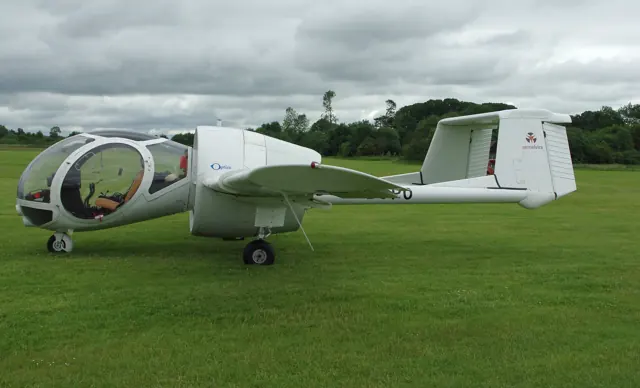
John Edgley's Optica was conceived for low-speed observation work. The crew sit ahead of a ducted propeller in an unusually rounded, extensively glazed cabin. Twin tail booms leave the centreline clear behind the fan, giving the aircraft a silhouette quite unlike a conventional light single. Its layout reflects the job: visibility and loitering were central design priorities.
Aircraft background
Wikipedia contributors · Read more ↗The view takes some getting used to
Sitting in the middle seat, Dolph found that the Optica demanded some rearrangement of familiar habits on the ground. The throttle and brake arrangement initially felt awkward. After Clive Davidson took the aircraft off from Thruxton, the view became the dominant impression: Hampshire lay below a cockpit that seemed to leave very little between its occupants and the landscape. A banked turn made that openness especially vivid.
General Aviation · April 2009. Thruxton demonstration with Clive Davidson in a restored 260-hp Optica. Davidson made the takeoff before Dolph took the controls.
General Aviation / IAOPA · Read more ↗Ballast lights detect presence, not correct balance
The ballast indicators illuminate when the relevant compartment contains weight. They do not confirm correct balance; MSFS 2024 ballast and passenger weights are managed through the EFB.
Optica · Microsoft Flight Simulator · MSFS 2024
Microsoft / aircraft developers · Read more ↗Into the cockpit
 YouTube
insultantable · 3 min ·
A flight in the Optica aircraft
A flight video featuring the Optica's distinctive observation-aircraft design.
Real aircraft · Edgley EA-7 Optica
Watch on YouTube ↗Preview images are served by AirframeDB. Videos open on YouTube only when you choose to watch.
Meet Edgley EA-7 Optica
John Edgley's Optica was conceived for low-speed observation work. The crew sit ahead of a ducted propeller in an unusually rounded, extensively glazed cabin. Twin tail booms leave the centreline clear behind the fan, giving the aircraft a silhouette quite unlike a conventional light single.
Its layout reflects the job: visibility and loitering were central design priorities. The Microsoft/Got Friends simulation represents the Series 300/301, with its avionics and loading features described in the developer documentation.
Edgley EA-7 Optica
Edgley → · Explore the family →
Edgley EA-7 Optica
Wikipedia contributors · Edgley Optica ↗Microsoft Flight Simulator · MSFS 2024 →Aircraft type designators
Use the code for the model you are flying. The linked authority lists the applicable aircraft.
History & design
G-BOPO returns to the air in 2008
Optica’s restoration diary follows G-BOPO from parts preparation and wing installation through painting and engine runs. It records Chris Taylor making the first post-restoration flight on 4 June 2008, followed by completion of the airworthiness test two days later.
Optica · G-BOPO restoration ↗Dated manufacturer restoration log; historical airframe status
Development milestones
Designer: John Edgley
First flight: 14 December 1979
Wikipedia contributors · Edgley Optica ↗Edgley Optica · family/variant named by the source · Wikipedia revision 1318375041
Pilot accounts
The view takes some getting used to
Sitting in the middle seat, Dolph found that the Optica demanded some rearrangement of familiar habits on the ground. The throttle and brake arrangement initially felt awkward. After Clive Davidson took the aircraft off from Thruxton, the view became the dominant impression: Hampshire lay below a cockpit that seemed to leave very little between its occupants and the landscape.
A banked turn made that openness especially vivid. Looking almost straight down, Dolph felt enough excitement to request the next turn in the other direction. Flying the aircraft himself, he found substantial control forces and appreciated the trim. He returned with enthusiasm for the experience, having encountered both the unusual ergonomics and the pleasure that the observation cockpit could provide.
General Aviation · April 2009. Thruxton demonstration with Clive Davidson in a restored 260-hp Optica. Davidson made the takeoff before Dolph took the controls.
Read the full account · General Aviation / IAOPA ↗Learning a new sight picture over Paris
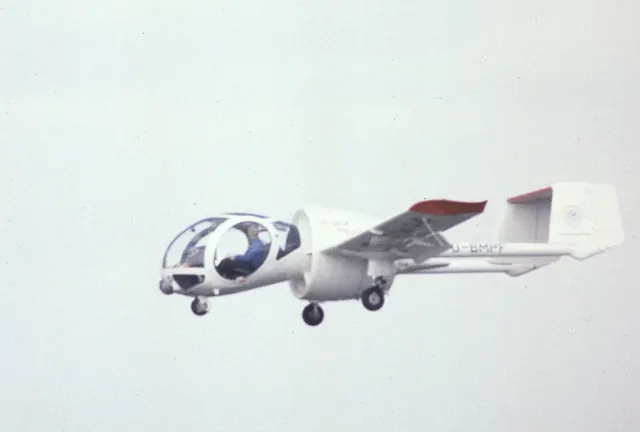
At Le Bourget, Thompson settled into the centre seat of an aircraft whose cabin offered almost too much to look at. Hugh Field handled the departure before passing him control. Without the usual nose and cockpit structure framing the horizon, Thompson initially had to work out which outside cues would tell him the aircraft’s attitude.
As the flight continued, peripheral references began to make more sense. The constrained air-show flight gave him an opportunity to observe roads below, although it did not allow a full performance evaluation. Returning to land brought another adjustment: he flared high and arrived firmly. He liked the extraordinary view while identifying control placement and the unfamiliar landing picture as things that still demanded attention.
AOPA Pilot · September 1983. Prototype G-BGMW at that year’s Paris Air Show, with Hugh O. Field. This aircraft had a 200-hp IO-360, unlike later 260-hp Opticas.
Read the full account · AOPA Pilot ↗A shadow helps explain an unfamiliar aircraft
Before departure, Urlacher discovered that the flaps were too far behind the cockpit to inspect in the usual way. Clive Davidson pointed out another visible clue: the wing’s shadow on the ground. It was a small example of how an apparently simple aeroplane could require fresh habits because of its unusual layout.
Over Hampshire, the glass cabin supplied the experience he had come for, opening the landscape around and below the occupants. The return brought a final lesson in perspective. Seated so low, Urlacher expected the landing flare earlier than Davidson’s prompt. He remained less fond of the hand-operated brake, but the remarkable view and the flight’s unusual sensations left a much warmer overall impression.
fliegermagazin · April 2010. Flight from Thruxton with Clive Davidson; the report concerns an EA-7 Optica, with its original cockpit arrangements.
Read the full account · fliegermagazin ↗In your simulator
Systems, equipment and documentation for each developer’s aircraft.
Compare simulator versions →MSFS 2024Optica
Microsoft Flight Simulator · Released
Optica
Microsoft Flight Simulator · Released
MSFS 2020EA-7 Edgley Optica
Got Friends · Released
EA-7 Edgley Optica
Got Friends · Released
Aircraft specifications
Published figures for the named real-aircraft variant. Simulator equipment and performance can differ.
| Specification | Published value |
|---|---|
| Length | 8.15 m (26 ft 9 in) |
| Wingspan | 12.00 m (39 ft 4 in) |
| Height | 2.31 m (7 ft 7 in) |
| Wing area | 15.84 m² (170.5 sq ft) |
| Empty weight | 948 kg (2,090 lb) |
| Max takeoff weight | 1,315 kg (2,899 lb) |
| Powerplant | 1 × Textron Lycoming IO-540-V4A5D air-cooled flat-six engine, 190 kW (260 hp) |
| Propellers | 5-bladed fixed-pitch ducted fan |
| Maximum speed | 213 km/h (132 mph, 115 kn) |
| Cruise speed | 130 km/h (81 mph, 70 kn) (loiter speed, 40% power) |
| Stall speed | 108 km/h (67 mph, 58 kn) outboard flaps up |
| Range | 1,056 km (656 mi, 570 nmi) at 130 km/h (81 mph; 70 kn) (45-minute reserves) |
| Service ceiling | 4,275 m (14,026 ft) |
| Rate of climb | 4.1 m/s (810 ft/min) |
Manuals & resources
Find your next read
Choose a topic for a short introduction and a link to the original source. Simulator references identify the developer and edition they cover.
Simulator documentation
Ballast lights detect presence, not correct balanceOptica · Microsoft Flight Simulator · MSFS 2024
The ballast indicators illuminate when the relevant compartment contains weight. They do not confirm correct balance; MSFS 2024 ballast and passenger weights are managed through the EFB.
Manual v3, ballast and EFB notes
Microsoft / aircraft developers · Read the source ↗Headphones change the cockpit soundOptica · Microsoft Flight Simulator · MSFS 2024
Click the headphones to dampen the sound. The manual specifies clicking their cord to remove that effect.
Manual v3, virtual cockpit controls
Microsoft / aircraft developers · Read the source ↗Camera equipment belongs to the research liveriesOptica · Microsoft Flight Simulator · MSFS 2024
The camera system is limited to Scientific Research Series 300 liveries. IR-H and IR-C supply hot and cold grayscale views; EO colour imagery is day-only.
Manual v3, camera display
Microsoft / aircraft developers · Read the source ↗Move the camera screen and adjust its image separatelyOptica · Microsoft Flight Simulator · MSFS 2024
Drag the camera display to reposition it. Its buttons adjust contrast, while the main panel’s Avionics Brightness knob controls brightness.
Manual v3, camera display controls
Microsoft / aircraft developers · Read the source ↗The MSFS 2024 EFB tracks the checklistOptica · Microsoft Flight Simulator · MSFS 2024
Interactive checklists in the MSFS 2024 EFB include cockpit locators and progress tracking. The manual describes the MSFS 2020 checklist interface separately.
Manual v3, MSFS 2024 checklist section
Microsoft / aircraft developers · Read the source ↗Observation-aircraft layout with modern navigation optionsOptica · Microsoft Flight Simulator · MSFS 2024
Got Friends documents a KAP140 autopilot used with the Working Title G530, along with pilot and copilot autopilot/trim-disconnect controls. Crew-dependent ballast options are also described. The loading options account for occupants in the forward cabin.
Archived simulator manual; installed package revision not observed · PDF pp.5-7
Microsoft / aircraft developers · Read the source ↗Pilot account
The view takes some getting used toGeneral Aviation · April 2009. Thruxton demonstration with Clive Davidson in a restored 260-hp Optica. Davidson made the takeoff before Dolph took the controls.
Sitting in the middle seat, Dolph found that the Optica demanded some rearrangement of familiar habits on the ground. The throttle and brake arrangement initially felt awkward. After Clive Davidson took the aircraft off from Thruxton, the view became the dominant impression: Hampshire lay below a cockpit that seemed to leave very little between its occupants and the landscape. A banked turn made that openness especially vivid.
Greg Dolph
General Aviation / IAOPA · Read the source ↗Learning a new sight picture over ParisAOPA Pilot · September 1983. Prototype G-BGMW at that year’s Paris Air Show, with Hugh O. Field. This aircraft had a 200-hp IO-360, unlike later 260-hp Opticas.
At Le Bourget, Thompson settled into the centre seat of an aircraft whose cabin offered almost too much to look at. Hugh Field handled the departure before passing him control. Without the usual nose and cockpit structure framing the horizon, Thompson initially had to work out which outside cues would tell him the aircraft’s attitude. As the flight continued, peripheral references began to make more sense.
Steven L. Thompson
AOPA Pilot · Read the source ↗Developer documentation
EA-7 Edgley Optica — product listingEA-7 Edgley Optica · MSFS 2020
Product listing captured 2026-09-30; edition scope from the reviewed catalogue
Got Friends · Read the source ↗Read the original documentation from the people who created it. Manuals open on their publisher’s website.
Manual
AeroElvira OpticaMicrosoft / aircraft developers Microsoft Flight Simulator aircraft manualsMicrosoft / aircraft developersAircraft background
Edgley OpticaWikipedia contributors · Research background · Wikipedia revision 1318375041 · retrieved 2026-09-12 G-BOPO restorationOptica · Manufacturer restoration log · March–June 2008Resource
MSFS 2024 FAQ and edition aircraft inventoryMicrosoftType designator
ICAO Doc 8643 — aircraft type designatorsInternational Civil Aviation Organization · Public search data retrieved 2026-09-14; authority update 2026-09-03Product
EA-7 Edgley Optica – Got FriendsGot Friends · Product listing captured 2026-09-30; edition scope from the reviewed catalogueBuilt-in force-feedback profiles
Read the documentary basis, editable starting settings and remaining questions for the aircraft you fly. Each explanation refers to the exact profile revision shown.
Catalogue programme-20261022-v1 · 4 profile choices
Got Friends EA-7 Edgley Optica Legacy Wheels
Got Friends · Free and Pro · Revision 2 · Inherited starting point
MSFS 2020
Got Friends EA-7 Edgley Optica Legacy Wheels: The profile supplies reversible resistance for the observation-aircraft rendition.
Got Friends EA-7 Edgley Optica Legacy Skis
Got Friends · Free and Pro · Revision 2 · Inherited starting point
MSFS 2020
Got Friends EA-7 Edgley Optica Legacy Skis: The profile supplies reversible resistance for the observation-aircraft rendition.
Edgley EA-7 Optica
Free and Pro · Revision 2 · Partial review
MSFS 2024
Edgley EA-7 Optica: The profile supplies reversible resistance for the observation-aircraft rendition.
Orbx Edgley EA-7 Optica
Orbx · Free and Pro · Revision 1 · Partial review
MSFS 2020
A fixed-wing observation aircraft with a helicopter-like view from its glazed nose.
Discuss this aircraft (0)
Questions, observations and useful sources from the community.
No published discussions yet. Bring a question or share a useful source.
Open aircraft discussions →Content expanded · What’s new
Something missing or a source that needs attention?
Suggest a correction ↗