

Start here
A few places to begin, from the aircraft’s story to the people who fly it.
Meet the aircraft
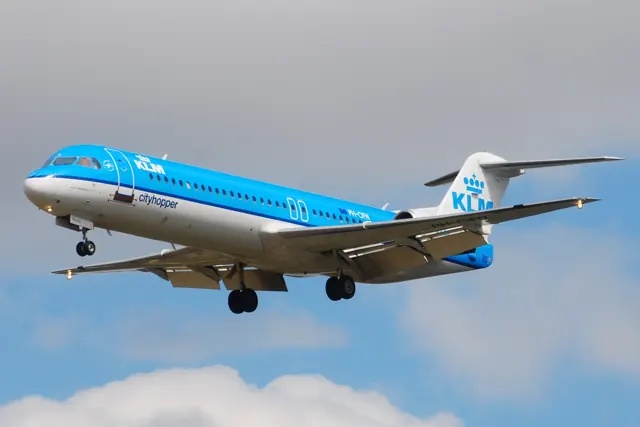
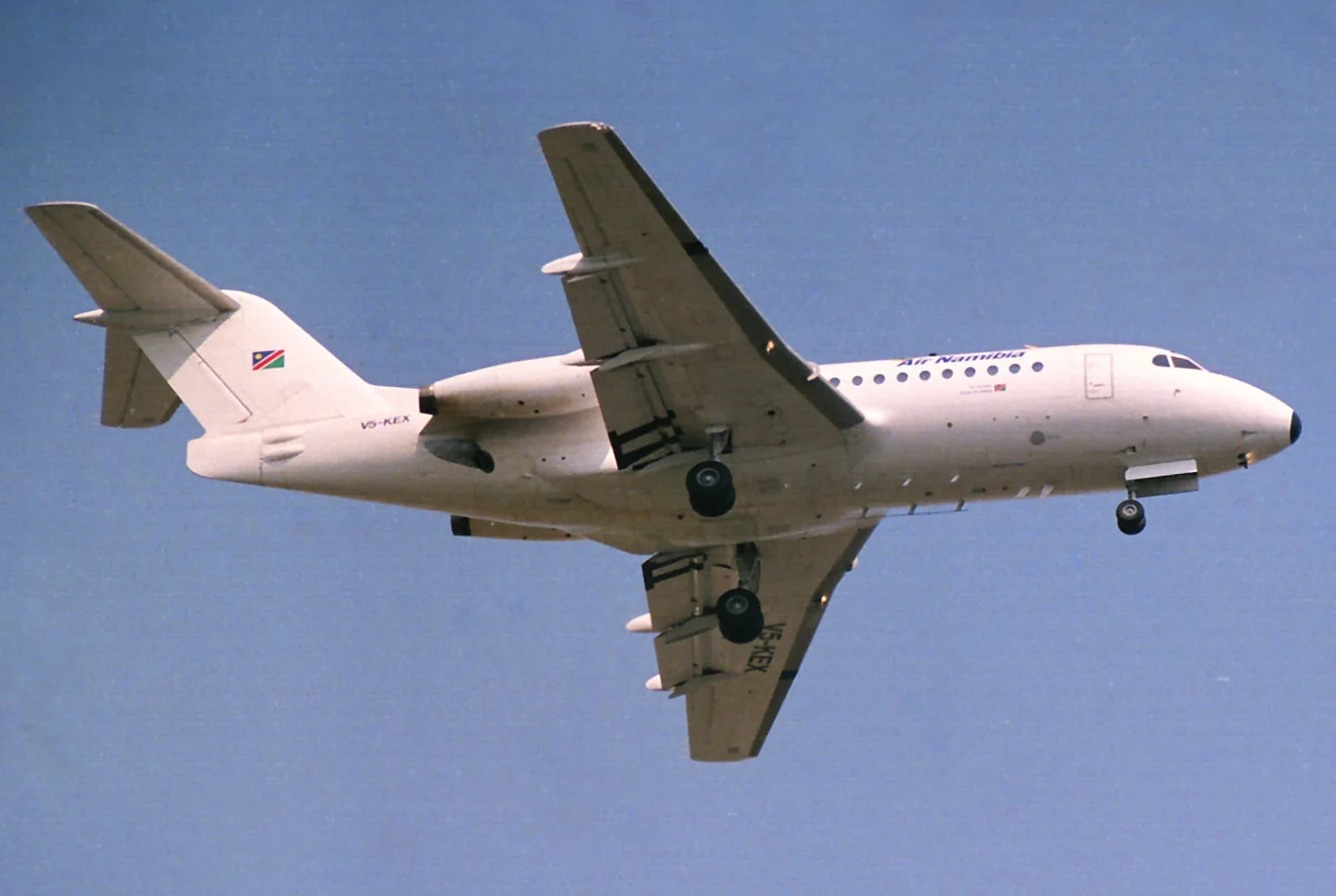
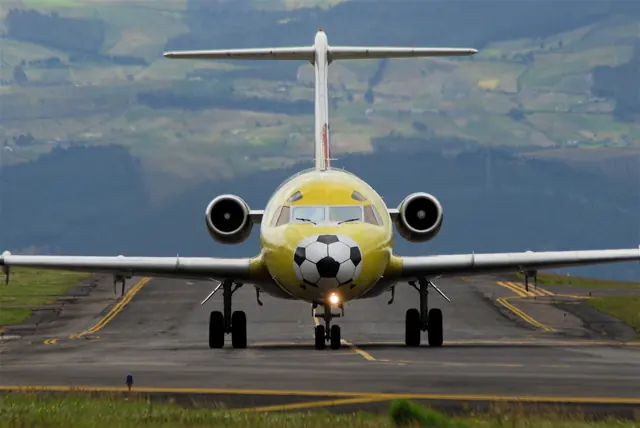
The F28 brought Fokker into the regional-jet market after its turboprop transports. Two rear-mounted engines, a low wing and a T-tail formed the basic layout; later versions changed the fuselage and wing.
Aircraft background
Wikipedia contributors · Read more ↗Teaching new crews while flying a new airline’s routes
An early Fokker assignment took Studstrup to Tripoli for eight months, supporting three F28s at Libyan Arab Airlines. Expatriate crews initially operated the aircraft while local pilots gained experience. The work mixed shuttles between Tripoli and Benghazi with desert oil-field destinations and international trips to cities such as Rome. Introducing the F28 in the United States brought a different working environment.
Pilot’s English career history. Fokker instructor supporting Libyan Arab Airlines and later F28 introductions in the United States; individual assignments are retrospective.
Niels Ove Studstrup · Read more ↗The tail speedbrake responds to throttle position
The guide describes a hydraulic tail speedbrake with continuously variable extension. Advancing either throttle to its detent retracts the brake and returns its cockpit lever, which helps explain an unexpected lever movement while exploring the simulator.
F28 Professional · Just Flight · MSFS 2020 · MSFS 2024
Just Flight · Read more ↗Into the cockpit
 YouTube
LaMa Aviation · 10 min ·
RARE Fokker F28-1000C Fellowship Cockpit Take Off from Mar del Plata | Fuerza Aerea Argentina TC-52
An Argentine Air Force F28-1000C departs Mar del Plata.
Real aircraft · Fokker F28 Fellowship
Watch on YouTube ↗Preview images are served by AirframeDB. Videos open on YouTube only when you choose to watch.
Meet Fokker F28 Fellowship
The F28 brought Fokker into the regional-jet market after its turboprop transports. Two rear-mounted engines, a low wing and a T-tail formed the basic layout; later versions changed the fuselage and wing.
The Fellowship's flight deck uses an earlier generation of airline equipment and automation than the BAe 146 and Embraer E-Jets. Just Flight's manual describes the variants and systems included in its package.
Fokker F28 Fellowship
Fokker → · Explore the family →
Fokker F28 Fellowship
Wikipedia contributors · Fokker F28 Fellowship ↗Just Flight · MSFS 2020 · MSFS 2024 →Aircraft type designators
Use the code for the model you are flying. The linked authority lists the applicable aircraft.
History & design
A prototype begins the Fellowship’s flying career
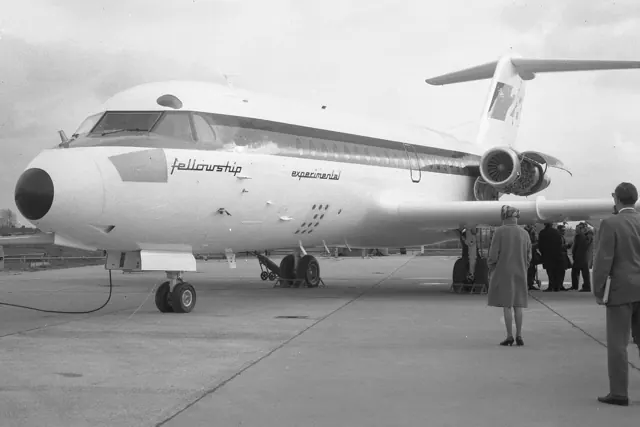
Van der Schraaf’s interview identifies PH-JHG as the aircraft flown by him and Cees Dik on 9 May 1967. Test instrumentation filled its unfinished cabin as the programme moved from construction into flight development.
Up in the Sky · Abe van der Schraaf: test pilot at Fokker ↗First-flight recollection published in 2022
Development milestones
First flight: 9 May 1967
Wikipedia contributors · Fokker F28 Fellowship ↗Fokker F28 Fellowship · family/variant named by the source · Wikipedia revision 1371843105
Pilot accounts
Teaching new crews while flying a new airline’s routes
An early Fokker assignment took Studstrup to Tripoli for eight months, supporting three F28s at Libyan Arab Airlines. Expatriate crews initially operated the aircraft while local pilots gained experience. The work mixed shuttles between Tripoli and Benghazi with desert oil-field destinations and international trips to cities such as Rome.
Introducing the F28 in the United States brought a different working environment. He supported Altair and Empire and enjoyed the opportunity to operate into the busy airports around New York and Washington. Across these assignments, the aircraft was both an airliner earning its keep and a setting for teaching other pilots.
Pilot’s English career history. Fokker instructor supporting Libyan Arab Airlines and later F28 introductions in the United States; individual assignments are retrospective.
Read the full account · Niels Ove Studstrup ↗Leaving an aircraft after twenty-one years in its cockpit
Wallin had flown the F28 since 1978 and regarded it as a particularly pilot-friendly aircraft. By its Swedish farewell in 1999, it had become a familiar part of his working life. His affection for its straightforward handling sat alongside an appreciation of what the aircraft had meant to regional air travel in Sweden.
The farewell brought that wider community together. After the last paying-passenger services, an invited flight returned to Ängelholm with current and former staff, followed by a gathering in the hangar. Wallin flew SE-DGP with Roland Karlsson for the occasion.
SAS Flight Operations farewell material reproduced by Linjeflyg.info in November 1999. Last passenger services and the invited farewell flight were separate events.
Read the full account · Linjeflyg.info / SAS Flight Operations ↗From the first prototype flight to demonstrations overseas
Van der Schraaf shared the F28’s first flight with Cees Dik after chief test pilot Jas Moll chose them for the task. The prototype’s interior was sparse, occupied by test equipment rather than the passenger fittings that would later make it an airliner. Development flying then gradually explored what the new aircraft could do.
Demonstration work carried the F28 much farther from its Dutch home. On an Australian trip, bad weather around Sydney and an unserviceable radar complicated the flying, while damage to the radome required repairs and replacement equipment. Recalling those assignments decades later, Van der Schraaf linked the excitement of introducing a new jet with the less glamorous delays and practical problems that accompanied taking it around the world.
Up in the Sky interview · September 2022. Fokker test pilot recalling the F28, including its first flight on 9 May 1967; this account does not describe an F100 flight.
Read the full account · Up in the Sky ↗In your simulator
Systems, equipment and documentation for each developer’s aircraft.
MSFS 2020 · MSFS 2024F28 Professional
Just Flight · Released
F28 Professional
Just Flight · Released
Manuals & resources
Find your next read
Choose a topic for a short introduction and a link to the original source. Simulator references identify the developer and edition they cover.
Simulator documentation
The tail speedbrake responds to throttle positionF28 Professional · Just Flight · MSFS 2020 · MSFS 2024
The guide describes a hydraulic tail speedbrake with continuously variable extension. Advancing either throttle to its detent retracts the brake and returns its cockpit lever, which helps explain an unexpected lever movement while exploring the simulator.
F28 Professional manual v2.2 · PDF pp.63–65
Just Flight · Read the source ↗Different control axes use different feel mechanismsF28 Professional · Just Flight · MSFS 2020 · MSFS 2024
Just Flight's F28 guide describes spring feel and datum-shift trim for roll and yaw, with a different arrangement for the elevator. Hydraulic failures also have distinct effects depending on the system involved. The stick shaker disengages the autopilot's pitch channel in the documented design, connecting stall warning with flight-guidance behaviour.
F28 manual v2.2 · PDF pp.31,59-60
Just Flight · Read the source ↗Wing lift dumpers have a separate ground roleF28 Professional · Just Flight · MSFS 2020 · MSFS 2024
The manual distinguishes the wing lift dumpers from the tail speedbrake. Their normal automatic deployment follows touchdown or a rejected takeoff, reducing lift and increasing drag while the aircraft is on the ground.
F28 Professional manual v2.2 · PDF p.65; page visually checked
Just Flight · Read the source ↗Pilot account
Teaching new crews while flying a new airline’s routesPilot’s English career history. Fokker instructor supporting Libyan Arab Airlines and later F28 introductions in the United States; individual assignments are retrospective.
An early Fokker assignment took Studstrup to Tripoli for eight months, supporting three F28s at Libyan Arab Airlines. Expatriate crews initially operated the aircraft while local pilots gained experience. The work mixed shuttles between Tripoli and Benghazi with desert oil-field destinations and international trips to cities such as Rome. Introducing the F28 in the United States brought a different working environment.
Niels Ove Studstrup
Niels Ove Studstrup · Read the source ↗Leaving an aircraft after twenty-one years in its cockpitSAS Flight Operations farewell material reproduced by Linjeflyg.info in November 1999. Last passenger services and the invited farewell flight were separate events.
Wallin had flown the F28 since 1978 and regarded it as a particularly pilot-friendly aircraft. By its Swedish farewell in 1999, it had become a familiar part of his working life. His affection for its straightforward handling sat alongside an appreciation of what the aircraft had meant to regional air travel in Sweden. The farewell brought that wider community together.
Rolf Wallin
Linjeflyg.info / SAS Flight Operations · Read the source ↗Read the original documentation from the people who created it. Manuals open on their publisher’s website.
Manual
F28 Professional MSFS Manual (version 2.2)Just Flight F28 manualsJust Flight Microsoft Flight Simulator aircraft manualsMicrosoft / aircraft developersAircraft background
Fokker F28 FellowshipWikipedia contributors · Research background · Wikipedia revision 1371843105 · retrieved 2026-09-12Product
F28 Professional (MSFS)Just Flight · Official developer / designated store catalogue · checked 2026-09-12Type designator
ICAO Doc 8643 — aircraft type designatorsInternational Civil Aviation Organization · Public search data retrieved 2026-09-14; authority update 2026-09-03Built-in force-feedback profiles
Read the documentary basis, editable starting settings and remaining questions for the aircraft you fly. Each explanation refers to the exact profile revision shown.
Catalogue programme-20261022-v1 · 8 profile choices
Just Flight F28-1000
Just Flight · Free and Pro · Revision 6 · Inherited starting point
MSFS 2020 · MSFS 2024
Just Flight F28-1000: Axis-specific feel motivates a separate pitch/roll balance.
Just Flight F28-2000
Just Flight · Free and Pro · Revision 5 · Inherited starting point
MSFS 2020 · MSFS 2024
Just Flight F28-2000: Axis-specific feel motivates a separate pitch/roll balance.
Just Flight F28-3000
Just Flight · Free and Pro · Revision 5 · Inherited starting point
MSFS 2020 · MSFS 2024
Just Flight F28-3000: Axis-specific feel motivates a separate pitch/roll balance.
Just Flight F28-4000
Just Flight · Free and Pro · Revision 5 · Inherited starting point
MSFS 2020 · MSFS 2024
Just Flight F28-4000: Axis-specific feel motivates a separate pitch/roll balance.
Fokker F28-1000
Free and Pro · Revision 3 · Partial review
MSFS 2020 · MSFS 2024
Fokker F28-1000: Axis-specific feel motivates a separate pitch/roll balance.
Fokker F28-2000
Free and Pro · Revision 1 · Partial review
MSFS 2020 · MSFS 2024
Fokker F28-2000: Axis-specific feel motivates a separate pitch/roll balance.
Fokker F28-3000
Free and Pro · Revision 1 · Partial review
MSFS 2020 · MSFS 2024
Fokker F28-3000: Axis-specific feel motivates a separate pitch/roll balance.
Fokker F28-4000
Free and Pro · Revision 1 · Partial review
MSFS 2020 · MSFS 2024
Fokker F28-4000: Axis-specific feel motivates a separate pitch/roll balance.
Discuss this aircraft (0)
Questions, observations and useful sources from the community.
No published discussions yet. Bring a question or share a useful source.
Open aircraft discussions →Content expanded · What’s new
Something missing or a source that needs attention?
Suggest a correction ↗