

Start here
A few places to begin, from the aircraft’s story to the people who fly it.
Meet the aircraft
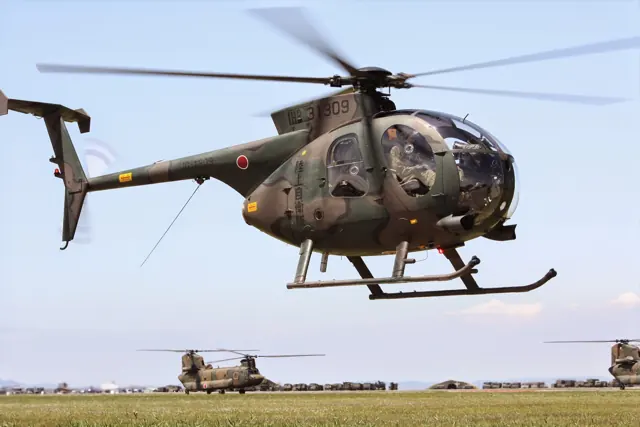
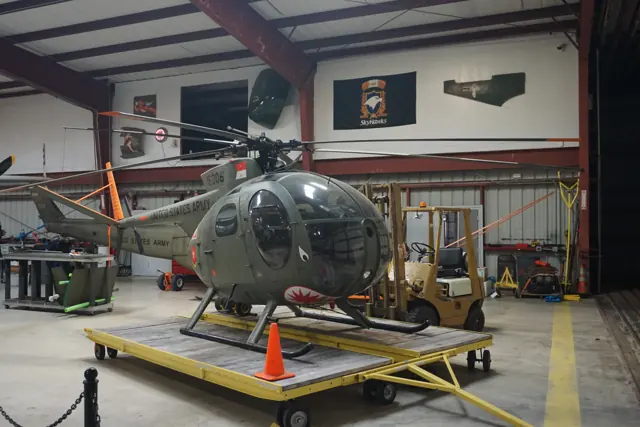
Hughes developed the compact, single-turbine OH-6 for the US Army's Light Observation Helicopter programme. Its reconnaissance and utility roles were followed by the civilian Hughes 500 lineage.
Aircraft background
Wikipedia contributors · Read more ↗Returning to a favourite after more than twenty years
A television helicopter had helped inspire Huling’s interest, but his factory visit also showed the people building the aircraft by hand. Four new helicopters were on the production line during a period when the company was trying to rebuild customer support and confidence. Flying one afterward gave him a more personal reason to enjoy the visit. His initial hover needed a few corrections before the feel returned.
AOPA · May 2023. Factory visit and supervised MD500E flight in N40125 with Dennis Banks, after Huling’s last flight on type in November 2000.
AOPA · Read more ↗The two supplied aircraft have different pilot positions
Taog’s manual places the command seat on the right in the military OH-6A and on the left in the civilian H500C. It describes the four-bladed rotor and differing engine installations. These are earlier family configurations than the later MD500E described in several pilot accounts.
OH-6A / H500C · Taog's Hangar · MSFS 2024
Taog's Hangar · Read more ↗Into the cockpit
 YouTube
Ed Whisenant Aviation · 7 min ·
Hughes 500 Start-Up, Takeoff & Landing Back on Helipad - Helicopter (369D) N36KR
A Hughes 369D starts, departs and returns to its helipad.
Real aircraft · Hughes OH-6 / 500
Watch on YouTube ↗Preview images are served by AirframeDB. Videos open on YouTube only when you choose to watch.
Meet Hughes OH-6 / 500
Hughes developed the compact, single-turbine OH-6 for the US Army's Light Observation Helicopter programme. Its reconnaissance and utility roles were followed by the civilian Hughes 500 lineage.
Engines, rotors and equipment changed across the OH-6 and 500 family. Taog's simulator package offers skid and float configurations and documents electric cyclic trim; it does not describe that trim as a full automatic flight-control system.
Hughes OH-6 / 500
Aircraft type designators
Use the code for the model you are flying. The linked authority lists the applicable aircraft.
History & design
The factory is part of the aircraft’s continuing story
Huling’s 2023 visit describes hand-built fuselages and tail booms alongside a leadership team working to restore customer support after a change of ownership. His report captures a particular period in the production history of the civilian MD500 family.
AOPA · The Ferrari of helicopters ↗Dated factory report; subsequent corporate status not inferred
Development milestones
First flight: February 27, 1963
Wikipedia contributors · Hughes OH-6 Cayuse ↗Hughes OH-6 Cayuse · family/variant named by the source · Wikipedia revision 1362659956
Pilot accounts
Returning to a favourite after more than twenty years
A television helicopter had helped inspire Huling’s interest, but his factory visit also showed the people building the aircraft by hand. Four new helicopters were on the production line during a period when the company was trying to rebuild customer support and confidence. Flying one afterward gave him a more personal reason to enjoy the visit.
His initial hover needed a few corrections before the feel returned. Banks then guided him into the desert for an off-airport landing, including a reminder to shed the habits of fixed-wing approaches. Huling appreciated the visibility through the newer, narrower instrument panel and later joined a separate photo flight.
AOPA · May 2023. Factory visit and supervised MD500E flight in N40125 with Dennis Banks, after Huling’s last flight on type in November 2000.
Read the full account · AOPA ↗A factory visit renews an instructor’s attachment to the type
Andrykowsky made a long drive to Arizona for time with Dennis Banks, whose familiarity with the aircraft impressed him as much as the flying. Practising autorotations in the desert was far removed from the author’s ordinary day, and he openly admitted a strong affection for the MD500 before offering his assessment.
That attachment had begun with a conversion course among law-enforcement pilots in California. He remembered being the only participant without a sidearm, a small detail that captured the unusual company in which he was learning. In describing later flying, he valued direct control response and the sense of being closely connected to the aircraft. He also acknowledged its cramped, noisy cabin. The account supplies an instructor’s enthusiastic experience, while its broader technical comparisons remain separate from verified specifications.
SA Flyer · archived 2017 article. Arizona visit with MD factory test pilot Dennis Banks; the author also recalls earlier MD500D conversion training in California.
Read the full account · SA Flyer ↗A flight-test student finds a demanding subject
Sparkes first encountered the MD500 as a test-pilot student expected to produce a detailed report after only an hour of flying. Kenyon’s knowledge allowed him to explore a broad range of handling within the school’s programme. The small airframe and generous cockpit view made an immediate impression, followed by controls more responsive than he had expected.
Hovering required close attention, and the aircraft continued to challenge his coordination in forward flight. Some changes in attitude and rotor behaviour caught him by surprise, giving him plenty to analyse afterward. Returning for low-speed work remained enjoyable despite the effort. The helicopter later reappeared during his time commanding the school.
Personal recollection · February 2022. MD500E experience through the Empire Test Pilots’ School, initially with Dennis Kenyon; flight date and registration are not stated.
Read the full account · Simon Sparkes ↗In your simulator
Systems, equipment and documentation for each developer’s aircraft.
Compare simulator versions →MSFS 2024OH-6A / H500C
Taog's Hangar · Released
OH-6A / H500C
Taog's Hangar · Released
MSFS 2020 · MSFS 2024Hughes OH-6 / 500
CowanSim · Released
Hughes OH-6 / 500
CowanSim · Released
X-Plane 11 · X-Plane 12Hughes OH-6 / 500
CowanSim · Released
Hughes OH-6 / 500
CowanSim · Released
Aircraft specifications
Published figures for the named real-aircraft variant. Simulator equipment and performance can differ.
| Specification | Published value |
|---|---|
| Length | 30 ft 3.75 in (9.2393 m) including rotors |
| Height | 8 ft 1.5 in (2.477 m) to top of rotor hub |
| Empty weight | 1,229 lb (557 kg) |
| Gross weight | 2,400 lb (1,089 kg) |
| Max takeoff weight | 2,700 lb (1,225 kg) |
| Powerplant | 1 × Allison T63-A-5A turboshaft engine, 317 shp (236 kW) de-rated to:- |
| Main rotor diameter | 26 ft 4 in (8.03 m) |
| Main rotor area | 544.63 sq ft (50.598 m² ) |
| Cruise speed | 130 kn (150 mph, 240 km/h) maximum at sea level |
| Range | 330 nmi (380 mi, 610 km) at 5,000 ft (1,524 m) |
| Service ceiling | 15,800 ft (4,800 m) |
| Rate of climb | 2,067 ft/min (10.50 m/s) |
Manuals & resources
Find your next read
Choose a topic for a short introduction and a link to the original source. Simulator references identify the developer and edition they cover.
Simulator documentation
The two supplied aircraft have different pilot positionsOH-6A / H500C · Taog's Hangar · MSFS 2024
Taog’s manual places the command seat on the right in the military OH-6A and on the left in the civilian H500C. It describes the four-bladed rotor and differing engine installations. These are earlier family configurations than the later MD500E described in several pilot accounts.
Taog OH-6A/H500C manual v1.1 · PDF pp.7–10
Taog's Hangar · Read the source ↗Light controls and working configurationsOH-6A / H500C · Taog's Hangar · MSFS 2024
The OH-6A and H500C are separately selectable aircraft in Taog's package, with different skid and float choices. The manual describes electric actuators for cyclic trim and controls without hydraulic boost. Mission attachments add their documented weights at specified loading stations.
MSFS2024; flight manual 1.1 · PDF pp.9-10,22
Taog's Hangar · Read the source ↗Cowan documents separate collective and throttle controlsHughes OH-6 / 500 · CowanSim · MSFS 2020 · MSFS 2024
The MSFS manual requires separate collective and twist-throttle axes, naming COLLECTIVE AXIS and SET HELICOPTER THROTTLE AXIS. It distinguishes the collective’s engine-RPM beep switch from the cyclic trim controls. The starter is a toggle that must be cycled off before another start.
Cowan MSFS 500E manual · PDF pp.1–5,9
CowanSim · Read the source ↗Starting and cockpit equipment can be configuredHughes OH-6 / 500 · CowanSim · X-Plane 11 · X-Plane 12
The X-Plane 12 guide offers automatic starter-button holding and a complete automated start. AviTab supplies maps and PDF viewing when installed, while an installed Reality XP GTN750 can replace the standard GPS units through the configuration menu.
Cowan 500E X-Plane 12 manual · PDF pp.1–7
CowanSim · Read the source ↗The VR seating position can be savedHughes OH-6 / 500 · CowanSim · X-Plane 11 · X-Plane 12
Clipboard arrows adjust the pilot’s view in six directions. Save Position writes the chosen position to the aircraft’s VR configuration, and the guide requires an aircraft reload to apply it. Cyclic trim uses the ordinary X-Plane 12 trim commands.
Cowan 500E X-Plane 12 manual · PDF p.9
CowanSim · Read the source ↗Pilot account
Returning to a favourite after more than twenty yearsAOPA · May 2023. Factory visit and supervised MD500E flight in N40125 with Dennis Banks, after Huling’s last flight on type in November 2000.
A television helicopter had helped inspire Huling’s interest, but his factory visit also showed the people building the aircraft by hand. Four new helicopters were on the production line during a period when the company was trying to rebuild customer support and confidence. Flying one afterward gave him a more personal reason to enjoy the visit. His initial hover needed a few corrections before the feel returned.
Murray Huling
AOPA · Read the source ↗A factory visit renews an instructor’s attachment to the typeSA Flyer · archived 2017 article. Arizona visit with MD factory test pilot Dennis Banks; the author also recalls earlier MD500D conversion training in California.
Andrykowsky made a long drive to Arizona for time with Dennis Banks, whose familiarity with the aircraft impressed him as much as the flying. Practising autorotations in the desert was far removed from the author’s ordinary day, and he openly admitted a strong affection for the MD500 before offering his assessment. That attachment had begun with a conversion course among law-enforcement pilots in California.
Christoph Andrykowsky
SA Flyer · Read the source ↗Read the original documentation from the people who created it. Manuals open on their publisher’s website.
Manual
Download manualTaog's Hangar Microsoft Flight Simulator aircraft manualsMicrosoft / aircraft developers Taog aircraft manualsTaog's HangarAircraft background
Hughes OH-6 CayuseWikipedia contributors · Research background · Wikipedia revision 1362659956 · retrieved 2026-09-12Product
500E for MSFSCowanSim · Official developer / designated store catalogue · checked 2026-09-12 500E for X-PlaneCowanSim · Official developer / designated store catalogue · checked 2026-09-12 OH-6A / H500CTaog’s Hangar · Official developer / designated store catalogue · checked 2026-09-12Type designator
ICAO Doc 8643 — aircraft type designatorsInternational Civil Aviation Organization · Public search data retrieved 2026-09-14; authority update 2026-09-03Developer documentation
User ManualCowanSim · Gathered developer documentation User ManualCowanSim · Gathered developer documentationBuilt-in force-feedback profiles
Read the documentary basis, editable starting settings and remaining questions for the aircraft you fly. Each explanation refers to the exact profile revision shown.
Catalogue programme-20261022-v1 · 9 profile choices
CowanSim 500E
CowanSim · Free and Pro · Revision 4 · Inherited starting point
MSFS 2020 · MSFS 2024
CowanSim 500E: The selected cyclic resistance accompanies the exact rotor/control configuration.
CowanSim 500E
CowanSim · Free and Pro · Revision 2 · Inherited starting point
X-Plane 12
CowanSim 500E: The selected cyclic resistance accompanies the exact rotor/control configuration.
Taog's Hangar OH-6A
Taog's Hangar · Free and Pro · Revision 3 · Inherited starting point
MSFS 2024
Taog's Hangar OH-6A: The selected cyclic resistance accompanies the exact rotor/control configuration.
Taog's Hangar H500C
Taog's Hangar · Free and Pro · Revision 2 · Inherited starting point
MSFS 2024
Taog's Hangar H500C: The selected cyclic resistance accompanies the exact rotor/control configuration.
Hughes OH-6A
Free and Pro · Revision 2 · Partial review
MSFS 2020 · MSFS 2024 · X-Plane 11 · X-Plane 12
Hughes OH-6A: The selected cyclic resistance accompanies the exact rotor/control configuration.
Hughes 500C
Free and Pro · Revision 1 · Partial review
MSFS 2020 · MSFS 2024 · X-Plane 11 · X-Plane 12
Hughes 500C: The selected cyclic resistance accompanies the exact rotor/control configuration.
MD 500E
Free and Pro · Revision 1 · Review pending
MSFS 2020 · MSFS 2024 · X-Plane 11 · X-Plane 12
MD 500E: The selected cyclic resistance accompanies the exact rotor/control configuration.
Shrike / Blackbird MD530F
Shrike / Blackbird · Free and Pro · Revision 1 · Inherited starting point
MSFS 2020 · MSFS 2024
A small observation-helicopter family with a rounded cabin and compact rotor system.
MD Helicopters MD530F Civil Utility
Free and Pro · Revision 1 · Partial review
MSFS 2020 · MSFS 2024 · X-Plane 12
A small observation-helicopter family with a rounded cabin and compact rotor system.
MD Helicopters MD530F Civil Utility
A small observation-helicopter family with a rounded cabin and compact rotor system.
Aircraft and simulator scope
- MD Helicopters MD530F Civil Utility · MSFS 2020 · Variant starting point
- MD Helicopters MD530F Civil Utility · MSFS 2024 · Variant starting point
- MD Helicopters MD530F Civil Utility · X-Plane 12 · Variant starting point
Universal named airframe/configuration; intended MSFS2020/MSFS2024/XP12 starting point, not add-on or edition acceptance. · Physical facts and prior documentary review are reused from their archived dated sources; new market availability is not inferred.
The simulator model and controls
A small observation-helicopter family with a rounded cabin and compact rotor system.
How this profile feels
The spring stays independent of airspeed. Directed aerodynamic loading is omitted.
Local force trim is off. Autopilot following is off.
Aircraft and configuration
Unarmed civil utility configuration: one Rolls-Royce250-C30 turboshaft, fully articulated five-blade main rotor, tail rotor and extended skid gear. The manufacturer identifies training, utility and light-cargo base roles. Weapons and optional mission equipment are outside this baseline.
About the values
Strengths are normalized hardware-feel settings. They set the effect balance; hand force depends on the device and its limits. The IAS reference is a tuning value.
What the documentation establishes
MD Helicopters MD530F Civil Utility: Unarmed civil utility configuration: one Rolls-Royce250-C30 turboshaft, fully articulated five-blade main rotor, tail rotor and extended skid gear. The manufacturer identifies training, utility and light-cargo base roles. Weapons and optional mission equipment are outside this baseline.
Documentary review and sources
These decisions describe the documentary basis and remaining gaps for this revision. Aircraft documentation and a starting setting describe different kinds of evidence.
Aircraft and variant
ReviewedA small observation-helicopter family with a rounded cabin and compact rotor system.
Flight controls
ReviewedA small observation-helicopter family with a rounded cabin and compact rotor system.
Trim
InheritedLocal force trim is off. Autopilot following is off.
Autopilot and stability
ReviewedAutopilot following is off; the configured spring and load retain the hardware feel.
Equipment
ReviewedUnarmed civil utility configuration: one Rolls-Royce250-C30 turboshaft, fully articulated five-blade main rotor, tail rotor and extended skid gear. The manufacturer identifies training, utility and light-cargo base roles. Weapons and optional mission equipment are outside this baseline.
Speeds and limits
InheritedThe indicated-speed references set the profile response scale; they are separate from aircraft operating limits.
Simulator integration
ReviewedThe profile targets msfs2020, msfs2024, xplane12. Add-on-specific controls use only the supported references configured by this profile.
Force-feedback settings
InheritedThe settings define the profile’s effect balance. Device output limits affect physical hand force.
Starting settings and their rationale
These configured values are starting estimates. The explanations describe what each setting controls; physical validation appears separately below.
| Setting | Starting value | What it controls and why |
|---|---|---|
| Spring strength | Starting value0.1 | What it controls and whyThis profile uses cyclic loading for Hughes OH-6 / 500. The baseline spring is 0.1. Low-speed spring blending is off. |
| Master force gain | Starting value0.65 | What it controls and whyScales overall profile strength while preserving effect balance, subject to device and output limits. |
| Profile force gain | Starting value0 | What it controls and whyThe 0 gain omits sustained directed airspeed loading. Spring resistance remains independent. |
| Force tuning speed/reference | Starting value110 kt | What it controls and whySets the IAS reference for aerodynamic loading. It is an estimate, not published cruise TAS or a flight limit. |
| Spring response reference speed | Starting value55.0 kt | What it controls and whySets the IAS where the low-speed blend reaches baseline strength; high-speed stiffening also uses it. |
| Aileron force scale | Starting value1 | What it controls and whyRoll and pitch aerodynamic scales are 1 and 1, respectively. These stored weights do not create directed aerodynamic loading while that term is inactive. No custom spring-travel curve is enabled. |
| Elevator force scale | Starting value1 | What it controls and whyScales pitch aerodynamic loading; pitch spring travel and trim responses are separate settings. |
| Trim feel | Starting valueDisabled | What it controls and whyRetained for compatibility and group membership. Trim relief, rather than this flag, controls centre movement. |
| Trim relief | Starting valueDisabled | What it controls and whyAllows trim relief with supported control law and valid telemetry. Axis authorities set its amount. |
| Autopilot follow | Starting valueDisabled | What it controls and whyAutopilot following is off; the configured spring and load retain the hardware feel. |
| Autopilot neutral hold | Starting valueDisabled | What it controls and whyPermits centering hold during a supported AP state, separate from following a moving target. |
| Output force limit | Starting value0.55 | What it controls and whyCaps directed-force output. Native spring effects and device limits remain separate. |
All 44 starting settings and their rationale
The settings define the profile’s effect balance. Device output limits affect physical hand force.
| Setting | Starting value | What it controls and why |
|---|---|---|
| Spring strength | Starting value0.1 | What it controls and whyThis profile uses cyclic loading for Hughes OH-6 / 500. The baseline spring is 0.1. Low-speed spring blending is off. |
| Profile force gain | Starting value0 | What it controls and whyThe 0 gain omits sustained directed airspeed loading. Spring resistance remains independent. |
| Elevator force scale | Starting value1 | What it controls and whyScales pitch aerodynamic loading; pitch spring travel and trim responses are separate settings. |
| Aileron force scale | Starting value1 | What it controls and whyRoll and pitch aerodynamic scales are 1 and 1, respectively. These stored weights do not create directed aerodynamic loading while that term is inactive. No custom spring-travel curve is enabled. |
| Output force limit | Starting value0.55 | What it controls and whyCaps directed-force output. Native spring effects and device limits remain separate. |
MD Helicopters MD530F Civil Utility: No documented neutral-position/FTR telemetry contract; local FTR and generic aircraft trim relief remain disabled to avoid competing ownership. Estimated pitch/roll trim authorities 0/0; exact add-on sign, travel, units and build-specific neutral remain unqualified. Rudder trim never substitutes for roll trim.
| Setting | Starting value | What it controls and why |
|---|---|---|
| Elevator Authority | Starting value0 | What it controls and whyScales supported pitch-trim relief and permitted centre movement. Zero removes pitch response. |
| Aileron Authority | Starting value0 | What it controls and whyScales supported roll-trim relief and permitted centre movement. Zero removes roll response. |
MD Helicopters MD530F Civil Utility: 110 KIAS is the retained estimated tuning reference. It is not published cruise TAS, VNE, a new flight limit or a measured force threshold. Source-specific operating quantities remain attached to their original configuration and conditions.
| Setting | Starting value | What it controls and why |
|---|---|---|
| Force tuning speed/reference | Starting value110 kt | What it controls and whySets the IAS reference for aerodynamic loading. It is an estimate, not published cruise TAS or a flight limit. |
Exact configured values with software explanations. Force magnitudes remain editable estimates; disabled features retain inactive values.
| Setting | Starting value | What it controls and why |
|---|---|---|
| Spring deadband | Starting value0.02 | What it controls and whySets travel around the centre before the baseline spring resists. Smaller values engage it sooner. |
| Master force gain | Starting value0.65 | What it controls and whyScales overall profile strength while preserving effect balance, subject to device and output limits. |
| QBlend Enabled | Starting valueDisabled | What it controls and whyAllows baseline spring strength to rise with indicated airspeed where the control law permits it. |
| QSpring Minimum Factor | Starting value0.5 | What it controls and whySets low-speed spring strength as a fraction of baseline when blending is enabled. One keeps full strength. |
| QSpring Start Knots | Starting value8 kt | What it controls and whySets the IAS where the low-speed spring blend starts rising. This is a feel threshold, not a flight limit. |
| Spring response reference speed | Starting value55.0 kt | What it controls and whySets the IAS where the low-speed blend reaches baseline strength; high-speed stiffening also uses it. |
| Airspeed spring stiffening gain | Starting value0 | What it controls and whyAdds permitted spring resistance above the full-blend speed. Zero removes this high-speed increase. |
| Airspeed spring stiffening limit | Starting value5 | What it controls and whyLimits the squared airspeed ratio used for high-speed spring stiffening; it is not a device-force cap. |
| Trim feel | Starting valueDisabled | What it controls and whyRetained for compatibility and group membership. Trim relief, rather than this flag, controls centre movement. |
| Trim relief | Starting valueDisabled | What it controls and whyAllows trim relief with supported control law and valid telemetry. Axis authorities set its amount. |
| Force Trim Enabled | Starting valueDisabled | What it controls and whyThe profile uses the trim behaviour configured below. Local force trim is off. The stored latch parameters are inactive; the profile does not supply a local hold-where-left neutral. |
| GLoad Enabled | Starting valueDisabled | What it controls and whyAllows load-factor changes to modify permitted spring laws. Passive fly-by-wire feel can suppress it. |
| Rate Damping Enabled | Starting valueDisabled | What it controls and whyEnables rate damping with the configured coefficients and control law. |
| Autopilot follow | Starting valueDisabled | What it controls and whyAutopilot following is off; the configured spring and load retain the hardware feel. |
| Autopilot follow authority | Starting value0.1 | What it controls and whySets admitted AP-follow gain, not a percentage of travel. Runtime ownership and input limits still apply. |
| Autopilot neutral hold | Starting valueDisabled | What it controls and whyPermits centering hold during a supported AP state, separate from following a moving target. |
| Autopilot neutral hold strength | Starting value0.6 | What it controls and whySets admitted AP neutral-hold strength; inactive while neutral hold is disabled. |
| Enabled | Starting valueEnabled | What it controls and whyEnables aerodynamic cues; each still needs nonzero strength and its simulator conditions. |
| Gain | Starting value0 | What it controls and whySets stall-buffet strength. Zero removes the cue without changing simulator stalls or warnings. |
| Gain | Starting value0 | What it controls and whySets high-Mach buffet strength; onset and full-strength thresholds are separate. |
| Gain | Starting value0 | What it controls and whySets flap buffet at the configured position and speed gates. Flap movement texture is separate. |
| Maximum flap index | Starting value3 | What it controls and whySets the final flap index for detent normalization. UP plus three detents uses maximum index3. |
| Minimum flap index | Starting value2 | What it controls and whySets the first flap detent that admits buffet; this is a handle index, not degrees. |
| Gain | Starting value0 | What it controls and whySets gear aerodynamic buffet; movement and ground-contact cues are separate. |
| Shaker Enabled | Starting valueDisabled | What it controls and whyPermits shaker at supported warning conditions; the switch does not establish aircraft equipment. |
| Stick shaker amplitude | Starting value0.5 | What it controls and whySets triggered shaker strength; inactive while the shaker feature is disabled. |
| Enabled | Starting valueEnabled | What it controls and whyEnables ground effects; each still needs its own strength and contact or motion telemetry. |
| Gain | Starting value0 | What it controls and whySets rolling texture strength, modified by speed, surface and undercarriage configuration. |
| Gain | Starting value0 | What it controls and whySets gear-bump texture during ground motion, separate from touchdown impact. |
| Gain | Starting value0.2 | What it controls and whySets landing-impact strength; landing telemetry and response shape determine the pulse. |
| Gain | Starting value0 | What it controls and whySets reverse-thrust vibration with valid reverser and engine conditions. Zero removes the cue. |
| Enabled | Starting valueDisabled | What it controls and whyEnables engine cues with nonzero settings and valid running-engine telemetry. |
| Gain | Starting value0 | What it controls and whySets estimated engine vibration using configured telemetry and response, not measured cockpit vibration. |
| Enabled | Starting valueEnabled | What it controls and whyEnables accessory cues with configured strengths and observed accessory movement. |
| Gain | Starting value0 | What it controls and whySets texture from observed flap movement; a command without movement does not establish the cue. |
| Gain | Starting value0 | What it controls and whySets texture from observed gear movement, separate from aerodynamic and touchdown effects. |
Limits and open questions
- MD Helicopters MD530F Civil Utility is a universal starting point; exact add-on matching, edition operation and physical hand-force calibration remain unqualified.
- Autopilot movement and unknown custom trim, failure or force-input signals are disabled. Confirm the selected equipment fit and trim direction for the implementation in use.
- Force magnitudes and speed tuning are editable inherited estimates. Owner physical and installed-aircraft acceptance remain pending.
Physical validation
No physical force validation is recorded in this public catalogue for this revision. Documentary review and software checks do not establish how a particular device feels.
Discuss this aircraft (0)
Questions, observations and useful sources from the community.
No published discussions yet. Bring a question or share a useful source.
Open aircraft discussions →Content expanded · What’s new
Something missing or a source that needs attention?
Suggest a correction ↗