

Start here
A few places to begin, from the aircraft’s story to the people who fly it.
Meet the aircraft
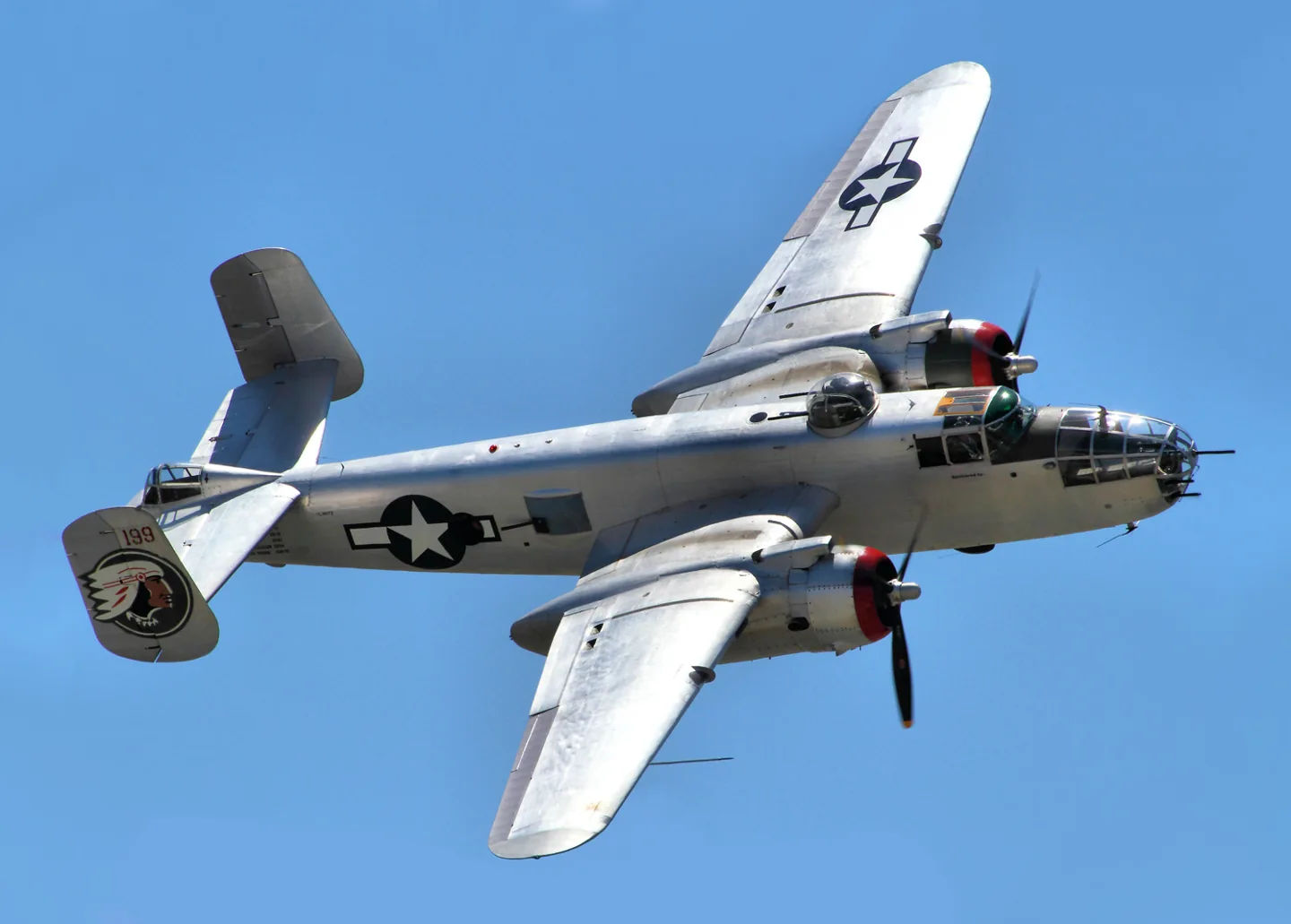
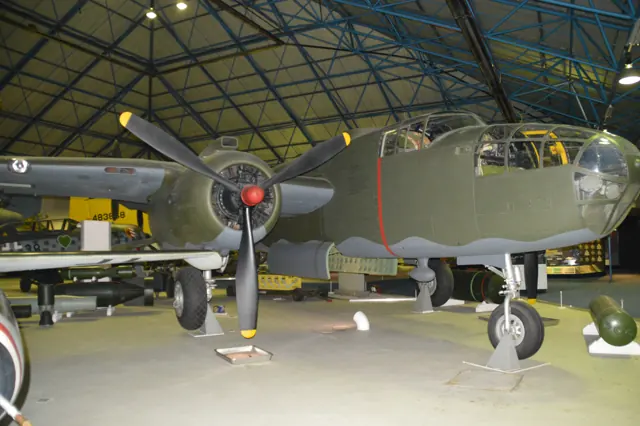
North American designed the B-25 Mitchell as a twin-engine medium bomber. Its name honours William Mitchell, an advocate for American military aviation. Multiple wartime versions carried different mission equipment. The simulator product identifies its represented version and simulator generation.
Aircraft background
Wikipedia contributors · Read more ↗Learning to work with Panchito
Haines arrived with experience in many aircraft and found the Mitchell surprisingly hard to fly gracefully. Taxiing was the first humbling lesson: small brake inputs produced abrupt changes, and observing fellow student Michael Horner did little to prepare him for trying it himself.
AOPA Pilot · December 2015. Second-in-command training in the Delaware Aviation Museum Foundation’s 1944 TB-25N Panchito with Paul Nuwer.
AOPA Pilot · Read more ↗Cockpit functions and fuel management
The product description includes an on-panel checklist, operating bomb-bay doors, an interior with crew figures and management of seven fuel tanks. The listing identifies version 1.4, dated 4 July 2017, for X-Plane 11 on Windows, macOS or Linux. These details describe the publisher’s stated package scope.
North American B-25 Mitchell · Khamsin · X-Plane 11
Khamsin · Read more ↗Into the cockpit
 YouTube
VMC Aviation Videos · 32 min ·
Fly along in a North American B-25 Cockpit from Engine Start to Shut Down
A preserved B-25J flight from engine start to shutdown, seen from the cockpit.
Real aircraft · North American B-25 Mitchell
Watch on YouTube ↗Preview images are served by AirframeDB. Videos open on YouTube only when you choose to watch.
Meet North American B-25 Mitchell
North American designed the B-25 Mitchell as a twin-engine medium bomber. Its name honours William Mitchell, an advocate for American military aviation. Multiple wartime versions carried different mission equipment. The simulator product identifies its represented version and simulator generation.
North American B-25 Mitchell
North American → · Explore the family →
North American B-25 Mitchell
Wikipedia contributors · North American B-25 Mitchell ↗Khamsin · X-Plane 11 →Aircraft type designators
Use the code for the model you are flying. The linked authority lists the applicable aircraft.
History & design
A medium bomber with several wartime jobs
First flown in August 1940, the B-25 became widely known through the Doolittle Raid of April 1942. Its work extended well beyond that mission. Designed for bombing from medium altitude, Mitchells were also used for low-level attacks against airfields and shipping in the Pacific, with successive variants adapting the nose and weapons installation to those tasks.
National Museum of the U.S. Air Force · North American B-25B Mitchell ↗National Museum of the U.S. Air Force · family history
Glass noses, solid noses and restored identities
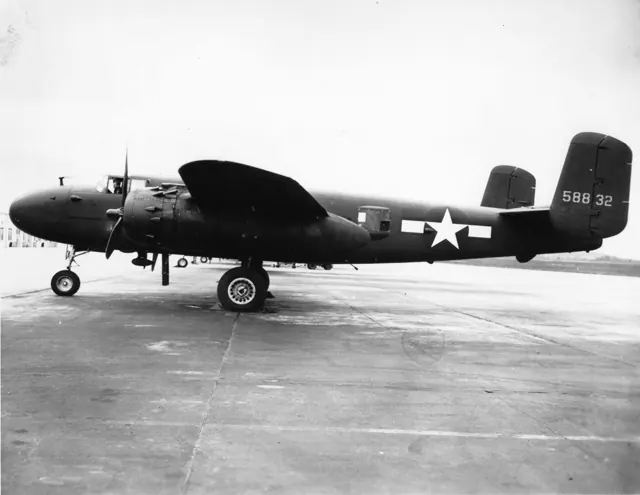
The B-25J appeared with a transparent bombardier’s nose and in a solid-nose attack configuration. Those differences matter when comparing surviving aircraft and simulator versions. The museum’s own Doolittle display is an RB-25D rebuilt to represent the raid leader’s B-25B, illustrating why an aircraft’s displayed markings and its original production identity may differ.
National Museum of the U.S. Air Force · North American B-25B Mitchell ↗National Museum of the U.S. Air Force · variants and display provenance
Development milestones
First flight: 19 August 1940
Developed from: North American NA-40
Wikipedia contributors · North American B-25 Mitchell ↗North American B-25 Mitchell · family/variant named by the source · Wikipedia revision 1371987511
Pilot accounts
Learning to work with Panchito
Haines arrived with experience in many aircraft and found the Mitchell surprisingly hard to fly gracefully. Taxiing was the first humbling lesson: small brake inputs produced abrupt changes, and observing fellow student Michael Horner did little to prepare him for trying it himself. Ground school and the walkaround made the machinery more familiar, while owner Larry Kelley’s explanations showed how much effort went into keeping Panchito flying.
In the air, Nuwer remained busy with engine settings and the many hydraulically operated systems. Haines felt the aircraft’s weight through heavy roll forces, accompanied by constant noise and vibration. The experience also made him think about the much younger crews who had flown wartime missions. His weekend brought a second-in-command endorsement and a stronger appreciation of both those crews and the volunteers preserving their aircraft.
AOPA Pilot · December 2015. Second-in-command training in the Delaware Aviation Museum Foundation’s 1944 TB-25N Panchito with Paul Nuwer.
Read the full account · AOPA Pilot ↗The noise and physical work of an old bomber
Schiff visited a B-25 kept flying partly through instruction and donations. Owner Jim Terry’s attachment began with his uncle’s wartime stories, and the restored Pacific Prowler carried that family connection into the training programme. In the cockpit, Schiff found an orderly arrangement, but starting and taxiing still required coordinated hand movements and a particularly gentle approach to the brakes.
He remembers the Mitchell as exceptionally loud, with its engines close beside the cockpit. Heavy control forces made manoeuvring physical, although he found the aircraft responsive to deliberate handling. Landing smoothly brought another challenge: keeping the nosewheel from arriving too abruptly after the main wheels touched. Throughout the flight he imagined the crews who had operated the type in wartime, an emotional response to a modern instructional flight in a surviving aircraft.
AOPA Pilot · September 2010. Flying Pacific Prowler with Scott “Gunny” Perdue in Texas; a wartime B-25J subsequently converted to an N-model trainer.
Read the full account · AOPA Pilot ↗The aircraft that changed his career
Fassold originally expected military training to lead to an airline career. Meeting the Mitchell at advanced flying school changed his plans: he liked it enough to join the permanent RCAF. He remembers moving from the dark access compartment into a bright cockpit with an excellent view, and feeling that the aircraft rewarded a pilot who understood what he wanted it to do.
Later postings gave that affection years of practical use. At Winnipeg he flew aircraft supporting airborne-interception training, then joined the VIP transport squadron in Ottawa. Taking senior officers flying sometimes meant managing much of the work from the right seat. The small Mitchell group also shared the grief of losing an aircraft and its occupants.
Vintage Wings of Canada · memoir published online August 2021. RCAF advanced training, air-observer instruction and VIP transport in the B-25.
Read the full account · Vintage Wings of Canada ↗In your simulator
Systems, equipment and documentation for each developer’s aircraft.
Compare simulator versions →X-Plane 11North American B-25 Mitchell
Khamsin · Released
North American B-25 Mitchell
Khamsin · Released
MSFS 2020B-25J Mitchell
Aeroplane Heaven · Released
B-25J Mitchell
Aeroplane Heaven · Released
Aircraft specifications
Published figures for the named real-aircraft variant. Simulator equipment and performance can differ.
| Specification | Published value |
|---|---|
| Length | 52 ft 11 in (16.13 m) |
| Wingspan | 67 ft 7 in (20.60 m) |
| Height | 16 ft 4 in (4.98 m) |
| Wing area | 618 sq ft (57.4 m² ) |
| Empty weight | 19,480 lb (8,836 kg) |
| Max takeoff weight | 35,000 lb (15,876 kg) |
| Powerplant | 2 × Wright R-2600-92 Twin Cyclone 14-cylinder two-row air-cooled radial piston engines, 1,700 hp (1,300 kW) each |
| Maximum speed | 272 mph (438 km/h, 236 kn) at 13,000 ft (4,000 m) |
| Cruise speed | 230 mph (370 km/h, 200 kn) |
| Range | 1,350 mi (2,170 km, 1,170 nmi) |
| Service ceiling | 24,200 ft (7,400 m) |
Manuals & resources
Find your next read
Choose a topic for a short introduction and a link to the original source. Simulator references identify the developer and edition they cover.
Simulator documentation
Cockpit functions and fuel managementNorth American B-25 Mitchell · Khamsin · X-Plane 11
The product description includes an on-panel checklist, operating bomb-bay doors, an interior with crew figures and management of seven fuel tanks. The listing identifies version 1.4, dated 4 July 2017, for X-Plane 11 on Windows, macOS or Linux. These details describe the publisher’s stated package scope.
X-Plane.org store · gathered 12 September 2026
Khamsin · Read the source ↗Two B-25J configurationsNorth American B-25 Mitchell · Khamsin · X-Plane 11
The designated store lists both the glass-nose B-25J bomber and a solid-nose strafer. Its paint descriptions include surviving aircraft such as Miss Mitchell, Pacific Prowler and Devil Dog. These are the package’s represented configurations and liveries; the individual real aircraft have their own conversion and restoration histories.
X-Plane.org store · Khamsin B-25 for X-Plane 11
Khamsin · Read the source ↗Pilot account
Learning to work with PanchitoAOPA Pilot · December 2015. Second-in-command training in the Delaware Aviation Museum Foundation’s 1944 TB-25N Panchito with Paul Nuwer.
Haines arrived with experience in many aircraft and found the Mitchell surprisingly hard to fly gracefully. Taxiing was the first humbling lesson: small brake inputs produced abrupt changes, and observing fellow student Michael Horner did little to prepare him for trying it himself. Ground school and the walkaround made the machinery more familiar, while owner Larry Kelley’s explanations showed how much effort went into keeping Panchito flying.
Thomas B. Haines
AOPA Pilot · Read the source ↗The noise and physical work of an old bomberAOPA Pilot · September 2010. Flying Pacific Prowler with Scott “Gunny” Perdue in Texas; a wartime B-25J subsequently converted to an N-model trainer.
Schiff visited a B-25 kept flying partly through instruction and donations. Owner Jim Terry’s attachment began with his uncle’s wartime stories, and the restored Pacific Prowler carried that family connection into the training programme. In the cockpit, Schiff found an orderly arrangement, but starting and taxiing still required coordinated hand movements and a particularly gentle approach to the brakes. He remembers the Mitchell as exceptionally loud, with its engines close beside the cockpit.
Barry Schiff
AOPA Pilot · Read the source ↗Developer documentation
B-25J Mitchell — product listingB-25J Mitchell · MSFS 2020
Product listing captured 2026-09-30; edition scope from the reviewed catalogue
www.aeroplaneheaven.com · Read the source ↗Read the original documentation from the people who created it. Manuals open on their publisher’s website.
Aircraft background
North American B-25 MitchellWikipedia contributors · Research background · retrieved 2026-09-12 North American B-25B MitchellNational Museum of the U.S. Air Force · Family development and the museum’s reconstructed B-model displayProduct
B-25 MitchellKhamsin · Official developer / designated store catalogue · checked 2026-09-12 Aeroplane Heaven - You're virtually there.™ North American B-25J Mitchell for MSFS 2020 ( 2024 compatible )www.aeroplaneheaven.com · Product listing captured 2026-09-30; edition scope from the reviewed catalogueType designator
ICAO Doc 8643 — aircraft type designatorsInternational Civil Aviation Organization · Public search data retrieved 2026-09-14; authority update 2026-09-03Built-in force-feedback profiles
Read the documentary basis, editable starting settings and remaining questions for the aircraft you fly. Each explanation refers to the exact profile revision shown.
Catalogue programme-20261022-v1 · 2 profile choices
Aeroplane Heaven B-25J Mitchell
Aeroplane Heaven · Free and Pro · Revision 3 · Inherited starting point
MSFS 2020 · MSFS 2024
Aeroplane Heaven B-25J Mitchell: Manual transport controls motivate sustained yoke resistance.
North American B-25 Mitchell
Free and Pro · Revision 1 · Partial review
X-Plane 11
North American B-25 Mitchell: Manual transport controls motivate sustained yoke resistance.
Discuss this aircraft (0)
Questions, observations and useful sources from the community.
No published discussions yet. Bring a question or share a useful source.
Open aircraft discussions →Content expanded · What’s new
Something missing or a source that needs attention?
Suggest a correction ↗