


Start here
A few places to begin, from the aircraft’s story to the people who fly it.
Meet the aircraft
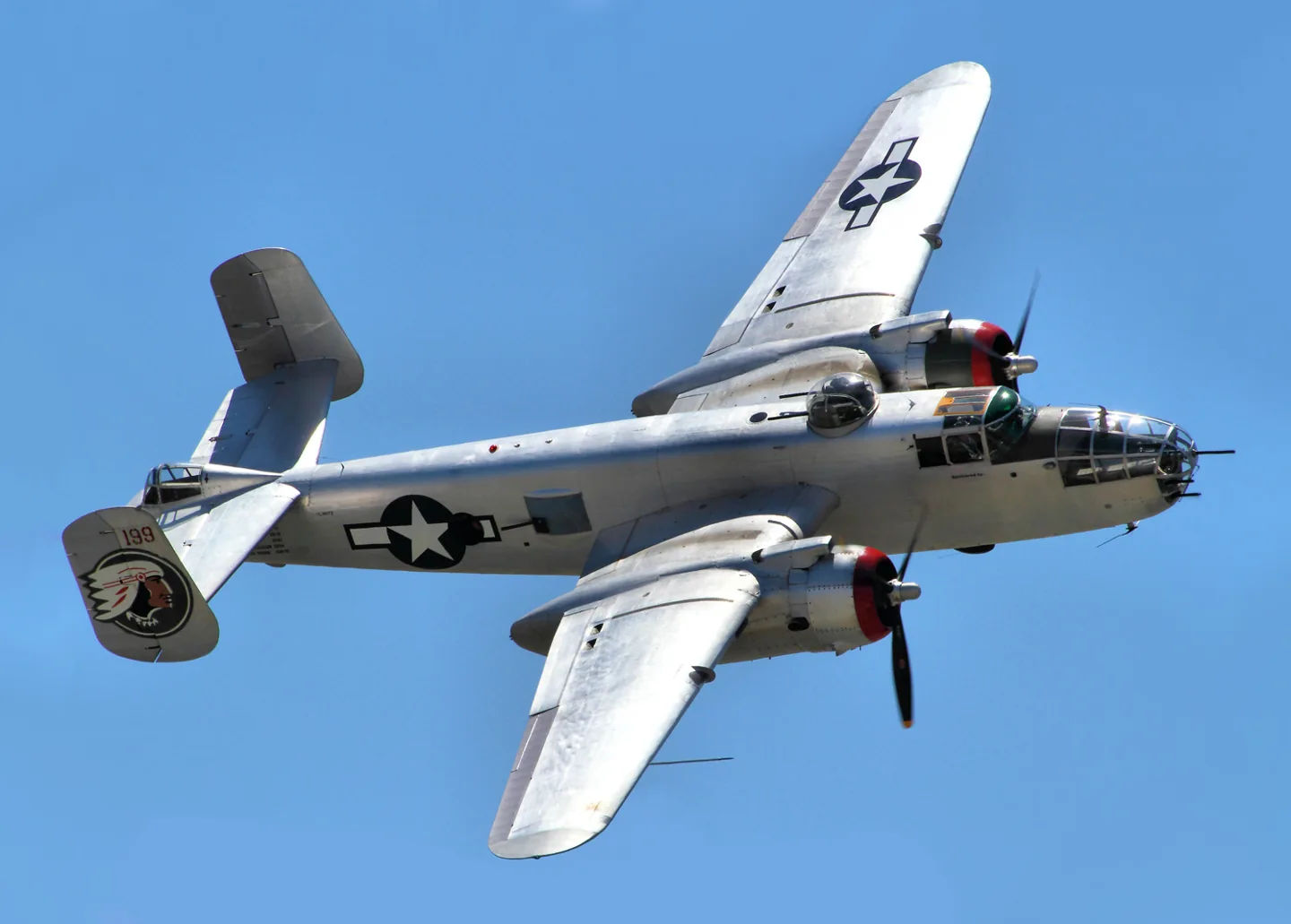
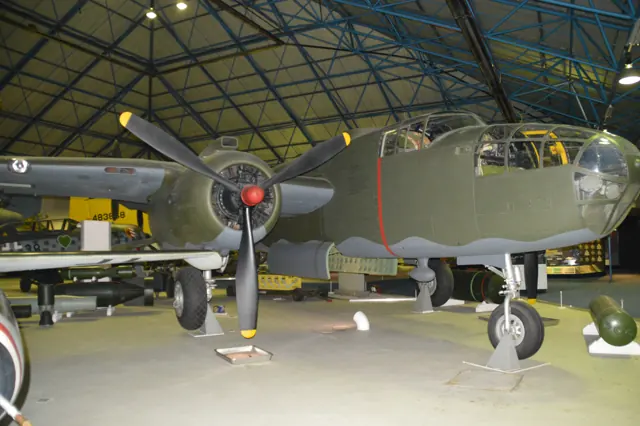
North American designed the B-25 Mitchell as a twin-engine medium bomber. Its name honours William Mitchell, an advocate for American military aviation. Multiple wartime versions carried different mission equipment. The simulator product identifies its represented version and simulator generation.
Aircraft background
Wikipedia contributors · Read more ↗Learning to work with Panchito
Haines arrived with experience in many aircraft and found the Mitchell surprisingly hard to fly gracefully. Taxiing was the first humbling lesson: small brake inputs produced abrupt changes, and observing fellow student Michael Horner did little to prepare him for trying it himself.
AOPA Pilot · December 2015. Second-in-command training in the Delaware Aviation Museum Foundation’s 1944 TB-25N Panchito with Paul Nuwer.
AOPA Pilot · Read more ↗Cockpit functions and fuel management
The product description includes an on-panel checklist, operating bomb-bay doors, an interior with crew figures and management of seven fuel tanks. The listing identifies version 1.4, dated 4 July 2017, for X-Plane 11 on Windows, macOS or Linux. These details describe the publisher’s stated package scope.
North American B-25 Mitchell · Khamsin · X-Plane 11
Khamsin · Read more ↗Into the cockpit
 YouTube
VMC Aviation Videos · 32 min ·
Fly along in a North American B-25 Cockpit from Engine Start to Shut Down
A preserved B-25J flight from engine start to shutdown, seen from the cockpit.
Real aircraft · North American B-25 Mitchell
Watch on YouTube ↗Preview images are served by AirframeDB. Videos open on YouTube only when you choose to watch.
Meet North American B-25 Mitchell
North American designed the B-25 Mitchell as a twin-engine medium bomber. Its name honours William Mitchell, an advocate for American military aviation. Multiple wartime versions carried different mission equipment. The simulator product identifies its represented version and simulator generation.
North American B-25 Mitchell
North American → · Explore the family →
North American B-25 Mitchell
Wikipedia contributors · North American B-25 Mitchell ↗Khamsin · X-Plane 11 →Aircraft type designators
Use the code for the model you are flying. The linked authority lists the applicable aircraft.
History & design
A medium bomber with several wartime jobs
First flown in August 1940, the B-25 became widely known through the Doolittle Raid of April 1942. Its work extended well beyond that mission. Designed for bombing from medium altitude, Mitchells were also used for low-level attacks against airfields and shipping in the Pacific, with successive variants adapting the nose and weapons installation to those tasks.
National Museum of the U.S. Air Force · North American B-25B Mitchell ↗National Museum of the U.S. Air Force · family history
Glass noses, solid noses and restored identities
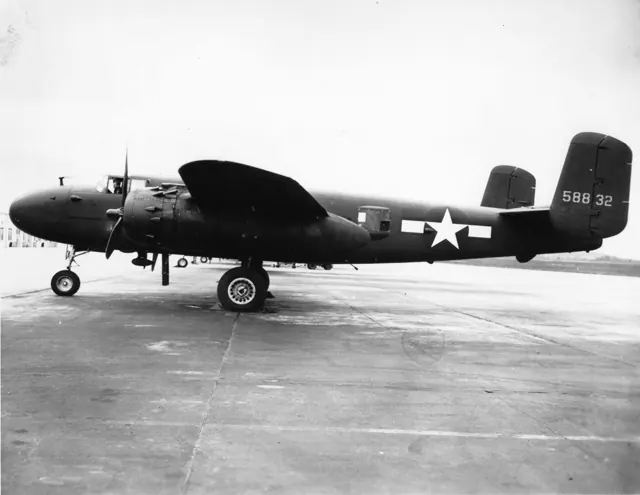
The B-25J appeared with a transparent bombardier’s nose and in a solid-nose attack configuration. Those differences matter when comparing surviving aircraft and simulator versions. The museum’s own Doolittle display is an RB-25D rebuilt to represent the raid leader’s B-25B, illustrating why an aircraft’s displayed markings and its original production identity may differ.
National Museum of the U.S. Air Force · North American B-25B Mitchell ↗National Museum of the U.S. Air Force · variants and display provenance
Development milestones
First flight: 19 August 1940
Developed from: North American NA-40
Wikipedia contributors · North American B-25 Mitchell ↗North American B-25 Mitchell · family/variant named by the source · Wikipedia revision 1371987511
Pilot accounts
Learning to work with Panchito
Haines arrived with experience in many aircraft and found the Mitchell surprisingly hard to fly gracefully. Taxiing was the first humbling lesson: small brake inputs produced abrupt changes, and observing fellow student Michael Horner did little to prepare him for trying it himself. Ground school and the walkaround made the machinery more familiar, while owner Larry Kelley’s explanations showed how much effort went into keeping Panchito flying.
In the air, Nuwer remained busy with engine settings and the many hydraulically operated systems. Haines felt the aircraft’s weight through heavy roll forces, accompanied by constant noise and vibration. The experience also made him think about the much younger crews who had flown wartime missions. His weekend brought a second-in-command endorsement and a stronger appreciation of both those crews and the volunteers preserving their aircraft.
AOPA Pilot · December 2015. Second-in-command training in the Delaware Aviation Museum Foundation’s 1944 TB-25N Panchito with Paul Nuwer.
Read the full account · AOPA Pilot ↗The noise and physical work of an old bomber
Schiff visited a B-25 kept flying partly through instruction and donations. Owner Jim Terry’s attachment began with his uncle’s wartime stories, and the restored Pacific Prowler carried that family connection into the training programme. In the cockpit, Schiff found an orderly arrangement, but starting and taxiing still required coordinated hand movements and a particularly gentle approach to the brakes.
He remembers the Mitchell as exceptionally loud, with its engines close beside the cockpit. Heavy control forces made manoeuvring physical, although he found the aircraft responsive to deliberate handling. Landing smoothly brought another challenge: keeping the nosewheel from arriving too abruptly after the main wheels touched. Throughout the flight he imagined the crews who had operated the type in wartime, an emotional response to a modern instructional flight in a surviving aircraft.
AOPA Pilot · September 2010. Flying Pacific Prowler with Scott “Gunny” Perdue in Texas; a wartime B-25J subsequently converted to an N-model trainer.
Read the full account · AOPA Pilot ↗The aircraft that changed his career
Fassold originally expected military training to lead to an airline career. Meeting the Mitchell at advanced flying school changed his plans: he liked it enough to join the permanent RCAF. He remembers moving from the dark access compartment into a bright cockpit with an excellent view, and feeling that the aircraft rewarded a pilot who understood what he wanted it to do.
Later postings gave that affection years of practical use. At Winnipeg he flew aircraft supporting airborne-interception training, then joined the VIP transport squadron in Ottawa. Taking senior officers flying sometimes meant managing much of the work from the right seat. The small Mitchell group also shared the grief of losing an aircraft and its occupants.
Vintage Wings of Canada · memoir published online August 2021. RCAF advanced training, air-observer instruction and VIP transport in the B-25.
Read the full account · Vintage Wings of Canada ↗In your simulator
Systems, equipment and documentation for each developer’s aircraft.
Compare simulator versions →X-Plane 11North American B-25 Mitchell
Khamsin · Released
North American B-25 Mitchell
Khamsin · Released
MSFS 2020B-25J Mitchell
Aeroplane Heaven · Released
B-25J Mitchell
Aeroplane Heaven · Released
Aircraft specifications
Published figures for the named real-aircraft variant. Simulator equipment and performance can differ.
| Specification | Published value |
|---|---|
| Length | 52 ft 11 in (16.13 m) |
| Wingspan | 67 ft 7 in (20.60 m) |
| Height | 16 ft 4 in (4.98 m) |
| Wing area | 618 sq ft (57.4 m² ) |
| Empty weight | 19,480 lb (8,836 kg) |
| Max takeoff weight | 35,000 lb (15,876 kg) |
| Powerplant | 2 × Wright R-2600-92 Twin Cyclone 14-cylinder two-row air-cooled radial piston engines, 1,700 hp (1,300 kW) each |
| Maximum speed | 272 mph (438 km/h, 236 kn) at 13,000 ft (4,000 m) |
| Cruise speed | 230 mph (370 km/h, 200 kn) |
| Range | 1,350 mi (2,170 km, 1,170 nmi) |
| Service ceiling | 24,200 ft (7,400 m) |
Manuals & resources
Find your next read
Choose a topic for a short introduction and a link to the original source. Simulator references identify the developer and edition they cover.
Simulator documentation
Cockpit functions and fuel managementNorth American B-25 Mitchell · Khamsin · X-Plane 11
The product description includes an on-panel checklist, operating bomb-bay doors, an interior with crew figures and management of seven fuel tanks. The listing identifies version 1.4, dated 4 July 2017, for X-Plane 11 on Windows, macOS or Linux. These details describe the publisher’s stated package scope.
X-Plane.org store · gathered 12 September 2026
Khamsin · Read the source ↗Two B-25J configurationsNorth American B-25 Mitchell · Khamsin · X-Plane 11
The designated store lists both the glass-nose B-25J bomber and a solid-nose strafer. Its paint descriptions include surviving aircraft such as Miss Mitchell, Pacific Prowler and Devil Dog. These are the package’s represented configurations and liveries; the individual real aircraft have their own conversion and restoration histories.
X-Plane.org store · Khamsin B-25 for X-Plane 11
Khamsin · Read the source ↗Pilot account
Learning to work with PanchitoAOPA Pilot · December 2015. Second-in-command training in the Delaware Aviation Museum Foundation’s 1944 TB-25N Panchito with Paul Nuwer.
Haines arrived with experience in many aircraft and found the Mitchell surprisingly hard to fly gracefully. Taxiing was the first humbling lesson: small brake inputs produced abrupt changes, and observing fellow student Michael Horner did little to prepare him for trying it himself. Ground school and the walkaround made the machinery more familiar, while owner Larry Kelley’s explanations showed how much effort went into keeping Panchito flying.
Thomas B. Haines
AOPA Pilot · Read the source ↗The noise and physical work of an old bomberAOPA Pilot · September 2010. Flying Pacific Prowler with Scott “Gunny” Perdue in Texas; a wartime B-25J subsequently converted to an N-model trainer.
Schiff visited a B-25 kept flying partly through instruction and donations. Owner Jim Terry’s attachment began with his uncle’s wartime stories, and the restored Pacific Prowler carried that family connection into the training programme. In the cockpit, Schiff found an orderly arrangement, but starting and taxiing still required coordinated hand movements and a particularly gentle approach to the brakes. He remembers the Mitchell as exceptionally loud, with its engines close beside the cockpit.
Barry Schiff
AOPA Pilot · Read the source ↗Developer documentation
B-25J Mitchell — product listingB-25J Mitchell · MSFS 2020
Product listing captured 2026-09-30; edition scope from the reviewed catalogue
www.aeroplaneheaven.com · Read the source ↗Read the original documentation from the people who created it. Manuals open on their publisher’s website.
Aircraft background
North American B-25 MitchellWikipedia contributors · Research background · retrieved 2026-09-12 North American B-25B MitchellNational Museum of the U.S. Air Force · Family development and the museum’s reconstructed B-model displayProduct
B-25 MitchellKhamsin · Official developer / designated store catalogue · checked 2026-09-12 Aeroplane Heaven - You're virtually there.™ North American B-25J Mitchell for MSFS 2020 ( 2024 compatible )www.aeroplaneheaven.com · Product listing captured 2026-09-30; edition scope from the reviewed catalogueType designator
ICAO Doc 8643 — aircraft type designatorsInternational Civil Aviation Organization · Public search data retrieved 2026-09-14; authority update 2026-09-03Built-in force-feedback profiles
Read the documentary basis, editable starting settings and remaining questions for the aircraft you fly. Each explanation refers to the exact profile revision shown.
Catalogue programme-20261022-v1 · 2 profile choices
Aeroplane Heaven B-25J Mitchell
Aeroplane Heaven · Free and Pro · Revision 3 · Inherited starting point
MSFS 2020 · MSFS 2024
Aeroplane Heaven B-25J Mitchell: Manual transport controls motivate sustained yoke resistance.
North American B-25 Mitchell
Free and Pro · Revision 1 · Partial review
X-Plane 11
North American B-25 Mitchell: Manual transport controls motivate sustained yoke resistance.
Aeroplane Heaven B-25J Mitchell
Aeroplane Heaven B-25J Mitchell: Manual transport controls motivate sustained yoke resistance.
Aircraft and simulator scope
- Aeroplane Heaven B-25J Mitchell · Aeroplane Heaven · MSFS 2020 · Add-on starting point
- Aeroplane Heaven B-25J Mitchell · Aeroplane Heaven · MSFS 2024 · Add-on starting point
The simulator model and controls
North American designed the B-25 Mitchell as a twin-engine medium bomber. Its name honours William Mitchell, an advocate for American military aviation. Multiple wartime versions carried different mission equipment. The simulator product identifies its represented version and simulator generation.
This profile selects Aeroplane Heaven B-25J Mitchell for MSFS 2020, MSFS 2024.
How this profile feels
Manual transport controls motivate sustained yoke resistance. Spring resistance builds with the selected airspeed response. A separate aerodynamic term adds speed-dependent control load.
Pitch and roll trim have separate documented controls. Valid trim provides the configured pressure relief. Autopilot following is off.
Controls and trim
The Mitchell documentation identifies trim on all three axes, hydraulic gear and a continuously moving flap selector that returns to neutral. Wing flaps and engine cowl flaps serve different systems. Modern GPS/AP equipment is separately described simulator equipment.
The selected implementation
Aeroplane Heaven’s B-25J has pitch, roll and rudder trim with hold-to-move continuous flaps. Its copilot modern GPS and autopilot are simulator additions.
About the values
The gains are normalized profile settings. They describe the chosen effect balance; hand force depends on the device and its output limits. IAS references are tuning values rather than operating limits. Physical acceptance of this revision remains pending.
Documentary review and sources
These decisions describe the documentary basis and remaining gaps for this revision. Aircraft documentation and a starting setting describe different kinds of evidence.
Aircraft and variant
InheritedThis profile selects Aeroplane Heaven B-25J Mitchell for MSFS 2020, MSFS 2024.
Flight controls
InheritedThe Mitchell documentation identifies trim on all three axes, hydraulic gear and a continuously moving flap selector that returns to neutral. Wing flaps and engine cowl flaps serve different systems. Modern GPS/AP equipment is separately described simulator equipment.
Trim
InheritedPitch and roll trim have separate documented controls. Pitch authority 0.3 provides load relief and permitted centre movement; roll authority is 0.1.
Autopilot and stability
InheritedAutopilot following is off; the configured spring and load retain the hardware feel.
Equipment
InheritedAeroplane Heaven’s B-25J has pitch, roll and rudder trim with hold-to-move continuous flaps. Its copilot modern GPS and autopilot are simulator additions.
Speeds and limits
InheritedThe indicated-speed references set the profile response scale; they are separate from aircraft operating limits.
Simulator integration
InheritedThe profile targets msfs2020, msfs2024. Add-on-specific controls use only the supported references configured by this profile.
Force-feedback settings
InheritedThe settings define the profile’s effect balance. Device output limits affect physical hand force.
Starting settings and their rationale
These configured values are starting estimates. The explanations describe what each setting controls; physical validation appears separately below.
| Setting | Starting value | What it controls and why |
|---|---|---|
| Spring strength | Starting value0.74 | What it controls and whyManual transport controls motivate sustained yoke resistance. The baseline spring is 0.74. Its low-speed blend reaches baseline strength at 65 KIAS. |
| Master force gain | Starting value0.85 | What it controls and whyScales overall profile strength while preserving effect balance, subject to device and output limits. |
| Profile force gain | Starting value0.95 | What it controls and whyThe aerodynamic-load gain is 0.95 with an indicated-speed reference of 185 KIAS. This supplies speed-dependent loading alongside the spring. |
| Force tuning speed/reference | Starting value185.0 kt | What it controls and whySets the IAS reference for aerodynamic loading. It is an estimate, not published cruise TAS or a flight limit. |
| Spring response reference speed | Starting value65 kt | What it controls and whySets the IAS where the low-speed blend reaches baseline strength; high-speed stiffening also uses it. |
| Aileron force scale | Starting value0.72 | What it controls and whyRoll and pitch aerodynamic scales are 0.72 and 1, respectively. They set the aerodynamic axis balance. No custom spring-travel curve is enabled. |
| Elevator force scale | Starting value1 | What it controls and whyScales pitch aerodynamic loading; pitch spring travel and trim responses are separate settings. |
| Trim feel | Starting valueDisabled | What it controls and whyRetained for compatibility and group membership. Trim relief, rather than this flag, controls centre movement. |
| Trim relief | Starting valueEnabled | What it controls and whyAllows trim relief with supported control law and valid telemetry. Axis authorities set its amount. |
| Autopilot follow | Starting valueDisabled | What it controls and whyAutopilot following is off; the configured spring and load retain the hardware feel. |
| Autopilot neutral hold | Starting valueDisabled | What it controls and whyPermits centering hold during a supported AP state, separate from following a moving target. |
| Output force limit | Starting value0.55 | What it controls and whyCaps directed-force output. Native spring effects and device limits remain separate. |
All 44 starting settings and their rationale
The settings define the profile’s effect balance. Device output limits affect physical hand force.
| Setting | Starting value | What it controls and why |
|---|---|---|
| Spring strength | Starting value0.74 | What it controls and whyManual transport controls motivate sustained yoke resistance. The baseline spring is 0.74. Its low-speed blend reaches baseline strength at 65 KIAS. |
| Spring deadband | Starting value0.04 | What it controls and whySets travel around the centre before the baseline spring resists. Smaller values engage it sooner. |
| Profile force gain | Starting value0.95 | What it controls and whyThe aerodynamic-load gain is 0.95 with an indicated-speed reference of 185 KIAS. This supplies speed-dependent loading alongside the spring. |
| Master force gain | Starting value0.85 | What it controls and whyScales overall profile strength while preserving effect balance, subject to device and output limits. |
| QBlend Enabled | Starting valueEnabled | What it controls and whyAllows baseline spring strength to rise with indicated airspeed where the control law permits it. |
| QSpring Minimum Factor | Starting value0.55 | What it controls and whySets low-speed spring strength as a fraction of baseline when blending is enabled. One keeps full strength. |
| QSpring Start Knots | Starting value8 kt | What it controls and whySets the IAS where the low-speed spring blend starts rising. This is a feel threshold, not a flight limit. |
| Spring response reference speed | Starting value65 kt | What it controls and whySets the IAS where the low-speed blend reaches baseline strength; high-speed stiffening also uses it. |
| Force tuning speed/reference | Starting value185.0 kt | What it controls and whySets the IAS reference for aerodynamic loading. It is an estimate, not published cruise TAS or a flight limit. |
| Airspeed spring stiffening gain | Starting value0.1 | What it controls and whyThe high-speed spring-stiffening gain is 0.1. It strengthens the permitted spring response above 65 KIAS, with the squared-speed ratio capped at 5. |
| Airspeed spring stiffening limit | Starting value5 | What it controls and whyLimits the squared airspeed ratio used for high-speed spring stiffening; it is not a device-force cap. |
| Aileron force scale | Starting value0.72 | What it controls and whyRoll and pitch aerodynamic scales are 0.72 and 1, respectively. They set the aerodynamic axis balance. No custom spring-travel curve is enabled. |
| Elevator force scale | Starting value1 | What it controls and whyScales pitch aerodynamic loading; pitch spring travel and trim responses are separate settings. |
| Output force limit | Starting value0.55 | What it controls and whyCaps directed-force output. Native spring effects and device limits remain separate. |
| Trim feel | Starting valueDisabled | What it controls and whyRetained for compatibility and group membership. Trim relief, rather than this flag, controls centre movement. |
| Trim relief | Starting valueEnabled | What it controls and whyAllows trim relief with supported control law and valid telemetry. Axis authorities set its amount. |
| Elevator Authority | Starting value0.3 | What it controls and whyPitch and roll trim have separate documented controls. Pitch authority 0.3 provides load relief and permitted centre movement; roll authority is 0.1. |
| Aileron Authority | Starting value0.1 | What it controls and whyScales supported roll-trim relief and permitted centre movement. Zero removes roll response. |
| Force Trim Enabled | Starting valueDisabled | What it controls and whyEnables local force trim, separate from aircraft-owned trim and add-on integration qualification. |
| GLoad Enabled | Starting valueEnabled | What it controls and whyAllows load-factor changes to modify permitted spring laws. Passive fly-by-wire feel can suppress it. |
| Rate Damping Enabled | Starting valueEnabled | What it controls and whyEnables rate damping with the configured coefficients and control law. |
| Autopilot follow | Starting valueDisabled | What it controls and whyAutopilot following is off; the configured spring and load retain the hardware feel. |
| Autopilot follow authority | Starting value0.05 | What it controls and whySets admitted AP-follow gain, not a percentage of travel. Runtime ownership and input limits still apply. |
| Autopilot neutral hold | Starting valueDisabled | What it controls and whyPermits centering hold during a supported AP state, separate from following a moving target. |
| Autopilot neutral hold strength | Starting value0.6 | What it controls and whySets admitted AP neutral-hold strength; inactive while neutral hold is disabled. |
| Enabled | Starting valueEnabled | What it controls and whyEnables aerodynamic cues; each still needs nonzero strength and its simulator conditions. |
| Gain | Starting value0.35 | What it controls and whySets stall-buffet strength. Zero removes the cue without changing simulator stalls or warnings. |
| Gain | Starting value0 | What it controls and whySets high-Mach buffet strength; onset and full-strength thresholds are separate. |
| Gain | Starting value0 | What it controls and whySets flap buffet at the configured position and speed gates. Flap movement texture is separate. |
| Maximum flap index | Starting value3 | What it controls and whySets the final flap index for detent normalization. UP plus three detents uses maximum index3. |
| Minimum flap index | Starting value2 | What it controls and whySets the first flap detent that admits buffet; this is a handle index, not degrees. |
| Gain | Starting value0 | What it controls and whySets gear aerodynamic buffet; movement and ground-contact cues are separate. |
| Shaker Enabled | Starting valueDisabled | What it controls and whyPermits shaker at supported warning conditions; the switch does not establish aircraft equipment. |
| Stick shaker amplitude | Starting value0.5 | What it controls and whySets triggered shaker strength; inactive while the shaker feature is disabled. |
| Enabled | Starting valueEnabled | What it controls and whyEnables ground effects; each still needs its own strength and contact or motion telemetry. |
| Gain | Starting value0.42 | What it controls and whySets rolling texture strength, modified by speed, surface and undercarriage configuration. |
| Gain | Starting value0.3 | What it controls and whySets gear-bump texture during ground motion, separate from touchdown impact. |
| Gain | Starting value0.75 | What it controls and whySets landing-impact strength; landing telemetry and response shape determine the pulse. |
| Gain | Starting value0 | What it controls and whySets reverse-thrust vibration with valid reverser and engine conditions. Zero removes the cue. |
| Enabled | Starting valueEnabled | What it controls and whyEnables engine cues with nonzero settings and valid running-engine telemetry. |
| Gain | Starting value0.12 | What it controls and whySets estimated engine vibration using configured telemetry and response, not measured cockpit vibration. |
| Enabled | Starting valueEnabled | What it controls and whyEnables accessory cues with configured strengths and observed accessory movement. |
| Gain | Starting value0.12 | What it controls and whySets texture from observed flap movement; a command without movement does not establish the cue. |
| Gain | Starting value0.12 | What it controls and whySets texture from observed gear movement, separate from aerodynamic and touchdown effects. |
Limits and open questions
- Conventional manual control approximation for this aircraft, with modest aerodynamic loading. Accessory hydraulics and avionics do not establish powered primary controls.
- Separate pitch and roll relief approximate the documented trim axes; linkage geometry and add-on neutral scaling remain unmeasured.
- Published AP equipment does not supply a calibrated servo or inceptor target. Follow and neutral hold remain disabled; no interface copied from another developer.
- Read-only native simulator channels; position input preserved. Actual accessory motion only. Custom systems, engine failures and historical operating procedures do not create unqualified force commands. Installed title/version and hardware travel remain acceptance limits.
- 185.0 KIAS is an estimated control-feel reference, not cruise TAS, V-speeds or an operating limit.
- Spring 0.74, lateral scale 0.72, trim relief 0.2/0.1; editable estimates, not measured hand forces.
- Physical and installed-aircraft checks are deferred. Save this profile as the aircraft default if telemetry omits its developer or configuration.
- Only actual accessory-position changes drive movement textures. No pressure-dependent failures, guessed servo outputs or input compensation.
- Earlier family-derived force values are superseded by this explicit review. Source limitations are not installed qualification.
Physical validation
No physical force validation is recorded in this public catalogue for this revision. Documentary review and software checks do not establish how a particular device feels.
Discuss this aircraft (0)
Questions, observations and useful sources from the community.
No published discussions yet. Bring a question or share a useful source.
Open aircraft discussions →Content expanded · What’s new
Something missing or a source that needs attention?
Suggest a correction ↗