

Start here
A few places to begin, from the aircraft’s story to the people who fly it.
Meet the aircraft
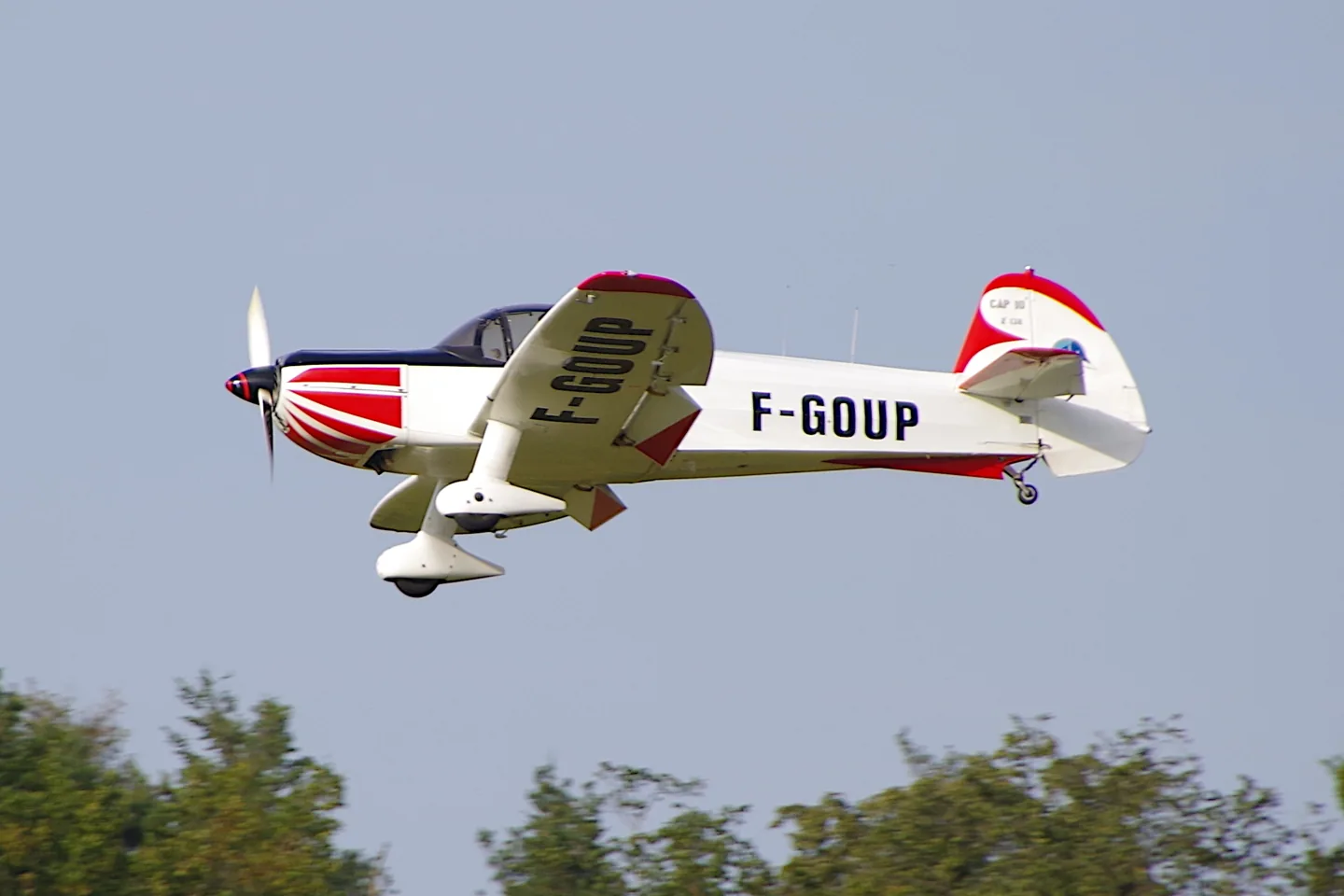
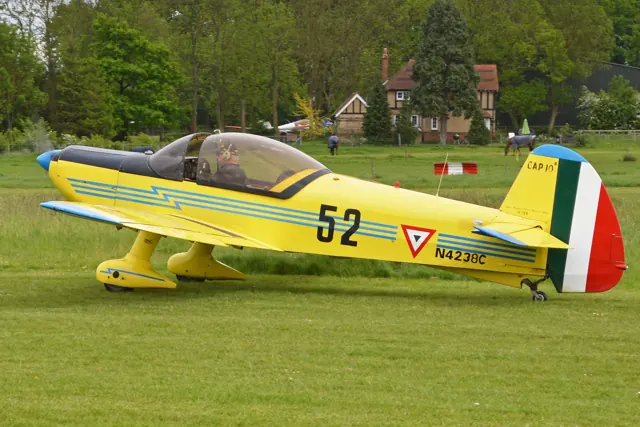
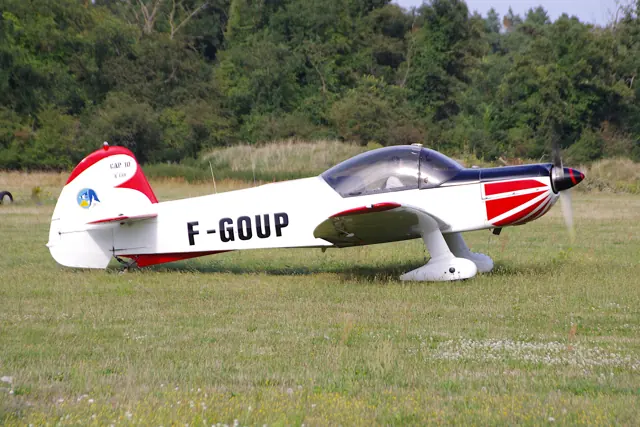
The CAP 10 developed from the Piel Emeraude and entered civilian and military aerobatic instruction. A wooden airframe and curved low wing carry two occupants side by side.
Aircraft background
Wikipedia contributors · Read more ↗Four flights turn an awkward first fit into confidence
Saget met the CAP 10 at Nangis in the company of Mudry pilot M. Buisson, whose store of flying stories he wished someone would publish. Getting strapped in was less entertaining: the harness was awkward to arrange, the seats felt close together and his head initially touched the canopy. Those cramped first impressions faded once they were flying. Across four flights, Saget developed a more detailed opinion of the prototype.
Aviation Magazine · April 1971. CAP 10 prototype 01 at Nangis with Avions Mudry pilot M. Buisson; four flights totalling one hour and fifty minutes.
Aviation Magazine / Dassault Voltige · Read more ↗Into the cockpit
 YouTube
Tuckie1000 · 17 min ·
An aerobatic training in Mudry CAP10B with Philippe Salvato
Aerobatic training with Philippe Salvato in a CAP10B, filmed in 2013.
Related variant · CAP10B
Watch on YouTube ↗Preview images are served by AirframeDB. Videos open on YouTube only when you choose to watch.
Meet Mudry CAP 10
The CAP 10 developed from the Piel Emeraude and entered civilian and military aerobatic instruction. A wooden airframe and curved low wing carry two occupants side by side.
The design passed through several manufacturers and later structural developments. Those changes account for the different company names and variant descriptions in its references.
Mudry CAP 10
Aircraft type designators
Use the code for the model you are flying. The linked authority lists the applicable aircraft.
History & design
A book helps owners recognise their aircraft’s past
A neighbour, Olivier Langeard, helped Joyce and Root identify their CAP 10’s French Connection history through a book. That discovery changed their restoration plans towards recovering its earlier air-show appearance. N780S was a surviving former team aircraft.
EAA Sport Aviation · Poetry and Power ↗Airframe provenance reported in Stanton’s restoration article
Development milestones
Designer: Nenad Hrisafović
First flight: 1968
Developed from: Piel Super Emeraude
Wikipedia contributors · Mudry CAP 10 ↗Mudry CAP 10 · family/variant named by the source · Wikipedia revision 1347387817
Pilot accounts
Four flights turn an awkward first fit into confidence
Saget met the CAP 10 at Nangis in the company of Mudry pilot M. Buisson, whose store of flying stories he wished someone would publish. Getting strapped in was less entertaining: the harness was awkward to arrange, the seats felt close together and his head initially touched the canopy. Those cramped first impressions faded once they were flying.
Across four flights, Saget developed a more detailed opinion of the prototype. He liked the aileron response but found the elevator unusually light and the rudder more demanding. The experience left him interested in what the aircraft could offer flying clubs as an aerobatic trainer.
Aviation Magazine · April 1971. CAP 10 prototype 01 at Nangis with Avions Mudry pilot M. Buisson; four flights totalling one hour and fifty minutes.
Read the full account · Aviation Magazine / Dassault Voltige ↗Two instructors bring different personalities to aerobatic training
Twombly’s first instructor, Montaine Mallet, brought an animated manner to the lesson, while Daniel Héligoin was quieter on the second flight. The side-by-side cockpit made their teaching easy to follow: he could see the instructor’s actions and gestures while learning how the aircraft responded. Ground handling and ordinary flying formed part of the introduction before the more dramatic manoeuvres.
The second lesson supplied his first outside loop, with a sensation of being thrown towards the bubble canopy. That experience gave a much more physical meaning to the aircraft’s aerobatic role.
AOPA Pilot · May 1989. CAP 10B flights with Montaine Mallet and Daniel Héligoin of the French Connection at Dutchess County Airport, Poughkeepsie.
Read the full account · AOPA Pilot ↗Restoring familiar lettering leads to a flight to Oshkosh
Coller’s favourite day in the restoration came when an artist reproduced the CAP 10’s old hand-painted lettering. Owners Tom Joyce and Kelly Root wanted the aircraft to look as it had during its French Connection air-show career, so photographs became references for recovering the script, markings and placards. The work connected a practical restoration with memories of a familiar display team.
By June 2015, Coller was making local test flights to settle the aircraft before a cross-country trip to Oshkosh. It appeared on display at AirVenture that summer. He described the satisfaction of seeing people recognise the restored aircraft and express their thanks, with its return preserving something they remembered from years of watching the French Connection perform.
Interview reported by Beth E. Stanton in Sport Aviation, May 2016. Coller restored and test-flew CAP 10B N780S for owners Tom Joyce and Kelly Root; the article also covers a separate Jet Waco.
Read the full account · EAA Sport Aviation ↗In your simulator
Systems, equipment and documentation for each developer’s aircraft.
Compare simulator versions →MSFS 2024CAP 10
Microsoft Flight Simulator · Released
CAP 10
Microsoft Flight Simulator · Released
MSFS 2020CAP 10
Microsoft Flight Simulator · Released
CAP 10
Microsoft Flight Simulator · Released
Aircraft specifications
Published figures for the named real-aircraft variant. Simulator equipment and performance can differ.
| Specification | Published value |
|---|---|
| Length | 7.16 m (23 ft 6 in) |
| Wingspan | 8.06 m (26 ft 5 in) |
| Height | 2.55 m (8 ft 4 in) |
| Wing area | 10.85 m² (116.8 sq ft) |
| Empty weight | 540 kg (1,190 lb) |
| Max takeoff weight | 760 kg (1,676 lb) |
| Powerplant | 1 × Lycoming AEIO-360-B2F 4-cylinder air-cooled, horizontally opposed, fuel injected piston engine , 134 kW (180 hp) |
| Propellers | 2-bladed Hoffmann fixed pitch wooden propeller |
| Maximum speed | 270 km/h (170 mph, 150 kn) |
| Cruise speed | 260 km/h (160 mph, 140 kn) 75% power |
| Stall speed | 100 km/h (62 mph, 54 kn) flaps up 85 km/h (53 mph; 46 kn) flaps down |
| Range | 1,200 km (750 mi, 650 nmi) |
| Service ceiling | 5,000 m (16,000 ft) |
| Rate of climb | 6 m/s (1,200 ft/min) max at sea level |
Manuals & resources
Find your next read
Choose a topic for a short introduction and a link to the original source. Simulator references identify the developer and edition they cover.
Pilot account
Four flights turn an awkward first fit into confidenceAviation Magazine · April 1971. CAP 10 prototype 01 at Nangis with Avions Mudry pilot M. Buisson; four flights totalling one hour and fifty minutes.
Saget met the CAP 10 at Nangis in the company of Mudry pilot M. Buisson, whose store of flying stories he wished someone would publish. Getting strapped in was less entertaining: the harness was awkward to arrange, the seats felt close together and his head initially touched the canopy. Those cramped first impressions faded once they were flying. Across four flights, Saget developed a more detailed opinion of the prototype.
Jean-Marie Saget
Aviation Magazine / Dassault Voltige · Read the source ↗Two instructors bring different personalities to aerobatic trainingAOPA Pilot · May 1989. CAP 10B flights with Montaine Mallet and Daniel Héligoin of the French Connection at Dutchess County Airport, Poughkeepsie.
Twombly’s first instructor, Montaine Mallet, brought an animated manner to the lesson, while Daniel Héligoin was quieter on the second flight. The side-by-side cockpit made their teaching easy to follow: he could see the instructor’s actions and gestures while learning how the aircraft responded. Ground handling and ordinary flying formed part of the introduction before the more dramatic manoeuvres.
Mark R. Twombly
AOPA Pilot · Read the source ↗Read the original documentation from the people who created it. Manuals open on their publisher’s website.
Manual
Microsoft Flight Simulator aircraft manualsMicrosoft / aircraft developersAircraft background
Mudry CAP 10Wikipedia contributors · Research background · Wikipedia revision 1347387817 · retrieved 2026-09-12Resource
MSFS 2024 FAQ and edition aircraft inventoryMicrosoft MSFS 2020 FAQ and edition aircraft inventoryMicrosoftType designator
ICAO Doc 8643 — aircraft type designatorsInternational Civil Aviation Organization · Public search data retrieved 2026-09-14; authority update 2026-09-03Built-in force-feedback profiles
Read the documentary basis, editable starting settings and remaining questions for the aircraft you fly. Each explanation refers to the exact profile revision shown.
Catalogue programme-20261022-v1 · 1 profile choice
Mudry CAP 10
Free and Pro · Revision 1 · Review pending
MSFS 2024 · MSFS 2020
Mudry CAP 10: The selected resistance supplies the aerobatic trainer’s stick balance.
Mudry CAP 10
Mudry CAP 10: The selected resistance supplies the aerobatic trainer’s stick balance.
Aircraft and simulator scope
- Mudry CAP 10 · MSFS 2024 · family starting point
- Mudry CAP 10 · MSFS 2020 · family starting point
Mudry CAP 10 · Family sources identify only the variants and product versions described above.
The simulator model and controls
The CAP 10 developed from the Piel Emeraude and entered civilian and military aerobatic instruction. A wooden airframe and curved low wing carry two occupants side by side.
This starting point selects Mudry CAP 10. Its aircraft-level settings do not select a particular developer’s custom systems.
How this profile feels
The selected resistance supplies the aerobatic trainer’s stick balance. Spring resistance builds with the selected airspeed response. A separate aerodynamic term adds speed-dependent control load.
Pitch relief is scoped to the selected CAP10 rendition. Valid trim provides the configured pressure relief. Autopilot following is off.
Controls and trim
The CAP10’s wooden low-wing airframe carries two occupants side by side for aerobatic instruction. Its Emeraude lineage and later structural/manufacturer changes retain distinct aircraft history around the represented variant.
About the values
The gains are normalized profile settings. They describe the chosen effect balance; hand force depends on the device and its output limits. IAS references are tuning values rather than operating limits. Physical acceptance of this revision remains pending.
Documentary review and sources
These decisions describe the documentary basis and remaining gaps for this revision. Aircraft documentation and a starting setting describe different kinds of evidence.
Aircraft and variant
Not yet reviewedThis starting point selects Mudry CAP 10. Its aircraft-level settings do not select a particular developer’s custom systems.
Flight controls
Not yet reviewedThe CAP10’s wooden low-wing airframe carries two occupants side by side for aerobatic instruction. Its Emeraude lineage and later structural/manufacturer changes retain distinct aircraft history around the represented variant.
Trim
Not yet reviewedPitch relief is scoped to the selected CAP10 rendition. Pitch authority 0.3 provides load relief and permitted centre movement; roll authority is 0.
Autopilot and stability
Not yet reviewedAutopilot following is off; the configured spring and load retain the hardware feel.
Equipment
Not yet reviewedGear, flap and ground cues follow the selected settings and available simulator-reported states.
Speeds and limits
Not yet reviewedThe indicated-speed references set the profile response scale; they are separate from aircraft operating limits.
Simulator integration
Not yet reviewedThe profile targets msfs2024, msfs2020. Add-on-specific controls use only the supported references configured by this profile.
Force-feedback settings
Not yet reviewedThe settings define the profile’s effect balance. Device output limits affect physical hand force.
Starting settings and their rationale
These configured values are starting estimates. The explanations describe what each setting controls; physical validation appears separately below.
| Setting | Starting value | What it controls and why |
|---|---|---|
| Spring strength | Starting value0.74 | What it controls and whyThe selected resistance supplies the aerobatic trainer’s stick balance. The baseline spring is 0.74. Its low-speed blend reaches baseline strength at 60 KIAS. |
| Master force gain | Starting value0.85 | What it controls and whyScales overall profile strength while preserving effect balance, subject to device and output limits. |
| Profile force gain | Starting value0.4 | What it controls and whyThe aerodynamic-load gain is 0.4 with an indicated-speed reference of 120 KIAS. This supplies speed-dependent loading alongside the spring. |
| Force tuning speed/reference | Starting value120.0 kt | What it controls and whySets the IAS reference for aerodynamic loading. It is an estimate, not published cruise TAS or a flight limit. |
| Spring response reference speed | Starting value60.0 kt | What it controls and whySets the IAS where the low-speed blend reaches baseline strength; high-speed stiffening also uses it. |
| Aileron force scale | Starting value0.72 | What it controls and whyRoll and pitch aerodynamic scales are 0.72 and 1, respectively. They set the aerodynamic axis balance. No custom spring-travel curve is enabled. |
| Elevator force scale | Starting value1.0 | What it controls and whyScales pitch aerodynamic loading; pitch spring travel and trim responses are separate settings. |
| Trim feel | Starting valueEnabled | What it controls and whyRetained for compatibility and group membership. Trim relief, rather than this flag, controls centre movement. |
| Trim relief | Starting valueEnabled | What it controls and whyAllows trim relief with supported control law and valid telemetry. Axis authorities set its amount. |
| Autopilot follow | Starting valueDisabled | What it controls and whyAutopilot following is off; the configured spring and load retain the hardware feel. |
| Autopilot neutral hold | Starting valueDisabled | What it controls and whyPermits centering hold during a supported AP state, separate from following a moving target. |
| Output force limit | Starting value0.55 | What it controls and whyCaps directed-force output. Native spring effects and device limits remain separate. |
All 44 starting settings and their rationale
The settings define the profile’s effect balance. Device output limits affect physical hand force.
| Setting | Starting value | What it controls and why |
|---|---|---|
| Spring strength | Starting value0.74 | What it controls and whyThe selected resistance supplies the aerobatic trainer’s stick balance. The baseline spring is 0.74. Its low-speed blend reaches baseline strength at 60 KIAS. |
| Spring deadband | Starting value0.03 | What it controls and whySets travel around the centre before the baseline spring resists. Smaller values engage it sooner. |
| Profile force gain | Starting value0.4 | What it controls and whyThe aerodynamic-load gain is 0.4 with an indicated-speed reference of 120 KIAS. This supplies speed-dependent loading alongside the spring. |
| Master force gain | Starting value0.85 | What it controls and whyScales overall profile strength while preserving effect balance, subject to device and output limits. |
| QBlend Enabled | Starting valueEnabled | What it controls and whyAllows baseline spring strength to rise with indicated airspeed where the control law permits it. |
| QSpring Minimum Factor | Starting value0.5 | What it controls and whySets low-speed spring strength as a fraction of baseline when blending is enabled. One keeps full strength. |
| QSpring Start Knots | Starting value16.8 kt | What it controls and whySets the IAS where the low-speed spring blend starts rising. This is a feel threshold, not a flight limit. |
| Spring response reference speed | Starting value60.0 kt | What it controls and whySets the IAS where the low-speed blend reaches baseline strength; high-speed stiffening also uses it. |
| Force tuning speed/reference | Starting value120.0 kt | What it controls and whySets the IAS reference for aerodynamic loading. It is an estimate, not published cruise TAS or a flight limit. |
| Airspeed spring stiffening gain | Starting value0 | What it controls and whyThe high-speed spring-stiffening gain is 0. No additional speed-driven stiffening is added; this does not disable independent aerodynamic loading. |
| Airspeed spring stiffening limit | Starting value5 | What it controls and whyLimits the squared airspeed ratio used for high-speed spring stiffening; it is not a device-force cap. |
| Aileron force scale | Starting value0.72 | What it controls and whyRoll and pitch aerodynamic scales are 0.72 and 1, respectively. They set the aerodynamic axis balance. No custom spring-travel curve is enabled. |
| Elevator force scale | Starting value1.0 | What it controls and whyScales pitch aerodynamic loading; pitch spring travel and trim responses are separate settings. |
| Output force limit | Starting value0.55 | What it controls and whyCaps directed-force output. Native spring effects and device limits remain separate. |
| Trim feel | Starting valueEnabled | What it controls and whyRetained for compatibility and group membership. Trim relief, rather than this flag, controls centre movement. |
| Trim relief | Starting valueEnabled | What it controls and whyAllows trim relief with supported control law and valid telemetry. Axis authorities set its amount. |
| Elevator Authority | Starting value0.3 | What it controls and whyPitch relief is scoped to the selected CAP10 rendition. Pitch authority 0.3 provides load relief and permitted centre movement; roll authority is 0. |
| Aileron Authority | Starting value0 | What it controls and whyScales supported roll-trim relief and permitted centre movement. Zero removes roll response. |
| Force Trim Enabled | Starting valueDisabled | What it controls and whyEnables local force trim, separate from aircraft-owned trim and add-on integration qualification. |
| GLoad Enabled | Starting valueEnabled | What it controls and whyAllows load-factor changes to modify permitted spring laws. Passive fly-by-wire feel can suppress it. |
| Rate Damping Enabled | Starting valueEnabled | What it controls and whyEnables rate damping with the configured coefficients and control law. |
| Autopilot follow | Starting valueDisabled | What it controls and whyAutopilot following is off; the configured spring and load retain the hardware feel. |
| Autopilot follow authority | Starting value0.05 | What it controls and whySets admitted AP-follow gain, not a percentage of travel. Runtime ownership and input limits still apply. |
| Autopilot neutral hold | Starting valueDisabled | What it controls and whyPermits centering hold during a supported AP state, separate from following a moving target. |
| Autopilot neutral hold strength | Starting value0.6 | What it controls and whySets admitted AP neutral-hold strength; inactive while neutral hold is disabled. |
| Enabled | Starting valueEnabled | What it controls and whyEnables aerodynamic cues; each still needs nonzero strength and its simulator conditions. |
| Gain | Starting value0.3 | What it controls and whySets stall-buffet strength. Zero removes the cue without changing simulator stalls or warnings. |
| Gain | Starting value0 | What it controls and whySets high-Mach buffet strength; onset and full-strength thresholds are separate. |
| Gain | Starting value0.14 | What it controls and whySets flap buffet at the configured position and speed gates. Flap movement texture is separate. |
| Maximum flap index | Starting value2 | What it controls and whySets the final flap index for detent normalization. UP plus three detents uses maximum index3. |
| Minimum flap index | Starting value2 | What it controls and whySets the first flap detent that admits buffet; this is a handle index, not degrees. |
| Gain | Starting value0 | What it controls and whySets gear aerodynamic buffet; movement and ground-contact cues are separate. |
| Shaker Enabled | Starting valueDisabled | What it controls and whyPermits shaker at supported warning conditions; the switch does not establish aircraft equipment. |
| Stick shaker amplitude | Starting value0.5 | What it controls and whySets triggered shaker strength; inactive while the shaker feature is disabled. |
| Enabled | Starting valueEnabled | What it controls and whyEnables ground effects; each still needs its own strength and contact or motion telemetry. |
| Gain | Starting value0.4 | What it controls and whySets rolling texture strength, modified by speed, surface and undercarriage configuration. |
| Gain | Starting value0.3 | What it controls and whySets gear-bump texture during ground motion, separate from touchdown impact. |
| Gain | Starting value0.6 | What it controls and whySets landing-impact strength; landing telemetry and response shape determine the pulse. |
| Gain | Starting value0 | What it controls and whySets reverse-thrust vibration with valid reverser and engine conditions. Zero removes the cue. |
| Enabled | Starting valueEnabled | What it controls and whyEnables engine cues with nonzero settings and valid running-engine telemetry. |
| Gain | Starting value0.12 | What it controls and whySets estimated engine vibration using configured telemetry and response, not measured cockpit vibration. |
| Enabled | Starting valueEnabled | What it controls and whyEnables accessory cues with configured strengths and observed accessory movement. |
| Gain | Starting value0.12 | What it controls and whySets texture from observed flap movement; a command without movement does not establish the cue. |
| Gain | Starting value0 | What it controls and whySets texture from observed gear movement, separate from aerodynamic and touchdown effects. |
Limits and open questions
- Selected Robin homepage describes DR401; it is not a matched CAP10 identity source.
- The selected homepage does not establish CAP10 controls.
- CAP10 trim gearing remains unresolved.
- Follow is off; no CAP10 installation was established.
- CAP10 flaps need a matched source; aerobatic role does not imply flapless equipment.
- No CAP10 IAS schedule was established.
- DR401 marketing cannot qualify CAP10 signals.
- CAP10 manual aerobatic strengths are not derived from DR401 marketing.
Physical validation
No physical force validation is recorded in this public catalogue for this revision. Documentary review and software checks do not establish how a particular device feels.
Discuss this aircraft (0)
Questions, observations and useful sources from the community.
No published discussions yet. Bring a question or share a useful source.
Open aircraft discussions →Content expanded · What’s new
Something missing or a source that needs attention?
Suggest a correction ↗