Find aircraft background, systems descriptions and manuals for the aircraft you are researching. Each note keeps its source and version context close by.
Simulator manuals describe the developer’s implementation. Aircraft background is research-based; pilot accounts describe an individual’s experience. Coverage here is limited to the selected notes and linked resources, not the full contents of every manual.
Latécoère 631
The Latécoère 631 was a French transatlantic transport project on a grand scale. Its long hull, high wing and six radial engines reflected the flying-boat approach to oceanic airline routes. Development and service were shaped by the disruption of the Second World War.
The aircraft belongs to the final large civil flying-boat era, before land-based airliners displaced that model of transport. Its multiple engines and expansive crew stations offer a very different systems and navigation context from a modern long-haul twinjet.
Aircraft / family
Learjet 45
The Learjet 45 carries forward the Learjet name in a midsize twinjet. Its two engines sit beside the rear fuselage, leaving the low wing clear of engine nacelles. The aircraft is represented here by an announced Just Flight project; a development listing is not a released simulator product.
Lockheed C-130 Hercules
The Hercules combines a high wing, four turboprops and a large cargo compartment. It was designed for military transport tasks including troops, freight and medical evacuation. The airframe also became the basis for numerous specialist aircraft, from tankers to weather and scientific platforms.
The family spans major engine and cockpit generations. A classic Hercules and a C-130J have different propulsion and crew arrangements, while specialist mission equipment creates further distinctions. The exact variant and simulator developer remain essential parts of a useful reference entry.
Aircraft / family
Lockheed L-1011 TriStar
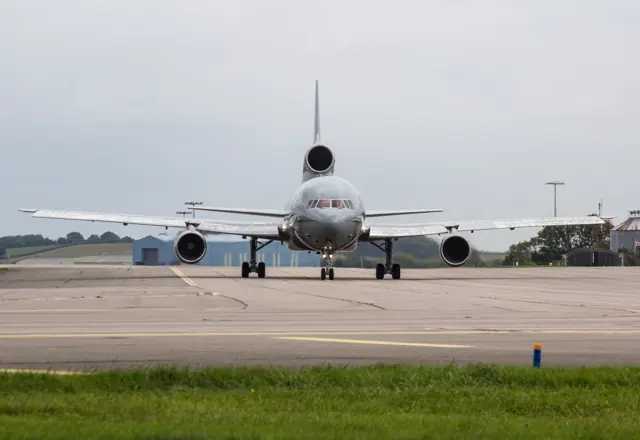
The L-1011 joined the first generation of wide-body airliners after the Boeing 747 and DC-10. Its three Rolls-Royce RB211 engines include a centre engine supplied through an S-shaped intake above the rear fuselage. Automatic landing and descent-control capability were notable parts of the design. Cabin layouts and range depend on the TriStar version.
Lockheed SR-71
Lockheed's Blackbird programme produced one of the most distinctive aircraft of the Cold War. Long chines blend into the fuselage and wing, while two large engine nacelles carry the propulsion system and inward-canted fins. The SR-71 served a strategic reconnaissance role.
Its design is closely tied to the thermal and aerodynamic demands of high-speed flight. The two-seat SR-71B trainer also has a raised rear cockpit, an important photographic distinction from the operational SR-71A. A simulator's documented systems establish how much of this specialised aircraft is represented.
Aircraft / family
M-24 Orion · Microsoft Flight Simulator · MSFS 2024
Gyroplane controls rather than helicopter controls
The M24 manual identifies dual centre sticks, a trim button, a mechanical pre-rotator and a rotor brake. The pre-rotator is used to spin up the rotor; it is not the same as a helicopter's continuously engine-driven rotor system. The cockpit diagram shows how these distinct controls are arranged.
Archived simulator manual; installed package revision not observed · PDF pp.3,5
Magni M-24 Orion
The M-24 Orion was developed by Magni Gyro in Italy. Its rotor provides lift while a separate engine-driven propeller supplies forward thrust. The enclosed cabin distinguishes it from many open-frame recreational gyroplanes.
An autogyro is a different aircraft category from a helicopter: the rotor normally turns through autorotation in flight rather than being continuously driven by the engine. That configuration makes the Orion an interesting comparison with both light helicopters and small fixed-wing aircraft in the simulator catalogue.
Aircraft / family
McDonnell Douglas F-4 Phantom II
The Phantom began as a US Navy aircraft and was subsequently adopted by the US Air Force, Marine Corps and numerous export customers. Its large intakes, upward-angled outer wing panels and downward-angled tailplanes give it a distinctive shape.
The family evolved through interceptor, strike and reconnaissance versions with different equipment. Its long service history also includes substantial national upgrades. A simulator's F-4 designation therefore needs its variant context before radar, engine or cockpit details can be meaningfully compared.
Aircraft / family
McDonnell Douglas KC-10 Extender
The KC-10 adapted the three-engine wide-body DC-10 to military tanker work. It retained the airliner's broad fuselage and characteristic tail-mounted engine while adding refuelling equipment and military systems. It served the US Air Force from 1981 to 2024.
The Extender's identity includes both its transport cabin and its fuel-transfer role. Those mission systems distinguish it from a civilian DC-10, even when the underlying airframe looks familiar. The simulator implementation needs its own account of which tanker and cargo functions are available.
Aircraft / family
McDonnell Douglas MD-11 · Rotate · Rotate · X-Plane 11 · X-Plane 12
Passenger and freight variants with a substantial systems update
Rotate's MD-11 v1.20 release covers both passenger and freighter versions. It adds SimBrief requests through ACARS/AOC pages, forecast winds, flight-plan import options and an alternative tape-style engine display. The release also revises manual handling, LSAS and control-wheel-steering behaviour. Some changes are explicitly X-Plane 12-only, so the simulator version remains part of the feature's scope.
Rotate MD-11 v1.20 · Developer release announcement and change list
McDonnell Douglas MD-11
The MD-11 retained the DC-10's three-engine arrangement, including the engine at the base of the fin. A longer fuselage, winglets and a two-pilot electronic flight deck marked the new development. Passenger and freighter versions served different markets.
Its automated systems and fuel-management arrangements are important parts of the aircraft's identity. The simulator implementation must be identified before discussing those details, because an MD-11 exterior does not establish which systems, failures or variants a developer has modelled.
Aircraft / family
McDonnell Douglas MD-80 / MD-82
The MD-80 programme developed the DC-9 into a larger airliner with an enlarged wing and later JT8D engines. The first flight took place in 1979, followed by airline service in 1980. Its T-tail and clean wing retain the family outline.
MD-81, MD-82, MD-83 and other suffixes identify different versions. Simulator products may also represent different cockpit equipment and system depth. The aircraft's control-tab arrangements are a particular point of interest, but descriptions must come from the appropriate manual rather than an assumption based on another airliner.
Aircraft / family