
Start here
A few places to begin, from the aircraft’s story to the people who fly it.
Meet the aircraft
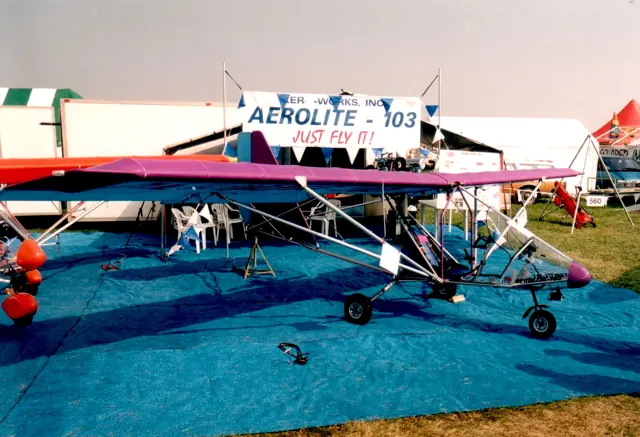
Terry Raber's Aerolite 103 combines a high wing, a pusher engine and a very light airframe. Its name refers to the US Part 103 ultralight category for which the original design was intended. The exposed cockpit and compact undercarriage make its construction easy to see. This is a very different kind of aircraft from an enclosed touring single.
Aircraft background
Wikipedia contributors · Read more ↗Responsive controls in an early Aerolite
Johnson found the early Aero-Lite 103 enjoyable to manoeuvre, with lively roll response and pitch control that remained manageable. Its coordinated handling made a favourable impression, as did the smooth operation of the control cables. He described quick departures, short landings and mild stalls during his evaluation, while recognising the need for rudder coordination. The cockpit had its own character.
EAA Experimenter, archived by Ultralight News, 1998. Early-aircraft flight evaluation, with period throttle, brake and manual-flap arrangements; archived EAA article.
EAA Experimenter, archived by Ultralight News · Read more ↗Open-air flying in X-Plane 11.20
Laminar introduced the Aerolite with X-Plane 11.20. Its announcement presents a single-seat, high-wing pusher and highlights the open view when using virtual reality.
Aero-Works Aerolite 103 · Laminar Research · X-Plane 11
Laminar Research · Read more ↗Into the cockpit
 YouTube
Fly Away Simulation · 3 min ·
Aero-Works Aerolite 103 Aircraft Add-on for MSFS
A showcase of Nemeth Designs' Aerolite for Microsoft Flight Simulator 2020.
Simulator · Nemeth Designs Aerolite · MSFS 2020
Watch on YouTube ↗Preview images are served by AirframeDB. Videos open on YouTube only when you choose to watch.
Meet Aero-Works Aerolite 103
Terry Raber's Aerolite 103 combines a high wing, a pusher engine and a very light airframe. Its name refers to the US Part 103 ultralight category for which the original design was intended. The exposed cockpit and compact undercarriage make its construction easy to see.
The pilot sits in an exposed seat with an open view of the landscape. Equipment and legal classification depend on the individual aircraft.
Aero-Works Aerolite 103
Aero-Works → · Explore the family →
Aero-Works Aerolite 103
Wikipedia contributors · Aero-Works Aerolite 103 ↗Laminar Research · X-Plane 12 →Laminar Research · X-Plane 11 →Aircraft type designators
A model-specific ICAO or FAA designator has not been confirmed in the references reviewed for this aircraft.
History & design
A small manufacturer’s combination of familiar ideas
Designer Terry Raber openly credited earlier ultralights for ideas used in the Aerolite. Dan Johnson’s 1998 report describes how he combined them into a compact aircraft and wanted to maintain a small business where customers could speak directly to the maker.
EAA Experimenter, archived by Ultralight News · Sensational Aero-Lite 103: A Pilot-Pleasing, Genuine Ultralight ↗Dan Johnson’s period report; 1998.
Pilot accounts
Responsive controls in an early Aerolite
Johnson found the early Aero-Lite 103 enjoyable to manoeuvre, with lively roll response and pitch control that remained manageable. Its coordinated handling made a favourable impression, as did the smooth operation of the control cables. He described quick departures, short landings and mild stalls during his evaluation, while recognising the need for rudder coordination.
The cockpit had its own character. Climbing aboard meant negotiating the surrounding tubes, and sitting down brought the nosewheel onto the ground. A twist-grip throttle shared its lever with the brake, while the flaps were adjusted by an overhead crank. These arrangements were fitted to the early aircraft he reviewed in 1998; later Aerolites have revised equipment.
EAA Experimenter, archived by Ultralight News, 1998. Early-aircraft flight evaluation, with period throttle, brake and manual-flap arrangements; archived EAA article.
Read the full account · EAA Experimenter, archived by Ultralight News ↗Forty-five-minute legs all the way to Oshkosh
At fourteen, Henry Scott set off from Warrenton, Virginia, for Oshkosh in an Aerolite 103. Dan Johnson's report, based on a conversation with Henry's father William, describes the preparation behind the journey: powered-paraglider experience, flights in a Cessna 150, and mountain-flying instruction before crossing the Appalachians. William chose the Aerolite partly because its familiar aircraft layout and flaps inspired confidence.
The trip became a succession of short stages, commonly about forty-five minutes, while Henry's father and sister followed by road. One day involved seven flights. Frequent stops allowed the family to reassess the weather, although Henry still encountered rain and arrived thoroughly wet on one leg. The mountains required attention to rising and sinking air. Johnson finished his article with William's message that Henry was on final at Oshkosh.
Plane + Pilot, 17 July 2019. 2019 cross-country account reported by Dan Johnson through an interview with William Scott; family ground support and preparation retained.
Read the full account · Plane + Pilot ↗Learning independence across forty-two stops
Scott returned to AirVenture in 2024 to discuss the Aerolite journey she had made the previous year. Her preparation began with powered paragliders before moving into the ultralight her father helped her buy in March 2023. Practising at different altitudes helped her become comfortable with it. Over the following months she worked on takeoffs, landings, navigation, radio communication and approaches with his support.
Her flight from South Carolina to Oshkosh took six days and forty-two stops. Her father followed by road and met her at airports to refuel the aircraft. In Abigail Oleniczak's interview, Scott describes learning to make decisions independently as the hardest part of the experience. The satisfaction came from discovering what she could accomplish herself, and she hoped telling the story would encourage other young people to pursue flying. This is her own 2023 journey, separate from Henry Scott's earlier trip.
EAA Hangar Flying, 27 July 2024. Interview reflecting on Alina’s 2023 cross-country flight, published during her 2024 AirVenture return.
Read the full account · EAA Hangar Flying ↗In your simulator
Systems, equipment and documentation for each developer’s aircraft.
Compare simulator versions →X-Plane 12Aero-Works Aerolite 103
Laminar Research · Released
Aero-Works Aerolite 103
Laminar Research · Released
X-Plane 11Aero-Works Aerolite 103
Laminar Research · Released
Aero-Works Aerolite 103
Laminar Research · Released
Manuals & resources
Find your next read
Choose a topic for a short introduction and a link to the original source. Simulator references identify the developer and edition they cover.
Simulator documentation
Open-air flying in X-Plane 11.20Aero-Works Aerolite 103 · Laminar Research · X-Plane 11
Laminar introduced the Aerolite with X-Plane 11.20. Its announcement presents a single-seat, high-wing pusher and highlights the open view when using virtual reality.
Laminar Research announcement, 9 March 2018; X-Plane 11.20.
Laminar Research · Read the source ↗Pilot account
Responsive controls in an early AeroliteEAA Experimenter, archived by Ultralight News, 1998. Early-aircraft flight evaluation, with period throttle, brake and manual-flap arrangements; archived EAA article.
Johnson found the early Aero-Lite 103 enjoyable to manoeuvre, with lively roll response and pitch control that remained manageable. Its coordinated handling made a favourable impression, as did the smooth operation of the control cables. He described quick departures, short landings and mild stalls during his evaluation, while recognising the need for rudder coordination. The cockpit had its own character.
Dan Johnson
EAA Experimenter, archived by Ultralight News · Read the source ↗Forty-five-minute legs all the way to OshkoshPlane + Pilot, 17 July 2019. 2019 cross-country account reported by Dan Johnson through an interview with William Scott; family ground support and preparation retained.
At fourteen, Henry Scott set off from Warrenton, Virginia, for Oshkosh in an Aerolite 103. Dan Johnson's report, based on a conversation with Henry's father William, describes the preparation behind the journey: powered-paraglider experience, flights in a Cessna 150, and mountain-flying instruction before crossing the Appalachians. William chose the Aerolite partly because its familiar aircraft layout and flaps inspired confidence.
Henry Scott, reported through his father William
Plane + Pilot · Read the source ↗Read the original documentation from the people who created it. Manuals open on their publisher’s website.
Manual
X-Plane 12 Desktop ManualLaminar Research X-Plane aircraft and avionics manualsLaminar ResearchAircraft background
Aero-Works Aerolite 103Wikipedia contributors · Research background · Wikipedia revision 304163334 · retrieved 2026-09-12Resource
Aerolite 103 additionLaminar ResearchBuilt-in force-feedback profiles
Read the documentary basis, editable starting settings and remaining questions for the aircraft you fly. Each explanation refers to the exact profile revision shown.
Catalogue programme-20261022-v1 · 2 profile choices
Aero-Works Aerolite 103
Free and Pro · Revision 2 · Partial review
X-Plane 12 · X-Plane 11
Aero-Works Aerolite 103: The light pusher's selected stick resistance is a profile approximation; published speeds and engine options do not supply a hand-force curve.
Nemeth Designs Aero-Works Aerolite 103
Nemeth Designs · Free and Pro · Revision 1 · Partial review
MSFS 2020 · MSFS 2024
An open, single-seat ultralight with its propeller behind the pilot.
Discuss this aircraft (0)
Questions, observations and useful sources from the community.
No published discussions yet. Bring a question or share a useful source.
Open aircraft discussions →Content expanded · What’s new
Something missing or a source that needs attention?
Suggest a correction ↗