
Start here
A few places to begin, from the aircraft’s story to the people who fly it.
Meet the aircraft
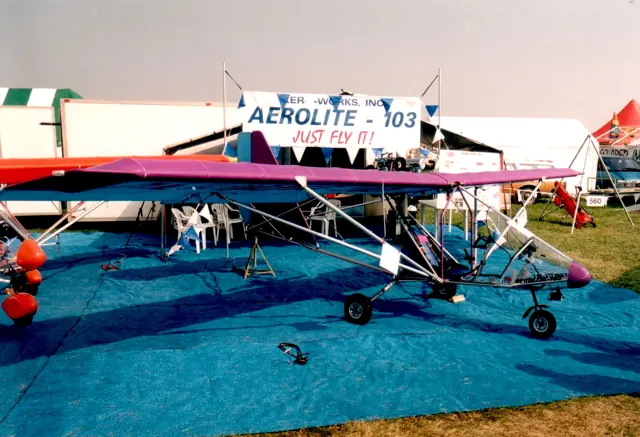
Terry Raber's Aerolite 103 combines a high wing, a pusher engine and a very light airframe. Its name refers to the US Part 103 ultralight category for which the original design was intended. The exposed cockpit and compact undercarriage make its construction easy to see. This is a very different kind of aircraft from an enclosed touring single.
Aircraft background
Wikipedia contributors · Read more ↗Responsive controls in an early Aerolite
Johnson found the early Aero-Lite 103 enjoyable to manoeuvre, with lively roll response and pitch control that remained manageable. Its coordinated handling made a favourable impression, as did the smooth operation of the control cables. He described quick departures, short landings and mild stalls during his evaluation, while recognising the need for rudder coordination. The cockpit had its own character.
EAA Experimenter, archived by Ultralight News, 1998. Early-aircraft flight evaluation, with period throttle, brake and manual-flap arrangements; archived EAA article.
EAA Experimenter, archived by Ultralight News · Read more ↗Open-air flying in X-Plane 11.20
Laminar introduced the Aerolite with X-Plane 11.20. Its announcement presents a single-seat, high-wing pusher and highlights the open view when using virtual reality.
Aero-Works Aerolite 103 · Laminar Research · X-Plane 11
Laminar Research · Read more ↗Into the cockpit
 YouTube
Fly Away Simulation · 3 min ·
Aero-Works Aerolite 103 Aircraft Add-on for MSFS
A showcase of Nemeth Designs' Aerolite for Microsoft Flight Simulator 2020.
Simulator · Nemeth Designs Aerolite · MSFS 2020
Watch on YouTube ↗Preview images are served by AirframeDB. Videos open on YouTube only when you choose to watch.
Meet Aero-Works Aerolite 103
Terry Raber's Aerolite 103 combines a high wing, a pusher engine and a very light airframe. Its name refers to the US Part 103 ultralight category for which the original design was intended. The exposed cockpit and compact undercarriage make its construction easy to see.
The pilot sits in an exposed seat with an open view of the landscape. Equipment and legal classification depend on the individual aircraft.
Aero-Works Aerolite 103
Aero-Works → · Explore the family →
Aero-Works Aerolite 103
Wikipedia contributors · Aero-Works Aerolite 103 ↗Laminar Research · X-Plane 12 →Laminar Research · X-Plane 11 →Aircraft type designators
A model-specific ICAO or FAA designator has not been confirmed in the references reviewed for this aircraft.
History & design
A small manufacturer’s combination of familiar ideas
Designer Terry Raber openly credited earlier ultralights for ideas used in the Aerolite. Dan Johnson’s 1998 report describes how he combined them into a compact aircraft and wanted to maintain a small business where customers could speak directly to the maker.
EAA Experimenter, archived by Ultralight News · Sensational Aero-Lite 103: A Pilot-Pleasing, Genuine Ultralight ↗Dan Johnson’s period report; 1998.
Pilot accounts
Responsive controls in an early Aerolite
Johnson found the early Aero-Lite 103 enjoyable to manoeuvre, with lively roll response and pitch control that remained manageable. Its coordinated handling made a favourable impression, as did the smooth operation of the control cables. He described quick departures, short landings and mild stalls during his evaluation, while recognising the need for rudder coordination.
The cockpit had its own character. Climbing aboard meant negotiating the surrounding tubes, and sitting down brought the nosewheel onto the ground. A twist-grip throttle shared its lever with the brake, while the flaps were adjusted by an overhead crank. These arrangements were fitted to the early aircraft he reviewed in 1998; later Aerolites have revised equipment.
EAA Experimenter, archived by Ultralight News, 1998. Early-aircraft flight evaluation, with period throttle, brake and manual-flap arrangements; archived EAA article.
Read the full account · EAA Experimenter, archived by Ultralight News ↗Forty-five-minute legs all the way to Oshkosh
At fourteen, Henry Scott set off from Warrenton, Virginia, for Oshkosh in an Aerolite 103. Dan Johnson's report, based on a conversation with Henry's father William, describes the preparation behind the journey: powered-paraglider experience, flights in a Cessna 150, and mountain-flying instruction before crossing the Appalachians. William chose the Aerolite partly because its familiar aircraft layout and flaps inspired confidence.
The trip became a succession of short stages, commonly about forty-five minutes, while Henry's father and sister followed by road. One day involved seven flights. Frequent stops allowed the family to reassess the weather, although Henry still encountered rain and arrived thoroughly wet on one leg. The mountains required attention to rising and sinking air. Johnson finished his article with William's message that Henry was on final at Oshkosh.
Plane + Pilot, 17 July 2019. 2019 cross-country account reported by Dan Johnson through an interview with William Scott; family ground support and preparation retained.
Read the full account · Plane + Pilot ↗Learning independence across forty-two stops
Scott returned to AirVenture in 2024 to discuss the Aerolite journey she had made the previous year. Her preparation began with powered paragliders before moving into the ultralight her father helped her buy in March 2023. Practising at different altitudes helped her become comfortable with it. Over the following months she worked on takeoffs, landings, navigation, radio communication and approaches with his support.
Her flight from South Carolina to Oshkosh took six days and forty-two stops. Her father followed by road and met her at airports to refuel the aircraft. In Abigail Oleniczak's interview, Scott describes learning to make decisions independently as the hardest part of the experience. The satisfaction came from discovering what she could accomplish herself, and she hoped telling the story would encourage other young people to pursue flying. This is her own 2023 journey, separate from Henry Scott's earlier trip.
EAA Hangar Flying, 27 July 2024. Interview reflecting on Alina’s 2023 cross-country flight, published during her 2024 AirVenture return.
Read the full account · EAA Hangar Flying ↗In your simulator
Systems, equipment and documentation for each developer’s aircraft.
Compare simulator versions →X-Plane 12Aero-Works Aerolite 103
Laminar Research · Released
Aero-Works Aerolite 103
Laminar Research · Released
X-Plane 11Aero-Works Aerolite 103
Laminar Research · Released
Aero-Works Aerolite 103
Laminar Research · Released
Manuals & resources
Find your next read
Choose a topic for a short introduction and a link to the original source. Simulator references identify the developer and edition they cover.
Simulator documentation
Open-air flying in X-Plane 11.20Aero-Works Aerolite 103 · Laminar Research · X-Plane 11
Laminar introduced the Aerolite with X-Plane 11.20. Its announcement presents a single-seat, high-wing pusher and highlights the open view when using virtual reality.
Laminar Research announcement, 9 March 2018; X-Plane 11.20.
Laminar Research · Read the source ↗Pilot account
Responsive controls in an early AeroliteEAA Experimenter, archived by Ultralight News, 1998. Early-aircraft flight evaluation, with period throttle, brake and manual-flap arrangements; archived EAA article.
Johnson found the early Aero-Lite 103 enjoyable to manoeuvre, with lively roll response and pitch control that remained manageable. Its coordinated handling made a favourable impression, as did the smooth operation of the control cables. He described quick departures, short landings and mild stalls during his evaluation, while recognising the need for rudder coordination. The cockpit had its own character.
Dan Johnson
EAA Experimenter, archived by Ultralight News · Read the source ↗Forty-five-minute legs all the way to OshkoshPlane + Pilot, 17 July 2019. 2019 cross-country account reported by Dan Johnson through an interview with William Scott; family ground support and preparation retained.
At fourteen, Henry Scott set off from Warrenton, Virginia, for Oshkosh in an Aerolite 103. Dan Johnson's report, based on a conversation with Henry's father William, describes the preparation behind the journey: powered-paraglider experience, flights in a Cessna 150, and mountain-flying instruction before crossing the Appalachians. William chose the Aerolite partly because its familiar aircraft layout and flaps inspired confidence.
Henry Scott, reported through his father William
Plane + Pilot · Read the source ↗Read the original documentation from the people who created it. Manuals open on their publisher’s website.
Manual
X-Plane 12 Desktop ManualLaminar Research X-Plane aircraft and avionics manualsLaminar ResearchAircraft background
Aero-Works Aerolite 103Wikipedia contributors · Research background · Wikipedia revision 304163334 · retrieved 2026-09-12Resource
Aerolite 103 additionLaminar ResearchBuilt-in force-feedback profiles
Read the documentary basis, editable starting settings and remaining questions for the aircraft you fly. Each explanation refers to the exact profile revision shown.
Catalogue programme-20261022-v1 · 2 profile choices
Aero-Works Aerolite 103
Free and Pro · Revision 2 · Partial review
X-Plane 12 · X-Plane 11
Aero-Works Aerolite 103: The light pusher's selected stick resistance is a profile approximation; published speeds and engine options do not supply a hand-force curve.
Nemeth Designs Aero-Works Aerolite 103
Nemeth Designs · Free and Pro · Revision 1 · Partial review
MSFS 2020 · MSFS 2024
An open, single-seat ultralight with its propeller behind the pilot.
Aero-Works Aerolite 103
Aero-Works Aerolite 103: The light pusher's selected stick resistance is a profile approximation; published speeds and engine options do not supply a hand-force curve.
Aircraft and simulator scope
- Aero-Works Aerolite 103 · X-Plane 12 · family starting point
- Aero-Works Aerolite 103 · X-Plane 11 · family starting point
U-Fly-It Aerolite 103 specification sheet; engine and empty-weight options vary. · Selected choice: Aero-Works Aerolite 103. Documentary scope does not establish every variant, add-on revision or simulator binding.
The simulator model and controls
Terry Raber's Aerolite 103 combines a high wing, a pusher engine and a very light airframe. Its name refers to the US Part 103 ultralight category for which the original design was intended. The exposed cockpit and compact undercarriage make its construction easy to see.
This starting point selects Aero-Works Aerolite 103. Its aircraft-level settings do not select a particular developer’s custom systems.
How this profile feels
Spring resistance builds with the selected airspeed response. A separate aerodynamic term adds speed-dependent control load.
Valid trim provides the configured pressure relief. Autopilot following is off.
Controls and trim
The manufacturer lists both Part 103 and heavier experimental Aerolite configurations, with different engine choices. Flap-up and flap-down performance also differs. This profile represents the named ultralight configuration with nominal stick loading; it does not assign one engine or legal category to every individually equipped Aerolite.
About the values
The gains are normalized profile settings. They describe the chosen effect balance; hand force depends on the device and its output limits. IAS references are tuning values rather than operating limits. Physical acceptance of this revision remains pending.
What the documentation establishes
The Aerolite is a single-seat ultralight, with both Part 103 and heavier experimental configurations listed.
Several engine powers and flap-up/flap-down conditions are listed; the source does not fix one engine installation for every Aerolite.
Cruise, never-exceed and stall figures are stated in mph. These are not a direct indicated-knot calibration.
Documentary review and sources
These decisions describe the documentary basis and remaining gaps for this revision. Aircraft documentation and a starting setting describe different kinds of evidence.
Aircraft and variant
ReviewedThis starting point selects Aero-Works Aerolite 103. Its aircraft-level settings do not select a particular developer’s custom systems.
Flight controls
Not yet reviewedThe manufacturer lists both Part 103 and heavier experimental Aerolite configurations, with different engine choices. Flap-up and flap-down performance also differs. This profile represents the named ultralight configuration with nominal stick loading; it does not assign one engine or legal category to every individually equipped Aerolite.
Trim
Not yet reviewedThe acquired specifications do not describe an exact trim-to-stick relationship; any enabled pitch relief remains a chosen approximation. Pitch authority 0.3 provides load relief and permitted centre movement; roll authority is 0.
Autopilot and stability
Not yet reviewedAutopilot following is off; the configured spring and load retain the hardware feel.
Equipment
ReviewedGear, flap and ground cues follow the selected settings and available simulator-reported states.
Speeds and limits
ReviewedThe indicated-speed references set the profile response scale; they are separate from aircraft operating limits.
Simulator integration
Not yet reviewedThe profile targets xplane12, xplane11. Add-on-specific controls use only the supported references configured by this profile.
Force-feedback settings
Not yet reviewedThe settings define the profile’s effect balance. Device output limits affect physical hand force.
Starting settings and their rationale
These configured values are starting estimates. The explanations describe what each setting controls; physical validation appears separately below.
| Setting | Starting value | What it controls and why |
|---|---|---|
| Spring strength | Starting value0.64 | What it controls and whyThe light pusher's selected stick resistance is a profile approximation; published speeds and engine options do not supply a hand-force curve. The baseline spring is 0.64. Its low-speed blend reaches baseline strength at 25 KIAS. |
| Master force gain | Starting value0.85 | What it controls and whyScales overall profile strength while preserving effect balance, subject to device and output limits. |
| Profile force gain | Starting value0.8 | What it controls and whyThe aerodynamic-load gain is 0.8 with an indicated-speed reference of 50 KIAS. This supplies speed-dependent loading alongside the spring. |
| Force tuning speed/reference | Starting value50.0 kt | What it controls and whySets the IAS reference for aerodynamic loading. It is an estimate, not published cruise TAS or a flight limit. |
| Spring response reference speed | Starting value25.0 kt | What it controls and whySets the IAS where the low-speed blend reaches baseline strength; high-speed stiffening also uses it. |
| Aileron force scale | Starting value0.6 | What it controls and whyRoll and pitch aerodynamic scales are 0.6 and 0.78, respectively. They set the aerodynamic axis balance. No custom spring-travel curve is enabled. |
| Elevator force scale | Starting value0.78 | What it controls and whyScales pitch aerodynamic loading; pitch spring travel and trim responses are separate settings. |
| Trim feel | Starting valueEnabled | What it controls and whyRetained for compatibility and group membership. Trim relief, rather than this flag, controls centre movement. |
| Trim relief | Starting valueEnabled | What it controls and whyAllows trim relief with supported control law and valid telemetry. Axis authorities set its amount. |
| Autopilot follow | Starting valueDisabled | What it controls and whyAutopilot following is off; the configured spring and load retain the hardware feel. |
| Autopilot neutral hold | Starting valueDisabled | What it controls and whyPermits centering hold during a supported AP state, separate from following a moving target. |
| Output force limit | Starting value0.55 | What it controls and whyCaps directed-force output. Native spring effects and device limits remain separate. |
All 44 starting settings and their rationale
The settings define the profile’s effect balance. Device output limits affect physical hand force.
| Setting | Starting value | What it controls and why |
|---|---|---|
| Spring strength | Starting value0.64 | What it controls and whyThe light pusher's selected stick resistance is a profile approximation; published speeds and engine options do not supply a hand-force curve. The baseline spring is 0.64. Its low-speed blend reaches baseline strength at 25 KIAS. |
| Spring deadband | Starting value0.045 | What it controls and whySets travel around the centre before the baseline spring resists. Smaller values engage it sooner. |
| Profile force gain | Starting value0.8 | What it controls and whyThe aerodynamic-load gain is 0.8 with an indicated-speed reference of 50 KIAS. This supplies speed-dependent loading alongside the spring. |
| Master force gain | Starting value0.85 | What it controls and whyScales overall profile strength while preserving effect balance, subject to device and output limits. |
| QBlend Enabled | Starting valueEnabled | What it controls and whyAllows baseline spring strength to rise with indicated airspeed where the control law permits it. |
| QSpring Minimum Factor | Starting value0.5 | What it controls and whySets low-speed spring strength as a fraction of baseline when blending is enabled. One keeps full strength. |
| QSpring Start Knots | Starting value7.0 kt | What it controls and whySets the IAS where the low-speed spring blend starts rising. This is a feel threshold, not a flight limit. |
| Spring response reference speed | Starting value25.0 kt | What it controls and whySets the IAS where the low-speed blend reaches baseline strength; high-speed stiffening also uses it. |
| Force tuning speed/reference | Starting value50.0 kt | What it controls and whySets the IAS reference for aerodynamic loading. It is an estimate, not published cruise TAS or a flight limit. |
| Airspeed spring stiffening gain | Starting value0.15 | What it controls and whyThe high-speed spring-stiffening gain is 0.15. It strengthens the permitted spring response above 25 KIAS, with the squared-speed ratio capped at 5. |
| Airspeed spring stiffening limit | Starting value5 | What it controls and whyLimits the squared airspeed ratio used for high-speed spring stiffening; it is not a device-force cap. |
| Aileron force scale | Starting value0.6 | What it controls and whyRoll and pitch aerodynamic scales are 0.6 and 0.78, respectively. They set the aerodynamic axis balance. No custom spring-travel curve is enabled. |
| Elevator force scale | Starting value0.78 | What it controls and whyScales pitch aerodynamic loading; pitch spring travel and trim responses are separate settings. |
| Output force limit | Starting value0.55 | What it controls and whyCaps directed-force output. Native spring effects and device limits remain separate. |
| Trim feel | Starting valueEnabled | What it controls and whyRetained for compatibility and group membership. Trim relief, rather than this flag, controls centre movement. |
| Trim relief | Starting valueEnabled | What it controls and whyAllows trim relief with supported control law and valid telemetry. Axis authorities set its amount. |
| Elevator Authority | Starting value0.3 | What it controls and whyThe acquired specifications do not describe an exact trim-to-stick relationship; any enabled pitch relief remains a chosen approximation. Pitch authority 0.3 provides load relief and permitted centre movement; roll authority is 0. |
| Aileron Authority | Starting value0 | What it controls and whyScales supported roll-trim relief and permitted centre movement. Zero removes roll response. |
| Force Trim Enabled | Starting valueDisabled | What it controls and whyEnables local force trim, separate from aircraft-owned trim and add-on integration qualification. |
| GLoad Enabled | Starting valueEnabled | What it controls and whyAllows load-factor changes to modify permitted spring laws. Passive fly-by-wire feel can suppress it. |
| Rate Damping Enabled | Starting valueEnabled | What it controls and whyEnables rate damping with the configured coefficients and control law. |
| Autopilot follow | Starting valueDisabled | What it controls and whyAutopilot following is off; the configured spring and load retain the hardware feel. |
| Autopilot follow authority | Starting value0.1 | What it controls and whySets admitted AP-follow gain, not a percentage of travel. Runtime ownership and input limits still apply. |
| Autopilot neutral hold | Starting valueDisabled | What it controls and whyPermits centering hold during a supported AP state, separate from following a moving target. |
| Autopilot neutral hold strength | Starting value0.6 | What it controls and whySets admitted AP neutral-hold strength; inactive while neutral hold is disabled. |
| Enabled | Starting valueEnabled | What it controls and whyEnables aerodynamic cues; each still needs nonzero strength and its simulator conditions. |
| Gain | Starting value0.35 | What it controls and whySets stall-buffet strength. Zero removes the cue without changing simulator stalls or warnings. |
| Gain | Starting value0 | What it controls and whySets high-Mach buffet strength; onset and full-strength thresholds are separate. |
| Gain | Starting value0.14 | What it controls and whySets flap buffet at the configured position and speed gates. Flap movement texture is separate. |
| Maximum flap index | Starting value2 | What it controls and whySets the final flap index for detent normalization. UP plus three detents uses maximum index3. |
| Minimum flap index | Starting value2 | What it controls and whySets the first flap detent that admits buffet; this is a handle index, not degrees. |
| Gain | Starting value0 | What it controls and whySets gear aerodynamic buffet; movement and ground-contact cues are separate. |
| Shaker Enabled | Starting valueDisabled | What it controls and whyPermits shaker at supported warning conditions; the switch does not establish aircraft equipment. |
| Stick shaker amplitude | Starting value0.5 | What it controls and whySets triggered shaker strength; inactive while the shaker feature is disabled. |
| Enabled | Starting valueEnabled | What it controls and whyEnables ground effects; each still needs its own strength and contact or motion telemetry. |
| Gain | Starting value0.4 | What it controls and whySets rolling texture strength, modified by speed, surface and undercarriage configuration. |
| Gain | Starting value0.25 | What it controls and whySets gear-bump texture during ground motion, separate from touchdown impact. |
| Gain | Starting value0.65 | What it controls and whySets landing-impact strength; landing telemetry and response shape determine the pulse. |
| Gain | Starting value0 | What it controls and whySets reverse-thrust vibration with valid reverser and engine conditions. Zero removes the cue. |
| Enabled | Starting valueEnabled | What it controls and whyEnables engine cues with nonzero settings and valid running-engine telemetry. |
| Gain | Starting value0.12 | What it controls and whySets estimated engine vibration using configured telemetry and response, not measured cockpit vibration. |
| Enabled | Starting valueEnabled | What it controls and whyEnables accessory cues with configured strengths and observed accessory movement. |
| Gain | Starting value0.12 | What it controls and whySets texture from observed flap movement; a command without movement does not establish the cue. |
| Gain | Starting value0 | What it controls and whySets texture from observed gear movement, separate from aerodynamic and touchdown effects. |
Limits and open questions
- The specification sheet does not identify control linkages or aerodynamic loads reaching the Aerolite stick.
- Flap-related stall speeds are supplied, but elevator-trim equipment or control travel is not described.
- No Aerolite autopilot equipment or simulator servo interface is identified in this specification sheet.
- An aircraft specification sheet does not document simulator control bindings or effect telemetry.
- Low published speeds alone do not determine Aerolite spring strength, propwash response or pitch-to-roll force ratio.
Physical validation
No physical force validation is recorded in this public catalogue for this revision. Documentary review and software checks do not establish how a particular device feels.
Discuss this aircraft (0)
Questions, observations and useful sources from the community.
No published discussions yet. Bring a question or share a useful source.
Open aircraft discussions →Content expanded · What’s new
Something missing or a source that needs attention?
Suggest a correction ↗