

Start here
A few places to begin, from the aircraft’s story to the people who fly it.
Meet the aircraft
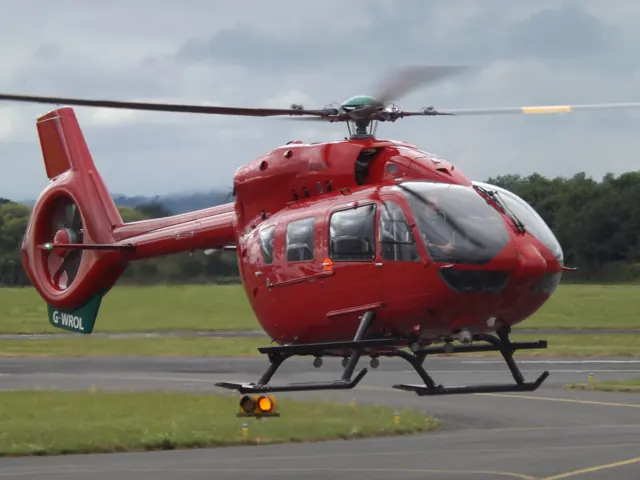
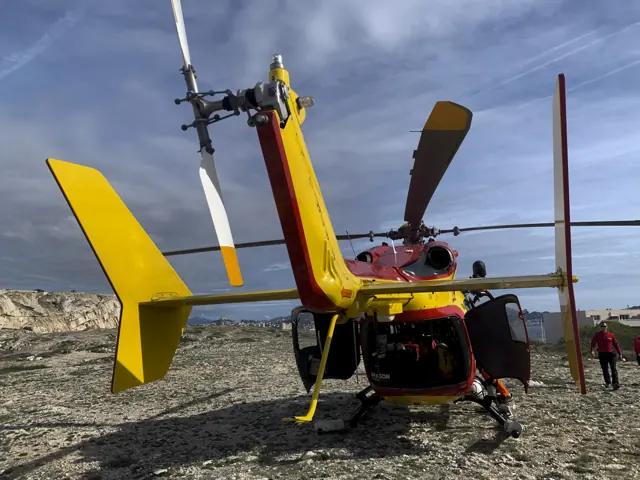
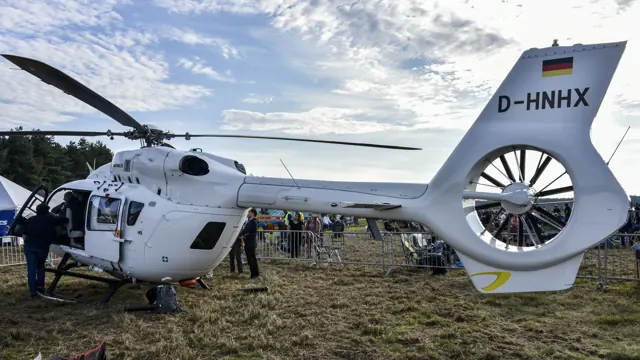
The H145 developed through the BK 117 and EC145 line. Its roomy cabin has made the family useful for emergency medical services, police work and passenger transport. Later H145 developments introduced the enclosed Fenestron tail rotor and, subsequently, a five-bladed main rotor. Earlier EC145s have a different rotor and tail arrangement from newer H145s.
Aircraft background
Wikipedia contributors · Read more ↗A prototype visit reveals how much the ride has changed
Duke arrived in Germany to find out what replacing the H145’s longstanding rotor system would mean in flight. The prototype still carried conspicuous test equipment and cabling, but the first hover drew his attention to something much less visible: how little vibration he could feel. Photographer Lloyd Horgan noticed the improvement from the cabin too. After trying the automation, Duke explored the aircraft with progressively less assistance.
Vertical · 2020. Late-October demonstration at Donauwörth with Volker Bau and Antoine Van Gent, in a five-bladed prototype carrying flight-test equipment.
Vertical · Read more ↗The weight page changes the aircraft, with a display caveat
The October 2022 guide lets users enter payload, crew and fuel on the VMS WEIGHT page and commit with VAL. It warns that those changes affect the aircraft without updating the separate MSFS weight dialog. Its engine-power-check page was not implemented in that documented version.
Airbus H145 · Hype Performance Group · MSFS 2020 · MSFS 2024
Hype Performance Group · Read more ↗Into the cockpit
 YouTube
Shipmeck
HPG H145 Basic Autopilot Use
A focused introduction to using the HPG H145 autopilot.
HPG H145; simulator autopilot tutorial
Watch on YouTube ↗Preview images are served by AirframeDB. Videos open on YouTube only when you choose to watch.
Meet Airbus H145
The H145 developed through the BK 117 and EC145 line. Its roomy cabin has made the family useful for emergency medical services, police work and passenger transport. Later H145 developments introduced the enclosed Fenestron tail rotor and, subsequently, a five-bladed main rotor.
Earlier EC145s have a different rotor and tail arrangement from newer H145s. Avionics and automatic flight-control equipment also depend on the generation and installation. Each simulator product identifies its represented configuration.
Airbus H145
Aircraft type designators
Use the code for the model you are flying. The linked authority lists the applicable aircraft.
History & design
A long family history meets a different rotor
Duke traces the H145 through the BK117 and EC145, explaining how the earlier rotor lineage finally gave way to a five-bladed design. Prototypes, certification and prospective retrofits were still under discussion in 2020.
Vertical · What it is like to fly the new five-bladed H145 ↗Family development; later five-bladed configuration
Firefighting broadens the picture of H145 work
Hillsboro’s first five-bladed H145 fire season included water-bucket work, crew transport and reconnaissance across several western US states. The operator’s 2025 retrospective adds those working roles to the type’s familiar medical and passenger-transport applications.
Airbus · Fighting fires with five blades ↗Operator’s account of its 2024 season
Development milestones
First flight: 12 June 1999
Developed from: MBB/Kawasaki BK 117
Wikipedia contributors · Eurocopter EC145 ↗Eurocopter EC145 · family/variant named by the source · Wikipedia revision 1374052604
Pilot accounts
A prototype visit reveals how much the ride has changed
Duke arrived in Germany to find out what replacing the H145’s longstanding rotor system would mean in flight. The prototype still carried conspicuous test equipment and cabling, but the first hover drew his attention to something much less visible: how little vibration he could feel. Photographer Lloyd Horgan noticed the improvement from the cabin too.
After trying the automation, Duke explored the aircraft with progressively less assistance. Direct control remained comfortable once he adjusted to the required movements. An approach into an unfamiliar gliding field highlighted the cockpit’s visibility, before Bau took over for more vigorous demonstrations. Later conversation with the test team revealed another part of development: convincing colleagues that the new rotor would work.
Vertical · 2020. Late-October demonstration at Donauwörth with Volker Bau and Antoine Van Gent, in a five-bladed prototype carrying flight-test equipment.
Read the full account · Vertical ↗An everyday H145 pilot tries the next version
Tosi approached the demonstration with experience of both the EC145 and four-bladed H145 in his civilian work. As a National Guardsman, he also wanted to assess the new Lakota configuration. The Mississippi heat supplied an immediate reason to appreciate the quick start and improved air conditioning before they even left the ramp.
His strongest impression was the smoother ride, particularly in the cabin. He also watched Aaron Hupp demonstrate simulated engine failures, considering what that capability would mean for the rooftop hospital operations he knew. Tosi welcomed several smaller refinements while observing that cruise speed had not meaningfully changed. His enthusiastic assessment is rooted in comparison with aircraft he regularly flew, and he explicitly acknowledged that his usual near-sea-level work shaped his view of available performance.
Vertical · November 2021. August flight from Columbus, Mississippi, with Aaron Hupp in a five-bladed H145 D3 configured as a UH-72B demonstrator.
Read the full account · Vertical ↗A new helicopter becomes familiar over a fire season
For Ludwig, learning the H145 became a season of practical discoveries. Firefighting work could leave a long journey back to base at the end of the day, and she particularly appreciated the autopilot on those return flights. It was equally welcome during lengthy ferry trips between assignments.
Her mountain work in Wyoming and Colorado strengthened her affection for the aircraft. She recalled transporting a crew and equipment to a high landing site and using a variable-fill bucket on fires. By the end of the season, the H145 had become so familiar that returning to a helicopter she had flown for years felt surprisingly foreign. Airbus published the interview as a customer story.
Airbus customer interview · June 2025, recalling Hillsboro Aviation’s 2024 season with the five-bladed H145. Individual missions and loading conditions vary.
Read the full account · Airbus ↗A difficult night flight to bring a patient to hospital
Gourley recalled a night mission to collect a patient suffering a heart attack on Stewart Island. Changing weather and strong winds stretched the task to more than three hours. The crew used the routes and navigation available to their operation, while the medical team stabilised the patient before transferring him to hospital.
For Gourley, that flight illustrated why cockpit systems mattered in the demanding environment of southern New Zealand. His wider work combined day and night flying, changing terrain and uncertain weather, with medical needs setting the destination. He valued the five-bladed aircraft’s smoothness and the assistance provided by Helionix. Airbus published the interview with Gourley.
Airbus customer interview · October 2022. Heli Otago mission from Taieri to Stewart Island and Dunedin; the exact flight date and registration are not given.
Read the full account · Airbus ↗In your simulator
Systems, equipment and documentation for each developer’s aircraft.
Compare simulator versions →MSFS 2020 · MSFS 2024Airbus H145 · Hype Performance Group
Hype Performance Group · Released
Airbus H145 · Hype Performance Group
Hype Performance Group · Released
MSFS 2020 · MSFS 2024H145
HPG · Released
H145
HPG · Released
Aircraft specifications
Published figures for the named real-aircraft variant. Simulator equipment and performance can differ.
| Specification | Published value |
|---|---|
| Length | 13.54 m (44 ft 5 in) |
| Height | 3.45 m (11 ft 4 in) (EC145 C-2) |
| Empty weight | 1,895 kg (4,178 lb) baseline aircraft definitions |
| Max takeoff weight | 3,800 kg (8,378 lb) with or without external load |
| Powerplant | 2 × Safran Arriel 2E turboshaft engines, 667 kW (894 hp) each for take-off |
| Main rotor diameter | 10.8 m (35 ft 5 in) |
| Main rotor area | 95 m² (1,020 sq ft) root: NACA 23012 ; tip: NACA 23010 |
| Cruise speed | 241 km/h (150 mph, 130 kn) (recommendation for H145) |
| Range | 650 km (400 mi, 350 nmi) with standard fuel tanks at SL |
| Service ceiling | 6,096 m (20,000 ft) for take-off and landing |
| Rate of climb | 8.1 m/s (1,590 ft/min) (EC145 C-2) |
Manuals & resources
Find your next read
Choose a topic for a short introduction and a link to the original source. Simulator references identify the developer and edition they cover.
Simulator documentation
Failures and maintenance are controlled through the tabletAirbus H145 · Hype Performance Group · Hype Performance Group · MSFS 2020 · MSFS 2024
The guide separates active failures from accumulated damage and degradation. Aircraft Damage can be disabled, while Do All Maintenance resets damage. Mission triggers can introduce failures, giving the package a configurable systems layer beyond its normal cockpit operation.
HPG H145 guide v1.0 · PDF pp.63–65
Hype Performance Group · Read the source ↗Basic stabilisation, upper modes and trim releaseAirbus H145 · Hype Performance Group · Hype Performance Group · MSFS 2020 · MSFS 2024
HPG's AFCS reference distinguishes basic attitude stabilisation from upper modes such as altitude, airspeed, navigation and ground-trajectory control. Automatic trim is required for upper-mode operation, while cyclic trim release pauses the control logic for pilot input. The guide also describes follow-up-trim settings.
HPG H145 online documentation · AFCS background, trim release and upper modes
Hype Performance Group · Read the source ↗The weight page changes the aircraft, with a display caveatAirbus H145 · Hype Performance Group · Hype Performance Group · MSFS 2020 · MSFS 2024
The October 2022 guide lets users enter payload, crew and fuel on the VMS WEIGHT page and commit with VAL. It warns that those changes affect the aircraft without updating the separate MSFS weight dialog. Its engine-power-check page was not implemented in that documented version.
HPG H145 guide v1.0 · PDF p.38
Hype Performance Group · Read the source ↗Helionix displays and mission equipmentAirbus H145 · Hype Performance Group · Hype Performance Group · MSFS 2020 · MSFS 2024
HPG's archived H145 guide identifies the BK-117 D2 and separates Base Pack from Action Pack features. It documents Helionix display pages, GTN750 integration options, failures and maintenance, and the tablet interface. The Action Pack adds equipment such as a hoist, cargo hook and water bucket. The October 2022 PDF covers MSFS 2020; later changes are recorded in the online documentation.
HPG H145 · PDF v1.0, October 2022 · MSFS 2020 · PDF pp.1–8; contents and package scope
Hype Performance Group · Read the source ↗Pilot account
A prototype visit reveals how much the ride has changedVertical · 2020. Late-October demonstration at Donauwörth with Volker Bau and Antoine Van Gent, in a five-bladed prototype carrying flight-test equipment.
Duke arrived in Germany to find out what replacing the H145’s longstanding rotor system would mean in flight. The prototype still carried conspicuous test equipment and cabling, but the first hover drew his attention to something much less visible: how little vibration he could feel. Photographer Lloyd Horgan noticed the improvement from the cabin too. After trying the automation, Duke explored the aircraft with progressively less assistance.
Jon Duke
Vertical · Read the source ↗An everyday H145 pilot tries the next versionVertical · November 2021. August flight from Columbus, Mississippi, with Aaron Hupp in a five-bladed H145 D3 configured as a UH-72B demonstrator.
Tosi approached the demonstration with experience of both the EC145 and four-bladed H145 in his civilian work. As a National Guardsman, he also wanted to assess the new Lakota configuration. The Mississippi heat supplied an immediate reason to appreciate the quick start and improved air conditioning before they even left the ramp. His strongest impression was the smoother ride, particularly in the cabin.
Michael Tosi
Vertical · Read the source ↗Developer documentation
H145 — product listingH145 · MSFS 2020 · MSFS 2024
Product listing captured 2026-09-30; edition scope from the reviewed catalogue
www.hypeperformancegroup.com · Read the source ↗Read the original documentation from the people who created it. Manuals open on their publisher’s website.
Manual
H145 User GuideHype Performance Group Microsoft Flight Simulator aircraft manualsMicrosoft / aircraft developersAircraft background
Eurocopter EC145Wikipedia contributors · Research background · Wikipedia revision 1374052604 · retrieved 2026-09-12Resource
H145 AFCSHype Performance GroupDeveloper reference
H145 SDK H eventsHype Performance GroupProduct
H145 Base PackHype Performance Group · Official developer / designated store catalogue · checked 2026-09-12 H145 Action PackHype Performance Group · Official developer / designated store catalogue · checked 2026-09-12Type designator
ICAO Doc 8643 — aircraft type designatorsInternational Civil Aviation Organization · Public search data retrieved 2026-09-14; authority update 2026-09-03Built-in force-feedback profiles
Read the documentary basis, editable starting settings and remaining questions for the aircraft you fly. Each explanation refers to the exact profile revision shown.
Catalogue programme-20261022-v1 · 3 profile choices
HPG H145
Hype Performance Group · Free and Pro · Revision 2 · Inherited starting point
MSFS 2020 · MSFS 2024
HPG H145: The selected cyclic spring and damping represent a reduced control feel; the H145 AFCS manages feedback and stabilization beyond these settings.
Airbus H145 D3 (five-blade)
Free and Pro · Revision 1 · Partial review
MSFS 2024 · MSFS 2020
Airbus H145 D3 (five-blade): The selected cyclic spring and damping represent a reduced control feel; the H145 AFCS manages feedback and stabilization beyond these settings.
Airbus H145 D2 (four-blade)
Free and Pro · Revision 1 · Partial review
MSFS 2024 · MSFS 2020
Airbus H145 D2 (four-blade): The selected cyclic spring and damping represent a reduced control feel; the H145 AFCS manages feedback and stabilization beyond these settings.
Documented interfaces
Source-documented identifiers. Documentation does not prove that every add-on populates a value correctly.
H:H145_SDK_CYCLIC_FORCE_TRIM_SET_NEW_CENTER
Cyclic force-trim new-center event.
- Units
- not specified
- Access
- send
Public guide snapshot; package unobserved
Hype Performance Group · SDK event entry ↗Discuss this aircraft (0)
Questions, observations and useful sources from the community.
No published discussions yet. Bring a question or share a useful source.
Open aircraft discussions →Content expanded · What’s new
Something missing or a source that needs attention?
Suggest a correction ↗