


Start here
A few places to begin, from the aircraft’s story to the people who fly it.
Meet the aircraft
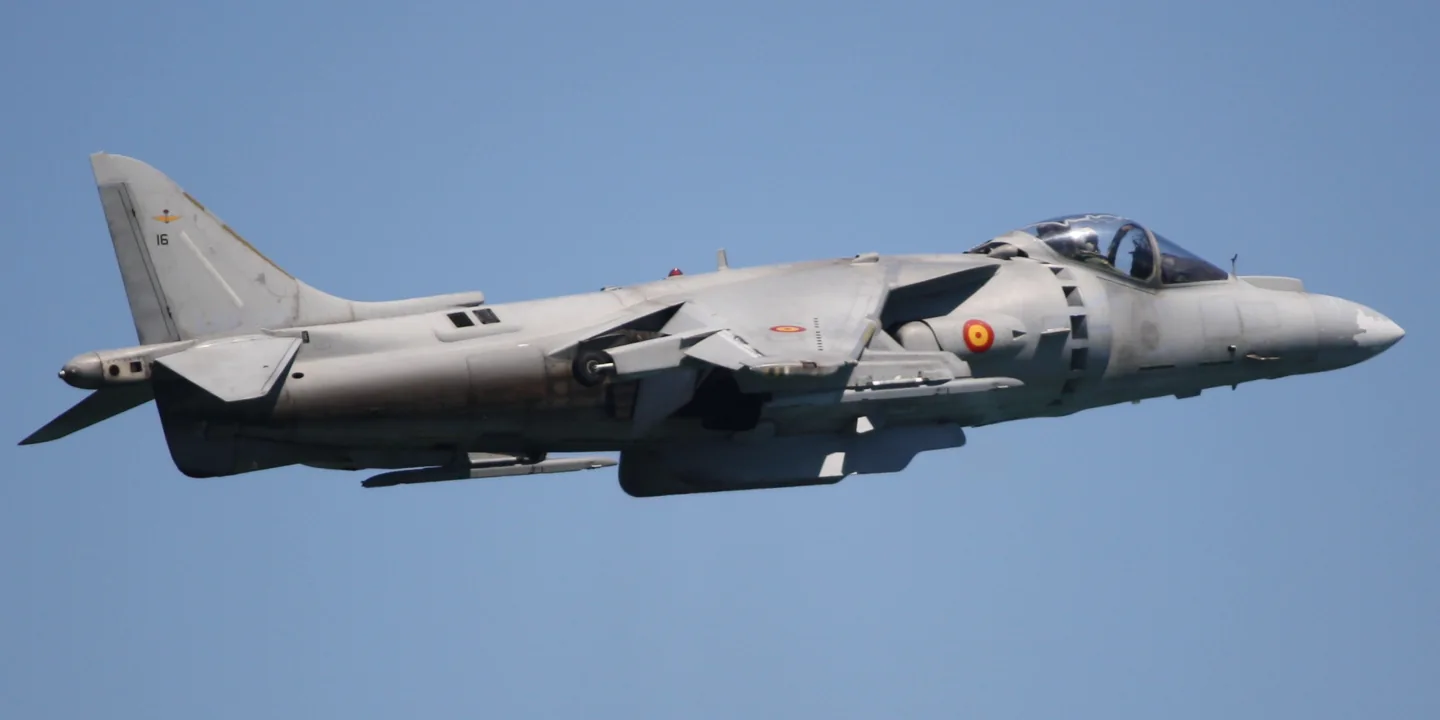
The AV-8B developed the vectored-thrust Harrier into a second generation of ground-attack aircraft. It served in close air support and reconnaissance roles in the United States, Spain and Italy. The British Harrier II and tandem-seat TAV-8B are related developments. The simulator product represents the AV-8B.
Aircraft background
Wikipedia contributors · Read more ↗The first ski-jump looks like a wall
Moving from the Hawk to the Harrier gave Schofield a much larger set of flying techniques to keep practised. He remembered the vibration on the ground, the view from the cockpit and the unusual experience of hovering over a field with cows nearby. Even returning after a weekend could leave a pilot feeling rusty in one part of the repertoire. His first carrier ski-jump departure brought a different surprise.
Hush-Kit interview · February 2019. RAF Harrier GR.7 conversion in 2000; this British Harrier II account does not establish identical AV-8B cockpit equipment.
Hush-Kit · Read more ↗Adjust how the simulator presents movement and sound
The package lists a Smartview camera tied to flight path and speed, configurable sounds and aural warnings, and optional particle effects. These presentation settings accompany the aircraft’s navigation and flight controls.
McDonnell Douglas AV-8B Harrier II · X-Trident · X-Plane 11
X-Trident · Read more ↗Into the cockpit
 YouTube
USA Military Channel · 9 min ·
COCKPIT VIEW - AV-8B Harrier II's Amazing Vertical Take-off & Landing
Cockpit footage shows the AV-8B operating from a ship and a runway.
Real aircraft · McDonnell Douglas AV-8B Harrier II
Watch on YouTube ↗Preview images are served by AirframeDB. Videos open on YouTube only when you choose to watch.
Meet McDonnell Douglas AV-8B Harrier II
The AV-8B developed the vectored-thrust Harrier into a second generation of ground-attack aircraft. It served in close air support and reconnaissance roles in the United States, Spain and Italy. The British Harrier II and tandem-seat TAV-8B are related developments. The simulator product represents the AV-8B.
McDonnell Douglas AV-8B Harrier II
McDonnell Douglas → · Explore the family →
McDonnell Douglas AV-8B Harrier II
Wikipedia contributors · McDonnell Douglas AV-8B Harrier II ↗X-Trident · X-Plane 11 →Aircraft type designators
Use the code for the model you are flying. The linked authority lists the applicable aircraft.
History & design
Cherry Point links the first aircraft with the final trainees
The Marine Corps report places the first AV-8B arrival at Cherry Point in January 1984. Forty years later, the same community marked the qualification of its final two new Harrier pilots, connecting the programme’s beginnings with its planned transition.
2nd Marine Aircraft Wing · Marines receive last AV-8B Harrier pilot designations ↗April 2024 retrospective; subsequent retirement timing is not established by this report
Development milestones
First flight: YAV-8B: 9 November 1978 AV-8B: 5 November 1981
Developed from: Hawker Siddeley Harrier
Wikipedia contributors · McDonnell Douglas AV-8B Harrier II ↗McDonnell Douglas AV-8B Harrier II · family/variant named by the source · Wikipedia revision 1372770805
Pilot accounts
The first ski-jump looks like a wall
Moving from the Hawk to the Harrier gave Schofield a much larger set of flying techniques to keep practised. He remembered the vibration on the ground, the view from the cockpit and the unusual experience of hovering over a field with cows nearby. Even returning after a weekend could leave a pilot feeling rusty in one part of the repertoire.
His first carrier ski-jump departure brought a different surprise. From the cockpit, the ramp looked alarmingly like a wall, despite the notes and briefing that explained what would happen. Once the aircraft was airborne, the immediate worry shifted to getting it back aboard.
Hush-Kit interview · February 2019. RAF Harrier GR.7 conversion in 2000; this British Harrier II account does not establish identical AV-8B cockpit equipment.
Read the full account · Hush-Kit ↗Joining the Harrier community as its final new class
Corbett and Jorgensen completed the last AV-8B pilot training class with a low-altitude close-air-support training sortie. For Corbett, earning the designation was a proud achievement with an unusual emotional setting: he was entering a community that already knew its aircraft was approaching the end of Marine service.
He described the occasion as bittersweet, recognising both the work behind reaching the cockpit and the significance of being among the final newcomers. The report also gives space to the squadron supporting the two pilots as they moved towards fleet assignments. It records the start of their Harrier careers in spring 2024, without assuming that the transition dates planned at the time describe the fleet’s present status.
2nd Marine Aircraft Wing report · April 2024. Corbett and Sven Jorgensen completed their final qualifying sortie on 29 March; counted as one reported account, with Corbett’s remarks.
Read the full account · 2nd Marine Aircraft Wing ↗Taking the AV-8B from a test programme onto ships
Nalls’s biography describes a move from operational flying into a small test team at Patuxent River after test-pilot school. Four pilots shared work on the new AV-8B, giving him a place in the aircraft’s development as well as experience flying it. The assignments extended beyond a normal squadron’s daily routine.
Shipboard trials took that work onto the Italian Giuseppe Garibaldi and Spanish Príncipe de Asturias, helping establish how the aircraft would operate from those decks. His biography also records engine-restart testing involving Harrier variants and other aircraft. These reported assignments show the range of a test pilot’s working life; the combined totals in the source are not presented as hours flown exclusively in an AV-8B.
Nalls Aviation biography. Selected material concerns AV-8B/TAV-8B test work after U.S. Air Force Test Pilot School in 1985; earlier AV-8A incidents are separate.
Read the full account · Nalls Aviation ↗In your simulator
Systems, equipment and documentation for each developer’s aircraft.
Compare simulator versions →X-Plane 11McDonnell Douglas AV-8B Harrier II
X-Trident · Released
McDonnell Douglas AV-8B Harrier II
X-Trident · Released
MSFS 2020 · MSFS 2024AV-8B Harrier II, Plus and GR9
DC Designs · Released
AV-8B Harrier II, Plus and GR9
DC Designs · Released
Aircraft specifications
Published figures for the named real-aircraft variant. Simulator equipment and performance can differ.
| Specification | Published value |
|---|---|
| Length | 46 ft 4 in (14.12 m) |
| Wingspan | 30 ft 4 in (9.25 m) |
| Height | 11 ft 8 in (3.55 m) |
| Wing area | 243.4 sq ft (22.61 m² ) |
| Empty weight | 13,968 lb (6,340 kg) |
| Gross weight | 22,950 lb (10,410 kg) |
| Powerplant | 1 × Rolls-Royce Pegasus F402-RR-408 (Mk 107) vectored-thrust turbofan , 23,500 lbf (105 kN) thrust |
| Maximum speed | 585 kn (673 mph, 1,083 km/h) |
| Maximum speed | Mach 0.9 |
| Range | 1,200 nmi (1,400 mi, 2,200 km) |
| Rate of climb | 14,700 ft/min (75 m/s) |
Manuals & resources
Find your next read
Choose a topic for a short introduction and a link to the original source. Simulator references identify the developer and edition they cover.
Simulator documentation
Adjust how the simulator presents movement and soundMcDonnell Douglas AV-8B Harrier II · X-Trident · X-Plane 11
The package lists a Smartview camera tied to flight path and speed, configurable sounds and aural warnings, and optional particle effects. These presentation settings accompany the aircraft’s navigation and flight controls.
X-Plane 11 product feature list · gathered September 2026
X-Trident · Read the source ↗Pilot account
The first ski-jump looks like a wallHush-Kit interview · February 2019. RAF Harrier GR.7 conversion in 2000; this British Harrier II account does not establish identical AV-8B cockpit equipment.
Moving from the Hawk to the Harrier gave Schofield a much larger set of flying techniques to keep practised. He remembered the vibration on the ground, the view from the cockpit and the unusual experience of hovering over a field with cows nearby. Even returning after a weekend could leave a pilot feeling rusty in one part of the repertoire. His first carrier ski-jump departure brought a different surprise.
James Schofield
Hush-Kit · Read the source ↗Joining the Harrier community as its final new class2nd Marine Aircraft Wing report · April 2024. Corbett and Sven Jorgensen completed their final qualifying sortie on 29 March; counted as one reported account, with Corbett’s remarks.
Corbett and Jorgensen completed the last AV-8B pilot training class with a low-altitude close-air-support training sortie. For Corbett, earning the designation was a proud achievement with an unusual emotional setting: he was entering a community that already knew its aircraft was approaching the end of Marine service. He described the occasion as bittersweet, recognising both the work behind reaching the cockpit and the significance of being among the final newcomers.
Joshua Corbett
2nd Marine Aircraft Wing · Read the source ↗Read the original documentation from the people who created it. Manuals open on their publisher’s website.
Manual
DC Designs AV-8B Harrier II manualDC Designs / Just Flight · Manual captured 28 September 2026; flap, trim and nozzle operationAircraft background
McDonnell Douglas AV-8B Harrier IIWikipedia contributors · Research background · retrieved 2026-09-12Product
Harrier AV-8B XP11X-Trident · Official developer / designated store catalogue · checked 2026-09-12Type designator
ICAO Doc 8643 — aircraft type designatorsInternational Civil Aviation Organization · Public search data retrieved 2026-09-14; authority update 2026-09-03Developer documentation
DC Designs AV-8B Harrier IIDC Designs / Just Flight · Product listing captured 28 September 2026; MSFS 2020 and 2024Built-in force-feedback profiles
Read the documentary basis, editable starting settings and remaining questions for the aircraft you fly. Each explanation refers to the exact profile revision shown.
Catalogue programme-20261022-v1 · 2 profile choices
McDonnell Douglas AV-8B Harrier II
Free and Pro · Revision 1 · Partial review
X-Plane 11
McDonnell Douglas AV-8B Harrier II: The selected centre accompanies the powered-control aircraft rendition.
DC Designs Harrier II (AV-8B / Plus / GR9)
DC Designs · Free and Pro · Revision 2 · Inherited starting point
MSFS 2020 · MSFS 2024
The second-generation Harrier, designed around vectored thrust and short-field operation.
McDonnell Douglas AV-8B Harrier II
McDonnell Douglas AV-8B Harrier II: The selected centre accompanies the powered-control aircraft rendition.
Aircraft and simulator scope
- McDonnell Douglas AV-8B Harrier II · X-Plane 11 · family starting point
McDonnell Douglas AV-8B Harrier II · Historical XP11 catalogue scope; compatibility is not transferred to XP12.
The simulator model and controls
The AV-8B developed the vectored-thrust Harrier into a second generation of ground-attack aircraft. It served in close air support and reconnaissance roles in the United States, Spain and Italy. The British Harrier II and tandem-seat TAV-8B are related developments. The simulator product represents the AV-8B.
This starting point selects McDonnell Douglas AV-8B Harrier II. Its aircraft-level settings do not select a particular developer’s custom systems.
How this profile feels
The selected centre accompanies the powered-control aircraft rendition. Spring resistance builds with the selected airspeed response. A separate aerodynamic term adds speed-dependent control load.
Trim response is separate from nozzle angle and vectored-thrust state. Valid trim provides the configured pressure relief. Autopilot following is off.
Controls and trim
The AV-8B develops the vectored-thrust Harrier concept for ground-attack work. Its engine/nozzle arrangement and mission systems belong to that aircraft, with British Harrier II and two-seat TAV-8B equipment kept as separately named developments.
About the values
The gains are normalized profile settings. They describe the chosen effect balance; hand force depends on the device and its output limits. IAS references are tuning values rather than operating limits. Physical acceptance of this revision remains pending.
What the documentation establishes
The X-Plane store identifies X-Trident's AV-8B XP11 product, including selective SAS and autopilot.
Documentary review and sources
These decisions describe the documentary basis and remaining gaps for this revision. Aircraft documentation and a starting setting describe different kinds of evidence.
Aircraft and variant
ReviewedThis starting point selects McDonnell Douglas AV-8B Harrier II. Its aircraft-level settings do not select a particular developer’s custom systems.
Flight controls
Not yet reviewedThe AV-8B develops the vectored-thrust Harrier concept for ground-attack work. Its engine/nozzle arrangement and mission systems belong to that aircraft, with British Harrier II and two-seat TAV-8B equipment kept as separately named developments.
Trim
Not yet reviewedTrim response is separate from nozzle angle and vectored-thrust state. Pitch authority 0.3 relieves permitted loading; hydraulic centre movement is off. Roll authority is 0.09.
Autopilot and stability
Not yet reviewedAutopilot following is off; the configured spring and load retain the hardware feel.
Equipment
Not yet reviewedGear, flap and ground cues follow the selected settings and available simulator-reported states.
Speeds and limits
Not yet reviewedThe indicated-speed references set the profile response scale; they are separate from aircraft operating limits.
Simulator integration
Not yet reviewedThe profile targets xplane11. Add-on-specific controls use only the supported references configured by this profile.
Force-feedback settings
Not yet reviewedThe settings define the profile’s effect balance. Device output limits affect physical hand force.
Starting settings and their rationale
These configured values are starting estimates. The explanations describe what each setting controls; physical validation appears separately below.
| Setting | Starting value | What it controls and why |
|---|---|---|
| Spring strength | Starting value0.8 | What it controls and whyThe selected centre accompanies the powered-control aircraft rendition. The baseline spring is 0.8. Its low-speed blend reaches baseline strength at 90 KIAS. |
| Master force gain | Starting value0.85 | What it controls and whyScales overall profile strength while preserving effect balance, subject to device and output limits. |
| Profile force gain | Starting value0.25 | What it controls and whyThe aerodynamic-load gain is 0.25 with an indicated-speed reference of 260 KIAS. The hydraulic-load factor of 0.35 scales that modeled term; it is a selected artificial-feel approximation. |
| Force tuning speed/reference | Starting value260.0 kt | What it controls and whySets the IAS reference for aerodynamic loading. It is an estimate, not published cruise TAS or a flight limit. |
| Spring response reference speed | Starting value90 kt | What it controls and whySets the IAS where the low-speed blend reaches baseline strength; high-speed stiffening also uses it. |
| Aileron force scale | Starting value0.65 | What it controls and whyRoll and pitch aerodynamic scales are 0.65 and 0.65, respectively. They set the aerodynamic axis balance. No custom spring-travel curve is enabled. |
| Elevator force scale | Starting value0.65 | What it controls and whyScales pitch aerodynamic loading; pitch spring travel and trim responses are separate settings. |
| Trim feel | Starting valueEnabled | What it controls and whyRetained for compatibility and group membership. Trim relief, rather than this flag, controls centre movement. |
| Trim relief | Starting valueEnabled | What it controls and whyAllows trim relief with supported control law and valid telemetry. Axis authorities set its amount. |
| Autopilot follow | Starting valueDisabled | What it controls and whyAutopilot following is off; the configured spring and load retain the hardware feel. |
| Autopilot neutral hold | Starting valueDisabled | What it controls and whyPermits centering hold during a supported AP state, separate from following a moving target. |
| Output force limit | Starting value0.55 | What it controls and whyCaps directed-force output. Native spring effects and device limits remain separate. |
All 44 starting settings and their rationale
The settings define the profile’s effect balance. Device output limits affect physical hand force.
| Setting | Starting value | What it controls and why |
|---|---|---|
| Spring strength | Starting value0.8 | What it controls and whyThe selected centre accompanies the powered-control aircraft rendition. The baseline spring is 0.8. Its low-speed blend reaches baseline strength at 90 KIAS. |
| Spring deadband | Starting value0.035 | What it controls and whySets travel around the centre before the baseline spring resists. Smaller values engage it sooner. |
| Profile force gain | Starting value0.25 | What it controls and whyThe aerodynamic-load gain is 0.25 with an indicated-speed reference of 260 KIAS. The hydraulic-load factor of 0.35 scales that modeled term; it is a selected artificial-feel approximation. |
| Master force gain | Starting value0.85 | What it controls and whyScales overall profile strength while preserving effect balance, subject to device and output limits. |
| QBlend Enabled | Starting valueEnabled | What it controls and whyAllows baseline spring strength to rise with indicated airspeed where the control law permits it. |
| QSpring Minimum Factor | Starting value0.55 | What it controls and whySets low-speed spring strength as a fraction of baseline when blending is enabled. One keeps full strength. |
| QSpring Start Knots | Starting value20 kt | What it controls and whySets the IAS where the low-speed spring blend starts rising. This is a feel threshold, not a flight limit. |
| Spring response reference speed | Starting value90 kt | What it controls and whySets the IAS where the low-speed blend reaches baseline strength; high-speed stiffening also uses it. |
| Force tuning speed/reference | Starting value260.0 kt | What it controls and whySets the IAS reference for aerodynamic loading. It is an estimate, not published cruise TAS or a flight limit. |
| Airspeed spring stiffening gain | Starting value0 | What it controls and whyThe high-speed spring-stiffening gain is 0. No additional speed-driven stiffening is added; this does not disable independent aerodynamic loading. |
| Airspeed spring stiffening limit | Starting value5 | What it controls and whyLimits the squared airspeed ratio used for high-speed spring stiffening; it is not a device-force cap. |
| Aileron force scale | Starting value0.65 | What it controls and whyRoll and pitch aerodynamic scales are 0.65 and 0.65, respectively. They set the aerodynamic axis balance. No custom spring-travel curve is enabled. |
| Elevator force scale | Starting value0.65 | What it controls and whyScales pitch aerodynamic loading; pitch spring travel and trim responses are separate settings. |
| Output force limit | Starting value0.55 | What it controls and whyCaps directed-force output. Native spring effects and device limits remain separate. |
| Trim feel | Starting valueEnabled | What it controls and whyRetained for compatibility and group membership. Trim relief, rather than this flag, controls centre movement. |
| Trim relief | Starting valueEnabled | What it controls and whyAllows trim relief with supported control law and valid telemetry. Axis authorities set its amount. |
| Elevator Authority | Starting value0.3 | What it controls and whyTrim response is separate from nozzle angle and vectored-thrust state. Pitch authority 0.3 relieves permitted loading; hydraulic centre movement is off. Roll authority is 0.09. |
| Aileron Authority | Starting value0.09 | What it controls and whyScales supported roll-trim relief and permitted centre movement. Zero removes roll response. |
| Force Trim Enabled | Starting valueDisabled | What it controls and whyEnables local force trim, separate from aircraft-owned trim and add-on integration qualification. |
| GLoad Enabled | Starting valueEnabled | What it controls and whyAllows load-factor changes to modify permitted spring laws. Passive fly-by-wire feel can suppress it. |
| Rate Damping Enabled | Starting valueEnabled | What it controls and whyEnables rate damping with the configured coefficients and control law. |
| Autopilot follow | Starting valueDisabled | What it controls and whyAutopilot following is off; the configured spring and load retain the hardware feel. |
| Autopilot follow authority | Starting value0.1 | What it controls and whySets admitted AP-follow gain, not a percentage of travel. Runtime ownership and input limits still apply. |
| Autopilot neutral hold | Starting valueDisabled | What it controls and whyPermits centering hold during a supported AP state, separate from following a moving target. |
| Autopilot neutral hold strength | Starting value0.6 | What it controls and whySets admitted AP neutral-hold strength; inactive while neutral hold is disabled. |
| Enabled | Starting valueEnabled | What it controls and whyEnables aerodynamic cues; each still needs nonzero strength and its simulator conditions. |
| Gain | Starting value0.3 | What it controls and whySets stall-buffet strength. Zero removes the cue without changing simulator stalls or warnings. |
| Gain | Starting value0 | What it controls and whySets high-Mach buffet strength; onset and full-strength thresholds are separate. |
| Gain | Starting value0.14 | What it controls and whySets flap buffet at the configured position and speed gates. Flap movement texture is separate. |
| Maximum flap index | Starting value3 | What it controls and whySets the final flap index for detent normalization. UP plus three detents uses maximum index3. |
| Minimum flap index | Starting value2 | What it controls and whySets the first flap detent that admits buffet; this is a handle index, not degrees. |
| Gain | Starting value0.1 | What it controls and whySets gear aerodynamic buffet; movement and ground-contact cues are separate. |
| Shaker Enabled | Starting valueEnabled | What it controls and whyPermits shaker at supported warning conditions; the switch does not establish aircraft equipment. |
| Stick shaker amplitude | Starting value0.9 | What it controls and whySets triggered shaker strength; inactive while the shaker feature is disabled. |
| Enabled | Starting valueEnabled | What it controls and whyEnables ground effects; each still needs its own strength and contact or motion telemetry. |
| Gain | Starting value0.4 | What it controls and whySets rolling texture strength, modified by speed, surface and undercarriage configuration. |
| Gain | Starting value0.32 | What it controls and whySets gear-bump texture during ground motion, separate from touchdown impact. |
| Gain | Starting value0.9 | What it controls and whySets landing-impact strength; landing telemetry and response shape determine the pulse. |
| Gain | Starting value0.5 | What it controls and whySets reverse-thrust vibration with valid reverser and engine conditions. Zero removes the cue. |
| Enabled | Starting valueEnabled | What it controls and whyEnables engine cues with nonzero settings and valid running-engine telemetry. |
| Gain | Starting value0.06 | What it controls and whySets estimated engine vibration using configured telemetry and response, not measured cockpit vibration. |
| Enabled | Starting valueEnabled | What it controls and whyEnables accessory cues with configured strengths and observed accessory movement. |
| Gain | Starting value0.12 | What it controls and whySets texture from observed flap movement; a command without movement does not establish the cue. |
| Gain | Starting value0.12 | What it controls and whySets texture from observed gear movement, separate from aerodynamic and touchdown effects. |
Limits and open questions
- Powered-lift transitions and custom SAS demands need dedicated interfaces; generic jet/artificial feel does not implement them.
- No simulator launch or physical force validation.
Physical validation
No physical force validation is recorded in this public catalogue for this revision. Documentary review and software checks do not establish how a particular device feels.
Discuss this aircraft (0)
Questions, observations and useful sources from the community.
No published discussions yet. Bring a question or share a useful source.
Open aircraft discussions →Content expanded · What’s new
Something missing or a source that needs attention?
Suggest a correction ↗