

Start here
A few places to begin, from the aircraft’s story to the people who fly it.
Meet the aircraft
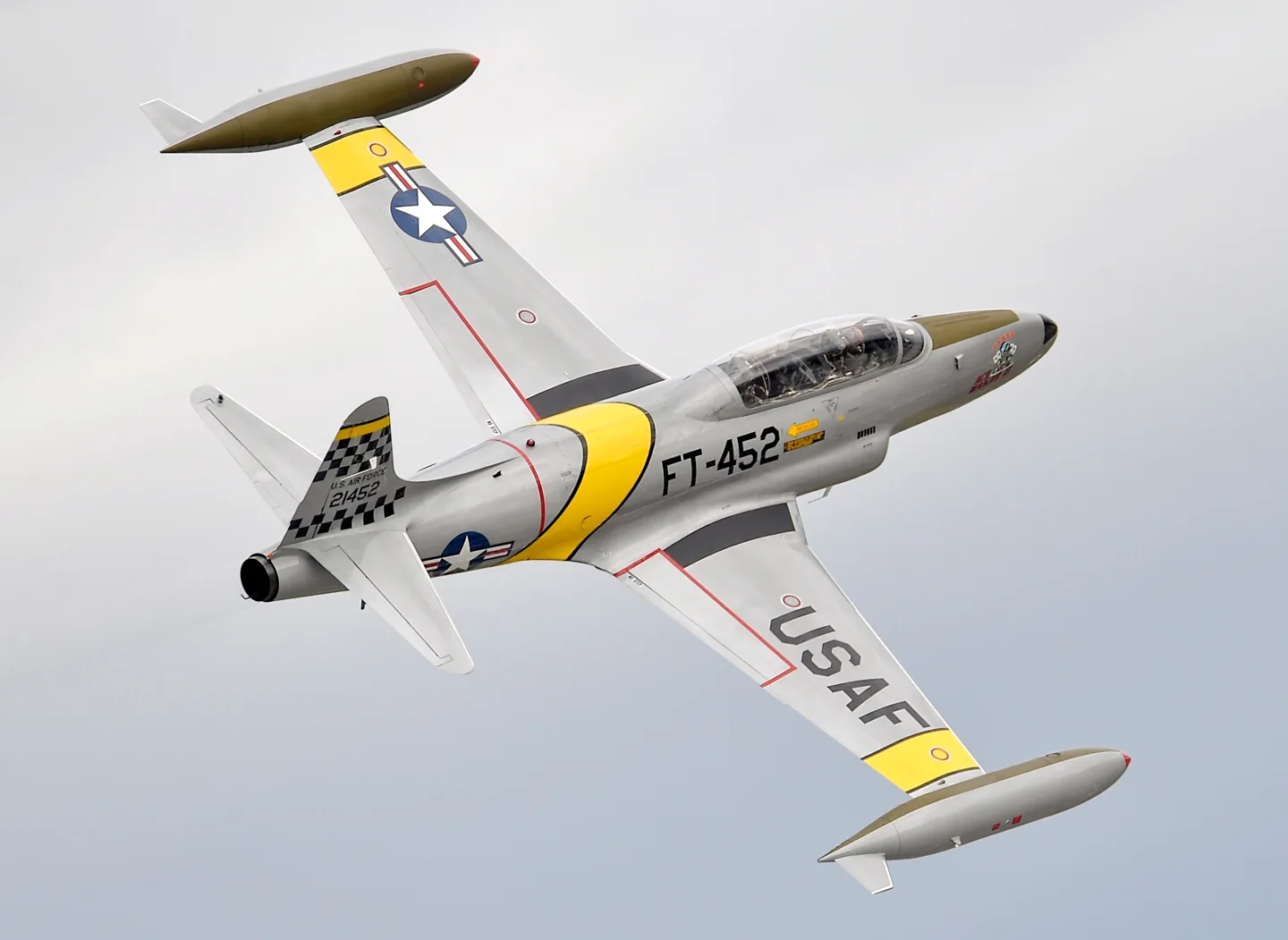
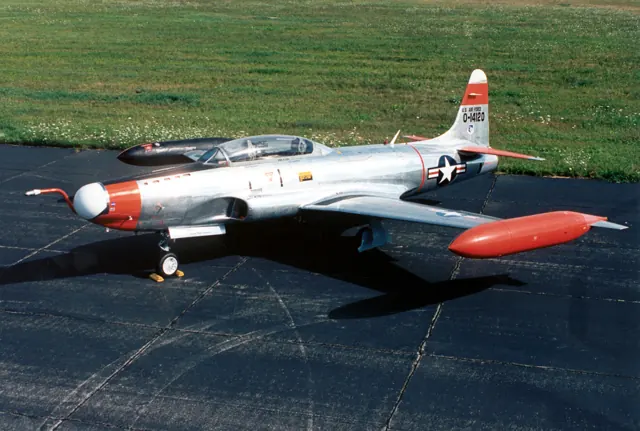
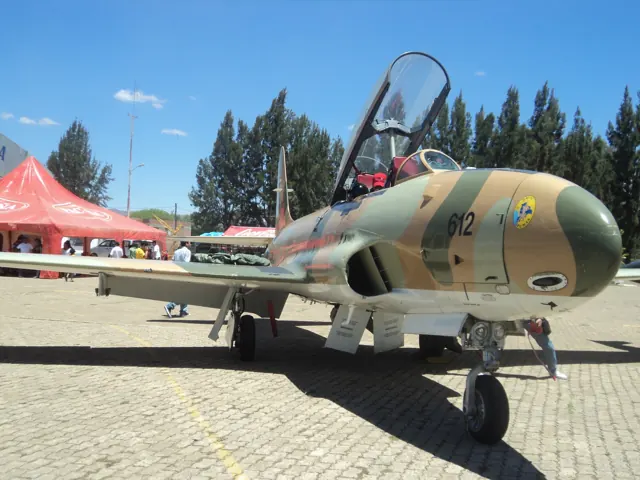
Lockheed developed the tandem-seat T-33 Shooting Star as a subsonic jet trainer. It prepared pilots of the early jet era for faster operational aircraft. The add-on developer documents the simulator's systems, liveries and package contents.
Aircraft background
Wikipedia contributors · Read more ↗The first jet takeoff brings an unexpected confidence boost
Peters had been warned that a new student might overcontrol the T-33 and rock its wings after takeoff. He remembered deciding to avoid chasing every small movement, then hearing his instructor praise the smoothness of that first departure. The compliment gave him a powerful boost in confidence. Difficulties he had encountered in earlier training seemed to fall into place in the jet.
Veterans Affairs Canada oral-history transcript. Canadian T-33 training recollection; the public transcript was read, not the video.
Veterans Affairs Canada · Read more ↗The modern cockpit adds familiar civil avionics
The illustrated modern panel includes a G3X Touch, GNS 430, GTX 330 transponder and GMC autopilot controller. The rear cockpit follows the corresponding classic or modern layout.
Lockheed T-33 Shooting Star · iniBuilds · MSFS 2020 · MSFS 2024
iniBuilds · Read more ↗Into the cockpit
 YouTube
Palm Springs Air Museum · 5 min ·
T-33 Shooting Star In Flight
Palm Springs Air Museum shares footage of its airworthy T-33.
Real aircraft · Lockheed T-33 Shooting Star
Watch on YouTube ↗Preview images are served by AirframeDB. Videos open on YouTube only when you choose to watch.
Meet Lockheed T-33 Shooting Star
Lockheed developed the tandem-seat T-33 Shooting Star as a subsonic jet trainer. It prepared pilots of the early jet era for faster operational aircraft. The add-on developer documents the simulator's systems, liveries and package contents.
Lockheed T-33 Shooting Star
Lockheed → · Explore the family →
Lockheed T-33 Shooting Star
Wikipedia contributors · Lockheed T-33 ↗iniBuilds · MSFS 2020 · MSFS 2024 →Aircraft type designators
Use the code for the model you are flying. The linked authority lists the applicable aircraft.
History & design
A military trainer finds a later life teaching civilian pilots
Schiff’s report describes Larry Salganek using a T-33 for instruction at Santa Fe after acquiring it in 1994. Students ranged from private and airline pilots to astronauts, giving a surviving jet trainer a continuing teaching role outside military service.
AOPA Pilot · Taming the T-Bird ↗School history reported in 2014; not a statement of current availability or prices
Development milestones
Designer: Clarence "Kelly" Johnson
First flight: 22 March 1948
Developed from: Lockheed P-80 Shooting Star
Wikipedia contributors · Lockheed T-33 ↗Lockheed T-33 · family/variant named by the source · Wikipedia revision 1374259491
Pilot accounts
The first jet takeoff brings an unexpected confidence boost
Peters had been warned that a new student might overcontrol the T-33 and rock its wings after takeoff. He remembered deciding to avoid chasing every small movement, then hearing his instructor praise the smoothness of that first departure. The compliment gave him a powerful boost in confidence.
Difficulties he had encountered in earlier training seemed to fall into place in the jet. His progress became rapid, and he finished with trophies for flying and academic performance. The result also brought a choice of subsequent aircraft for the highest-placed students.
Veterans Affairs Canada oral-history transcript. Canadian T-33 training recollection; the public transcript was read, not the video.
Read the full account · Veterans Affairs Canada ↗A patient instructor makes an old jet less intimidating
Schiff’s first T-33 takeoff at Santa Fe made a long runway feel surprisingly short in the high density altitude. Once airborne, the light roll forces and straightforward cockpit gave him a strong sense of the early jet era. The aircraft required attention and coordination without the automation of a modern jet.
Larry Salganek’s teaching style helped make that workload enjoyable. Schiff remembered being repeatedly encouraged, even when he felt his performance did not entirely deserve it. The reassurance helped him relax and build confidence.
AOPA Pilot · January 2014. Instruction with Larry Salganek at Santa Fe in a privately operated T-33; historical operating figures remain in the original article.
Read the full account · AOPA Pilot ↗A reward flight turns into an exercise in communication
Kershner expected a gentle local flight for an enlisted sailor receiving an Airman of the Month reward. A landing-gear control problem kept the wheels down, and an uneven fuel-feed problem then made one wing increasingly heavy. He tried to keep the passenger occupied with views around San Francisco while working through the difficulties.
Communication with the ground added an absurd complication. Squadron staff were looking for the officer responsible for their T-33s, apparently failing to understand that Kershner himself was that officer and was already speaking from the aircraft. He recalled releasing the full tip tank and returning to land. The story retains his humour about the misunderstanding while leaving the detailed emergency procedures and later rumours about the passenger in the source.
AOPA Pilot retrospective · November 1995. A 1955 U.S. Navy TV-2/T-33 flight with a first-time passenger; historical decisions are the author’s account.
Read the full account · AOPA Pilot ↗In your simulator
Systems, equipment and documentation for each developer’s aircraft.
MSFS 2020 · MSFS 2024Lockheed T-33 Shooting Star
iniBuilds · Released
Lockheed T-33 Shooting Star
iniBuilds · Released
Aircraft specifications
Published figures for the named real-aircraft variant. Simulator equipment and performance can differ.
| Specification | Published value |
|---|---|
| Length | 37 ft 9 in (11.51 m) |
| Wingspan | 38 ft 10.5 in (11.849 m) |
| Height | 11 ft 8 in (3.56 m) |
| Wing area | 234.8 sq ft (21.81 m² ) |
| Empty weight | 8,365 lb (3,794 kg) |
| Gross weight | 12,071 lb (5,475 kg) |
| Max takeoff weight | 15,061 lb (6,832 kg) |
| Powerplant | 1 × Allison J33-A-35 centrifugal flow turbojet engine, 5,400 lbf (24 kN) thrust for take-off with water injection |
| Maximum speed | 600 mph (970 km/h, 520 kn) at sea level |
| Cruise speed | 455 mph (732 km/h, 395 kn) |
| Range | 1,275 mi (2,052 km, 1,108 nmi) |
| Service ceiling | 48,000 ft (15,000 m) |
| Rate of climb | 4,870 ft/min (24.7 m/s) |
Manuals & resources
Find your next read
Choose a topic for a short introduction and a link to the original source. Simulator references identify the developer and edition they cover.
Simulator documentation
The modern cockpit adds familiar civil avionicsLockheed T-33 Shooting Star · iniBuilds · MSFS 2020 · MSFS 2024
The illustrated modern panel includes a G3X Touch, GNS 430, GTX 330 transponder and GMC autopilot controller. The rear cockpit follows the corresponding classic or modern layout.
MSFS 2024 manual · PDF pp.30–32
iniBuilds · Read the source ↗Ground equipment and display effects are selectableLockheed T-33 Shooting Star · iniBuilds · MSFS 2020 · MSFS 2024
The product lists covers, chocks, an entry ladder, engine plugs and pitot covers, plus smoke and flare effects. It separately labels wing-mounted drop bombs as an iniStore-only feature.
iniBuilds T-33 product description · gathered September 2026; store-specific feature distinction
iniBuilds · Read the source ↗Flap readings use different units in the two cockpitsLockheed T-33 Shooting Star · iniBuilds · MSFS 2020 · MSFS 2024
The guide distinguishes the G3X display’s flap angle in degrees from the classic gauge’s percentage of full travel. Comparing the numbers directly would mix two different scales.
MSFS 2024 manual · PDF p.11 visually checked; attachment labelled 1.0.4, preface 1.0.3
iniBuilds · Read the source ↗Walkaround items affect whether the aircraft can operateLockheed T-33 Shooting Star · iniBuilds · MSFS 2020 · MSFS 2024
Engine covers prevent starting, chocks prevent movement, and installed landing-gear pins keep the gear locked down. The manual places their removal in the MSFS 2024 walkaround.
MSFS 2024 manual · PDF pp.7–8; no claim about the 2020 walkaround interface
iniBuilds · Read the source ↗Find procedure checklists in the simulator EFBLockheed T-33 Shooting Star · iniBuilds · MSFS 2020 · MSFS 2024
The manual directs users to the aircraft icon and Checklists in the simulator’s electronic flight bag. This supplements the separate manual and quick-reference card.
MSFS 2024 manual · PDF p.9
iniBuilds · Read the source ↗Pilot account
The first jet takeoff brings an unexpected confidence boostVeterans Affairs Canada oral-history transcript. Canadian T-33 training recollection; the public transcript was read, not the video.
Peters had been warned that a new student might overcontrol the T-33 and rock its wings after takeoff. He remembered deciding to avoid chasing every small movement, then hearing his instructor praise the smoothness of that first departure. The compliment gave him a powerful boost in confidence. Difficulties he had encountered in earlier training seemed to fall into place in the jet. His progress became rapid, and he finished with trophies for flying and academic performance.
Walter Peters
Veterans Affairs Canada · Read the source ↗A patient instructor makes an old jet less intimidatingAOPA Pilot · January 2014. Instruction with Larry Salganek at Santa Fe in a privately operated T-33; historical operating figures remain in the original article.
Schiff’s first T-33 takeoff at Santa Fe made a long runway feel surprisingly short in the high density altitude. Once airborne, the light roll forces and straightforward cockpit gave him a strong sense of the early jet era. The aircraft required attention and coordination without the automation of a modern jet. Larry Salganek’s teaching style helped make that workload enjoyable. Schiff remembered being repeatedly encouraged, even when he felt his performance did not entirely deserve it.
Barry Schiff
AOPA Pilot · Read the source ↗Read the original documentation from the people who created it. Manuals open on their publisher’s website.
Aircraft background
Lockheed T-33Wikipedia contributors · Research background · retrieved 2026-09-12Product
T-33 Jet Trainer for MSFSiniBuilds · Official developer / designated store catalogue · checked 2026-09-12Developer documentation
T-33 Jet Trainer MSFS 2024 manualiniBuilds · Forum attachment labelled 1.0.4; PDF preface says 1.0.3, 28 November 2024Type designator
ICAO Doc 8643 — aircraft type designatorsInternational Civil Aviation Organization · Public search data retrieved 2026-09-14; authority update 2026-09-03Built-in force-feedback profiles
Read the documentary basis, editable starting settings and remaining questions for the aircraft you fly. Each explanation refers to the exact profile revision shown.
Catalogue programme-20261022-v1 · 2 profile choices
iniBuilds T-33 Jet Trainer
iniBuilds · Free and Pro · Revision 5 · Inherited starting point
MSFS 2020 · MSFS 2024
iniBuilds T-33 Jet Trainer: Assisted roll and spring-aided pitch motivate separate axis loading.
Lockheed T-33 Shooting Star
Free and Pro · Revision 1 · Partial review
MSFS 2024 · MSFS 2020
Lockheed T-33 Shooting Star: Assisted roll and spring-aided pitch motivate separate axis loading.
Lockheed T-33 Shooting Star
Lockheed T-33 Shooting Star: Assisted roll and spring-aided pitch motivate separate axis loading.
Aircraft and simulator scope
- Lockheed T-33 Shooting Star · MSFS 2024 · family starting point
- Lockheed T-33 Shooting Star · MSFS 2020 · family starting point
Lockheed T-33 Shooting Star · The sources cover iniBuilds/SimWorks Studios' T-33 with separate classic and modern cockpits.
The simulator model and controls
Lockheed developed the tandem-seat T-33 Shooting Star as a subsonic jet trainer. It prepared pilots of the early jet era for faster operational aircraft. The add-on developer documents the simulator's systems, liveries and package contents.
This starting point selects Lockheed T-33 Shooting Star. Its aircraft-level settings do not select a particular developer’s custom systems.
How this profile feels
Assisted roll and spring-aided pitch motivate separate axis loading. Spring resistance builds with the selected airspeed response. A separate aerodynamic term adds speed-dependent control load.
Electrical pitch and left-aileron tabs supply distinct trim mechanisms. Valid trim provides the configured pressure relief. Autopilot following is off.
Controls and trim
The T-33 documentation identifies hydraulic aileron boost, elevator spring assistance and electrical elevator/left-aileron tabs. Electric split flaps and hydraulic dive brakes are separate systems. Classic TACAN and modern navigation fits identify different cockpit equipment.
About the values
The gains are normalized profile settings. They describe the chosen effect balance; hand force depends on the device and its output limits. IAS references are tuning values rather than operating limits. Physical acceptance of this revision remains pending.
What the documentation establishes
The sources cover iniBuilds/SimWorks Studios' T-33 with separate classic and modern cockpits.
The checklist requires neutral trim but does not explain the trim actuator or aerodynamic mechanism.
The modern cockpit includes a GMC autopilot panel, while the classic cockpit differs. Automatic flight is therefore edition dependent despite disabled following in the starting point.
Dive brakes require hydraulic pressure; gear is retractable tricycle; flaps are indicated from 0 to 45 degrees or as a percentage. Exact detents are not established.
The specifications give 505 KIAS maximum and 380 KTAS cruise, while the introduction quotes different mph performance and ceiling. A 230-knot loading reference is not directly validated.
Documentary review and sources
These decisions describe the documentary basis and remaining gaps for this revision. Aircraft documentation and a starting setting describe different kinds of evidence.
Aircraft and variant
ReviewedThis starting point selects Lockheed T-33 Shooting Star. Its aircraft-level settings do not select a particular developer’s custom systems.
Flight controls
Not yet reviewedThe T-33 documentation identifies hydraulic aileron boost, elevator spring assistance and electrical elevator/left-aileron tabs. Electric split flaps and hydraulic dive brakes are separate systems. Classic TACAN and modern navigation fits identify different cockpit equipment.
Trim
ReviewedElectrical pitch and left-aileron tabs supply distinct trim mechanisms. Pitch authority 0.3 provides load relief and permitted centre movement; roll authority is 0.
Autopilot and stability
ReviewedAutopilot following is off; the configured spring and load retain the hardware feel.
Equipment
ReviewedGear, flap and ground cues follow the selected settings and available simulator-reported states.
Speeds and limits
ReviewedThe indicated-speed references set the profile response scale; they are separate from aircraft operating limits.
Simulator integration
Not yet reviewedThe profile targets msfs2024, msfs2020. Add-on-specific controls use only the supported references configured by this profile.
Force-feedback settings
Not yet reviewedThe settings define the profile’s effect balance. Device output limits affect physical hand force.
Starting settings and their rationale
These configured values are starting estimates. The explanations describe what each setting controls; physical validation appears separately below.
| Setting | Starting value | What it controls and why |
|---|---|---|
| Spring strength | Starting value0.74 | What it controls and whyAssisted roll and spring-aided pitch motivate separate axis loading. The baseline spring is 0.74. Its low-speed blend reaches baseline strength at 90 KIAS. |
| Master force gain | Starting value0.85 | What it controls and whyScales overall profile strength while preserving effect balance, subject to device and output limits. |
| Profile force gain | Starting value0.8 | What it controls and whyThe aerodynamic-load gain is 0.8 with an indicated-speed reference of 230 KIAS. This supplies speed-dependent loading alongside the spring. |
| Force tuning speed/reference | Starting value230.0 kt | What it controls and whySets the IAS reference for aerodynamic loading. It is an estimate, not published cruise TAS or a flight limit. |
| Spring response reference speed | Starting value90 kt | What it controls and whySets the IAS where the low-speed blend reaches baseline strength; high-speed stiffening also uses it. |
| Aileron force scale | Starting value0.72 | What it controls and whyRoll and pitch aerodynamic scales are 0.72 and 1, respectively. They set the aerodynamic axis balance. No custom spring-travel curve is enabled. |
| Elevator force scale | Starting value1.0 | What it controls and whyScales pitch aerodynamic loading; pitch spring travel and trim responses are separate settings. |
| Trim feel | Starting valueEnabled | What it controls and whyRetained for compatibility and group membership. Trim relief, rather than this flag, controls centre movement. |
| Trim relief | Starting valueEnabled | What it controls and whyAllows trim relief with supported control law and valid telemetry. Axis authorities set its amount. |
| Autopilot follow | Starting valueDisabled | What it controls and whyAutopilot following is off; the configured spring and load retain the hardware feel. |
| Autopilot neutral hold | Starting valueDisabled | What it controls and whyPermits centering hold during a supported AP state, separate from following a moving target. |
| Output force limit | Starting value0.55 | What it controls and whyCaps directed-force output. Native spring effects and device limits remain separate. |
All 44 starting settings and their rationale
The settings define the profile’s effect balance. Device output limits affect physical hand force.
| Setting | Starting value | What it controls and why |
|---|---|---|
| Spring strength | Starting value0.74 | What it controls and whyAssisted roll and spring-aided pitch motivate separate axis loading. The baseline spring is 0.74. Its low-speed blend reaches baseline strength at 90 KIAS. |
| Spring deadband | Starting value0.045 | What it controls and whySets travel around the centre before the baseline spring resists. Smaller values engage it sooner. |
| Profile force gain | Starting value0.8 | What it controls and whyThe aerodynamic-load gain is 0.8 with an indicated-speed reference of 230 KIAS. This supplies speed-dependent loading alongside the spring. |
| Master force gain | Starting value0.85 | What it controls and whyScales overall profile strength while preserving effect balance, subject to device and output limits. |
| QBlend Enabled | Starting valueEnabled | What it controls and whyAllows baseline spring strength to rise with indicated airspeed where the control law permits it. |
| QSpring Minimum Factor | Starting value0.5 | What it controls and whySets low-speed spring strength as a fraction of baseline when blending is enabled. One keeps full strength. |
| QSpring Start Knots | Starting value20 kt | What it controls and whySets the IAS where the low-speed spring blend starts rising. This is a feel threshold, not a flight limit. |
| Spring response reference speed | Starting value90 kt | What it controls and whySets the IAS where the low-speed blend reaches baseline strength; high-speed stiffening also uses it. |
| Force tuning speed/reference | Starting value230.0 kt | What it controls and whySets the IAS reference for aerodynamic loading. It is an estimate, not published cruise TAS or a flight limit. |
| Airspeed spring stiffening gain | Starting value0.15 | What it controls and whyThe high-speed spring-stiffening gain is 0.15. It strengthens the permitted spring response above 90 KIAS, with the squared-speed ratio capped at 5. |
| Airspeed spring stiffening limit | Starting value5 | What it controls and whyLimits the squared airspeed ratio used for high-speed spring stiffening; it is not a device-force cap. |
| Aileron force scale | Starting value0.72 | What it controls and whyRoll and pitch aerodynamic scales are 0.72 and 1, respectively. They set the aerodynamic axis balance. No custom spring-travel curve is enabled. |
| Elevator force scale | Starting value1.0 | What it controls and whyScales pitch aerodynamic loading; pitch spring travel and trim responses are separate settings. |
| Output force limit | Starting value0.55 | What it controls and whyCaps directed-force output. Native spring effects and device limits remain separate. |
| Trim feel | Starting valueEnabled | What it controls and whyRetained for compatibility and group membership. Trim relief, rather than this flag, controls centre movement. |
| Trim relief | Starting valueEnabled | What it controls and whyAllows trim relief with supported control law and valid telemetry. Axis authorities set its amount. |
| Elevator Authority | Starting value0.3 | What it controls and whyElectrical pitch and left-aileron tabs supply distinct trim mechanisms. Pitch authority 0.3 provides load relief and permitted centre movement; roll authority is 0. |
| Aileron Authority | Starting value0 | What it controls and whyScales supported roll-trim relief and permitted centre movement. Zero removes roll response. |
| Force Trim Enabled | Starting valueDisabled | What it controls and whyEnables local force trim, separate from aircraft-owned trim and add-on integration qualification. |
| GLoad Enabled | Starting valueEnabled | What it controls and whyAllows load-factor changes to modify permitted spring laws. Passive fly-by-wire feel can suppress it. |
| Rate Damping Enabled | Starting valueEnabled | What it controls and whyEnables rate damping with the configured coefficients and control law. |
| Autopilot follow | Starting valueDisabled | What it controls and whyAutopilot following is off; the configured spring and load retain the hardware feel. |
| Autopilot follow authority | Starting value0.1 | What it controls and whySets admitted AP-follow gain, not a percentage of travel. Runtime ownership and input limits still apply. |
| Autopilot neutral hold | Starting valueDisabled | What it controls and whyPermits centering hold during a supported AP state, separate from following a moving target. |
| Autopilot neutral hold strength | Starting value0.6 | What it controls and whySets admitted AP neutral-hold strength; inactive while neutral hold is disabled. |
| Enabled | Starting valueEnabled | What it controls and whyEnables aerodynamic cues; each still needs nonzero strength and its simulator conditions. |
| Gain | Starting value0.35 | What it controls and whySets stall-buffet strength. Zero removes the cue without changing simulator stalls or warnings. |
| Gain | Starting value0 | What it controls and whySets high-Mach buffet strength; onset and full-strength thresholds are separate. |
| Gain | Starting value0.14 | What it controls and whySets flap buffet at the configured position and speed gates. Flap movement texture is separate. |
| Maximum flap index | Starting value2 | What it controls and whySets the final flap index for detent normalization. UP plus three detents uses maximum index3. |
| Minimum flap index | Starting value2 | What it controls and whySets the first flap detent that admits buffet; this is a handle index, not degrees. |
| Gain | Starting value0.1 | What it controls and whySets gear aerodynamic buffet; movement and ground-contact cues are separate. |
| Shaker Enabled | Starting valueDisabled | What it controls and whyPermits shaker at supported warning conditions; the switch does not establish aircraft equipment. |
| Stick shaker amplitude | Starting value0.5 | What it controls and whySets triggered shaker strength; inactive while the shaker feature is disabled. |
| Enabled | Starting valueEnabled | What it controls and whyEnables ground effects; each still needs its own strength and contact or motion telemetry. |
| Gain | Starting value0.4 | What it controls and whySets rolling texture strength, modified by speed, surface and undercarriage configuration. |
| Gain | Starting value0.25 | What it controls and whySets gear-bump texture during ground motion, separate from touchdown impact. |
| Gain | Starting value0.65 | What it controls and whySets landing-impact strength; landing telemetry and response shape determine the pulse. |
| Gain | Starting value0 | What it controls and whySets reverse-thrust vibration with valid reverser and engine conditions. Zero removes the cue. |
| Enabled | Starting valueEnabled | What it controls and whyEnables engine cues with nonzero settings and valid running-engine telemetry. |
| Gain | Starting value0.06 | What it controls and whySets estimated engine vibration using configured telemetry and response, not measured cockpit vibration. |
| Enabled | Starting valueEnabled | What it controls and whyEnables accessory cues with configured strengths and observed accessory movement. |
| Gain | Starting value0.12 | What it controls and whySets texture from observed flap movement; a command without movement does not establish the cue. |
| Gain | Starting value0.12 | What it controls and whySets texture from observed gear movement, separate from aerodynamic and touchdown effects. |
Limits and open questions
- A one-to-one simulator input ratio is documented, but it does not prove manual pitch, assisted roll or real hand-force gearing.
- Sensitivity guidance and cockpit interactions do not publish external trim or automatic-flight status signals.
- The retained guide supplies no measured control-force curve supporting unequal pitch and roll loading.
- Lockheed T-33 Shooting Star documentary evidence does not establish force-feedback hardware acceptance.
Physical validation
No physical force validation is recorded in this public catalogue for this revision. Documentary review and software checks do not establish how a particular device feels.
Discuss this aircraft (0)
Questions, observations and useful sources from the community.
No published discussions yet. Bring a question or share a useful source.
Open aircraft discussions →Content expanded · What’s new
Something missing or a source that needs attention?
Suggest a correction ↗