
Start here
A few places to begin, from the aircraft’s story to the people who fly it.
Meet the aircraft
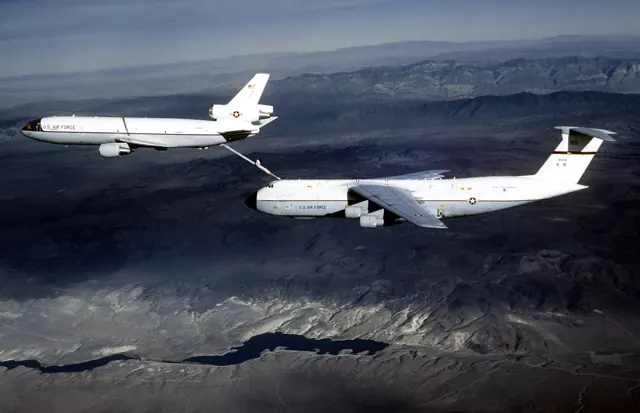
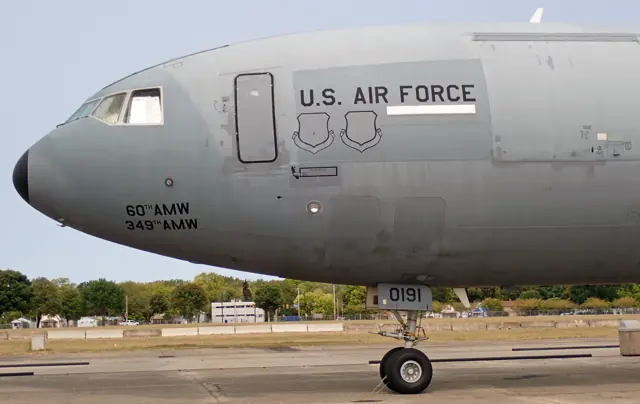
The KC-10 adapted the DC-10 wide-body trijet for military tanker work. It retained the broad fuselage and tail-mounted centre engine while adding refuelling equipment and military systems. US Air Force service ran from 1981 to 2024.
Aircraft background
Wikipedia contributors · Read more ↗One night over Iraq stays with a tanker pilot
Johnson described the tanker as a lifeline for fighter crews running short of fuel far from safety. His appreciation also carried a direct memory of danger: during a 2004 mission over Iraq, his KC-10 was fired upon while refuelling F-16s. He remembered increasing speed to get away from the area. It was, he said, the first and only time he had been shot at.
National Air and Space Museum interview · June 2025. Former KC-10 pilot recalling a 2004 mission; the incident is his attributed recollection.
National Air and Space Museum · Read more ↗Into the cockpit
 YouTube
Gung Ho Vids · 5 min ·
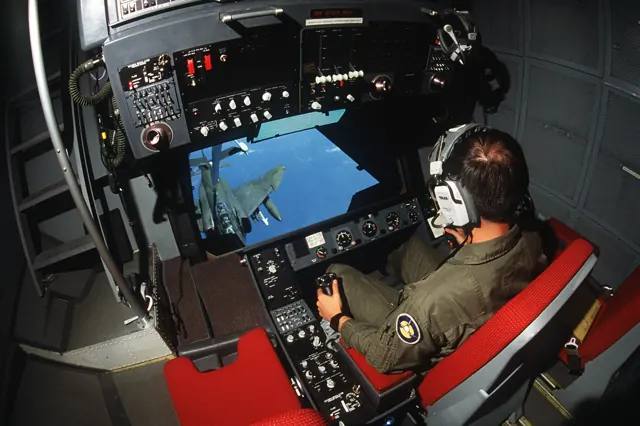
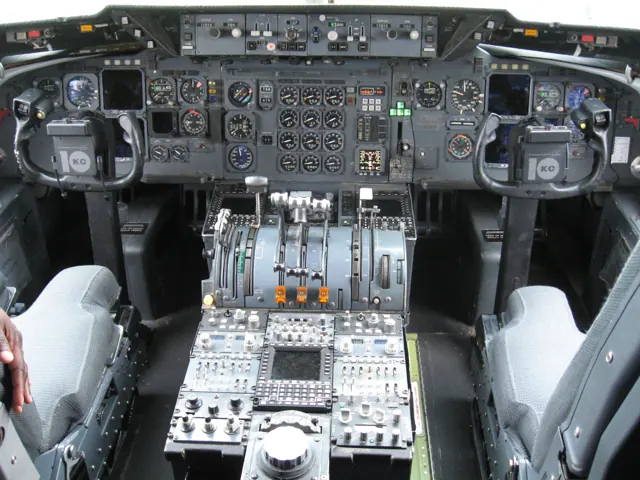
KC-10 Extender Inflight Cockpit Video
KC-10 cockpit footage during a US Air Force aerial-refuelling mission.
Real aircraft · McDonnell Douglas KC-10 Extender
Watch on YouTube ↗Preview images are served by AirframeDB. Videos open on YouTube only when you choose to watch.
Meet McDonnell Douglas KC-10 Extender
The KC-10 adapted the DC-10 wide-body trijet for military tanker work. It retained the broad fuselage and tail-mounted centre engine while adding refuelling equipment and military systems. US Air Force service ran from 1981 to 2024.
The Extender combined fuel transfer with passenger and cargo transport. The simulator documentation describes which tanker and cargo functions are modelled.
McDonnell Douglas KC-10 Extender
McDonnell Douglas → · Explore the family →
McDonnell Douglas KC-10 Extender
Wikipedia contributors · McDonnell Douglas KC-10 Extender ↗Laminar Research · X-Plane 11 →Aircraft type designators
Use the code for the model you are flying. The linked authority lists the applicable aircraft.
History & design
Excalibur closes the U.S. Air Force chapter
Roza’s contemporary report records the final U.S. Air Force KC-10 flight on 26 September 2024, departing Travis for retirement in Arizona. The farewell centred on Excalibur, 79-1948, and the people who had operated and maintained the fleet.
Air & Space Forces Magazine · A Very Special Airplane: Air Force Bids Farewell to the KC-10 ↗Operator-specific retirement; other tanker operators are outside this claim
Development milestones
First flight: 12 July 1980 ( 1980-07-12 )
Developed from: McDonnell Douglas DC-10
Wikipedia contributors · McDonnell Douglas KC-10 Extender ↗McDonnell Douglas KC-10 Extender · family/variant named by the source · Wikipedia revision 1371419410
Pilot accounts
One night over Iraq stays with a tanker pilot
Johnson described the tanker as a lifeline for fighter crews running short of fuel far from safety. His appreciation also carried a direct memory of danger: during a 2004 mission over Iraq, his KC-10 was fired upon while refuelling F-16s. He remembered increasing speed to get away from the area.
It was, he said, the first and only time he had been shot at. Recalling the episode years later, he spoke warmly of the KC-10’s service while also acknowledging the newer technology in its replacement.
National Air and Space Museum interview · June 2025. Former KC-10 pilot recalling a 2004 mission; the incident is his attributed recollection.
Read the full account · National Air and Space Museum ↗A final ferry flight belongs to both pilot and aircraft
Among Pillion’s favourite KC-10 memories was refuelling a B-2 near Guam at night, the bomber’s first fuel stop after its long journey from Whiteman. Seeing the aircraft in that setting left him wondering about the mission behind it. The memory captures the unusual encounters that could become part of a tanker crew’s working life.
His final military flight coincided with the retirement ferry of 86-0036. Pillion found himself thinking about the aircraft’s ending as much as his own departure from military flying. The crew had volunteered for the trip, giving the farewell a shared significance. His interview records that moment in 2020 without treating his hopes for the fleet’s future as events that later occurred.
Photorecon interview · September 2020. KC-10 pilot since 1989; final military flight in retiring aircraft 86-0036. Earlier rescue-helicopter experience is separate.
Read the full account · Photorecon ↗A familiar tanker’s farewell brings generations together
Baer’s affection for the KC-10 came from thousands of hours and the confidence he had developed in its reliability. He recalled meeting fighters over Afghanistan with little fuel remaining and helping them return to their missions. In his account, the aircraft’s value was inseparable from the crews depending on it.
For the Air Force farewell, restoring Excalibur’s historic knight-and-dragon nose art became another way of honouring that service. Old photographs helped the team recover the design before obtaining approval to paint it. Baer also valued the gathering of former and current crew members, whose different generations shared the same attachment. The last flight marked the end of a particular operator’s service, not all KC-10-derived flying worldwide.
Air & Space Forces Magazine · September 2024. KC-10 pilot and 9th Air Refueling Squadron commander discussing the final U.S. Air Force flight of Excalibur, 79-1948.
Read the full account · Air & Space Forces Magazine ↗In your simulator
Systems, equipment and documentation for each developer’s aircraft.
X-Plane 11McDonnell Douglas KC-10 Extender
Laminar Research · Released
McDonnell Douglas KC-10 Extender
Laminar Research · Released
Aircraft specifications
Published figures for the named real-aircraft variant. Simulator equipment and performance can differ.
| Specification | Published value |
|---|---|
| Length | 181 ft 7 in (55.35 m) |
| Wingspan | 165 ft 4.5 in (50.406 m) |
| Height | 58 ft 1 in (17.70 m) |
| Wing area | 3,958 sq ft (367.7 m² ) |
| Empty weight | 241,027 lb (109,328 kg) |
| Gross weight | 590,000 lb (267,619 kg) |
| Max takeoff weight | 590,000 lb (267,619 kg) |
| Powerplant | 3 × General Electric F103 (GE CF6-50C2) turbofan engines, 52,500 lbf (234 kN) thrust each |
| Maximum speed | 538 mph (866 km/h, 468 kn) |
| Maximum speed | Mach 0.89 |
| Range | 4,400 mi (7,100 km, 3,800 nmi) with a maximum passenger capacity; 3,800 nmi (7,038 km; 4,373 mi) with maximum cargo capacity. |
| Service ceiling | 42,000 ft (13,000 m) |
| Rate of climb | 6,870 ft/min (34.9 m/s) |
Manuals & resources
Find your next read
Choose a topic for a short introduction and a link to the original source. Simulator references identify the developer and edition they cover.
Pilot account
One night over Iraq stays with a tanker pilotNational Air and Space Museum interview · June 2025. Former KC-10 pilot recalling a 2004 mission; the incident is his attributed recollection.
Johnson described the tanker as a lifeline for fighter crews running short of fuel far from safety. His appreciation also carried a direct memory of danger: during a 2004 mission over Iraq, his KC-10 was fired upon while refuelling F-16s. He remembered increasing speed to get away from the area. It was, he said, the first and only time he had been shot at. Recalling the episode years later, he spoke warmly of the KC-10’s service while also acknowledging the newer technology in its replacement.
Jay Johnson
National Air and Space Museum · Read the source ↗A final ferry flight belongs to both pilot and aircraftPhotorecon interview · September 2020. KC-10 pilot since 1989; final military flight in retiring aircraft 86-0036. Earlier rescue-helicopter experience is separate.
Among Pillion’s favourite KC-10 memories was refuelling a B-2 near Guam at night, the bomber’s first fuel stop after its long journey from Whiteman. Seeing the aircraft in that setting left him wondering about the mission behind it. The memory captures the unusual encounters that could become part of a tanker crew’s working life. His final military flight coincided with the retirement ferry of 86-0036.
Mike Pillion
Photorecon · Read the source ↗Read the original documentation from the people who created it. Manuals open on their publisher’s website.
Manual
X-Plane 11 Desktop ManualLaminar Research X-Plane aircraft and avionics manualsLaminar ResearchAircraft background
McDonnell Douglas KC-10 ExtenderWikipedia contributors · Research background · Wikipedia revision 1371419410 · retrieved 2026-09-12Type designator
ICAO Doc 8643 — aircraft type designatorsInternational Civil Aviation Organization · Public search data retrieved 2026-09-14; authority update 2026-09-03Built-in force-feedback profiles
Read the documentary basis, editable starting settings and remaining questions for the aircraft you fly. Each explanation refers to the exact profile revision shown.
Catalogue programme-20261022-v1 · 1 profile choice
McDonnell Douglas KC-10 Extender
Free and Pro · Revision 1 · Partial review
X-Plane 11
McDonnell Douglas KC-10 Extender: The selected powered-control law supplies transport yoke resistance.
McDonnell Douglas KC-10 Extender
McDonnell Douglas KC-10 Extender: The selected powered-control law supplies transport yoke resistance.
Aircraft and simulator scope
- McDonnell Douglas KC-10 Extender · X-Plane 11 · family starting point
McDonnell Douglas KC-10 Extender · Historical XP11 catalogue scope; compatibility is not transferred to XP12.
The simulator model and controls
The KC-10 adapted the DC-10 wide-body trijet for military tanker work. It retained the broad fuselage and tail-mounted centre engine while adding refuelling equipment and military systems. US Air Force service ran from 1981 to 2024.
This starting point selects McDonnell Douglas KC-10 Extender. Its aircraft-level settings do not select a particular developer’s custom systems.
How this profile feels
The selected powered-control law supplies transport yoke resistance. Spring resistance builds with the selected airspeed response. A separate aerodynamic term adds speed-dependent control load.
Trim response remains separate from fuel-transfer equipment. Valid trim provides the configured pressure relief. Autopilot following is enabled for supported control references.
Controls and trim
The KC-10 adapted the DC-10’s three-engine wide-body airframe for military refuelling and transport. Its boom, fuel-transfer equipment and military systems are separate from the underlying airliner controls.
About the values
The gains are normalized profile settings. They describe the chosen effect balance; hand force depends on the device and its output limits. IAS references are tuning values rather than operating limits. Physical acceptance of this revision remains pending.
What the documentation establishes
Laminar's XP11 desktop manual explicitly lists KC-10 Extender among included aircraft.
Documentary review and sources
These decisions describe the documentary basis and remaining gaps for this revision. Aircraft documentation and a starting setting describe different kinds of evidence.
Aircraft and variant
ReviewedThis starting point selects McDonnell Douglas KC-10 Extender. Its aircraft-level settings do not select a particular developer’s custom systems.
Flight controls
Not yet reviewedThe KC-10 adapted the DC-10’s three-engine wide-body airframe for military refuelling and transport. Its boom, fuel-transfer equipment and military systems are separate from the underlying airliner controls.
Trim
Not yet reviewedTrim response remains separate from fuel-transfer equipment. Pitch authority 0.3 relieves permitted loading; hydraulic centre movement is off. Roll authority is 0.09.
Autopilot and stability
Not yet reviewedFollowing is on at 0.1 authority when a supported, valid autopilot control reference is available.
Equipment
Not yet reviewedGear, flap and ground cues follow the selected settings and available simulator-reported states.
Speeds and limits
Not yet reviewedThe indicated-speed references set the profile response scale; they are separate from aircraft operating limits.
Simulator integration
Not yet reviewedThe profile targets xplane11. Add-on-specific controls use only the supported references configured by this profile.
Force-feedback settings
Not yet reviewedThe settings define the profile’s effect balance. Device output limits affect physical hand force.
Starting settings and their rationale
These configured values are starting estimates. The explanations describe what each setting controls; physical validation appears separately below.
| Setting | Starting value | What it controls and why |
|---|---|---|
| Spring strength | Starting value0.8 | What it controls and whyThe selected powered-control law supplies transport yoke resistance. The baseline spring is 0.8. Its low-speed blend reaches baseline strength at 90 KIAS. |
| Master force gain | Starting value0.85 | What it controls and whyScales overall profile strength while preserving effect balance, subject to device and output limits. |
| Profile force gain | Starting value0.25 | What it controls and whyThe aerodynamic-load gain is 0.25 with an indicated-speed reference of 270 KIAS. The hydraulic-load factor of 0.35 scales that modeled term; it is a selected artificial-feel approximation. |
| Force tuning speed/reference | Starting value270.0 kt | What it controls and whySets the IAS reference for aerodynamic loading. It is an estimate, not published cruise TAS or a flight limit. |
| Spring response reference speed | Starting value90 kt | What it controls and whySets the IAS where the low-speed blend reaches baseline strength; high-speed stiffening also uses it. |
| Aileron force scale | Starting value0.65 | What it controls and whyRoll and pitch aerodynamic scales are 0.65 and 0.65, respectively. They set the aerodynamic axis balance. No custom spring-travel curve is enabled. |
| Elevator force scale | Starting value0.65 | What it controls and whyScales pitch aerodynamic loading; pitch spring travel and trim responses are separate settings. |
| Trim feel | Starting valueEnabled | What it controls and whyRetained for compatibility and group membership. Trim relief, rather than this flag, controls centre movement. |
| Trim relief | Starting valueEnabled | What it controls and whyAllows trim relief with supported control law and valid telemetry. Axis authorities set its amount. |
| Autopilot follow | Starting valueEnabled | What it controls and whyFollowing is on at 0.1 authority when a supported, valid autopilot control reference is available. |
| Autopilot neutral hold | Starting valueDisabled | What it controls and whyPermits centering hold during a supported AP state, separate from following a moving target. |
| Output force limit | Starting value0.55 | What it controls and whyCaps directed-force output. Native spring effects and device limits remain separate. |
All 44 starting settings and their rationale
The settings define the profile’s effect balance. Device output limits affect physical hand force.
| Setting | Starting value | What it controls and why |
|---|---|---|
| Spring strength | Starting value0.8 | What it controls and whyThe selected powered-control law supplies transport yoke resistance. The baseline spring is 0.8. Its low-speed blend reaches baseline strength at 90 KIAS. |
| Spring deadband | Starting value0.035 | What it controls and whySets travel around the centre before the baseline spring resists. Smaller values engage it sooner. |
| Profile force gain | Starting value0.25 | What it controls and whyThe aerodynamic-load gain is 0.25 with an indicated-speed reference of 270 KIAS. The hydraulic-load factor of 0.35 scales that modeled term; it is a selected artificial-feel approximation. |
| Master force gain | Starting value0.85 | What it controls and whyScales overall profile strength while preserving effect balance, subject to device and output limits. |
| QBlend Enabled | Starting valueEnabled | What it controls and whyAllows baseline spring strength to rise with indicated airspeed where the control law permits it. |
| QSpring Minimum Factor | Starting value0.55 | What it controls and whySets low-speed spring strength as a fraction of baseline when blending is enabled. One keeps full strength. |
| QSpring Start Knots | Starting value20 kt | What it controls and whySets the IAS where the low-speed spring blend starts rising. This is a feel threshold, not a flight limit. |
| Spring response reference speed | Starting value90 kt | What it controls and whySets the IAS where the low-speed blend reaches baseline strength; high-speed stiffening also uses it. |
| Force tuning speed/reference | Starting value270.0 kt | What it controls and whySets the IAS reference for aerodynamic loading. It is an estimate, not published cruise TAS or a flight limit. |
| Airspeed spring stiffening gain | Starting value0 | What it controls and whyThe high-speed spring-stiffening gain is 0. No additional speed-driven stiffening is added; this does not disable independent aerodynamic loading. |
| Airspeed spring stiffening limit | Starting value5 | What it controls and whyLimits the squared airspeed ratio used for high-speed spring stiffening; it is not a device-force cap. |
| Aileron force scale | Starting value0.65 | What it controls and whyRoll and pitch aerodynamic scales are 0.65 and 0.65, respectively. They set the aerodynamic axis balance. No custom spring-travel curve is enabled. |
| Elevator force scale | Starting value0.65 | What it controls and whyScales pitch aerodynamic loading; pitch spring travel and trim responses are separate settings. |
| Output force limit | Starting value0.55 | What it controls and whyCaps directed-force output. Native spring effects and device limits remain separate. |
| Trim feel | Starting valueEnabled | What it controls and whyRetained for compatibility and group membership. Trim relief, rather than this flag, controls centre movement. |
| Trim relief | Starting valueEnabled | What it controls and whyAllows trim relief with supported control law and valid telemetry. Axis authorities set its amount. |
| Elevator Authority | Starting value0.3 | What it controls and whyTrim response remains separate from fuel-transfer equipment. Pitch authority 0.3 relieves permitted loading; hydraulic centre movement is off. Roll authority is 0.09. |
| Aileron Authority | Starting value0.09 | What it controls and whyScales supported roll-trim relief and permitted centre movement. Zero removes roll response. |
| Force Trim Enabled | Starting valueDisabled | What it controls and whyEnables local force trim, separate from aircraft-owned trim and add-on integration qualification. |
| GLoad Enabled | Starting valueEnabled | What it controls and whyAllows load-factor changes to modify permitted spring laws. Passive fly-by-wire feel can suppress it. |
| Rate Damping Enabled | Starting valueEnabled | What it controls and whyEnables rate damping with the configured coefficients and control law. |
| Autopilot follow | Starting valueEnabled | What it controls and whyFollowing is on at 0.1 authority when a supported, valid autopilot control reference is available. |
| Autopilot follow authority | Starting value0.1 | What it controls and whySets admitted AP-follow gain, not a percentage of travel. Runtime ownership and input limits still apply. |
| Autopilot neutral hold | Starting valueDisabled | What it controls and whyPermits centering hold during a supported AP state, separate from following a moving target. |
| Autopilot neutral hold strength | Starting value0.6 | What it controls and whySets admitted AP neutral-hold strength; inactive while neutral hold is disabled. |
| Enabled | Starting valueEnabled | What it controls and whyEnables aerodynamic cues; each still needs nonzero strength and its simulator conditions. |
| Gain | Starting value0.3 | What it controls and whySets stall-buffet strength. Zero removes the cue without changing simulator stalls or warnings. |
| Gain | Starting value0.22 | What it controls and whySets high-Mach buffet strength; onset and full-strength thresholds are separate. |
| Gain | Starting value0.14 | What it controls and whySets flap buffet at the configured position and speed gates. Flap movement texture is separate. |
| Maximum flap index | Starting value5 | What it controls and whySets the final flap index for detent normalization. UP plus three detents uses maximum index3. |
| Minimum flap index | Starting value2 | What it controls and whySets the first flap detent that admits buffet; this is a handle index, not degrees. |
| Gain | Starting value0.1 | What it controls and whySets gear aerodynamic buffet; movement and ground-contact cues are separate. |
| Shaker Enabled | Starting valueEnabled | What it controls and whyPermits shaker at supported warning conditions; the switch does not establish aircraft equipment. |
| Stick shaker amplitude | Starting value0.9 | What it controls and whySets triggered shaker strength; inactive while the shaker feature is disabled. |
| Enabled | Starting valueEnabled | What it controls and whyEnables ground effects; each still needs its own strength and contact or motion telemetry. |
| Gain | Starting value0.4 | What it controls and whySets rolling texture strength, modified by speed, surface and undercarriage configuration. |
| Gain | Starting value0.32 | What it controls and whySets gear-bump texture during ground motion, separate from touchdown impact. |
| Gain | Starting value0.9 | What it controls and whySets landing-impact strength; landing telemetry and response shape determine the pulse. |
| Gain | Starting value0.5 | What it controls and whySets reverse-thrust vibration with valid reverser and engine conditions. Zero removes the cue. |
| Enabled | Starting valueEnabled | What it controls and whyEnables engine cues with nonzero settings and valid running-engine telemetry. |
| Gain | Starting value0.06 | What it controls and whySets estimated engine vibration using configured telemetry and response, not measured cockpit vibration. |
| Enabled | Starting valueEnabled | What it controls and whyEnables accessory cues with configured strengths and observed accessory movement. |
| Gain | Starting value0.12 | What it controls and whySets texture from observed flap movement; a command without movement does not establish the cue. |
| Gain | Starting value0.12 | What it controls and whySets texture from observed gear movement, separate from aerodynamic and touchdown effects. |
Limits and open questions
- The simulator list establishes historical identity only. General joystick/trim setup chapters cannot establish KC-10 gearing, artificial feel or valid autopilot demands.
- No simulator launch or physical force validation.
Physical validation
No physical force validation is recorded in this public catalogue for this revision. Documentary review and software checks do not establish how a particular device feels.
Discuss this aircraft (0)
Questions, observations and useful sources from the community.
No published discussions yet. Bring a question or share a useful source.
Open aircraft discussions →Content expanded · What’s new
Something missing or a source that needs attention?
Suggest a correction ↗