Find aircraft background, systems descriptions and manuals for the aircraft you are researching. Each note keeps its source and version context close by.
Simulator manuals describe the developer’s implementation. Aircraft background is research-based; pilot accounts describe an individual’s experience. Coverage here is limited to the selected notes and linked resources, not the full contents of every manual.
Bell 206 family · CowanSim · CowanSim · X-Plane 11 · X-Plane 12
Disconnecting an upper mode can leave SAS active
The X-Plane SAS guide distinguishes trim release, upper-mode disconnection and the underlying stability system. Its published force-trim-release and autopilot-disconnect commands have different effects: disconnecting the upper modes can preserve SAS. The documented 44-knot threshold applies to mode availability, not to a universal helicopter operating limit.
Archived X-Plane SAS/AP manual · PDF pp.1-4
Bell 206 family
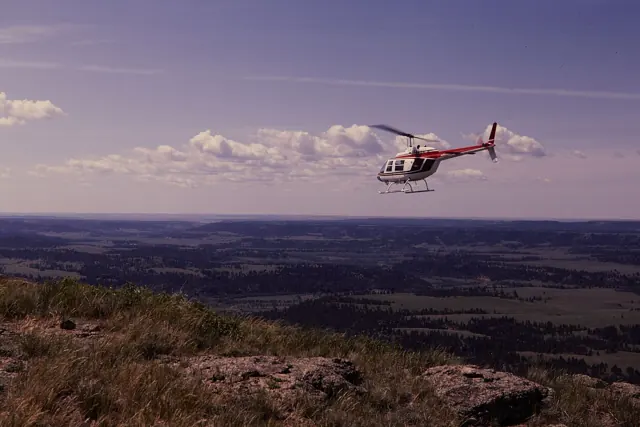
Bell reworked an unsuccessful military observation-helicopter proposal into the commercial JetRanger. The resulting 206 family became widely used for passenger transport, observation and utility work. The familiar single-engine versions use a two-bladed main rotor.
The 206B JetRanger and stretched 206L LongRanger are separate branches of that story. Their cabins, engines and equipment are not identical. Cowan documents each model's trim, autopilot and stability-assistance features separately.
Aircraft / family
Tur-bine or not Tur-bine?
James Berry · May 2021, personal type-rating account
Pilot Report: Bell JetRanger II
Uncredited May 1973 flight report, republished March 2018; demonstration by Tuck Middlebrook
Dick Smith Australian Explorer, VH-DIK
Dick Smith’s journey documented by curator Margaret Simpson; object 90/816
Bell 222 family · CowanSim · CowanSim · MSFS 2020 · MSFS 2024
Autopilot standby retains the underlying stabilisation
The 222 autopilot guide says pressing SBY once removes armed or active autopilot modes while leaving Auto Trim/SAS active. It documents autopilot availability above 44 knots, with SAS required for those modes. This describes CowanSim’s software system.
222 Autopilot System guide · PDF pp.1,4; undated
Bell 222 family · CowanSim · CowanSim · MSFS 2020 · MSFS 2024
The 222UT distinguishes rotor-speed adjustment from aircraft trim
The guide maps governor fine adjustment to Engine Trim RPM Increase/Decrease, while cyclic trim uses the separate rotor longitudinal and lateral trim controls. Rotor Trim Reset has its own binding. These similarly named controls perform different functions in this package.
MSFS 222UT setup guide · PDF pp.4–5; undated
Bell 222 family · CowanSim · CowanSim · MSFS 2020 · MSFS 2024
Give the 222B collective and throttles separate controls
CowanSim documents a collective axis and separate helicopter throttle axes for the two twist grips. A user without dedicated throttle hardware can operate the grips with the mouse. The idle-stop command is distinct from simply moving an axis.
MSFS 222B setup guide · PDF pp.1–3; undated
Bell 222 family · CowanSim · CowanSim · X-Plane 11 · X-Plane 12
The X-Plane 222B offers cabin and panel choices
CowanSim’s listing describes luxury and medical interiors, configurable panels, AviTab integration and optional RXP GTN 750 integration. These features belong to the 222B product described by the page.
Developer product listing · captured September 2026
Bell 222 family · CowanSim · CowanSim · X-Plane 11 · X-Plane 12
Choose texture size to suit the installation
The listed package includes 2K and 4K versions, FMOD audio, window-rain effects and VR support. Its version summary gives separate X-Plane 11 and 12 release dates for v2.60.
Developer listing · X-Plane 11 v2.60 February 2022; X-Plane 12 v2.60 May 2023
Bell 222 family
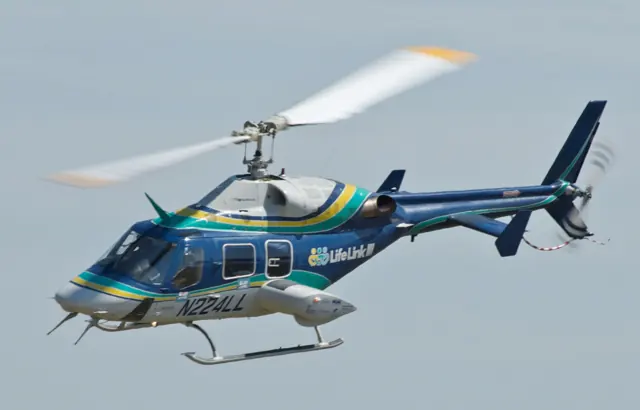
Bell developed the 222 as a light helicopter with two engines. The 230 followed with a different powerplant installation and further refinements. The simulator products represent the 222B and 222UT, with photographs captioned for their depicted variants.
Bell 222B/222U section of the 2019 type-data sheet.
Check that box, and fly it to the ground!
Chris Kruse · recollection of 14 April 2000