
Start here
A few places to begin, from the aircraft’s story to the people who fly it.
Meet the aircraft
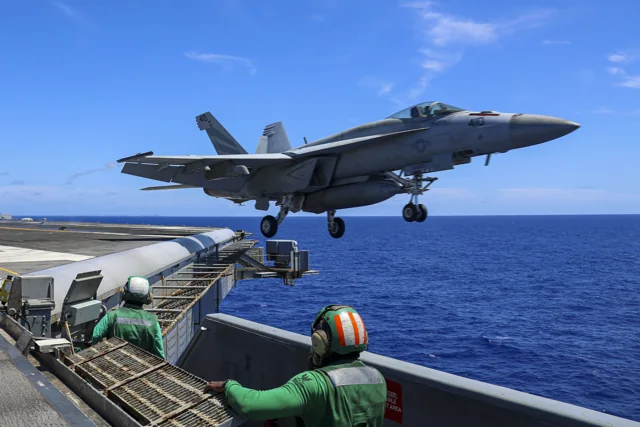
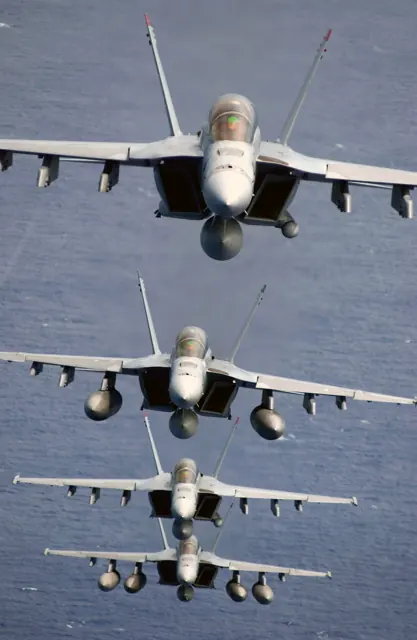
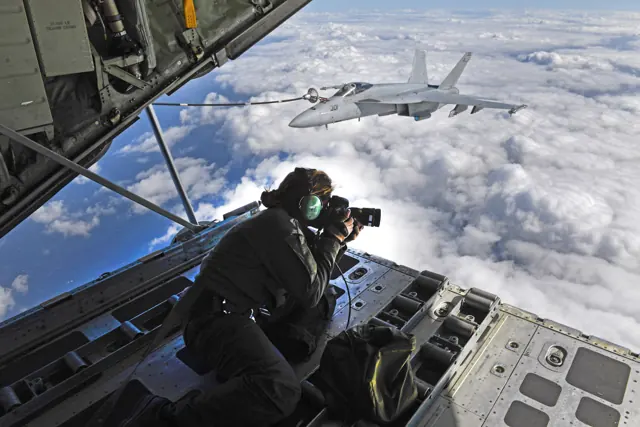
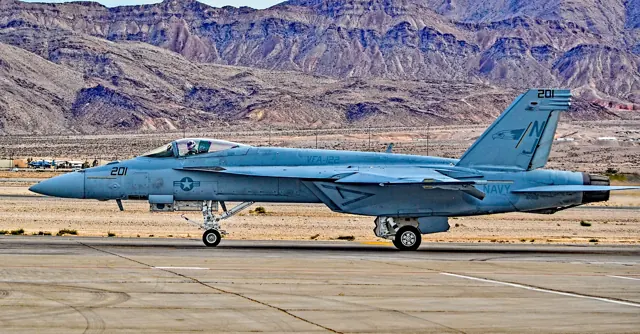
The Super Hornet family comprises the single-seat F/A-18E and tandem-seat F/A-18F. Although the name and outline recall the earlier Hornet, the Super Hornet is a substantially developed aircraft with a larger airframe. Twin engines, outward-canted fins and carrier equipment define its configuration. The E and F also make a useful image distinction: a two-seat photograph depicts the F variant.
Aircraft background
Wikipedia contributors · Read more ↗A familiar cockpit brings some unfamiliar habits
Moving from the older Hornet to the Super Hornet gave Buonerba a cockpit that was familiar enough to feel welcoming. In the air, however, he noticed a heavier character and still regarded the legacy aircraft as a little more nimble. Returning to the carrier was where he particularly appreciated the newer aircraft’s more accommodating handling. The cockpit update also required changes to habits built over years.
Hush-Kit interview · July 2012. Pilot comparing legacy F/A-18C with the E/F Super Hornet family; two-seat mission comments concern the F model.
Hush-Kit · Read more ↗Into the cockpit
 YouTube
USA Military Channel · 3 min ·
F/A-18E Super Hornets Cool Cockpit Video Aboard USS Ronald Reagan
Carrier-operation cockpit footage from F/A-18E Super Hornets aboard USS Ronald Reagan.
Real aircraft · Boeing F/A-18E
Watch on YouTube ↗Preview images are served by AirframeDB. Videos open on YouTube only when you choose to watch.
Meet Boeing F/A-18E
The Super Hornet family comprises the single-seat F/A-18E and tandem-seat F/A-18F. Although the name and outline recall the earlier Hornet, the Super Hornet is a substantially developed aircraft with a larger airframe. Twin engines, outward-canted fins and carrier equipment define its configuration.
Two-seat photographs depict the F variant. The MSFS entry represents the E, with its systems described in the developer documentation.
Boeing F/A-18E
Aircraft type designators
Use the code for the model you are flying. The linked authority lists the applicable aircraft.
History & design
First impressions were followed by months of sea-trial preparation
Niewoehner recalls colleagues teasing Fred Madenwald for declaring the aircraft ready for sea after its first flight. Fourteen months of testing preceded its initial carrier landings; their later success prompted the team to acknowledge his confidence.
Federation of American Scientists archive · The F/A-18E/F Super Hornet: A Test Pilot Dispels the Myths ↗Test-team recollection, not a claim that testing was unnecessary
Development milestones
First flight: 29 November 1995 ( 1995-11-29 )
Developed from: McDonnell Douglas F/A-18 Hornet
Wikipedia contributors · Boeing F/A-18E/F Super Hornet ↗Boeing F/A-18E/F Super Hornet · family/variant named by the source · Wikipedia revision 1372781952
Pilot accounts
A familiar cockpit brings some unfamiliar habits
Moving from the older Hornet to the Super Hornet gave Buonerba a cockpit that was familiar enough to feel welcoming. In the air, however, he noticed a heavier character and still regarded the legacy aircraft as a little more nimble. Returning to the carrier was where he particularly appreciated the newer aircraft’s more accommodating handling.
The cockpit update also required changes to habits built over years. On the old keypad, he could enter information largely by touch; the touchscreen needed him to look at the display and check where he was pressing. He admitted occasionally getting into arguments with it.
Hush-Kit interview · July 2012. Pilot comparing legacy F/A-18C with the E/F Super Hornet family; two-seat mission comments concern the F model.
Read the full account · Hush-Kit ↗The test pilot finds familiar controls in a larger aircraft
Niewoehner’s first impression of the Super Hornet was shaped by how much he already recognised. Switch locations and procedures helped a Hornet pilot settle in quickly, while the larger aircraft’s behaviour around the landing pattern made a favourable impression. Greater weight had not, in his view, made it an awkward aircraft to bring home.
His work also took him far beyond that familiar introduction. He describes flying the E4 test aircraft with external tanks, stores and ballast while the team investigated demanding corners of its handling envelope. Those trials formed part of the evidence behind his confidence in the design.
First-person development report archived by FAS. Navy lead test pilot describes E/F flying, including a specifically identified E4 test aircraft; historical test configurations are not operating guidance.
Read the full account · Federation of American Scientists archive ↗A calm instructor helps a nervous visitor through the flight
Rehfeld spent considerable time helping aviation writer Brad Elward prepare for a Super Hornet flight. He explained the plan, answered questions and maintained a calm manner that made the unfamiliar equipment and procedures less intimidating. Once airborne, he continued talking his guest through what the aircraft was doing.
Over the training area, Rehfeld demonstrated manoeuvres and explained some of the changing sounds and sensations at lower speeds. Elward’s enthusiasm eventually met the physical limits of a first-time passenger: aerobatics and practice approaches left him feeling ill. Rehfeld adapted the return accordingly, telling the tower they would spend a while flying straight and level. The writer remembered that consideration alongside the aircraft’s performance.
Brad Elward’s eyewitness account of a VFA-122 familiarization flight from NAS Lemoore. Rehfeld piloted the two-seat F/A-18F; Elward was the passenger and narrator, not its pilot.
Read the full account · Brad Elward ↗In your simulator
Systems, equipment and documentation for each developer’s aircraft.
Compare simulator versions →MSFS 2024F/A-18E
Microsoft Flight Simulator · Released
F/A-18E
Microsoft Flight Simulator · Released
MSFS 2020F/A-18E
Microsoft Flight Simulator · Released
F/A-18E
Microsoft Flight Simulator · Released
Aircraft specifications
Published figures for the named real-aircraft variant. Simulator equipment and performance can differ.
| Specification | Published value |
|---|---|
| Length | 60 ft 1.25 in (18.31 m) |
| Wingspan | 44 ft 8.5 in (13.62 m) |
| Height | 16 ft 0 in (4.88 m) |
| Wing area | 500 sq ft (46.5 m² ) |
| Empty weight | 32,081 lb (14,552 kg) |
| Gross weight | 47,000 lb (21,320 kg) (equipped for fighter escort) |
| Max takeoff weight | 66,000 lb (29,937 kg) |
| Powerplant | 2 × General Electric F414-GE-400 turbofans , 13,000 lbf (58 kN) thrust each dry, 22,000 lbf (98 kN) with afterburner |
| Maximum speed | Mach 1.8, 1,030 kn (1,185 mph; 1,908 km/h) clean at 40,000 ft Mach 1.06, 700 kn (806 mph; 1,296 km/h) at sea level Mach 1.62, 932 kn (1,073 mph; 1,726 km/h) at 36,000 ft, air-to-air loadout (2× AIM-120, 2× AIM-9, internal fuel only) |
| Cruise speed | 482 kn (555 mph, 893 km/h) fighter escort |
| Stall speed | 129 kn (148 mph, 239 km/h) power-off |
| Range | 1,275 nmi (1,458 mi, 2,346 km) with armament of two AIM-9s |
| Service ceiling | 52,300 ft (15,940 m) |
| Rate of climb | 44,882 ft/min (228 m/s) |
Manuals & resources
Find your next read
Choose a topic for a short introduction and a link to the original source. Simulator references identify the developer and edition they cover.
Pilot account
A familiar cockpit brings some unfamiliar habitsHush-Kit interview · July 2012. Pilot comparing legacy F/A-18C with the E/F Super Hornet family; two-seat mission comments concern the F model.
Moving from the older Hornet to the Super Hornet gave Buonerba a cockpit that was familiar enough to feel welcoming. In the air, however, he noticed a heavier character and still regarded the legacy aircraft as a little more nimble. Returning to the carrier was where he particularly appreciated the newer aircraft’s more accommodating handling. The cockpit update also required changes to habits built over years.
Dave Buonerba
Hush-Kit · Read the source ↗The test pilot finds familiar controls in a larger aircraftFirst-person development report archived by FAS. Navy lead test pilot describes E/F flying, including a specifically identified E4 test aircraft; historical test configurations are not operating guidance.
Niewoehner’s first impression of the Super Hornet was shaped by how much he already recognised. Switch locations and procedures helped a Hornet pilot settle in quickly, while the larger aircraft’s behaviour around the landing pattern made a favourable impression. Greater weight had not, in his view, made it an awkward aircraft to bring home. His work also took him far beyond that familiar introduction.
Rob Niewoehner
Federation of American Scientists archive · Read the source ↗Read the original documentation from the people who created it. Manuals open on their publisher’s website.
Manual
Microsoft Flight Simulator aircraft manualsMicrosoft / aircraft developersAircraft background
Boeing F/A-18E/F Super HornetWikipedia contributors · Research background · Wikipedia revision 1372781952 · retrieved 2026-09-12Resource
MSFS 2024 FAQ and edition aircraft inventoryMicrosoft MSFS 2020 FAQ and edition aircraft inventoryMicrosoftType designator
ICAO Doc 8643 — aircraft type designatorsInternational Civil Aviation Organization · Public search data retrieved 2026-09-14; authority update 2026-09-03Built-in force-feedback profiles
Read the documentary basis, editable starting settings and remaining questions for the aircraft you fly. Each explanation refers to the exact profile revision shown.
Catalogue programme-20261022-v1 · 1 profile choice
Boeing F/A-18E
Free and Pro · Revision 1 · Partial review
MSFS 2024 · MSFS 2020
Boeing F/A-18E: The selected electronic-control spring is nominal; NAVAIR's engine and seating details do not define inceptor resistance.
Discuss this aircraft (0)
Questions, observations and useful sources from the community.
No published discussions yet. Bring a question or share a useful source.
Open aircraft discussions →Content expanded · What’s new
Something missing or a source that needs attention?
Suggest a correction ↗