




Start here
A few places to begin, from the aircraft’s story to the people who fly it.
Meet the aircraft
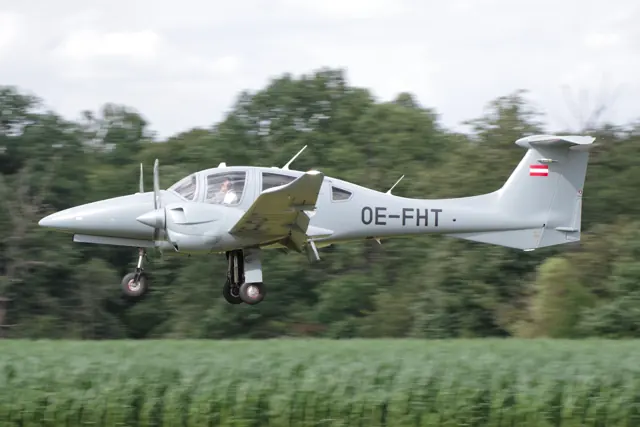
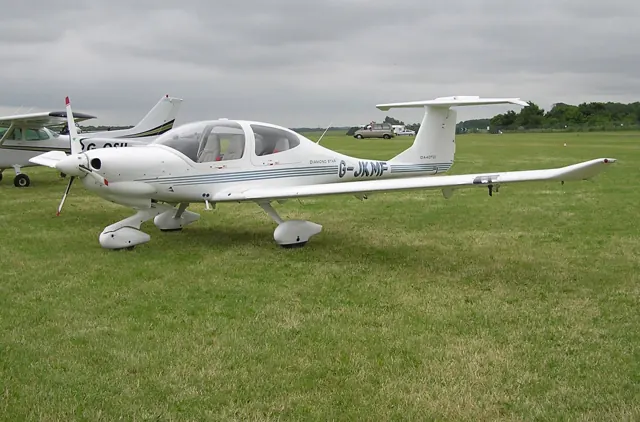
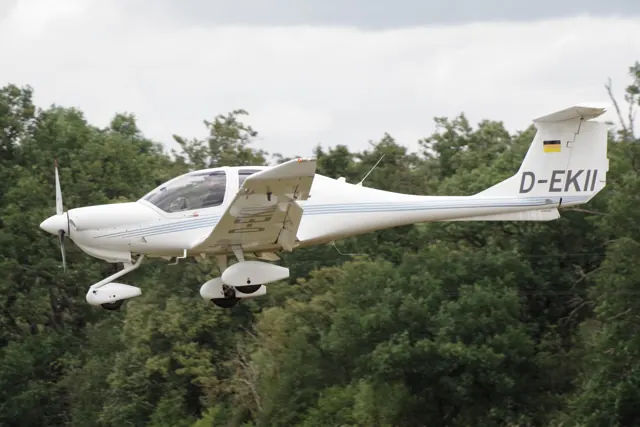
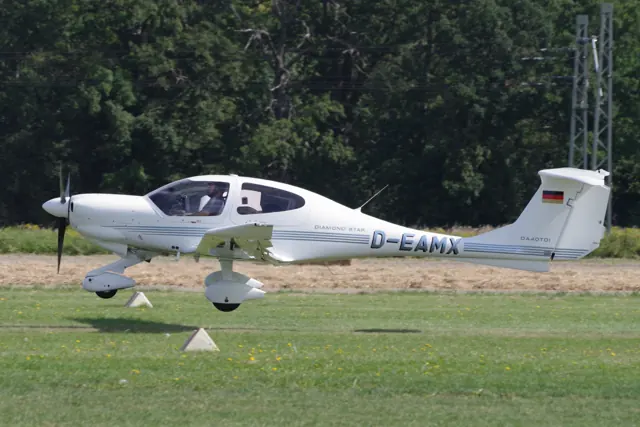
The DA40 took the DA20's general concept into a larger cabin. Its low wing, fixed tricycle undercarriage and extensive canopy glazing give it a distinctive appearance. Production has taken place in Austria and Canada, with several engine and equipment developments. The petrol-engined and diesel-family DA40 variants are not merely different liveries. Engine management and cockpit equipment differ, and simulator packages may represent different points in that development.
Aircraft background
Wikipedia contributors · Read more ↗Familiar fine handling, with a qualified verdict on the diesel
Whiteman approached the Austro-powered DA40 NG with experience of the original prototype and earlier production versions. Flying G-SUEO with its regular demonstration pilot, Mark, he appreciated the simple power control and comfortable seating, although mastering the Garmin displays would require more study. Initial acceleration was strong, but the departure did not deliver the improvement he had hoped for.
Pilot, 12 June 2015. DA40 NG G-SUEO evaluation, with comparisons to earlier DA40 versions; possible rigging issue remains aircraft-specific.
Pilot · Read more ↗Into the cockpit
 YouTube
LifeStyle Aviation
Official Diamond DA40 NG Demo Flight | Lifestyle Aviation
Follow a demonstration flight through takeoff, manoeuvres, slow flight and landing.
Real DA40 NG; manufacturer dealer demonstration
Watch on YouTube ↗Preview images are served by AirframeDB. Videos open on YouTube only when you choose to watch.
Meet Diamond DA40
The DA40 took the DA20's general concept into a larger cabin. Its low wing, fixed tricycle undercarriage and extensive canopy glazing give it a distinctive appearance. Production has taken place in Austria and Canada, with several engine and equipment developments.
Petrol-engined and diesel-family DA40s differ in engine management and cockpit equipment. The simulator products identify their represented model.
Diamond DA40
Aircraft type designators
Use the code for the model you are flying. The linked authority lists the applicable aircraft.
History & design
Development milestones
First flight: 5 November 1997
Developed from: Diamond DA20
Wikipedia contributors · Diamond DA40 Diamond Star ↗Diamond DA40 Diamond Star · family/variant named by the source · Wikipedia revision 1373674831
Pilot accounts
Familiar fine handling, with a qualified verdict on the diesel
Whiteman approached the Austro-powered DA40 NG with experience of the original prototype and earlier production versions. Flying G-SUEO with its regular demonstration pilot, Mark, he appreciated the simple power control and comfortable seating, although mastering the Garmin displays would require more study. Initial acceleration was strong, but the departure did not deliver the improvement he had hoped for. Retracting the flaps brought a noticeable reduction in the modest early climb.
Once established, the familiar appeal returned: light, well-coordinated controls, a useful mechanical trimwheel and excellent visibility made formation flying and general manoeuvring a pleasure. The aeroplane required continuing right-pedal pressure, which Mark suspected might reflect that particular aircraft's rigging; Whiteman did not establish it as a fleet characteristic. His final assessment remained mixed. He admired the DA40's handling and recognised the diesel's potential economy, while wishing its takeoff and initial climb felt more convincing.
Pilot, 12 June 2015. DA40 NG G-SUEO evaluation, with comparisons to earlier DA40 versions; possible rigging issue remains aircraft-specific.
Read the full account · Pilot ↗A trainer that rewards coordination and planning
Turner evaluated the DA40 as a prospective training aircraft and found plenty to keep a student engaged. Its low seating position and broad view made the runway feel close, while the initial takeoff required deliberate directional control. In the air, he found the stick easy to adopt and the controls light without becoming vague. Once properly trimmed, the aircraft held its attitude well, but its clean airframe demanded anticipation when levelling off or preparing to descend.
An overcast formed beneath the demonstration flight, so the return included an IFR clearance and vectors to an ILS. That gave Turner a practical opportunity to explore the workload of an instrument approach before breaking into visual conditions for landing. He finished the flight smiling and considered the Diamond a promising trainer for future professional pilots. His praise included the demands it placed on rudder coordination and energy management, alongside reservations about ground ventilation, storage space and the attention required during transition.
StudentPilot.com, 27 November 2004. Early DA40 demonstration assessed as an airline-training platform; personal handling observations, not operating instructions.
Read the full account · StudentPilot.com ↗Dinner at Santa Paula changes a traditional pilot’s mind
Lee wanted to experience the DA40 XLS on an ordinary outing, so he joined distributor demonstration pilot Robert Stewart for a trip from Long Beach to Santa Paula. The wraparound view immediately impressed him, and he welcomed the manual trimwheel after initially fumbling with electric trim. Climbing out toward the coast, he began to appreciate how much of the surrounding landscape was visible from ahead of the wing.
The journey combined low-speed handling demonstrations, music through the headsets and a look at the Garmin synthetic-vision display before an arrival among Santa Paula's classic aircraft. Lee had expected to dislike a modern composite aeroplane, but found that the technology left plenty of opportunity to enjoy hand-flying. Returning to Long Beach, he was reluctant to walk away.
Plane + Pilot, 24 February 2009. DA40 XLS demonstration trip with Robert Stewart; quoted fleet safety statistics and broad accident-prevention claims are excluded.
Read the full account · Plane + Pilot ↗In your simulator
Systems, equipment and documentation for each developer’s aircraft.
Compare simulator versions →MSFS 2024DA40 NG
Microsoft Flight Simulator · Released
DA40 NG
Microsoft Flight Simulator · Released
MSFS 2024DA40 TDI
Microsoft Flight Simulator · Released
DA40 TDI
Microsoft Flight Simulator · Released
MSFS 2020DA40 NG
Microsoft Flight Simulator · Released
DA40 NG
Microsoft Flight Simulator · Released
MSFS 2020DA40-TDI
Microsoft Flight Simulator · Released
DA40-TDI
Microsoft Flight Simulator · Released
MSFS 2020 · MSFS 2024COWS DA40 Series
COWS · Released
COWS DA40 Series
COWS · Released
X-Plane 12DA40 Expansion Pack
NHAdrian / Alabeo · Released
DA40 Expansion Pack
NHAdrian / Alabeo · Released
X-Plane 12DA40NG
RealSimGear · Released
DA40NG
RealSimGear · Released
X-Plane 12DA40NG
SimSolutions · Released
DA40NG
SimSolutions · Released
X-Plane 12Diamond DA40-180 Diamond Star
STMA · Released
Diamond DA40-180 Diamond Star
STMA · Released
Aircraft specifications
Published figures for the named real-aircraft variant. Simulator equipment and performance can differ.
| Specification | Published value |
|---|---|
| Length | 8.1 m (26 ft 7 in) |
| Wingspan | 11.9 m (39 ft 1 in) |
| Height | 1.98 m (6 ft 6 in) |
| Wing area | 13.5 m² (145 sq ft) |
| Empty weight | 795 kg (1,753 lb) |
| Gross weight | 1,198 kg (2,641 lb) |
| Powerplant | 1 × Lycoming IO-360-M1A 4-cylinder air-cooled horizontally-opposed piston engine, 134 kW (180 hp) |
| Cruise speed | 279 km/h (173 mph, 151 kn) TAS |
| Stall speed | 91 km/h (57 mph, 49 kn) flaps down |
| Range | 1,341 km (833 mi, 724 nmi) |
| Service ceiling | 5,000 m (16,000 ft) |
| Rate of climb | 5.69 m/s (1,120 ft/min) |
Manuals & resources
Find your next read
Choose a topic for a short introduction and a link to the original source. Simulator references identify the developer and edition they cover.
Pilot account
Familiar fine handling, with a qualified verdict on the dieselPilot, 12 June 2015. DA40 NG G-SUEO evaluation, with comparisons to earlier DA40 versions; possible rigging issue remains aircraft-specific.
Whiteman approached the Austro-powered DA40 NG with experience of the original prototype and earlier production versions. Flying G-SUEO with its regular demonstration pilot, Mark, he appreciated the simple power control and comfortable seating, although mastering the Garmin displays would require more study. Initial acceleration was strong, but the departure did not deliver the improvement he had hoped for. Retracting the flaps brought a noticeable reduction in the modest early climb.
Philip Whiteman
Pilot · Read the source ↗A trainer that rewards coordination and planningStudentPilot.com, 27 November 2004. Early DA40 demonstration assessed as an airline-training platform; personal handling observations, not operating instructions.
Turner evaluated the DA40 as a prospective training aircraft and found plenty to keep a student engaged. Its low seating position and broad view made the runway feel close, while the initial takeoff required deliberate directional control. In the air, he found the stick easy to adopt and the controls light without becoming vague. Once properly trimmed, the aircraft held its attitude well, but its clean airframe demanded anticipation when levelling off or preparing to descend.
Thomas Turner
StudentPilot.com · Read the source ↗Developer documentation
COWS DA40 Series — product listingCOWS DA40 Series · MSFS 2020 · MSFS 2024
Product listing captured 2026-09-30; edition scope from the reviewed catalogue
www.cows.studio · Read the source ↗DA40 Expansion Pack — product listingDA40 Expansion Pack · X-Plane 12
Product listing captured 2026-09-24; edition scope from the reviewed catalogue
NHAdrian / Alabeo · Read the source ↗DA40NG — product listingDA40NG · X-Plane 12
Product listing captured 2026-09-23; edition scope from the reviewed catalogue
www.x-aviation.com · Read the source ↗DA40NG — product listingDA40NG · X-Plane 12
Product listing captured 2026-09-23; edition scope from the reviewed catalogue
store.x-plane.org · Read the source ↗Diamond DA40-180 Diamond Star — product listingDiamond DA40-180 Diamond Star · X-Plane 12
Product listing captured 2026-09-24; edition scope from the reviewed catalogue
STMA · Read the source ↗Read the original documentation from the people who created it. Manuals open on their publisher’s website.
Manual
Microsoft Flight Simulator aircraft manualsMicrosoft / aircraft developersAircraft background
Diamond DA40 Diamond StarWikipedia contributors · Research background · Wikipedia revision 1373674831 · retrieved 2026-09-12Resource
MSFS 2024 FAQ and edition aircraft inventoryMicrosoft MSFS 2020 FAQ and edition aircraft inventoryMicrosoftType designator
ICAO Doc 8643 — aircraft type designatorsInternational Civil Aviation Organization · Public search data retrieved 2026-09-14; authority update 2026-09-03Product
COWS | DA40 Serieswww.cows.studio · Product listing captured 2026-09-30; edition scope from the reviewed catalogue DA40 Expansion PackNHAdrian / Alabeo · Product listing captured 2026-09-24; edition scope from the reviewed catalogue Take Command!: RealSimGear DA40NG, X-Aviationwww.x-aviation.com · Product listing captured 2026-09-23; edition scope from the reviewed catalogue Diamond DA40NG-SimSolutions-DA40store.x-plane.org · Product listing captured 2026-09-23; edition scope from the reviewed catalogue Diamond DA40-180 Diamond StarSTMA · Product listing captured 2026-09-24; edition scope from the reviewed catalogueBuilt-in force-feedback profiles
Read the documentary basis, editable starting settings and remaining questions for the aircraft you fly. Each explanation refers to the exact profile revision shown.
Catalogue programme-20261022-v1 · 10 profile choices
COWS DA40 XLS
COWS · Free and Pro · Revision 4 · Inherited starting point
MSFS 2020 · MSFS 2024
COWS DA40 XLS: Mechanical linkage motivates airspeed-sensitive stick resistance.
COWS DA40 NG
COWS · Free and Pro · Revision 3 · Inherited starting point
MSFS 2020 · MSFS 2024
COWS DA40 NG: Mechanical linkage motivates airspeed-sensitive stick resistance.
NHAdrian / Alabeo Alabeo DA40 Expansion Pack
NHAdrian / Alabeo · Free and Pro · Revision 3 · Inherited starting point
X-Plane 12
NHAdrian / Alabeo Alabeo DA40 Expansion Pack: Mechanical linkage motivates airspeed-sensitive stick resistance.
RealSimGear DA40NG
RealSimGear · Free and Pro · Revision 2 · Inherited starting point
X-Plane 12
RealSimGear DA40NG: Mechanical linkage motivates airspeed-sensitive stick resistance.
SimSolutions Diamond DA40NG
SimSolutions · Free and Pro · Revision 2 · Inherited starting point
X-Plane 12
SimSolutions Diamond DA40NG: Mechanical linkage motivates airspeed-sensitive stick resistance.
STMA Diamond DA40-180
STMA · Free and Pro · Revision 3 · Inherited starting point
X-Plane 12
STMA Diamond DA40-180: Mechanical linkage motivates airspeed-sensitive stick resistance.
Diamond DA40 NG
Free and Pro · Revision 2 · Partial review
MSFS 2020 · MSFS 2024
Diamond DA40 NG: Mechanical linkage motivates airspeed-sensitive stick resistance.
Diamond DA40 TDI
Free and Pro · Revision 1 · Review pending
MSFS 2020 · MSFS 2024
Diamond DA40 TDI: Mechanical linkage motivates airspeed-sensitive stick resistance.
Diamond DA40 XLS
Free and Pro · Revision 1 · Review pending
MSFS 2020 · MSFS 2024
Diamond DA40 XLS: Mechanical linkage motivates airspeed-sensitive stick resistance.
Diamond DA40 NG
Free and Pro · Revision 4 · Partial review
MSFS 2024 · MSFS 2020
Mechanical stick controls with aerodynamic pitch trim and separately tuned pitch and roll resistance.
Diamond DA40 NG
Diamond DA40 NG: Mechanical linkage motivates airspeed-sensitive stick resistance.
Aircraft and simulator scope
- Diamond DA40 NG · MSFS 2020 · Variant starting point
- Diamond DA40 NG · MSFS 2024 · Variant starting point
Diamond DA40 NG · The selected DA40 NG matches the manufacturer table's diesel variant; XLT figures remain separate. Diamond's table covers DA40 NG and XLT; TDI and XLS are not the named variants in this source.
The simulator model and controls
The DA40 took the DA20's general concept into a larger cabin. Its low wing, fixed tricycle undercarriage and extensive canopy glazing give it a distinctive appearance. Production has taken place in Austria and Canada, with several engine and equipment developments.
This starting point selects Diamond DA40 NG. Its aircraft-level settings do not select a particular developer’s custom systems.
How this profile feels
Mechanical linkage motivates airspeed-sensitive stick resistance. Spring resistance builds with the selected airspeed response. A separate aerodynamic term adds speed-dependent control load.
The DA40 elevator tab supplies pitch pressure relief, unlike the DA20’s spring-preload system. Valid trim provides the configured pressure relief. Autopilot following is enabled for supported control references.
Controls and trim
The DA40’s elevator and ailerons use pushrods, with cables operating the rudder. A Bowden cable drives the elevator trim tab, and electric flaps select their named positions. Lycoming XLS and diesel NG versions retain different propulsion and cockpit equipment.
About the values
The gains are normalized profile settings. They describe the chosen effect balance; hand force depends on the device and its output limits. IAS references are tuning values rather than operating limits. Physical acceptance of this revision remains pending.
What the documentation establishes
The selected DA40 NG matches the manufacturer table's diesel variant; XLT figures remain separate. Diamond's table covers DA40 NG and XLT; TDI and XLS are not the named variants in this source.
The table distinguishes AE300 diesel piston and IO360 gasoline piston engines with different propellers; jet fuel does not establish turbine propulsion.
The NG figures include TAS cruise and CAS landing stall, while the XLT stall is labeled IAS. Those definitions must remain distinct from a shared tuning reference.
Documentary review and sources
These decisions describe the documentary basis and remaining gaps for this revision. Aircraft documentation and a starting setting describe different kinds of evidence.
Aircraft and variant
ReviewedThis starting point selects Diamond DA40 NG. Its aircraft-level settings do not select a particular developer’s custom systems.
Flight controls
Not yet reviewedThe DA40’s elevator and ailerons use pushrods, with cables operating the rudder. A Bowden cable drives the elevator trim tab, and electric flaps select their named positions. Lycoming XLS and diesel NG versions retain different propulsion and cockpit equipment.
Trim
Not yet reviewedThe DA40 elevator tab supplies pitch pressure relief, unlike the DA20’s spring-preload system. Pitch authority 0.3 provides load relief and permitted centre movement; roll authority is 0.
Autopilot and stability
Not yet reviewedFollowing is on at 0.1 authority when a supported, valid autopilot control reference is available.
Equipment
ReviewedGear, flap and ground cues follow the selected settings and available simulator-reported states.
Speeds and limits
ReviewedThe indicated-speed references set the profile response scale; they are separate from aircraft operating limits.
Simulator integration
Not yet reviewedThe profile targets msfs2020, msfs2024. Add-on-specific controls use only the supported references configured by this profile.
Force-feedback settings
Not yet reviewedThe settings define the profile’s effect balance. Device output limits affect physical hand force.
Starting settings and their rationale
These configured values are starting estimates. The explanations describe what each setting controls; physical validation appears separately below.
| Setting | Starting value | What it controls and why |
|---|---|---|
| Spring strength | Starting value0.74 | What it controls and whyMechanical linkage motivates airspeed-sensitive stick resistance. The baseline spring is 0.74. Its low-speed blend reaches baseline strength at 67.5 KIAS. |
| Master force gain | Starting value0.85 | What it controls and whyScales overall profile strength while preserving effect balance, subject to device and output limits. |
| Profile force gain | Starting value0.8 | What it controls and whyThe aerodynamic-load gain is 0.8 with an indicated-speed reference of 135 KIAS. This supplies speed-dependent loading alongside the spring. |
| Force tuning speed/reference | Starting value135.0 kt | What it controls and whySets the IAS reference for aerodynamic loading. It is an estimate, not published cruise TAS or a flight limit. |
| Spring response reference speed | Starting value67.5 kt | What it controls and whySets the IAS where the low-speed blend reaches baseline strength; high-speed stiffening also uses it. |
| Aileron force scale | Starting value0.72 | What it controls and whyRoll and pitch aerodynamic scales are 0.72 and 1, respectively. They set the aerodynamic axis balance. No custom spring-travel curve is enabled. |
| Elevator force scale | Starting value1.0 | What it controls and whyScales pitch aerodynamic loading; pitch spring travel and trim responses are separate settings. |
| Trim feel | Starting valueEnabled | What it controls and whyRetained for compatibility and group membership. Trim relief, rather than this flag, controls centre movement. |
| Trim relief | Starting valueEnabled | What it controls and whyAllows trim relief with supported control law and valid telemetry. Axis authorities set its amount. |
| Autopilot follow | Starting valueEnabled | What it controls and whyFollowing is on at 0.1 authority when a supported, valid autopilot control reference is available. |
| Autopilot neutral hold | Starting valueDisabled | What it controls and whyPermits centering hold during a supported AP state, separate from following a moving target. |
| Output force limit | Starting value0.55 | What it controls and whyCaps directed-force output. Native spring effects and device limits remain separate. |
All 44 starting settings and their rationale
The settings define the profile’s effect balance. Device output limits affect physical hand force.
| Setting | Starting value | What it controls and why |
|---|---|---|
| Spring strength | Starting value0.74 | What it controls and whyMechanical linkage motivates airspeed-sensitive stick resistance. The baseline spring is 0.74. Its low-speed blend reaches baseline strength at 67.5 KIAS. |
| Spring deadband | Starting value0.045 | What it controls and whySets travel around the centre before the baseline spring resists. Smaller values engage it sooner. |
| Profile force gain | Starting value0.8 | What it controls and whyThe aerodynamic-load gain is 0.8 with an indicated-speed reference of 135 KIAS. This supplies speed-dependent loading alongside the spring. |
| Master force gain | Starting value0.85 | What it controls and whyScales overall profile strength while preserving effect balance, subject to device and output limits. |
| QBlend Enabled | Starting valueEnabled | What it controls and whyAllows baseline spring strength to rise with indicated airspeed where the control law permits it. |
| QSpring Minimum Factor | Starting value0.5 | What it controls and whySets low-speed spring strength as a fraction of baseline when blending is enabled. One keeps full strength. |
| QSpring Start Knots | Starting value18.9 kt | What it controls and whySets the IAS where the low-speed spring blend starts rising. This is a feel threshold, not a flight limit. |
| Spring response reference speed | Starting value67.5 kt | What it controls and whySets the IAS where the low-speed blend reaches baseline strength; high-speed stiffening also uses it. |
| Force tuning speed/reference | Starting value135.0 kt | What it controls and whySets the IAS reference for aerodynamic loading. It is an estimate, not published cruise TAS or a flight limit. |
| Airspeed spring stiffening gain | Starting value0.15 | What it controls and whyThe high-speed spring-stiffening gain is 0.15. It strengthens the permitted spring response above 67.5 KIAS, with the squared-speed ratio capped at 5. |
| Airspeed spring stiffening limit | Starting value5 | What it controls and whyLimits the squared airspeed ratio used for high-speed spring stiffening; it is not a device-force cap. |
| Aileron force scale | Starting value0.72 | What it controls and whyRoll and pitch aerodynamic scales are 0.72 and 1, respectively. They set the aerodynamic axis balance. No custom spring-travel curve is enabled. |
| Elevator force scale | Starting value1.0 | What it controls and whyScales pitch aerodynamic loading; pitch spring travel and trim responses are separate settings. |
| Output force limit | Starting value0.55 | What it controls and whyCaps directed-force output. Native spring effects and device limits remain separate. |
| Trim feel | Starting valueEnabled | What it controls and whyRetained for compatibility and group membership. Trim relief, rather than this flag, controls centre movement. |
| Trim relief | Starting valueEnabled | What it controls and whyAllows trim relief with supported control law and valid telemetry. Axis authorities set its amount. |
| Elevator Authority | Starting value0.3 | What it controls and whyThe DA40 elevator tab supplies pitch pressure relief, unlike the DA20’s spring-preload system. Pitch authority 0.3 provides load relief and permitted centre movement; roll authority is 0. |
| Aileron Authority | Starting value0 | What it controls and whyScales supported roll-trim relief and permitted centre movement. Zero removes roll response. |
| Force Trim Enabled | Starting valueDisabled | What it controls and whyEnables local force trim, separate from aircraft-owned trim and add-on integration qualification. |
| GLoad Enabled | Starting valueEnabled | What it controls and whyAllows load-factor changes to modify permitted spring laws. Passive fly-by-wire feel can suppress it. |
| Rate Damping Enabled | Starting valueEnabled | What it controls and whyEnables rate damping with the configured coefficients and control law. |
| Autopilot follow | Starting valueEnabled | What it controls and whyFollowing is on at 0.1 authority when a supported, valid autopilot control reference is available. |
| Autopilot follow authority | Starting value0.1 | What it controls and whySets admitted AP-follow gain, not a percentage of travel. Runtime ownership and input limits still apply. |
| Autopilot neutral hold | Starting valueDisabled | What it controls and whyPermits centering hold during a supported AP state, separate from following a moving target. |
| Autopilot neutral hold strength | Starting value0.6 | What it controls and whySets admitted AP neutral-hold strength; inactive while neutral hold is disabled. |
| Enabled | Starting valueEnabled | What it controls and whyEnables aerodynamic cues; each still needs nonzero strength and its simulator conditions. |
| Gain | Starting value0.35 | What it controls and whySets stall-buffet strength. Zero removes the cue without changing simulator stalls or warnings. |
| Gain | Starting value0 | What it controls and whySets high-Mach buffet strength; onset and full-strength thresholds are separate. |
| Gain | Starting value0.14 | What it controls and whySets flap buffet at the configured position and speed gates. Flap movement texture is separate. |
| Maximum flap index | Starting value2 | What it controls and whySets the final flap index for detent normalization. UP plus three detents uses maximum index3. |
| Minimum flap index | Starting value2 | What it controls and whySets the first flap detent that admits buffet; this is a handle index, not degrees. |
| Gain | Starting value0 | What it controls and whySets gear aerodynamic buffet; movement and ground-contact cues are separate. |
| Shaker Enabled | Starting valueDisabled | What it controls and whyPermits shaker at supported warning conditions; the switch does not establish aircraft equipment. |
| Stick shaker amplitude | Starting value0.5 | What it controls and whySets triggered shaker strength; inactive while the shaker feature is disabled. |
| Enabled | Starting valueEnabled | What it controls and whyEnables ground effects; each still needs its own strength and contact or motion telemetry. |
| Gain | Starting value0.4 | What it controls and whySets rolling texture strength, modified by speed, surface and undercarriage configuration. |
| Gain | Starting value0.25 | What it controls and whySets gear-bump texture during ground motion, separate from touchdown impact. |
| Gain | Starting value0.65 | What it controls and whySets landing-impact strength; landing telemetry and response shape determine the pulse. |
| Gain | Starting value0 | What it controls and whySets reverse-thrust vibration with valid reverser and engine conditions. Zero removes the cue. |
| Enabled | Starting valueEnabled | What it controls and whyEnables engine cues with nonzero settings and valid running-engine telemetry. |
| Gain | Starting value0.12 | What it controls and whySets estimated engine vibration using configured telemetry and response, not measured cockpit vibration. |
| Enabled | Starting valueEnabled | What it controls and whyEnables accessory cues with configured strengths and observed accessory movement. |
| Gain | Starting value0.12 | What it controls and whySets texture from observed flap movement; a command without movement does not establish the cue. |
| Gain | Starting value0 | What it controls and whySets texture from observed gear movement, separate from aerodynamic and touchdown effects. |
Limits and open questions
- The technical table does not describe primary flight controls.
- Trim mechanism and control-pressure relief are absent from this specification table.
- The table does not identify an autopilot installation or its operation.
- Real-aircraft specifications do not define simulator or add-on signal semantics.
- The table supplies performance and equipment, without stick-force or vibration measurements.
- Diamond DA40 NG documentary evidence does not establish force-feedback hardware acceptance.
Physical validation
No physical force validation is recorded in this public catalogue for this revision. Documentary review and software checks do not establish how a particular device feels.
Discuss this aircraft (2)
Questions, observations and useful sources from the community.
- DA 40 D (TDI) Reference Speeds →1 reply · Last activity
- DA 40 D (TDI) Landing Distances →1 reply · Last activity
Content expanded · What’s new
Something missing or a source that needs attention?
Suggest a correction ↗