


Start here
A few places to begin, from the aircraft’s story to the people who fly it.
Meet the aircraft
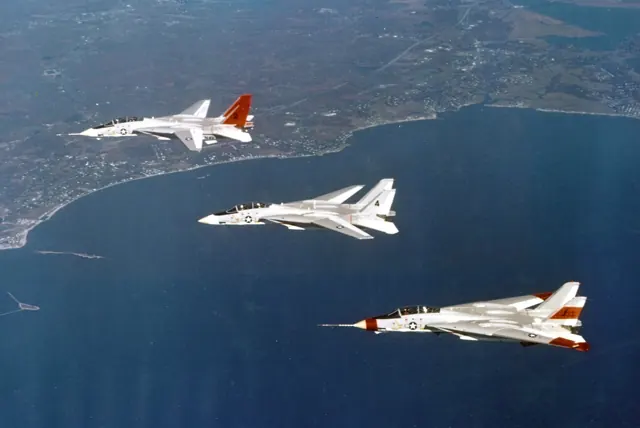
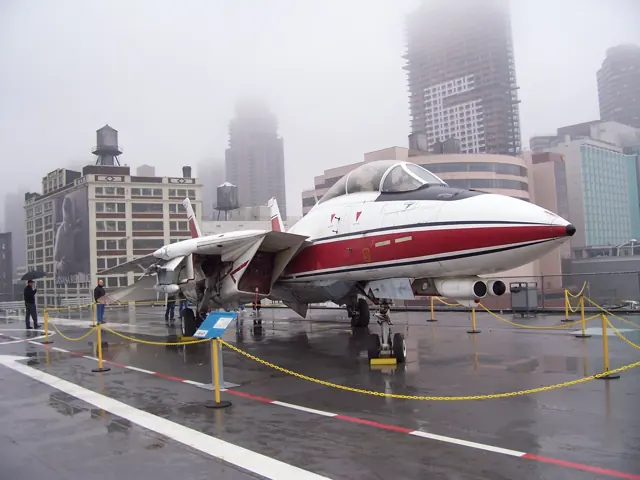
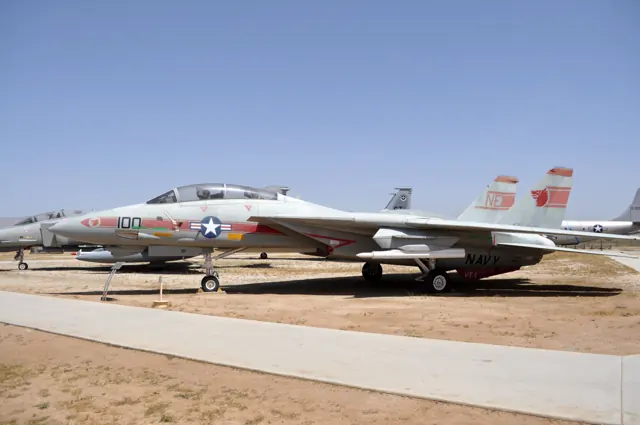
The Tomcat was developed for the US Navy after the F-111B programme ended. Twin engines, widely spaced tails and variable-sweep wings supported fleet defence and, later, strike missions.
Aircraft background
Wikipedia contributors · Read more ↗A demanding cockpit depends on people on the ground
Erie remembered the Tomcat as an aircraft that demanded attention to the stick and throttles, particularly during landing. Flying it also meant working closely with the radar intercept officer behind him. His affection for the aircraft included respect for the effort required from both seats, rather than treating the pilot as the whole crew.
Hush-Kit interview · November 2022. U.S. Navy F-14A/B pilot, instructor and later VF-154 maintenance officer.
Hush-Kit · Read more ↗Wing sweep has automatic and manual controls
Laminar’s guide describes an automatic sweep mode, manual forward and aft commands, a bombing position and a guarded emergency handle. These are separate controls to explore in the simulated cockpit.
Grumman F-14 Tomcat · Laminar Research · X-Plane 12
Laminar Research · Read more ↗Into the cockpit
 YouTube
Animagraffs · 46 min ·
How the Grumman F-14 Tomcat Works
An animated tour explains the F-14's layout and mechanisms.
Real aircraft · Grumman F-14 Tomcat
Watch on YouTube ↗Preview images are served by AirframeDB. Videos open on YouTube only when you choose to watch.
Meet Grumman F-14 Tomcat
The Tomcat was developed for the US Navy after the F-111B programme ended. Twin engines, widely spaced tails and variable-sweep wings supported fleet defence and, later, strike missions.
Pilot and radar-intercept officer divided the work between two cockpits. Engines, avionics and other systems changed between F-14 versions; the X-Plane documentation describes the model included in that simulation.
Grumman F-14 Tomcat
Grumman → · Explore the family →
Grumman F-14 Tomcat
Wikipedia contributors · Grumman F-14 Tomcat ↗Laminar Research · X-Plane 12 →Aircraft type designators
Use the code for the model you are flying. The linked authority lists the applicable aircraft.
History & design
A preserved Tomcat carries a specific service history
The National Naval Aviation Museum identifies its displayed F-14D with a combat sortie from USS Theodore Roosevelt on 8 February 2006, its 224th. The museum’s airframe history gives the preserved aircraft a connection to the final period of U.S. Navy Tomcat operations.
National Naval Aviation Museum · F-14D Tomcat ↗Specific museum aircraft; not a claim about the end of all worldwide F-14 flying
Development milestones
First flight: 21 December 1970 ( 1970-12-21 )
Wikipedia contributors · Grumman F-14 Tomcat ↗Grumman F-14 Tomcat · family/variant named by the source · Wikipedia revision 1374360313
Pilot accounts
A demanding cockpit depends on people on the ground
Erie remembered the Tomcat as an aircraft that demanded attention to the stick and throttles, particularly during landing. Flying it also meant working closely with the radar intercept officer behind him. His affection for the aircraft included respect for the effort required from both seats, rather than treating the pilot as the whole crew.
One of his favourite maintenance memories concerned a young sailor who had just arrived after a long journey. A persistent fault had resisted previous attempts to fix it, but the newcomer offered to investigate and found a hidden connector problem. Erie’s recollection gives that practical success as much personality as the flying.
Hush-Kit interview · November 2022. U.S. Navy F-14A/B pilot, instructor and later VF-154 maintenance officer.
Read the full account · Hush-Kit ↗A first cockpit visit becomes a career ambition
Roustaie first encountered the Tomcat during his training years in the United States. A chance to look inside its cockpit left a strong impression: it seemed roomy and inviting, and he hoped he would eventually fly it. Returning to Iran and flying the F-4E did not displace that ambition.
When he finally reached the F-14’s front seat, the view became one of its strongest attractions. He compared it with the more restrictive feeling he remembered in the Phantom, where looking around could mean moving his helmet against the canopy. He also liked the arrangement of the controls and the cockpit environment.
Hush-Kit interview · February 2020. Iranian F-14A pilot recalling earlier training in the United States and service on the F-4E.
Read the full account · Hush-Kit ↗A familiar cockpit still demands an alert crew
Mazandarani appreciated the Tomcat’s accessible controls and outward view, comparing the cockpit favourably with the F-5 he had flown earlier. Yet his interview also describes a moment when a familiar aircraft and airfield did not prevent a dangerous loss of awareness. The contrast is part of his own recollection of long operational nights.
Returning to Isfahan in the early morning, he saw another Tomcat in an inverted attitude near the airfield. A calm radio call prompted the other pilot to level the aircraft. Mazandarani connected the episode with fatigue and the need to keep watching what was happening around the crew. The story conveys his concern for a colleague without treating his later explanation as an independently established accident finding.
Hush-Kit interview · April 2020. Iranian F-14A pilot’s retrospective account; the night incident is an attributed recollection without an attached investigation.
Read the full account · Hush-Kit ↗In your simulator
Systems, equipment and documentation for each developer’s aircraft.
Compare simulator versions →X-Plane 12Grumman F-14 Tomcat
Laminar Research · Released
Grumman F-14 Tomcat
Laminar Research · Released
MSFS 2020 · MSFS 2024F-14A/B Tomcat
DC Designs · Released
F-14A/B Tomcat
DC Designs · Released
MSFS 2020 · MSFS 2024F-14 Tomcat
IndiaFoxtEcho · Released
F-14 Tomcat
IndiaFoxtEcho · Released
Aircraft specifications
Published figures for the named real-aircraft variant. Simulator equipment and performance can differ.
| Specification | Published value |
|---|---|
| Length | 62 ft 9 in (19.13 m) |
| Wingspan | 64 ft 1.5 in (19.545 m) |
| Height | 16 ft (4.9 m) |
| Wing area | 565 sq ft (52.5 m² ) wings only 1,008 sq ft (94 m² ) effective area including fuselage |
| Empty weight | 43,735 lb (19,838 kg) |
| Gross weight | 61,000 lb (27,669 kg) |
| Max takeoff weight | 74,350 lb (33,725 kg) |
| Powerplant | 2 × General Electric F110 -GE-400 afterburning turbofans , 16,333 lbf (72.65 kN) thrust each dry, 26,950 lbf (119.9 kN) with afterburner |
| Maximum speed | Mach 2.34, 1,544 mph (1,342 kn; 2,485 km/h) at 40,000 ft (12,190 m) Mach 1.2, 794 kn (914 mph; 1,470 km/h) at sea level |
| Cruise speed | 420 kn (480 mph, 780 km/h) |
| Stall speed | 118 kn (136 mph, 219 km/h) power-off |
| Range | 1,600 nmi (1,800 mi, 3,000 km) |
| Service ceiling | 53,000 ft (16,000 m) plus |
| Rate of climb | 45,000 ft/min (230 m/s) plus |
Manuals & resources
Find your next read
Choose a topic for a short introduction and a link to the original source. Simulator references identify the developer and edition they cover.
Simulator documentation
Wing sweep has automatic and manual controlsGrumman F-14 Tomcat · Laminar Research · X-Plane 12
Laminar’s guide describes an automatic sweep mode, manual forward and aft commands, a bombing position and a guarded emergency handle. These are separate controls to explore in the simulated cockpit.
X-Plane F-14 manual · PDF pp.63–64
Laminar Research · Read the source ↗Stabilisation is a prerequisite for the autopilotGrumman F-14 Tomcat · Laminar Research · X-Plane 12
The manual requires the pitch, roll and yaw stability-augmentation channels before autopilot engagement. Heading hold uses the attitude at stick release rather than a conventional selected-heading turn command.
X-Plane F-14 manual · PDF p.73
Laminar Research · Read the source ↗Digital augmentation alongside the variable-sweep wingGrumman F-14 Tomcat · Laminar Research · X-Plane 12
The F-14 guide documents trim and spoiler indications, hydraulic systems and selectable digital augmentation in pitch, roll and yaw. The manual describes these systems separately from wing sweep.
Archived simulator manual; installed package revision not observed · PDF pp.49,52,68
Laminar Research · Read the source ↗Pilot account
A demanding cockpit depends on people on the groundHush-Kit interview · November 2022. U.S. Navy F-14A/B pilot, instructor and later VF-154 maintenance officer.
Erie remembered the Tomcat as an aircraft that demanded attention to the stick and throttles, particularly during landing. Flying it also meant working closely with the radar intercept officer behind him. His affection for the aircraft included respect for the effort required from both seats, rather than treating the pilot as the whole crew. One of his favourite maintenance memories concerned a young sailor who had just arrived after a long journey.
Richard “Corky” Erie
Hush-Kit · Read the source ↗A first cockpit visit becomes a career ambitionHush-Kit interview · February 2020. Iranian F-14A pilot recalling earlier training in the United States and service on the F-4E.
Roustaie first encountered the Tomcat during his training years in the United States. A chance to look inside its cockpit left a strong impression: it seemed roomy and inviting, and he hoped he would eventually fly it. Returning to Iran and flying the F-4E did not displace that ambition. When he finally reached the F-14’s front seat, the view became one of its strongest attractions.
Mostafa Roustaie
Hush-Kit · Read the source ↗Developer documentation
F-14A/B Tomcat — product listingF-14A/B Tomcat · MSFS 2020 · MSFS 2024
Product listing captured 2026-09-24; edition scope from the reviewed catalogue
DC Designs · Read the source ↗F-14 Tomcat — product listingF-14 Tomcat · MSFS 2020 · MSFS 2024
Product listing captured 2026-09-24; edition scope from the reviewed catalogue
IndiaFoxtEcho / publisher · Read the source ↗Read the original documentation from the people who created it. Manuals open on their publisher’s website.
Manual
Grumman F-14 POHLaminar Research X-Plane 12 Desktop ManualLaminar Research X-Plane aircraft and avionics manualsLaminar ResearchAircraft background
Grumman F-14 TomcatWikipedia contributors · Research background · Wikipedia revision 1374360313 · retrieved 2026-09-12 F-14D TomcatNational Naval Aviation Museum · Museum airframe history · retrieved September 2026Type designator
ICAO Doc 8643 — aircraft type designatorsInternational Civil Aviation Organization · Public search data retrieved 2026-09-14; authority update 2026-09-03Product
F-14A/B Tomcat exact product reviewDC Designs · Product listing captured 2026-09-24; edition scope from the reviewed catalogue F-14 TomcatIndiaFoxtEcho / publisher · Product listing captured 2026-09-24; edition scope from the reviewed catalogueBuilt-in force-feedback profiles
Read the documentary basis, editable starting settings and remaining questions for the aircraft you fly. Each explanation refers to the exact profile revision shown.
Catalogue programme-20261022-v1 · 5 profile choices
DC Designs F-14A Tomcat
DC Designs · Free and Pro · Revision 3 · Inherited starting point
MSFS 2020 · MSFS 2024
DC Designs F-14A Tomcat: Artificial feel supplies centering around powered primary controls.
DC Designs F-14B Tomcat
DC Designs · Free and Pro · Revision 3 · Inherited starting point
MSFS 2020 · MSFS 2024
DC Designs F-14B Tomcat: Artificial feel supplies centering around powered primary controls.
IndiaFoxtEcho F-14A Tomcat (Early and Late)
IndiaFoxtEcho · Free and Pro · Revision 3 · Inherited starting point
MSFS 2020 · MSFS 2024
IndiaFoxtEcho F-14A Tomcat (Early and Late): Artificial feel supplies centering around powered primary controls.
IndiaFoxtEcho F-14B Tomcat
IndiaFoxtEcho · Free and Pro · Revision 3 · Inherited starting point
MSFS 2020 · MSFS 2024
IndiaFoxtEcho F-14B Tomcat: Artificial feel supplies centering around powered primary controls.
Grumman F-14 Tomcat
Free and Pro · Revision 1 · Partial review
X-Plane 12
Grumman F-14 Tomcat: Artificial feel supplies centering around powered primary controls.
Discuss this aircraft (0)
Questions, observations and useful sources from the community.
No published discussions yet. Bring a question or share a useful source.
Open aircraft discussions →Content expanded · What’s new
Something missing or a source that needs attention?
Suggest a correction ↗