




Start here
A few places to begin, from the aircraft’s story to the people who fly it.
Meet the aircraft
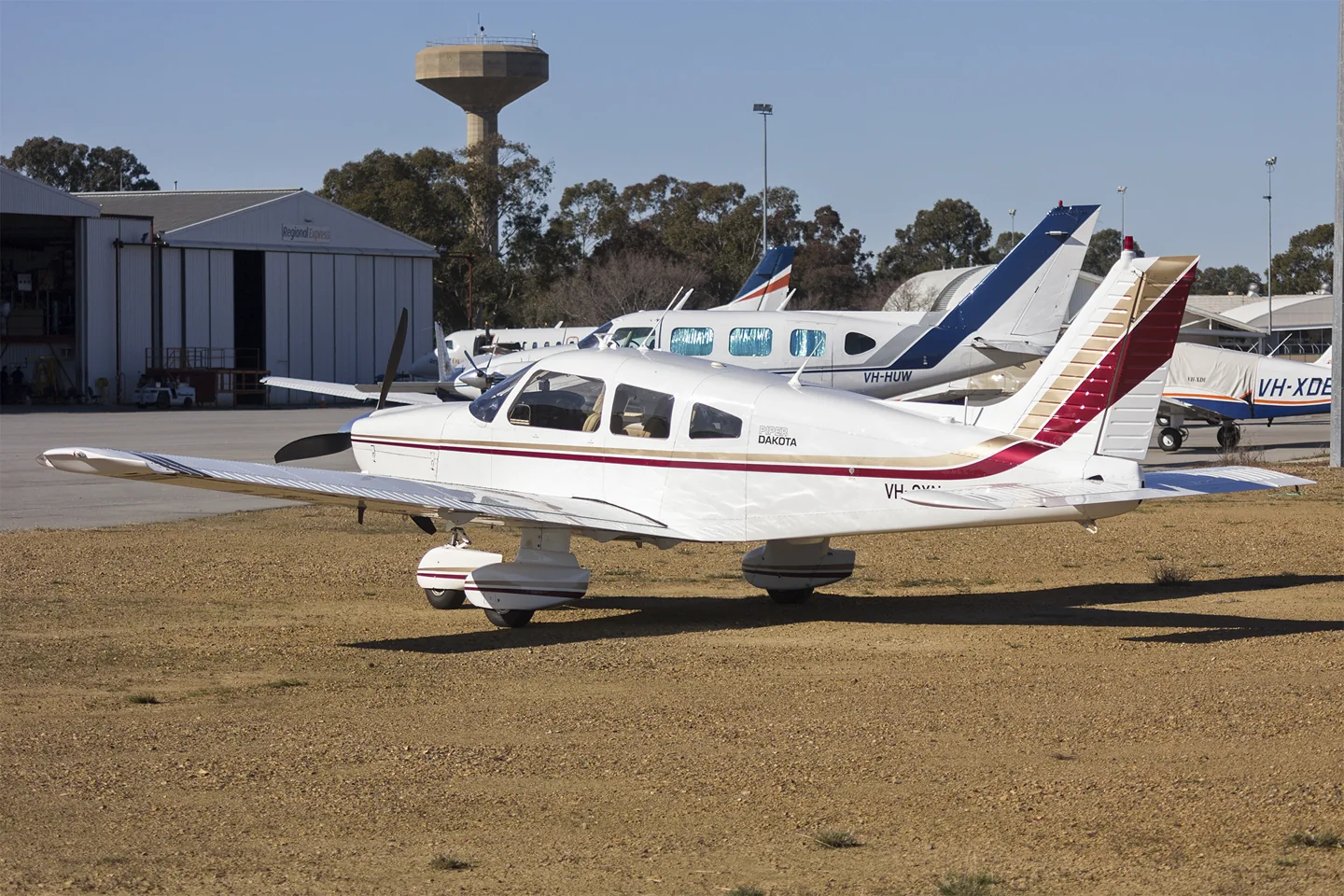
The PA-28-236 Dakota combines the PA-28's low-wing, four-seat cabin with a six-cylinder engine and fixed tricycle gear. The family also includes the smaller Warrior and retractable-gear Arrow.
Aircraft background
Wikipedia contributors · Read more ↗A long journey in the new Dakota
Tripp expected the larger engine to make the Dakota feel nose-heavy, but found it light to steer and pleasant through takeoff and climb. His evaluation ranged from small airports to busy airline fields, with day and night instrument flying and several missed approaches. The cabin and straightforward cockpit arrangement helped make the long travelling days comfortable.
AOPA Pilot · January 1979. Factory demonstrator N22336, evaluated on a 2,000-mile cross-country and local flights at different loads.
AOPA Pilot / Aero Resources archive · Read more ↗The Dakota’s release and represented configuration
Microsoft’s 27 June 2025 announcement describes the fixed-gear PA-28-236 with a 235 hp Lycoming and two-blade constant-speed propeller. The package includes ten liveries. It was offered free to MSFS 2024 owners as the third of four launch-related gifts, with a separate paid Marketplace release for MSFS 2020.
PA-28-236 Dakota · Microsoft Flight Simulator · MSFS 2024
Microsoft · Read more ↗Into the cockpit
 YouTube
Johanns Media · 60 min ·
Behind the Scenes - Episode #07 - Piper Dakota Documentary
A Dakota owner presents the aircraft through a flight and explanatory commentary.
Real aircraft · Piper PA-28-236 Dakota
Watch on YouTube ↗Preview images are served by AirframeDB. Videos open on YouTube only when you choose to watch.
Meet Piper PA-28-236 Dakota
The PA-28-236 Dakota combines the PA-28's low-wing, four-seat cabin with a six-cylinder engine and fixed tricycle gear. The family also includes the smaller Warrior and retractable-gear Arrow.
The Dakota retains the stabilator and single right-side cabin door. Its engine, loading and performance figures are specific to this version.
Piper PA-28
Aircraft type designators
Use the code for the model you are flying. The linked authority lists the applicable aircraft.
PA-28-235, PA-28-236 Dakota and PA-28-201T Turbo Dakota
ICAO Doc 8643 — aircraft type designators ↗Checked 2026-09-14History & design
Development milestones
The 14 January 1960 first-flight date belongs to the original PA-28 Cherokee family. The PA-28-236 Dakota is a later member of that family.
Wikipedia contributors · Piper PA-28 Cherokee ↗Clarifies the family milestone in the linked PA-28 history
The Cherokee 235 becomes the Dakota
Tripp’s January 1979 flight check describes the Dakota replacing the Cherokee 235 with a longer, semi-tapered wing, revised cowling and other detail improvements. It retained a 235 hp six-cylinder Lycoming with a constant-speed propeller.
AOPA Pilot / Aero Resources archive · Piper Dakota: The Little Hauler ↗Contemporary introduction report · PDF pp.1–2
Pilot accounts
A long journey in the new Dakota
Tripp expected the larger engine to make the Dakota feel nose-heavy, but found it light to steer and pleasant through takeoff and climb. His evaluation ranged from small airports to busy airline fields, with day and night instrument flying and several missed approaches. The cabin and straightforward cockpit arrangement helped make the long travelling days comfortable.
He also recorded details that a brief demonstration might miss. The microphone was too easy to knock from its holder, the towbar felt uncomfortably short, and disturbed hands-off flight still needed attention rather than an assumption that the aeroplane would right itself. A passenger slept through most of the long cross-country, which Tripp offered as memorable evidence of the cabin’s comfort.
AOPA Pilot · January 1979. Factory demonstrator N22336, evaluated on a 2,000-mile cross-country and local flights at different loads.
Read the full account · AOPA Pilot / Aero Resources archive ↗The club aircraft chosen when people and bags come along
Baluha described the Dakota as his club’s travelling aircraft, also useful for shorter flights when additional payload was needed. One journey from Connecticut to Appleton, Wisconsin, went around the lakes with a single fuel stop. For him, the combination of cabin capacity and endurance made the aircraft useful beyond its local flying role.
The club had changed both the engine installation and propeller, and he associated the three-blade conversion with stronger climb performance. Ownership had also exposed a persistent nosewheel-shimmy problem that led to an expensive repair. His account therefore belongs to that particular modified club aeroplane: it records how members used it, what they changed and an issue they had to resolve, alongside the enthusiasm for its carrying capacity.
Flying 20 Club president, quoted by AVweb in April 2014. Club-owned 1979 PA-28-236 with a replacement engine configuration and three-blade propeller.
Read the full account · AVweb / Aviation Consumer ↗Comfort, coastal trips and one missing convenience
Cunningham wanted a simpler, comfortable aircraft after owning a faster Mooney. The Dakota’s fixed undercarriage and solid feel appealed to him, and he liked the way it settled into a landing without the prolonged float he wished to avoid. The cabin and six-cylinder engine helped compensate for the speed he still sometimes missed.
His flying included trips with his friend George Wilhite and a coastal journey that helped rescue the enjoyment of a disrupted sailing outing. The Dakota also had a notable omission: an autopilot, which Cunningham was considering adding. His account places the aeroplane among work commitments, friendship and the challenge of making time to fly.
Interviewed by Michelle Adserias, Piper Owner Society · June 2025. Cunningham’s 1981 Dakota.
Read the full account · Piper Owner Society ↗In your simulator
Systems, equipment and documentation for each developer’s aircraft.
Compare simulator versions →MSFS 2024PA-28-236 Dakota
Microsoft Flight Simulator · Released
PA-28-236 Dakota
Microsoft Flight Simulator · Released
MSFS 2020PA-28-236 Dakota
Microsoft Flight Simulator · Released
PA-28-236 Dakota
Microsoft Flight Simulator · Released
Aircraft specifications
Published figures for the named real-aircraft variant. Simulator equipment and performance can differ.
| Specification | Published value |
|---|---|
| Length | 23 ft 3.6 in (7.102 m) |
| Wingspan | 30 ft 0 in (9.14 m) |
| Height | 7 ft 3.6 in (2.225 m) |
| Wing area | 160 sq ft (15 m² ) |
| Empty weight | 1,201 lb (545 kg) |
| Gross weight | 2,150 lb (975 kg) |
| Max takeoff weight | 2,150 lb (975 kg) |
| Powerplant | 1 × Lycoming O-320-E2A 4-cylinder air-cooled horizontally-opposed piston engine, 150 hp (110 kW) |
| Propellers | Sensenich M74DM |
| Maximum speed | 123 kn (142 mph, 228 km/h) |
| Cruise speed | 108 kn (124 mph, 200 km/h) |
| Stall speed | 47 kn (54 mph, 87 km/h) |
| Range | 465 nmi (535 mi, 861 km) |
| Service ceiling | 14,300 ft (4,400 m) |
| Rate of climb | 660 ft/min (3.4 m/s) |
Manuals & resources
Find your next read
Choose a topic for a short introduction and a link to the original source. Simulator references identify the developer and edition they cover.
Simulator documentation
The Dakota’s release and represented configurationPA-28-236 Dakota · Microsoft Flight Simulator · MSFS 2024
Microsoft’s 27 June 2025 announcement describes the fixed-gear PA-28-236 with a 235 hp Lycoming and two-blade constant-speed propeller. The package includes ten liveries. It was offered free to MSFS 2024 owners as the third of four launch-related gifts, with a separate paid Marketplace release for MSFS 2020.
Official Famous Flyer 12 announcement · historical release terms
Microsoft · Read the source ↗The original MSFS 2020 releasePA-28-236 Dakota · Microsoft Flight Simulator · MSFS 2020
The June 2025 Famous Flyer 12 announcement explicitly lists a paid MSFS 2020 Marketplace release alongside the free make-good aircraft for MSFS 2024 owners.
2025-06-27 · release and package scope
Microsoft Flight Simulator Team · Read the source ↗Pilot account
A long journey in the new DakotaAOPA Pilot · January 1979. Factory demonstrator N22336, evaluated on a 2,000-mile cross-country and local flights at different loads.
Tripp expected the larger engine to make the Dakota feel nose-heavy, but found it light to steer and pleasant through takeoff and climb. His evaluation ranged from small airports to busy airline fields, with day and night instrument flying and several missed approaches. The cabin and straightforward cockpit arrangement helped make the long travelling days comfortable. He also recorded details that a brief demonstration might miss.
Edward G. Tripp
AOPA Pilot / Aero Resources archive · Read the source ↗The club aircraft chosen when people and bags come alongFlying 20 Club president, quoted by AVweb in April 2014. Club-owned 1979 PA-28-236 with a replacement engine configuration and three-blade propeller.
Baluha described the Dakota as his club’s travelling aircraft, also useful for shorter flights when additional payload was needed. One journey from Connecticut to Appleton, Wisconsin, went around the lakes with a single fuel stop. For him, the combination of cabin capacity and endurance made the aircraft useful beyond its local flying role. The club had changed both the engine installation and propeller, and he associated the three-blade conversion with stronger climb performance.
Gary Baluha
AVweb / Aviation Consumer · Read the source ↗Read the original documentation from the people who created it. Manuals open on their publisher’s website.
Manual
Microsoft Flight Simulator aircraft manualsMicrosoft / aircraft developersAircraft background
Piper PA-28 CherokeeWikipedia contributors · Research background · Wikipedia revision 1370180190 · retrieved 2026-09-12Resource
Dakota free for MSFS 2024 ownersMicrosoftType designator
ICAO Doc 8643 — aircraft type designatorsInternational Civil Aviation Organization · Public search data retrieved 2026-09-14; authority update 2026-09-03Built-in force-feedback profiles
Read the documentary basis, editable starting settings and remaining questions for the aircraft you fly. Each explanation refers to the exact profile revision shown.
Catalogue programme-20261022-v1 · 1 profile choice
Piper PA-28-236 Dakota
Free and Pro · Revision 2 · Partial review
MSFS 2024 · MSFS 2020
Piper PA-28-236 Dakota: The profile supplies selected stabilator-aircraft yoke loading.
Discuss this aircraft (0)
Questions, observations and useful sources from the community.
No published discussions yet. Bring a question or share a useful source.
Open aircraft discussions →Content expanded · What’s new
Something missing or a source that needs attention?
Suggest a correction ↗