
Start here
A few places to begin, from the aircraft’s story to the people who fly it.
Meet the aircraft
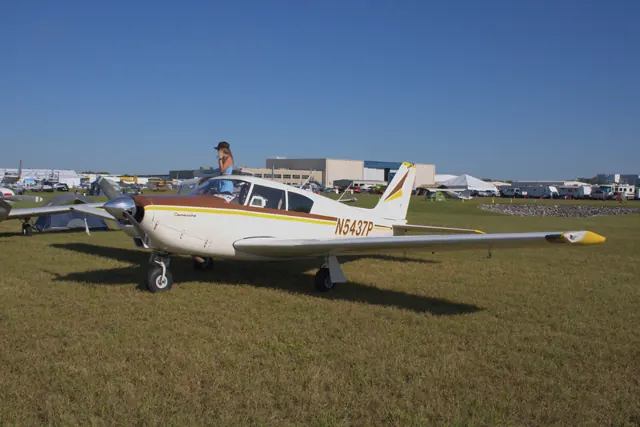
Piper's Comanche first flew in 1956 with an all-metal low-wing airframe, enclosed cabin and retractable tricycle gear. Later versions changed engine power and seating, alongside the separate Twin Comanche line.
Aircraft background
Wikipedia contributors · Read more ↗A restored 250 on a short grass runway
Unwin flew Mark Bonsall's refurbished 1963 Comanche 250 from Netherthorpe with instructor Nick Riddin. This particular aircraft had fuel injection and a three-blade propeller, so it was not an untouched factory example. With two aboard and partial fuel, it accelerated briskly from the grass strip.
30 March 2017. Modified PA-24-250 N61970, Netherthorpe, United Kingdom.
Pilot · Read more ↗An aircraft that retains its mechanical history
A2A's Accu-Sim 2 Comanche uses its external Merlin flight-physics system and a per-cylinder engine model. The manual describes fuel priming, fuel contamination and ground behaviour that responds to tyre loading. Persistent aircraft condition connects one simulator session with the next, while the maintenance and inspection interfaces make that condition visible.
Piper Comanche · A2A · MSFS 2024 · MSFS 2020
A2A Simulations · Read more ↗Into the cockpit
 YouTube
A2A Simulations
A2A Accu-Sim Comanche 250 Autopilot Guide | S-TEC (MSFS2020/24) & GPSS Explained (MSFS 2024)
A guide to the S-TEC autopilot and the native 2024 edition's GPSS feature.
A2A Comanche; MSFS 2020/2024; GPSS specific to native 2024
Watch on YouTube ↗Preview images are served by AirframeDB. Videos open on YouTube only when you choose to watch.
Meet Piper Comanche
Piper's Comanche first flew in 1956 with an all-metal low-wing airframe, enclosed cabin and retractable tricycle gear. Later versions changed engine power and seating, alongside the separate Twin Comanche line.
Production ended after the 1972 flood at Piper's Lock Haven plant. A2A models a particular Comanche with persistent engine and airframe condition; its manual describes the loading, maintenance and mechanical systems included in the simulation.
Piper Comanche
Piper → · Explore the family →
Piper Comanche
Wikipedia contributors · Piper PA-24 Comanche ↗A2A · MSFS 2024 · MSFS 2020 →Aircraft type designators
Use the code for the model you are flying. The linked authority lists the applicable aircraft.
History & design
Development milestones
First flight: May 24, 1956
Wikipedia contributors · Piper PA-24 Comanche ↗Piper PA-24 Comanche · family/variant named by the source · Wikipedia revision 1371634258
Systems & details
A moving tailplane and hand-operated flaps
The Comanche 250’s pitch control uses a stabilator: the horizontal tail moves as a unit instead of carrying a separate hinged elevator. Its anti-servo tab also provides longitudinal trim. A2A’s aircraft description pairs that arrangement with manually operated flaps and conventional yoke-and-pedal controls. This combination gives the cockpit several distinct mechanical controls, even before the separate engine and propeller levers are considered.
Landing gear connected by cables and a gear train
An electric motor and reduction mechanism beneath the floor move the three landing-gear units through push-pull cables. The nosewheel steering disconnects as the gear retracts, reducing the steering mechanism’s contribution to airborne rudder-pedal loads. The manual also describes a ground anti-retraction switch and separate indications for gear position. The selector operates the documented electrical and mechanical landing-gear system.
Documented detail
The list supplies trim-required lights and AP controls, and identifies the elevator trim handle with a standard SimVar requested in percent.
Pilot accounts
A restored 250 on a short grass runway
Unwin flew Mark Bonsall's refurbished 1963 Comanche 250 from Netherthorpe with instructor Nick Riddin. This particular aircraft had fuel injection and a three-blade propeller, so it was not an untouched factory example. With two aboard and partial fuel, it accelerated briskly from the grass strip. Unwin liked the harmonisation of the primary controls and their low initial resistance, although he found the older instrument and engine-control layout less intuitive than a modern cockpit. In airwork, his stalls gave clear warning and little inclination to drop a wing.
The landing and photo flights exposed different demands. He could feel the aircraft entering ground effect and thought excess approach speed would produce a long float; careful speed control rewarded him with successive satisfactory landings. Flying close formation for the photographer required more work, partly because the view from his chosen seat was restrictive. His overall appreciation was for a capable touring aircraft, with handling observations tied to the loading and modifications of the example he actually flew.
30 March 2017. Modified PA-24-250 N61970, Netherthorpe, United Kingdom.
Read the full account · Pilot ↗Why an experienced owner kept his 1958 Comanche
Wall's attachment to the Comanche began with a flying-club comparison in 1958. Interviewed by Bill Cox, he recalled flying a loaded Comanche 250 and a contemporary Bonanza between Burbank and Phoenix. He considered the Comanche the stronger performer in that particular comparison, while acknowledging the appeal of the Beechcraft's handling. Decades later, after a professional flying career, that experience helped draw him back to a 1958 Comanche of his own.
By the 2005 article, Wall had accumulated more than a thousand hours in the type and restored his aircraft extensively. He distinguished brochure claims from his experience: the advertised climb figure seemed optimistic to him, while maximum cruise was closer to what he observed. His usual choice was an economical high-altitude cruise rather than maximum speed. As an owner and mechanic, he also valued access for maintenance and familiarity with the systems he had rebuilt. These are the preferences and reported results of one experienced owner, rather than a controlled comparison of all Comanches and Bonanzas.
1 March 2005. Owner account of a 1958 Comanche 250, including a recalled 1958 comparison.
Read the full account · Plane & Pilot ↗An unannounced Comanche with considerably more power
Looking back on his test-flying years, Kershner remembered the Comanche 400 as one of the aircraft that stood out. He identified the two final test aircraft and explained Pug Piper's interest in obtaining high-altitude performance without turbocharging. The extra power gave him an impression reminiscent of a fighter, but he also recalled substantial fuel consumption and troublesome hot starts during the flight-test period. His account concerns the eight-cylinder 400, a different proposition from the familiar 180 and 250.
One flight supplied the story's human detail. Over Lock Haven, he overtook a conventional Comanche and made further passes that prompted its pilot to ask what version he was flying. Kershner gave an evasive answer over the radio, then returned to a reprimand for drawing attention to an aircraft Piper had not yet announced. He also remembered watching the fuel indication move towards empty.
May 1997. Retrospective by Piper test pilot William K. Kershner; PA-24-400 subsection.
Read the full account · AOPA Pilot ↗The owner whose Comanche became the simulation
In the manual's developer notes, Gentile explains why A2A chose his own Comanche 250, N6229P, for its new Accu-Sim system. He had owned and operated the aeroplane for more than a decade. That familiarity gave the team continuing access to an aircraft they could examine and fly while investigating questions raised during development. His account describes the connection between an owner's long experience and the choice of a simulation subject.
Gentile's affection is equally explicit. He values the Comanche's combination of speed, load-carrying ability, cabin room and manageable handling, and says the aircraft has become part of the family. The appeal began with its appearance and deepened over years of operation. This is an enthusiastic owner's introduction, written by the developer selling the simulation, rather than an independent comparison flight.
Scott Gentile, A2A Comanche 250 manual (2023) · PDF p.7 / printed p.5 · owner of N6229P and A2A president.
Read the full account · A2A Simulations ↗In your simulator
Systems, equipment and documentation for each developer’s aircraft.
MSFS 2024 · MSFS 2020Piper Comanche · A2A
A2A · Released
Piper Comanche · A2A
A2A · Released
Aircraft specifications
Published figures for the named real-aircraft variant. Simulator equipment and performance can differ.
| Specification | Published value |
|---|---|
| Length | 25 ft 0 in (7.62 m) |
| Wingspan | 36 ft 0 in (10.97 m) |
| Height | 7 ft 6 in (2.29 m) |
| Wing area | 178 sq ft (16.5 m² ) |
| Empty weight | 1,773 lb (804 kg) |
| Max takeoff weight | 3,200 lb (1,451 kg) |
| Powerplant | 1 × Lycoming IO-540 air-cooled six-cylinder horizontally-opposed engine, 260 hp (190 kW) |
| Propellers | 2-bladed Hartzell HC82XK1D metal constant-speed propeller , 6 ft 5 in (1.96 m) diameter |
| Maximum speed | 195 mph (314 km/h, 169 kn) at sea level |
| Cruise speed | 185 mph (298 km/h, 161 kn) at 6,300 ft (1,900 m) (max. cruise, 75% power) |
| Range | 1,225 mi (1,971 km, 1,064 nmi) at 10,500 ft (3,200 m) (auxiliary fuel tanks, 65% power) |
| Service ceiling | 19,500 ft (5,900 m) |
| Rate of climb | 1,320 ft/min (6.7 m/s) |
Manuals & resources
Find your next read
Choose a topic for a short introduction and a link to the original source. Simulator references identify the developer and edition they cover.
Simulator documentation
An aircraft that retains its mechanical historyPiper Comanche · A2A · A2A · MSFS 2024 · MSFS 2020
A2A's Accu-Sim 2 Comanche uses its external Merlin flight-physics system and a per-cylinder engine model. The manual describes fuel priming, fuel contamination and ground behaviour that responds to tyre loading. Persistent aircraft condition connects one simulator session with the next, while the maintenance and inspection interfaces make that condition visible. The full manual is the starting point for understanding the aircraft; the separate variable list serves cockpit builders.
Accu-Sim 2 Comanche for MSFS · PDF p.8; features and systems
A2A Simulations · Read the source ↗Condition, inspections and configurable equipmentPiper Comanche · A2A · A2A · MSFS 2024 · MSFS 2020
The maintenance interface records engine and airframe hours and provides an inspection diagram showing the condition of individual systems. Its New, Used and Auction starting conditions give the same aircraft different mechanical histories; the Auction option can produce a wide range of condition. The maintenance page also provides an overhaul function. The manual describes selectable airframe modifications, soundproofing and a choice of McCauley or MT three-bladed propeller. These are configuration options within A2A's model. These features are specific to A2A's Comanche.
Accu-Sim Comanche 250 for MSFS · PDF pp.22,50–51 / printed pp.20,48–49
A2A Simulations · Read the source ↗Loading the aircraft belongs to Accu-SimPiper Comanche · A2A · A2A · MSFS 2024 · MSFS 2020
The Comanche's tablet handles fuel, passengers and baggage through Accu-Sim's own simulation. A2A states that the default MSFS weight-and-balance menu is not supported for this aircraft because the model uses external code. The tablet shows a live centre-of-gravity diagram as the load changes, provides fuel presets and can update the JPI engine monitor's fuel state. This is a consequential difference from a default simulator aircraft, even before considering how either one flies.
Accu-Sim Comanche 250 for MSFS · PDF p.50 / printed p.48 · Fuel and payload
A2A Simulations · Read the source ↗Pilot account
A restored 250 on a short grass runway30 March 2017. Modified PA-24-250 N61970, Netherthorpe, United Kingdom.
Unwin flew Mark Bonsall's refurbished 1963 Comanche 250 from Netherthorpe with instructor Nick Riddin. This particular aircraft had fuel injection and a three-blade propeller, so it was not an untouched factory example. With two aboard and partial fuel, it accelerated briskly from the grass strip. Unwin liked the harmonisation of the primary controls and their low initial resistance, although he found the older instrument and engine-control layout less intuitive than a modern cockpit.
Dave Unwin
Pilot · Read the source ↗Why an experienced owner kept his 1958 Comanche1 March 2005. Owner account of a 1958 Comanche 250, including a recalled 1958 comparison.
Wall's attachment to the Comanche began with a flying-club comparison in 1958. Interviewed by Bill Cox, he recalled flying a loaded Comanche 250 and a contemporary Bonanza between Burbank and Phoenix. He considered the Comanche the stronger performer in that particular comparison, while acknowledging the appeal of the Beechcraft's handling. Decades later, after a professional flying career, that experience helped draw him back to a 1958 Comanche of his own.
Robert Wall, interviewed by Bill Cox
Plane & Pilot · Read the source ↗Read the original documentation from the people who created it. Manuals open on their publisher’s website.
Manual
Comanche Pilot ManualA2A Simulations Comanche variables listA2A Simulations Microsoft Flight Simulator aircraft manualsMicrosoft / aircraft developersAircraft background
Piper PA-24 ComancheWikipedia contributors · Research background · Wikipedia revision 1371634258 · retrieved 2026-09-12Product
Accu-Sim Comanche · native MSFS 2024A2A Simulations · Official developer / designated store catalogue · checked 2026-09-12 Accu-Sim Comanche · MSFS 2020A2A Simulations · Official developer / designated store catalogue · checked 2026-09-12Type designator
ICAO Doc 8643 — aircraft type designatorsInternational Civil Aviation Organization · Public search data retrieved 2026-09-14; authority update 2026-09-03Built-in force-feedback profiles
Read the documentary basis, editable starting settings and remaining questions for the aircraft you fly. Each explanation refers to the exact profile revision shown.
Catalogue programme-20261022-v1 · 2 profile choices
A2A Comanche 250
A2A · Free and Pro · Revision 5 · Inherited starting point
MSFS 2020 · MSFS 2024
A2A Comanche 250: The stabilator/anti-servo arrangement motivates reversible yoke loading.
Piper Comanche
Free and Pro · Revision 2 · Partial review
MSFS 2024 · MSFS 2020
Piper Comanche: The stabilator/anti-servo arrangement motivates reversible yoke loading.
Documented interfaces
Source-documented identifiers. Documentation does not prove that every add-on populates a value correctly.
L:ApTrimUpLight
Trim-up-required lamp.
- Units
- bool
- Access
- not specified by variable list
Public list revision unlabelled
A2A Simulations · PDF page 1 ↗L:ApTrimDnLight
Trim-down-required lamp.
- Units
- bool
- Access
- not specified by variable list
Public list revision unlabelled
A2A Simulations · PDF page 1 ↗L:ApMaster
Autopilot master switch; not proof servos active.
- Units
- not specified
- Access
- not specified by variable list
Public list revision unlabelled
A2A Simulations · PDF page 3 ↗ELEVATOR TRIM PCT
Elevator trim handle binding.
- Units
- percent (A2A request)
- Access
- not specified by list
Public list revision unlabelled
A2A Simulations · PDF page 8 ↗Discuss this aircraft (0)
Questions, observations and useful sources from the community.
No published discussions yet. Bring a question or share a useful source.
Open aircraft discussions →Content expanded · What’s new
Something missing or a source that needs attention?
Suggest a correction ↗