Find aircraft background, systems descriptions and manuals for the aircraft you are researching. Each note keeps its source and version context close by.
Simulator manuals describe the developer’s implementation. Aircraft background is research-based; pilot accounts describe an individual’s experience. Coverage here is limited to the selected notes and linked resources, not the full contents of every manual.
Tornado GR1/IDS · IndiaFoxtEcho · MSFS 2020 · MSFS 2024 (retailer-listed compatibility)
Product and simulator edition
This IndiaFoxtEcho product has an early IDS cockpit and external GR.1 and ECR visual models. Orbx lists the MSFS 2020 product as compatible with MSFS 2024; the listing does not establish a separate native 2024 edition.
Product listing captured 2026-09-30; edition scope from the reviewed catalogue
Panavia Tornado
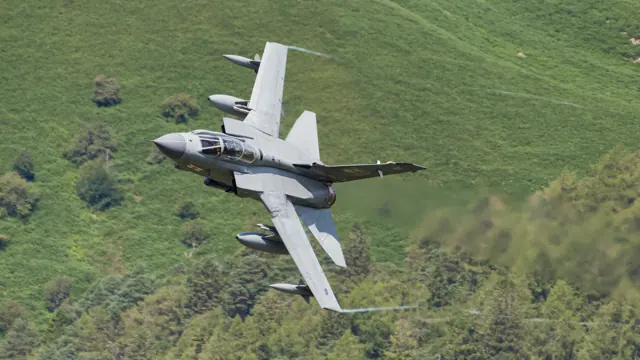
Italy, the United Kingdom and Germany jointly developed the variable-sweep Tornado through Panavia. The IDS served strike missions, the ECR suppression of air defences and the ADV interception. Mission equipment and performance differ between these versions.
Flying and fighting in the Tornado GR4A
Mandy Hickson · 26 July 2020
Interview with a Tornado pilot
Michael Napier · 23 April 2016
Former RAF Tornado F3 pilot interview
Jon Dunn · 31 October 2023
Nemeth Designs Partenavia P68B Victor · Nemeth Designs · MSFS 2020 · MSFS 2024
Stabilator and cockpit controls
The manual describes two conventional control wheels, pedals and an all-moving stabilator. It identifies stabilator and rudder trim, while cockpit labels use elevator and aileron wording. That difference in terminology is retained in the document context. Electric flaps and fixed tricycle gear have separate functions.
P68B manual; aircraft description, flight controls and cockpit illustrations
Nemeth Designs Partenavia P68B Victor · Nemeth Designs · MSFS 2020 · MSFS 2024
The Autocontrol installation
The documented Autocontrol panel provides roll, heading, altitude and pitch controls. Those cockpit functions are described separately from the stabilator and trim mechanisms.
P68B manual; aircraft description, flight controls and cockpit illustrations
Partenavia P68B Victor
The P68B Victor combines a high cantilever wing, six seats and fixed tricycle landing gear. Two Lycoming IO-360 piston engines each produce 200 hp and drive constant-speed propellers. Partenavia produced the line before Vulcanair continued it.
Nemeth's manual describes conventional control wheels and pedals, an all-moving stabilator and electric flaps. The simulated cockpit also provides Autocontrol roll, heading, altitude and pitch functions.
Partenavia P68B Victor
U15 Phoenix · VSKYLABS · X-Plane 11 · X-Plane 12
Long and short Phoenix wing tips
VSKYLABS represents the piston-powered Phoenix with interchangeable long and short wing tips. Separate native editions are available for X-Plane 11 and 12.
Official developer / designated-store reference · checked 2026-09-14
Phoenix Air U15 Phoenix
The Czech-built U15 Phoenix combines a low wing, side-by-side cockpit and fixed tailwheel landing gear. Its long wing can be shortened by exchanging the tips, allowing the same aircraft to serve touring and soaring roles.
VSKYLABS represents the piston-powered U15 in separate X-Plane 11 and 12 products. The developer describes the project as approved by Phoenix Air while remaining an independent simulation.
Phoenix Air U15 and VSKYLABS wing configurations
Piaggio / Focke-Wulf P.149
The P.149 developed from Piaggio’s two-seat P.148 into a four-seat training and utility aircraft. ATSimulations’ historical section records its first flight on 19 June 1953 and its selection by the German armed forces. The Focke-Wulf P.149D name in the simulator reflects that German production and service chapter.
The aircraft combines a piston engine and constant-speed propeller with retractable tricycle gear and slotted flaps. The developer manual documents pitch and rudder trim tabs, with no aileron-trim control in its configuration. Four seats and a trainer’s controls give it a role that spans instruction and light transport rather than simply adding power to a two-seat trainer.
Manual history section · ATSimulations P.149D · ATSimulations P.149D guide; production-aircraft reference
FlightFX P.180 Avanti II · FlightFX · MSFS 2020 · MSFS 2024
Coordinated surfaces and trim
The manual identifies aileron cables and bellcranks and elevator rods and cables. Pitch trim changes stabiliser position, while roll trim acts through the right-aileron servo tab. Forward-wing and main-wing flaps operate in coordination. Autopilot autotrim and yaw damping have separate functions.
FlightFX P180 manualv1.6.1 Rev2025-02-06, PDF pp.35-36 and87