Find aircraft background, systems descriptions and manuals for the aircraft you are researching. Each note keeps its source and version context close by.
Simulator manuals describe the developer’s implementation. Aircraft background is research-based; pilot accounts describe an individual’s experience. Coverage here is limited to the selected notes and linked resources, not the full contents of every manual.
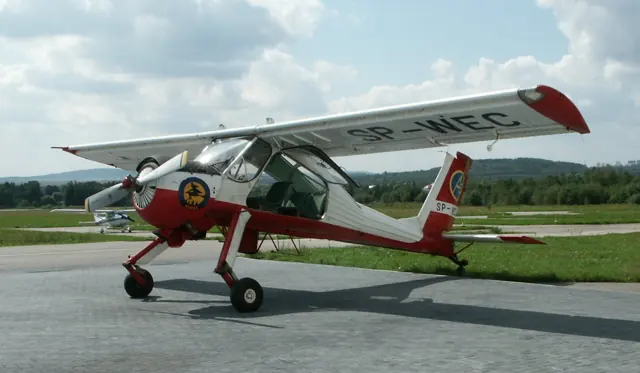
PZL-104 Wilga
PZL Warszawa-Okęcie developed the Wilga for civil utility and short-field work. The manufacturer later became part of EADS. Versions differ in engines and equipment; the simulator products also have separate X-Plane generation support.
CT/4E Airtrainer · VSKYLABS · X-Plane 11 · X-Plane 12
The simulated CT/4E
VSKYLABS represents the CT/4E with a 300 hp Lycoming engine and three-blade propeller. Separate X-Plane 11 and 12 products use a native aircraft model and support desktop and VR flying.
Official developer / designated-store reference · checked 2026-09-14
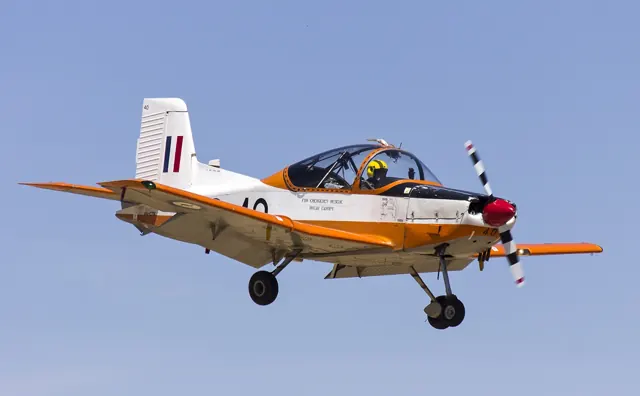
Pacific Aerospace CT/4 Airtrainer
The CT/4 Airtrainer places instructor and student beside one another under a broad canopy. The CT/4E uses a 300 hp Lycoming engine and a three-blade propeller, combining powered flight training with aerobatic capability.
VSKYLABS represents the CT/4E in X-Plane. Its published feature list describes a native aircraft model, analog cockpit and support for desktop and VR flying.
VSKYLABS CT/4E
Partenavia P68B Victor
The P68B Victor combines a high cantilever wing, six seats and fixed tricycle landing gear. Two Lycoming IO-360 piston engines each produce 200 hp and drive constant-speed propellers. Partenavia produced the line before Vulcanair continued it.
Nemeth's manual describes conventional control wheels and pedals, an all-moving stabilator and electric flaps. The simulated cockpit also provides Autocontrol roll, heading, altitude and pitch functions.
Partenavia P68B Victor
Piaggio / Focke-Wulf P.149
The P.149 developed from Piaggio’s two-seat P.148 into a four-seat training and utility aircraft. ATSimulations’ historical section records its first flight on 19 June 1953 and its selection by the German armed forces. The Focke-Wulf P.149D name in the simulator reflects that German production and service chapter.
The aircraft combines a piston engine and constant-speed propeller with retractable tricycle gear and slotted flaps. The developer manual documents pitch and rudder trim tabs, with no aileron-trim control in its configuration. Four seats and a trainer’s controls give it a role that spans instruction and light transport rather than simply adding power to a two-seat trainer.
Manual history section · ATSimulations P.149D · ATSimulations P.149D guide; production-aircraft reference
Pilatus PC-12 NGX · Thranda · X-Plane 12
The tablet connects loading, equipment and systems
The PC-12’s EFB includes individual-seat loading, centre-of-gravity plotting, paint customisation and engine-mode options. Thranda also documents an electrical model with bus-tie breakers, standby and non-essential buses, external power and failures, plus shaker/pusher logic. These are published simulator features, with their controls described in the package documentation.
Thranda’s documented X-Plane 12 feature scope
Pilatus PC-12 NGX · SimCoders · X-Plane 11
An expansion for Carenado’s X-Plane 11 PC-12
SimCoders requires the Carenado X-Plane 11 PC-12 for this REP. Its engine additions include custom temperature evolution, throttle response, propeller-governor behaviour and hot starts. A maintenance interface, walkaround and saved battery and engine condition add continuity between flights. This listing does not establish compatibility with Thranda’s newer PC-12.
Gathered SimCoders product page · X-Plane 11 requirement
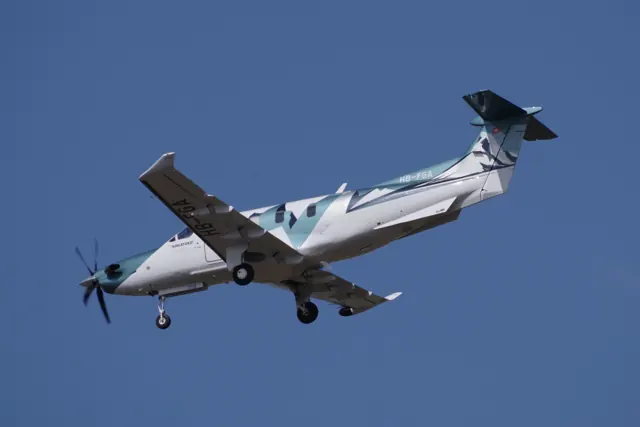
Pilatus PC-12 NGX
Pilatus designed the PC-12 for business and utility transport. A low wing, retractable gear, rear cargo door and single Pratt & Whitney Canada turboprop support executive, regional-service and air-ambulance roles.
The NGX is a later development with updated engine management and cockpit equipment. Earlier PC-12 aircraft have different systems and performance specifications.
Aircraft / family
Pilatus PC-24
Pilatus designed the PC-24 to combine a business-jet cabin with access to shorter and less conventional airfields. Rear-mounted Williams engines leave the wing clear, and a large cargo door supports several cabin roles. It first flew in 2015.
The PC-24 shares the PC-12's utility emphasis through a separate jet airframe, propulsion system and flight deck. Simulator documentation describes the represented avionics, ground and cargo features.
Aircraft / family
Pilatus PC-6 B2 · Thranda · Thranda · X-Plane 12 · X-Plane 11
Engine handling has consequences in the simulation
The developer documents a working throttle gate and condition-lever latch, with engine damage from excessive torque when its more detailed engine mode is selected. Passenger doors respond to acceleration, and tiedowns and chocks restrain the aircraft. The tablet also offers simplified engine and steering options.
Thranda’s documented simulator behaviour; no physical-control qualification
Pilatus PC-6 B2 · SimCoders · X-Plane 12
The Porter REP targets Thranda’s X-Plane 12 aircraft
SimCoders explicitly requires the XP12 Turbo Porter and also supports its amphibian. Documented additions include a custom tailwheel model, engine-temperature and hot-start behaviour, persistent component condition and a maintenance hangar. An optional virtual economy connects flying with fuel and repair costs.
Gathered SimCoders product page · XP12 base-aircraft requirement
Pilatus PC-6 B2
The Porter first flew with piston power in 1959. Turboprop versions later became familiar in parachuting and remote-area transport, retaining the narrow fuselage, high wing and long landing-gear legs.
The simulator represents the PC-6 B2. Engines, limits and equipment differ across Porter variants; wheel and float options, cabin layouts and avionics are documented for each package.
Aircraft / family