MSFS
Cessna 404 Titan ↗
A cabin-class piston twin designed for commuter, cargo and utility work.
1 implementations+ Compare
Explore the aircraft. Find your simulator. Follow the sources.
A cabin-class piston twin designed for commuter, cargo and utility work.
A single-engine turboprop workhorse for passenger services, freight and remote-area transport.
A five-seat turbine helicopter developed from Robinson's smaller piston-helicopter line.
A stretched development of the DC-9 with rear-mounted engines and a five-abreast cabin.
A personal jet with one engine above the rear fuselage and a distinctive V-tail.
Epic's experimental light-jet project, represented in simulation by Aerobask.
A twin-radial airliner that helped make practical passenger transport a regular business.
A light turbine helicopter combining an Alouette II airframe with more powerful Alouette III components.
A large twin-engine helicopter from the Super Puma line, used for offshore and public-service work.
A long-range twin designed around a new wide-body airframe and extensive composite construction.
An open-cockpit biplane trainer that found a second life in civilian flying.
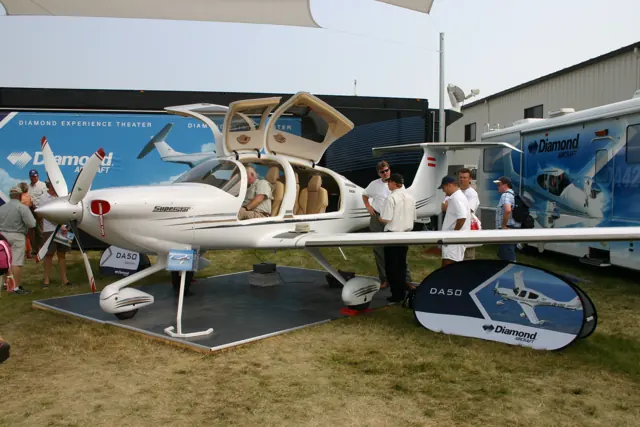
A five-seat composite single whose development led to the diesel DA50 RG.
A twin-radial military transport with a rear ramp and short-field design priorities.
A four-engine jetliner that helped establish the shape of long-distance jet travel.
Beechcraft's Model 76, designed to introduce pilots to twin-engine flying.
A retractable-gear touring single with an all-metal airframe and a long-lived enthusiast following.
A two-seat composite trainer with a low wing and a large canopy.
A four-seat composite touring and training aircraft developed from Diamond's smaller two-seater.
A First World War trainer that became a familiar sight in the barnstorming era.
A twin-turboprop regional airliner developed through Swedish and American industrial cooperation.
The four-engine wide-body whose raised flight deck created one of aviation's most recognisable profiles.
A single-seat competition sailplane offered in Standard and 18-metre configurations.
The second-generation Harrier, designed around vectored thrust and short-field operation.
A long-range fighter whose different engine and canopy developments produced several distinct forms.
This is AirframeDB’s first release. More features and aircraft research are planned. Leave your email if you’d like occasional updates.