Find aircraft background, systems descriptions and manuals for the aircraft you are researching. Each note keeps its source and version context close by.
Simulator manuals describe the developer’s implementation. Aircraft background is research-based; pilot accounts describe an individual’s experience. Coverage here is limited to the selected notes and linked resources, not the full contents of every manual.
F.VII · Microsoft Flight Simulator · MSFS 2020
Select the configuration before the livery
The guide lists a single-engine transport, original Southern Cross trimotor, Friendship floatplane, modern retrofits and ski-equipped Josephine Ford. Aircraft selection comes before the separate livery tab.
MSFS 2020 manual · PDF pages 10–11
F.VII · Microsoft Flight Simulator · MSFS 2020
Ground controls differ between the original and retrofit aircraft
The single-engine F.VIIa and original Southern Cross use tailskids without toe brakes. Modern retrofits have toe brakes and a castoring tailwheel; the guide requires full forward yoke to enable its free movement during taxi.
MSFS 2020 manual · PDF page 31, visually checked
F.VII · Microsoft Flight Simulator · MSFS 2020
Choose an in-game checklist or the reference cards
The manual offers in-game checklists, its included Quick Reference Cards or the Ctrl+E quick-start command.
MSFS 2020 manual · PDF page 31
F.VII · Microsoft Flight Simulator · MSFS 2020
Check the units for the selected variant
The original configurations’ speed tables use kilometres per hour; the modern retrofit table uses knots. The two tables use different speed units.
MSFS 2020 manual · PDF pages 29–30
F.VII · Microsoft Flight Simulator · MSFS 2020
The original MSFS 2020 release
The January 2022 Local Legend II announcement offers the F.VII for both PC and Xbox. Its recreated historic aircraft include Southern Cross, Josephine Ford and Friendship.
2022-01-31 · release and package scope
Fokker F.VII
Fokker's F.VII began as a single-engine airliner, with its engine in the nose. The trimotor developments added two engines beneath the wing and helped establish early airline networks and long-distance routes. Cabin size and engine choices varied across the family and licensed production.
The F.VIIa and F.VIIb differed in configuration. The simulator package includes several historical aircraft and later retrofits, with different ground controls and navigation equipment.
Aircraft / family
The Tasman Flight
18 September 1928; Ulm’s interview and Kingsford Smith’s public reply after the September crossing
Captain Colin Watt OAM DFM
Memorial biography recording his flying history; publication date not stated
Local Legend 23 — F27 Friendship · Microsoft Flight Simulator · MSFS 2020 · MSFS 2024
Friendship in MSFS 2020 and 2024
Fokker developed passenger, cargo and military versions during a long production life. Microsoft’s Local Legend 23 release brings the Friendship to both MSFS 2020 and 2024; the linked release description provides the represented aircraft and package scope.
Official developer / designated-store reference · checked 2026-09-14
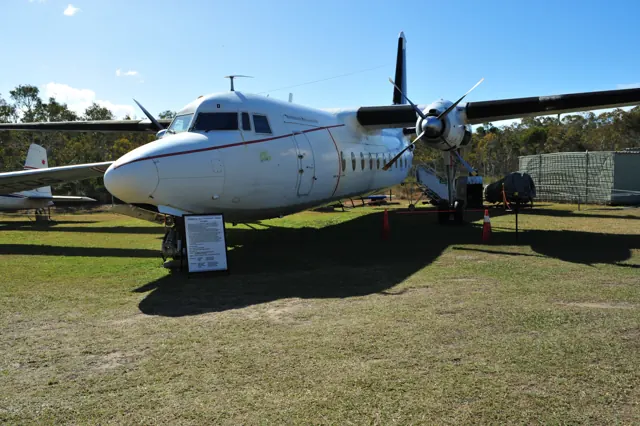
Fokker F27 Friendship
The F27 Friendship brought turboprop power and cabin pressurisation to regional routes previously served by piston airliners. Its first prototype flew in November 1955, and the F27-100 entered airline service with Aer Lingus in November 1958.
Passenger, cargo and military versions followed during a long production life. Microsoft's Local Legend 23 package represents the Friendship in MSFS 2020 and 2024.
Microsoft F27 Friendship release reference
F28 Professional · Just Flight · MSFS 2020 · MSFS 2024
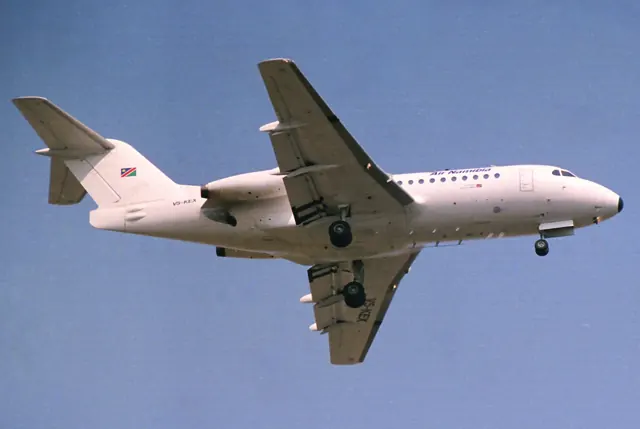
The tail speedbrake responds to throttle position
The guide describes a hydraulic tail speedbrake with continuously variable extension. Advancing either throttle to its detent retracts the brake and returns its cockpit lever, which helps explain an unexpected lever movement while exploring the simulator.
F28 Professional manual v2.2 · PDF pp.63–65
F28 Professional · Just Flight · MSFS 2020 · MSFS 2024
Wing lift dumpers have a separate ground role
The manual distinguishes the wing lift dumpers from the tail speedbrake. Their normal automatic deployment follows touchdown or a rejected takeoff, reducing lift and increasing drag while the aircraft is on the ground.
F28 Professional manual v2.2 · PDF p.65; page visually checked