Find aircraft background, systems descriptions and manuals for the aircraft you are researching. Each note keeps its source and version context close by.
Simulator manuals describe the developer’s implementation. Aircraft background is research-based; pilot accounts describe an individual’s experience. Coverage here is limited to the selected notes and linked resources, not the full contents of every manual.
Commander 114 · Black Square · MSFS 2020 · MSFS 2024
Two engine configurations and a choice of cockpit equipment
Black Square represents a 1977 normally aspirated Commander 114 and a turbonormalised, air-conditioned version. The manual describes interchangeable radio equipment, a stormscope, hydraulic landing gear and the S-TEC System 60-2 autopilot. It also covers mechanical effects such as wheel shimmy, making the aircraft's equipment and condition part of the product description.
Black Square Commander 114 · PDF p.9; introduction and variants
Rockwell Commander 114
Rockwell introduced the 112 in the early 1970s and followed it with the Commander 114 in 1976. The aircraft combines a roomy cabin, retractable landing gear and a distinctive cruciform tail. The later 114 used a more powerful engine alongside other changes.
Black Square's implementation represents a 1977 Commander 114 and a turbonormalised, air-conditioned development. Its wide choice of radios and navigation equipment is part of the add-on's identity, rather than a single universal panel specification for every real Commander.
Aircraft / family
RotorWay Exec / JetExec
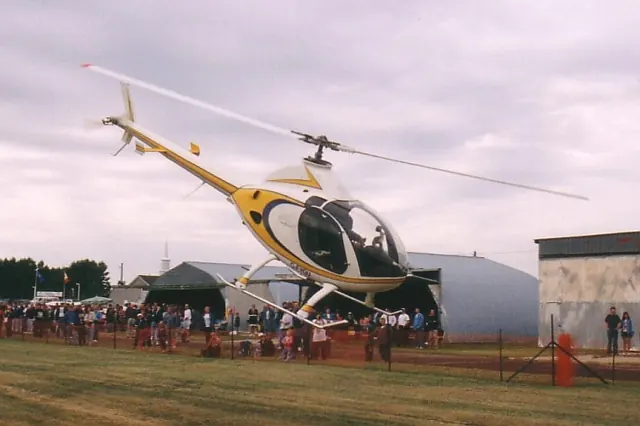
The Exec family was supplied for amateur construction by RotorWay in Arizona. The basic design uses skids and a two-blade main rotor. FlyInside's catalogue distinguishes the RW162F from the JetExec rather than treating their different powerplants as cosmetic variations. Product-specific engine and systems descriptions remain with each implementation.
Ryan NYP “Spirit of St. Louis”
The Spirit of St. Louis was built around carrying fuel for a very long flight. Its high wing and single radial engine surround a one-seat cockpit whose forward view was obstructed by the fuel-tank arrangement. Lindbergh flew it from New York to Paris in May 1927.
Its unusual visibility and sparse cockpit are consequences of a specific mission, not typical features of every aircraft of the period. The simulator offers a way to inspect that singular layout; the aircraft should be understood as a customised historical machine rather than a production touring type.
Aircraft / family
Saab 17 B
The Saab 17 programme began at ASJA before that company became part of Saab. It used a single radial engine and an all-metal low-wing airframe. Different versions were equipped for land, winter and maritime operations.
Its undercarriage fairings and variant-specific equipment are useful identification details. The Saab 17 is entirely separate from the much later Saab 340 regional airliner, despite appearing under the same manufacturer in a broad simulator catalogue.
Aircraft / family
Savoia-Marchetti S.55
The S.55 places its payload across two boat hulls joined by a broad wing structure. Two engines share a centreline tractor-and-pusher installation above that wing, while twin booms support the tail. The configuration is striking even among inter-war flying boats.
The design served both military and commercial purposes and became associated with long-distance formation flights. Its unusual geometry is the starting point for understanding the aircraft: it is not a conventional single-hull flying boat with an extra float attached.
Aircraft / family
Sikorsky S-76
The S-76 was Sikorsky's first helicopter developed specifically for the civil market. Twin turbine engines, a four-bladed main rotor and retractable landing gear support a broad range of passenger, offshore and emergency-service roles.
The programme includes several engine and avionics generations. An S-76C+ photograph, for example, illustrates a specific development. The simulator model's documented autopilot and cockpit equipment should remain attached to that version rather than treated as a universal S-76 specification.
Aircraft / family
S12G · Microsoft Flight Simulator · MSFS 2024
A sailplane cockpit with separate engine electrics
The Stemme S12G manual identifies digital trim indication and gliding instruments, together with separate engine and airframe electrical controls. The propulsion installation is part of a self-launching sailplane, so its controls have a different purpose from those in a conventional touring single.
Archived simulator manual; installed package revision not observed · PDF p.8; cockpit
Stemme S12G
Stemme's design avoids carrying an exposed engine mast during normal gliding flight. The powerplant is mounted within the fuselage and drives a propeller that can fold into the nose. Side-by-side seating and long wings complete an unusual combination of touring practicality and sailplane design.
The S12G in MSFS is a later member of the lineage. Its own manual is the reference for the propulsion controls and cockpit, while S10 material explains the underlying design concept. A photograph of the earlier S10 is labelled as family background when used.
Aircraft / family
Tecnam P2006T
Tecnam developed the P2006T at Capua in Italy as a light twin-engine aircraft. Its shoulder-wing configuration and all-metal construction form the basis of the design. The simulator catalogue offers both analog and glass-cockpit interpretations, with separate MSFS and X-Plane products. Each product's supported generation is checked independently.
Tecnam P2010
Tecnam unveiled the P2010 in 2011 and first flew it in 2012. European certification followed in 2014 and FAA validation in 2015. The design combines a four-seat cabin with mixed metal and composite construction. Engine choices and later variants require their own specification context; the simulator product is identified separately.
Tecnam’s new multitasker
Published 1 February 2022; demonstration flight in the original Traveller. The STOL and other engine variants differ.