Find aircraft background, systems descriptions and manuals for the aircraft you are researching. Each note keeps its source and version context close by.
Simulator manuals describe the developer’s implementation. Aircraft background is research-based; pilot accounts describe an individual’s experience. Coverage here is limited to the selected notes and linked resources, not the full contents of every manual.
F.VII · Microsoft Flight Simulator · MSFS 2020
Select the configuration before the livery
The guide lists a single-engine transport, original Southern Cross trimotor, Friendship floatplane, modern retrofits and ski-equipped Josephine Ford. Aircraft selection comes before the separate livery tab.
MSFS 2020 manual · PDF pages 10–11
F.VII · Microsoft Flight Simulator · MSFS 2020
Ground controls differ between the original and retrofit aircraft
The single-engine F.VIIa and original Southern Cross use tailskids without toe brakes. Modern retrofits have toe brakes and a castoring tailwheel; the guide requires full forward yoke to enable its free movement during taxi.
MSFS 2020 manual · PDF page 31, visually checked
Fokker F.VII
Fokker's F.VII began as a single-engine airliner, with its engine in the nose. The trimotor developments added two engines beneath the wing and helped establish early airline networks and long-distance routes. Cabin size and engine choices varied across the family and licensed production.
The F.VIIa and F.VIIb differed in configuration. The simulator package includes several historical aircraft and later retrofits, with different ground controls and navigation equipment.
Aircraft / family
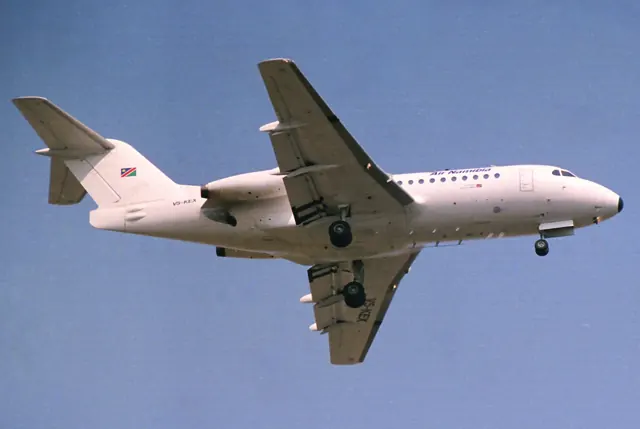
Fokker F28 Fellowship
The F28 brought Fokker into the regional-jet market after its turboprop transports. Two rear-mounted engines, a low wing and a T-tail formed the basic layout; later versions changed the fuselage and wing.
The Fellowship's flight deck uses an earlier generation of airline equipment and automation than the BAe 146 and Embraer E-Jets. Just Flight's manual describes the variants and systems included in its package.
Aircraft / family
4AT Trimotor · Microsoft Flight Simulator · MSFS 2024
Different undercarriages and unusual engine instruments
The manual includes wheel, ski and float versions. Engine instruments mounted outside on the struts form part of the cockpit view and have panel-light illumination. Conventional simulator brake bindings remain available alongside the represented cockpit brake lever. These details belong to this 4-AT package.
Gathered TriMotor manual · PDF pp.4–5
Ford 4AT Trimotor
The Trimotor combined a high wing and fixed landing gear with an engine in the nose and one beneath each wing. Ford's industrial name entered the growing air-transport market through a design used by airlines, government operators and military customers.
The cabin and cockpit date from the transition between open-cockpit flying and pressurised airliners. The simulator offers optional modern navigation equipment alongside the period installation.
Aircraft / family
Missing Engine
Joe Kimm · Contrails 172, November 2009, PDF p.14
Ford 5-AT Trimotor
The Ford 5-AT is the larger Trimotor configuration powered by three Wasp radial engines. It has fixed landing gear and no wing flaps. Ted Cook's X-Plane 12 package provides optional portable G430 navigation and a copilot fuel-and-gauge popup.
Ford 5-AT Trimotor
Got Friends Gee Bee R3 Special · Got Friends · MSFS 2020 · MSFS 2024
The fictional propulsion installation
Got Friends describes its custom engine as producing 1,000 hp at a constant 2,700 RPM, with nitrous injection adding a temporary boost. Those values are specifications of the virtual R3.
Gee Bee R3 manual v2.0.1; PDF pp.2–3 Introduction, History and Specifications; controls and smoke tables
Gee Bee R3 Special
The Gee Bee R3 is a modern racing-aircraft concept that did not become a full-size real aircraft, although the design circulated in the RC community. Got Friends developed it as the team's first payware aircraft.
Its simulation uses a fictional Jimmy Doolittle Turbo NOS engine described as delivering 1,000 hp to a three-bladed propeller at 2,700 RPM. Elevator trim and pneumatic speed brakes accompany configurable smoke effects.
Gee Bee R3 Special
GippsAero GA8 Airvan
The GA8 Airvan combines a single piston engine with fixed tricycle gear and wing flaps. Passenger and cargo arrangements support its utility role.
GippsAero GA8 Airvan
Got Friends Astro ONE
The Astro ONE is Got Friends' creative electric-VTOL design inspired by the Jetson ONE. Its manual describes an independent custom physics engine and a race-focused cockpit with terrain tracking, hover, sport and boost modes.
The developer takes liberties with the real design, including its avionics, guards, lighting and assistance features. Emerald Scenery Design and community contributors supplied racetracks for the package.
Got Friends Astro ONE · Got Friends Astro ONE manual; virtual aircraft figures