Find aircraft background, systems descriptions and manuals for the aircraft you are researching. Each note keeps its source and version context close by.
Simulator manuals describe the developer’s implementation. Aircraft background is research-based; pilot accounts describe an individual’s experience. Coverage here is limited to the selected notes and linked resources, not the full contents of every manual.
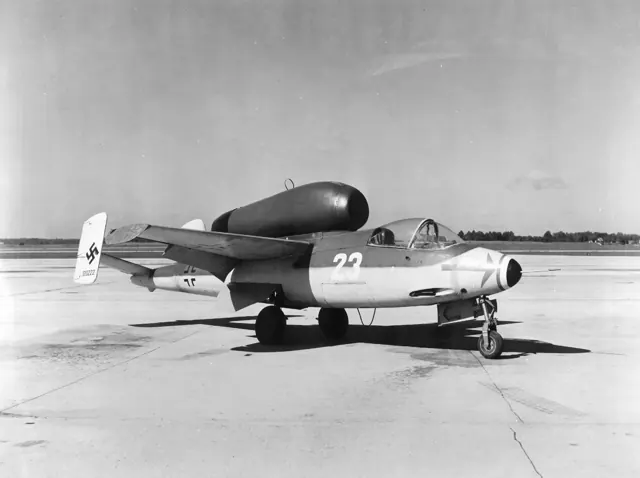
Heinkel He 162
The He 162 was built during the closing stages of the Second World War, among the first generation of jet fighters. A single jet engine sits above its compact fuselage.
VSKYLABS' simulation explores early jet handling and operating limits, including developer-modelled engine and airframe failures caused by mishandling.
He 162 A-2: Smithsonian preserved-aircraft record
Honda HA-420 HondaJet
The HondaJet mounts its engines above the main wing. Honda's design account traces that arrangement to Michimasa Fujino's work in 1997, allowing the cabin to avoid the rear-fuselage engine installation used on many small business jets.
FlightFX's HJet represents the HA-420 with a custom G3000, VNAV, cruise-speed control and automated hydraulics. HJet24 is a separate native MSFS 2024 rebuild with Working Title integration and revised automation.
Honda HA-420 HondaJet
Hughes H-4 Hercules
The H-4 Hercules was conceived as a wartime transatlantic transport and completed after the war. Eight engines and an immense wing surrounded its flying-boat hull. The prototype made one brief flight on 2 November 1947 and never entered operational transport service.
The familiar Spruce Goose nickname conceals a construction detail: birch was a major material in the wooden airframe. The simulator represents this single experimental aircraft.
Aircraft / family
OH-6A / H500C · Taog's Hangar · MSFS 2024
The two supplied aircraft have different pilot positions
Taog’s manual places the command seat on the right in the military OH-6A and on the left in the civilian H500C. It describes the four-bladed rotor and differing engine installations. These are earlier family configurations than the later MD500E described in several pilot accounts.
Taog OH-6A/H500C manual v1.1 · PDF pp.7–10
Hughes OH-6 / 500 · CowanSim · MSFS 2020 · MSFS 2024
Cowan documents separate collective and throttle controls
The MSFS manual requires separate collective and twist-throttle axes, naming COLLECTIVE AXIS and SET HELICOPTER THROTTLE AXIS. It distinguishes the collective’s engine-RPM beep switch from the cyclic trim controls. The starter is a toggle that must be cycled off before another start.
Cowan MSFS 500E manual · PDF pp.1–5,9
Hughes OH-6 / 500
Hughes developed the compact, single-turbine OH-6 for the US Army's Light Observation Helicopter programme. Its reconnaissance and utility roles were followed by the civilian Hughes 500 lineage.
Engines, rotors and equipment changed across the OH-6 and 500 family. Taog's simulator package offers skid and float configurations and documents electric cyclic trim; it does not describe that trim as a full automatic flight-control system.
Aircraft / family
Flying Fries Hughes XF-11 · Flying Fries · MSFS 2020 · MSFS 2024
Three-axis trim and control lock
The manual identifies trim controls on all three axes. Its control lock removes normal aileron and elevator control while elevator trim remains usable. Engine-failure features and sounds have their own version context.
XF-11 manual v3.0.0, 1 June 2026; PDF pp.5–7 History; pp.19–20 and 32–34 trim and control lock
Hughes XF-11
The XF-11 began as Hughes' military reconnaissance project during the Second World War. The developer's history follows the programme from a larger intended production order to two flying prototypes after the war. The first used two Pratt & Whitney R-4360 Wasp Major engines.
Flying Fries represents the contra-rotating-propeller configuration with period autopilot equipment and custom simulation features. Its manual describes three-axis trim and a control lock that can immobilise aileron and elevator controls while leaving elevator trim available.
Hughes XF-11
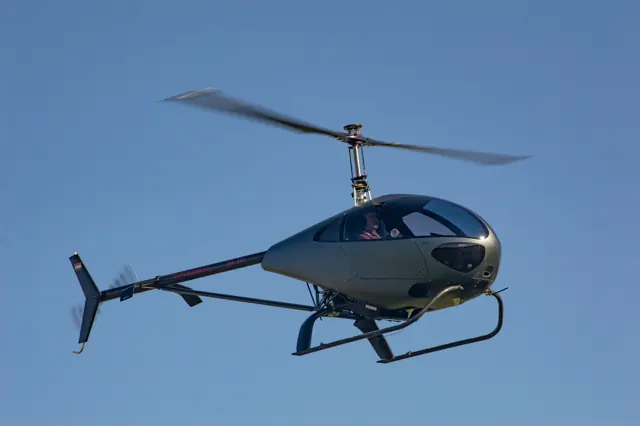
Hungarocopter HC-02
The HC-02 is a two-seat helicopter developed and manufactured in Hungary. Its compact layout uses a Rotax 915 iS engine, with the project’s documentation also discussing an electric emergency-power system.
VSKYLABS represents the HC-02 in an X-Plane 12 product. The developer describes an independent simulation built around native X-Plane features and provides separate operating and update documentation.
Hungarocopter two-seat HC-02 ERS
ICON A5
ICON designed the A5 for recreational flying from water and runways. The two-seat amphibian has a compact boat hull, retractable landing gear and a high-mounted engine driving a pusher propeller behind the cockpit. A broad canopy provides visibility around the cabin.
Aircraft / family
Nemeth Designs Ilyushin Il-18D · Nemeth Designs · MSFS 2024
Mechanical controls and trim
Sections 2.1.5–2.1.7 describe rigid mechanical elevator controls with a loading spring and aileron runs using rods and cables. Elevator trim acts through a mechanical tab, and the right aileron has electric trim. The four-engine propulsion installation is separate from those primary-control mechanisms.
Nemeth technical description; sections 2.1.5–2.1.7 primary controls and trim; AP-6E and equipment
JMB VL-3 Evolution
The VL-3 originated with Aveko and continued under JMB Aircraft. Its composite low-wing airframe and enclosed side-by-side two-seat cabin belong to the European ultralight and light-aircraft market.
The Evolution programme has offered different engines, landing gear and cockpit equipment over time. Simulator product descriptions identify the configuration represented by each package.
Aircraft / family