Find aircraft background, systems descriptions and manuals for the aircraft you are researching. Each note keeps its source and version context close by.
Simulator manuals describe the developer’s implementation. Aircraft background is research-based; pilot accounts describe an individual’s experience. Coverage here is limited to the selected notes and linked resources, not the full contents of every manual.
M-24 Orion · Microsoft Flight Simulator · MSFS 2024
This manual describes a Rotax 915 installation
The MSFS 2024 guide identifies a Rotax 915 iS engine. The older Rotax 914 aircraft in the pilot accounts are different configurations.
Official M24 manual · PDF page 6
M-24 Orion · Microsoft Flight Simulator · MSFS 2024
A compact panel retains a yaw string
The illustrated panel includes an engine-information system, radio, transponder and conventional flight instruments, with a yaw string ahead of the cockpit.
Manual PDF page 5
M-24 Orion · Microsoft Flight Simulator · MSFS 2024
Gyroplane controls rather than helicopter controls
The M24 manual identifies dual centre sticks, a trim button, a mechanical pre-rotator and a rotor brake. The pre-rotator is used to spin up the rotor; it is not the same as a helicopter's continuously engine-driven rotor system. The cockpit diagram shows how these distinct controls are arranged.
Archived simulator manual; installed package revision not observed · PDF pp.3,5
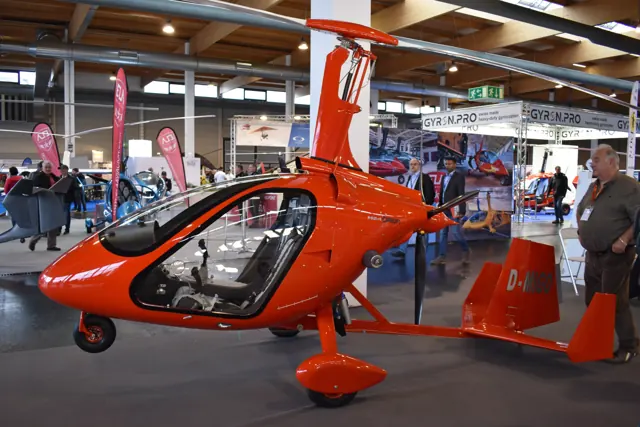
Magni M-24 Orion
Magni Gyro developed the M-24 Orion in Italy with an enclosed side-by-side two-seat cabin and a pusher propeller. Its freely turning rotor produces lift through autorotation in flight; a separate engine-driven propeller provides forward thrust. The enclosed cabin differs from the open-frame layout of many recreational gyroplanes.
Aircraft / family
Magni M16
The M16 is an open-cockpit tandem gyroplane with a pusher engine and a rotor above its two occupants. Its principal rotor is not continuously driven by the engine in flight: it turns by autorotation as air passes through the disc. Engine power acts through the propeller to provide forward thrust, and ground prerotation is a separate part of preparing the rotor for takeoff.
The control stick tilts the rotor head and changes the direction in which the rotor disc carries the aircraft. The manual’s trim system acts through a cable and spring assembly, changing the force the pilot holds at the stick. That combination of rotor-head control and spring trim is central to the M16’s cockpit character.
M16C handbook configuration; national approvals and individual equipment may differ.
Magni M22
The M22 combines tandem seating with a pusher powerplant and an autorotating rotor. Its rear seat is slightly elevated, a detail identified in the M22C manual’s cockpit description. The rotor produces lift while engine power supplies thrust through the propeller. Prerotation on the ground prepares the rotor for takeoff; the rotor’s sustained flight rotation comes from airflow through the disc.
The M22C manual describes direct stick control of the rotor head and an actuator working on the trim cable/spring assembly. Trim therefore changes the force held by the pilot without replacing the pilot’s rotor-head command.
M22C Voyager handbook configuration; national approvals and individual equipment may differ.
Martin P6M-2 SeaMaster
Martin's P6M-2 SeaMaster was a flying boat powered by Pratt & Whitney J75 turbojets. The Smithsonian preserves a J75-P-2 engine that powered this version.
Virtavia P6M-2 manual; J75-powered production configuration, distinct from J71 prototypes.
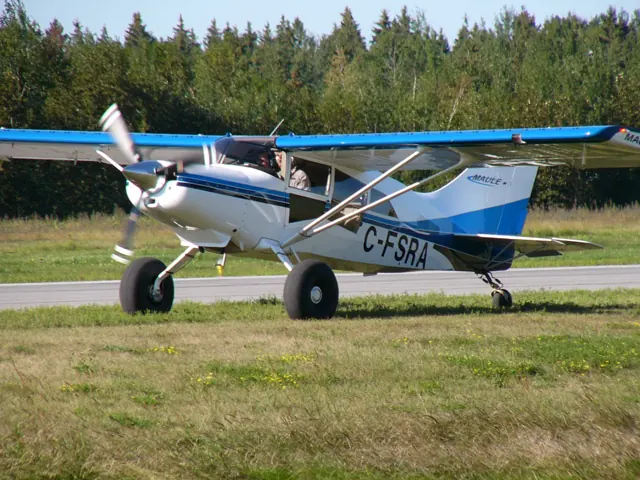
Maule M-7
The M-7-235B combines Maule's high-wing utility layout with tailwheel undercarriage, a large cabin loading door and a 235 hp Lycoming engine. Land and water configurations have been offered.
VSKYLABS includes analog and G1000 landplanes plus an analog amphibian. The landplanes have conventional wheels or large bush tyres. The developer's manual documents the simulated equipment and procedures.
VSKYLABS M-7-235B landplane · VSKYLABS M-7-235B seaplane
Max Holste MH.1521 Broussard
Restauravia's MH.1521 Broussard has a 450 hp radial engine, fixed tailwheel landing gear and electrically commanded flaps. Cockpit diagrams identify pitch and rudder trim, with no aileron-trim control.
Max Holste MH.1521 Broussard
Maxair Drifter
The Drifter is an open-air pusher ultralight with its occupants below the wing and the engine behind them. Ant’s handbook traces the design to the 1980s and describes approximately 500 built. The small airframe’s view and arrangement come from that low-speed recreational role, with little cockpit structure between the occupants and the surrounding air.
The handbook describes a Rotax 582 driving a four-blade Brolga propeller through a reduction gearbox. Pitch trim uses a wire-operated tab controlled from a lever on the front stick. Wheel and float versions give the same broad aircraft a different surface-contact arrangement, while the propulsion and trim mechanism retain their own identity.
Ant’s handbook configuration · Drifter handbook
McDonnell Douglas DC-9
Douglas introduced the DC-9 in 1965 for short-range routes. Its rear-mounted twin engines and two-crew flight deck supported economical airline operation. The family developed through numerous versions, several of which appear in separate simulator products.
DC-9-14 in Delta museum summary
McDonnell Douglas F-4 Phantom II
The Phantom began as a US Navy aircraft and was adopted by the US Air Force, Marine Corps and export customers. Large intakes, upward-angled outer wing panels and downward-angled tailplanes distinguish its airframe.
Interceptor, strike and reconnaissance versions carried different engines, radar and cockpit equipment. National upgrades added further differences during the type's long service.
Aircraft / family