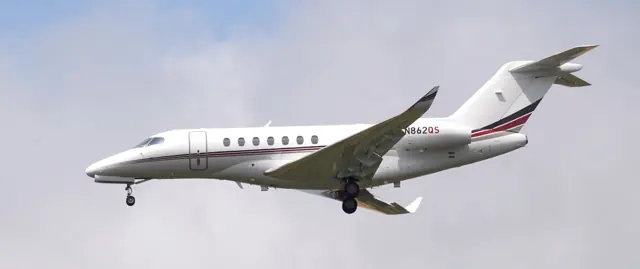
Find aircraft background, systems descriptions and manuals for the aircraft you are researching. Each note keeps its source and version context close by.
Simulator manuals describe the developer’s implementation. Aircraft background is research-based; pilot accounts describe an individual’s experience. Coverage here is limited to the selected notes and linked resources, not the full contents of every manual.
Cessna Citation CJ4 · Microsoft Flight Simulator · MSFS 2020
Following a path still leaves speed to the pilot
The guide explicitly states that VNAV does not move the throttles. The pilot manages speed while the flight guidance follows the descent path. VNAV provides flight guidance without automatic thrust control.
CJ4 Operator’s Guide v1 · PDF p.56; exact release applicability unresolved
Cessna Citation CJ4 · Microsoft Flight Simulator · MSFS 2020
Flight guidance and yaw damping are separate controls
The CJ4 guide documents a flight-guidance panel with flight-level-change, heading and navigation functions. It treats yaw-damper engagement separately from autopilot use and includes pilot-managed pitch trim.
CJ4 user guide v1; exact release applicability unresolved · PDF pp.8,10; climb and AP operation
Cessna Citation CJ4
The CitationJet programme began with the Model 525, first flown in 1991, and developed through a series of larger and more capable CJ aircraft. The CJ4 is the Model 525C, a later branch of that family with a different wing and a stretched cabin.
Working Title documents the simulated CJ4's avionics, flight guidance and equipment. Its flight deck differs from the earlier CitationJet and M2.
Aircraft / family
CJ4 Debut
Thomas A. Horne · 1 December 2010
Refined Mobility: Cessna CJ4 Flight Test
Robert Erdos · 30 September 2011
Citation CJ4 Gen2
Rich Pickett · July 2021
Citation Longitude · Microsoft Flight Simulator · MSFS 2024
Fuel management includes automatic pump logic
The guide’s simulation notes describe automatic boost and recirculation pump management, transfer-valve and scavenge logic, and custom gravity crossflow behavior. Fuel temperature also responds to the wing skin, fuel mass and returned fuel.
Archived Model 700 guide · PDF p.55; installed package revision not observed
Citation Longitude · Microsoft Flight Simulator · MSFS 2024
The cabin environment is part of the model
The documented air-conditioning simulation follows bleed-air temperature through the pack and into the cabin. It includes automatic temperature control and separate air-cycle-machine-only or heat-exchanger-only modes with different heating and cooling capabilities.
Archived Model 700 guide · PDF p.83; installed package revision not observed
Citation Longitude · Microsoft Flight Simulator · MSFS 2024
Three axes, different control paths
The Longitude guide describes mechanical pitch and roll controls, hydraulically operated roll spoilers and an electronically controlled rudder. Its simulated hydraulic failures can affect rudder, yaw-damper and spoiler authority. The guide also marks locks, disconnects and secondary trim as unmodelled in the documented version. Engine FADEC, the APU and fuel transfer have their own detailed sections.
Archived simulator manual; installed package revision not observed · PDF pp.39,104,117; simulation notes
Cessna Citation Longitude · Microsoft Flight Simulator · MSFS 2020
Fuel management includes automatic pump logic
The guide’s simulation notes describe automatic boost and recirculation pump management, transfer-valve and scavenge logic, and custom gravity crossflow behavior. Fuel temperature also responds to the wing skin, fuel mass and returned fuel.
Archived Model 700 guide · PDF p.55; installed package revision not observed
Cessna Citation Longitude · Microsoft Flight Simulator · MSFS 2020
The cabin environment is part of the model
The documented air-conditioning simulation follows bleed-air temperature through the pack and into the cabin. It includes automatic temperature control and separate air-cycle-machine-only or heat-exchanger-only modes with different heating and cooling capabilities.
Archived Model 700 guide · PDF p.83; installed package revision not observed
Cessna Citation Longitude · Microsoft Flight Simulator · MSFS 2020
Three axes, different control paths
The Longitude guide describes mechanical pitch and roll controls, hydraulically operated roll spoilers and an electronically controlled rudder. Its simulated hydraulic failures can affect rudder, yaw-damper and spoiler authority. The guide also marks locks, disconnects and secondary trim as unmodelled in the documented version. Engine FADEC, the APU and fuel transfer have their own detailed sections.
Archived simulator manual; installed package revision not observed · PDF pp.39,104,117; simulation notes