MSFS
Cessna 404 Titan ↗
A cabin-class piston twin designed for commuter, cargo and utility work.
1 implementations+ Compare
Explore the aircraft. Find your simulator. Follow the sources.
A cabin-class piston twin designed for commuter, cargo and utility work.
A 1920s transport family that developed from a single-engine airliner into a trimotor.
A two-seat naval fighter with variable-sweep wings and a cockpit built around pilot and radar-intercept officer roles.
A tandem two-seat sailplane family used for training and cross-country soaring.
A large twin-radial transport that carried heavy loads through wartime and post-war freight service.
A compact racing aeroplane built around a large radial engine and very short fuselage.
A tailwheel utility single built around a high wing and a substantial working cabin.
A compact Czech touring aircraft with side-by-side seats and a streamlined low-wing airframe.
A box-shaped utility twin whose cabin and rear access are central to its design.
An enclosed, two-seat autogyro with side-by-side seating and a pusher propeller.
The H130 utility helicopter, descended from the AS350 and fitted with a Fenestron.
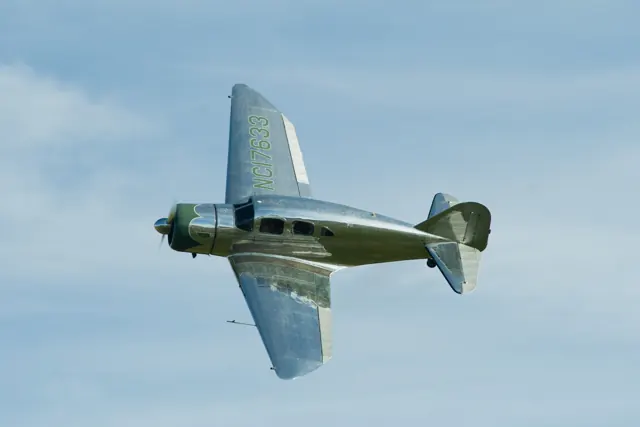
A late-1930s cabin aircraft with metal construction and retractable landing gear.
A small three-engine demonstrator created to explore technologies for a future supersonic airliner.
A swept-wing business jet designed around high subsonic cruise speed.
A long-running touring single, familiar in both V-tail and conventional-tail forms.
Ted Smith's piston twin, later produced by Piper as the Aerostar.
SOCATA's touring-aircraft family, including the Tobago and Trinidad.
A wartime fighter developed from the earlier Curtiss P-36.
A fixed-gear twin turboprop with a long history in regional and remote-area transport.
A four-seat kit-built touring aircraft that expanded the RV family beyond two-seat designs.
The Huey: a turbine-powered utility helicopter with a broad cabin and an unmistakable two-bladed rotor.
A two-seat light amphibian with a compact boat hull and a pusher propeller.
A twin-engine business jet designed to retain some of the utility flexibility associated with the PC-12.
A stretched development of the DC-9 with rear-mounted engines and a five-abreast cabin.
This is AirframeDB’s first release. More features and aircraft research are planned. Leave your email if you’d like occasional updates.