Find aircraft background, systems descriptions and manuals for the aircraft you are researching. Each note keeps its source and version context close by.
Simulator manuals describe the developer’s implementation. Aircraft background is research-based; pilot accounts describe an individual’s experience. Coverage here is limited to the selected notes and linked resources, not the full contents of every manual.
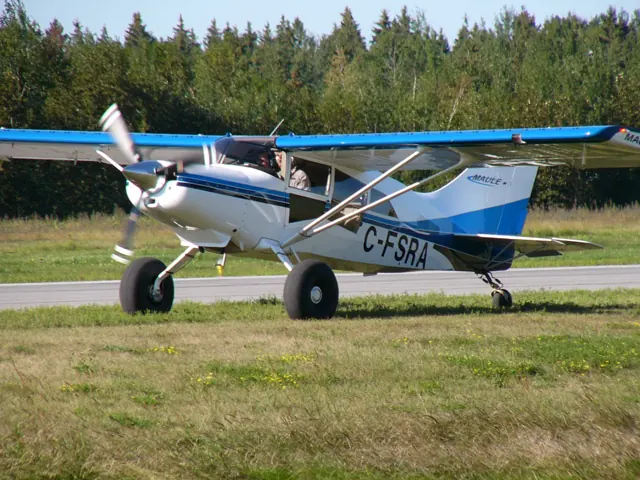
Maule M-7
The M-7-235B combines Maule's high-wing utility layout with tailwheel undercarriage, a large cabin loading door and a 235 hp Lycoming engine. Land and water configurations have been offered.
VSKYLABS includes analog and G1000 landplanes plus an analog amphibian. The landplanes have conventional wheels or large bush tyres. The developer's manual documents the simulated equipment and procedures.
VSKYLABS M-7-235B landplane · VSKYLABS M-7-235B seaplane
Max Holste MH.1521 Broussard
Restauravia's MH.1521 Broussard has a 450 hp radial engine, fixed tailwheel landing gear and electrically commanded flaps. Cockpit diagrams identify pitch and rudder trim, with no aileron-trim control.
Max Holste MH.1521 Broussard
Maxair Drifter
The Drifter is an open-air pusher ultralight with its occupants below the wing and the engine behind them. Ant’s handbook traces the design to the 1980s and describes approximately 500 built. The small airframe’s view and arrangement come from that low-speed recreational role, with little cockpit structure between the occupants and the surrounding air.
The handbook describes a Rotax 582 driving a four-blade Brolga propeller through a reduction gearbox. Pitch trim uses a wire-operated tab controlled from a lever on the front stick. Wheel and float versions give the same broad aircraft a different surface-contact arrangement, while the propulsion and trim mechanism retain their own identity.
Ant’s handbook configuration · Drifter handbook
IndiaFoxtEcho T-45C Goshawk · IndiaFoxtEcho · MSFS 2020 · MSFS 2024
Powered surfaces and artificial feel
The manual describes powered stabilator and aileron controls and an unpowered rudder. Spring cartridges, inertia and viscous damping supply feel. A speedbrake interconnect can move the stabilator without moving the stick, so that surface motion has a different mechanism from pilot trim.
PDF pages 63-71,147-148,153 image
IndiaFoxtEcho T-45C Goshawk · IndiaFoxtEcho · MSFS 2020 · MSFS 2024
The documented simulation
IndiaFoxtEcho marks RAT/emergency hydraulic and emergency-flap functions as absent in the simulation. The documentation distinguishes a pedal shaker from a stick shaker and gives 200 KIAS gear/flap limits separately from the 217-knot slat inhibition threshold.
PDF pages 63-71,147-148,153 image
McDonnell Douglas / BAe T-45C Goshawk
The T-45 adapted the British Aerospace Hawk Mk.60 for U.S. Navy and Marine Corps carrier training. Its airframe required strengthening for catapult launches and carrier landings, giving the Hawk lineage a different operating role.
The T-45C control system combines powered stabilator and ailerons with an unpowered rudder. Spring cartridges, inertia and viscous damping provide control feel. IndiaFoxtEcho's manual separately identifies simulator features and unimplemented emergency functions.
McDonnell Douglas / BAe T-45C Goshawk
McDonnell Douglas / Boeing F-15 Eagle
The F-15 began as an air-superiority fighter, with the first F-15A flight in July 1972. The Air Force records the C and D entering its inventory in 1979, followed by a family that also includes the two-seat, dual-role F-15E. High thrust-to-weight ratio and low wing loading are the features the service emphasizes in explaining its manoeuvrability.
USAF family history · Developer listing · Developer manual
McDonnell Douglas AV-8B Harrier II · X-Trident · X-Plane 11
Navigation and sensor displays can leave the cockpit panel
The X-Trident listing includes scaled navigation maps, VOR/ILS and TACAN, terrain mapping, and floating multifunction displays. Its feature list also identifies the upfront and control-display units as interactive cockpit components.
Harrier AV-8B for X-Plane 11 · developer store description
McDonnell Douglas AV-8B Harrier II · X-Trident · X-Plane 11
Adjust how the simulator presents movement and sound
The package lists a Smartview camera tied to flight path and speed, configurable sounds and aural warnings, and optional particle effects. These presentation settings accompany the aircraft’s navigation and flight controls.
X-Plane 11 product feature list · gathered September 2026
AV-8B Harrier II, Plus and GR9 · DC Designs · MSFS 2020 · MSFS 2024
Product and edition scope
DC Designs lists AV-8B Harrier II, Plus and GR9 for MSFS 2020 · MSFS 2024. The linked listing was captured 28 September 2026.
Product listing captured 28 September 2026; MSFS 2020 and 2024
AV-8B Harrier II, Plus and GR9 · DC Designs · MSFS 2020 · MSFS 2024
Controls and systems in the developer manual
The DC Designs manual describes automatic flap and trim behaviour and a nozzle-controlled transition between hover and wing-borne flight. Equipment differs among the listed variants.
Manual captured 28 September 2026; flap, trim and nozzle operation
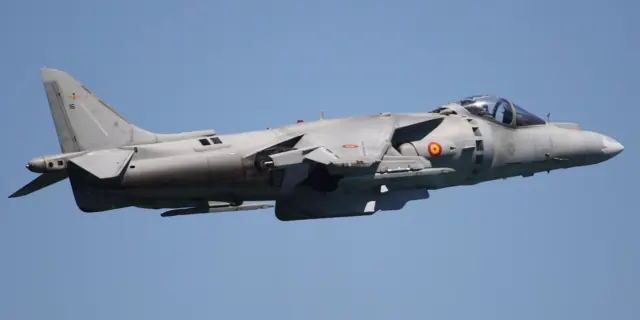
McDonnell Douglas AV-8B Harrier II
The AV-8B developed the vectored-thrust Harrier into a second generation of ground-attack aircraft. It served in close air support and reconnaissance roles in the United States, Spain and Italy. The British Harrier II and tandem-seat TAV-8B are related developments. The simulator product represents the AV-8B.