Find aircraft background, systems descriptions and manuals for the aircraft you are researching. Each note keeps its source and version context close by.
Simulator manuals describe the developer’s implementation. Aircraft background is research-based; pilot accounts describe an individual’s experience. Coverage here is limited to the selected notes and linked resources, not the full contents of every manual.
Fokker 50
The Fokker 50 flight-controls document describes mechanical rods and cables, spring and balance tabs for the ailerons, electrical roll trim and a manually operated elevator trim tab. The elevator flight-control and longitudinal stability augmentation systems modify pitch feel. The wing flaps are hydraulically operated.
Fokker 50
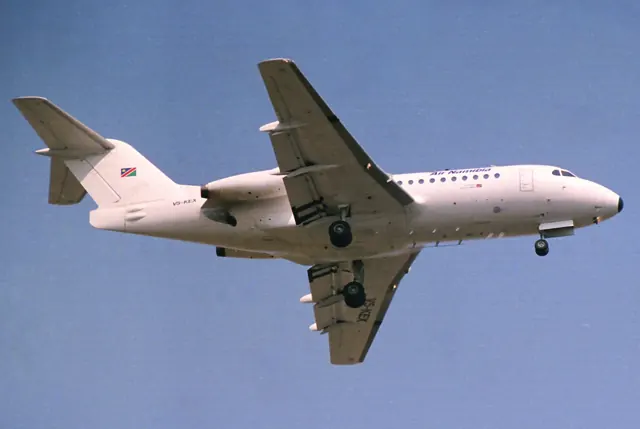
F28 Professional · Just Flight · MSFS 2020 · MSFS 2024
The tail speedbrake responds to throttle position
The guide describes a hydraulic tail speedbrake with continuously variable extension. Advancing either throttle to its detent retracts the brake and returns its cockpit lever, which helps explain an unexpected lever movement while exploring the simulator.
F28 Professional manual v2.2 · PDF pp.63–65
F28 Professional · Just Flight · MSFS 2020 · MSFS 2024
Different control axes use different feel mechanisms
Just Flight's F28 guide describes spring feel and datum-shift trim for roll and yaw, with a different arrangement for the elevator. Hydraulic failures also have distinct effects depending on the system involved. The stick shaker disengages the autopilot's pitch channel in the documented design, connecting stall warning with flight-guidance behaviour.
F28 manual v2.2 · PDF pp.31,59-60
Albatross G111/HU16 · Microsoft Flight Simulator · MSFS 2024
The MSFS 2024 hydraulic model separates two systems
The guide describes an engine-pump-powered main system for gear and flaps, plus an accumulator-equipped brake subsystem. Falling main pressure can slow or stop gear and flap movement.
Albatross guide v2.3.6, PDF pages 34–35; MSFS 2024-specific behaviour
Albatross G111/HU16 · Microsoft Flight Simulator · MSFS 2024
Runway equipment and water equipment in one aircraft
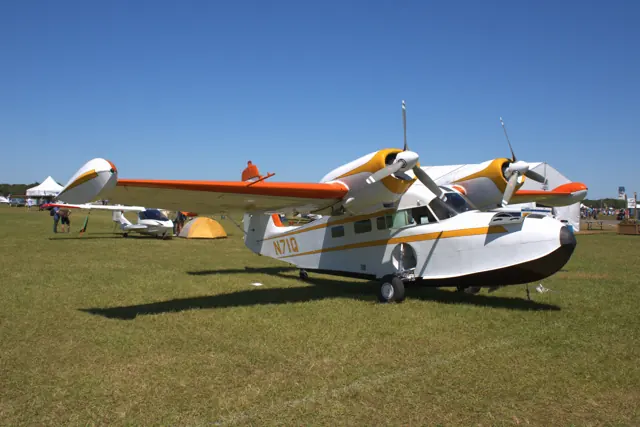
The Albatross guide covers hydraulic and landing-gear instruments, nosewheel steering choices, chocks and a sea anchor. It also identifies trim and autopilot controls. HU-16E and G-111 options differ, so the military and civilian configurations retain separate context even within the same package.
Albatross manual v2.3.6.1 · PDF pp.6,8-9,23
Grumman F-14 Tomcat · Laminar Research · X-Plane 12
Digital augmentation alongside the variable-sweep wing
The F-14 guide documents trim and spoiler indications, hydraulic systems and selectable digital augmentation in pitch, roll and yaw. The manual describes these systems separately from wing sweep.
Archived simulator manual; installed package revision not observed · PDF pp.49,52,68
Grumman F6F-5 Hellcat
The Hellcat began as a proposed improvement to Grumman's Wildcat before developing into a larger fighter. Its first prototype flew in June 1942, and the Navy accepted the first production F6F-3 in January 1943. The F6F-5 followed in mid-1944.
FlyingIron's F6F-5 manual describes manual primary controls, aileron spring tabs and trim on all three axes. Hydraulic blowback changes flap position with airspeed.
Grumman F6F-5 Hellcat
Grumman G-44A Widgeon · Flysimware · MSFS 2020 · MSFS 2024
Hydraulic levers and hardware assignments
The manual describes an optional realistic hydraulic mode on the copilot-seat clipboard. In this mode, the gear and flap levers must be held while the mechanism moves; releasing a lever closes its valve. Flysimware warns that a persistent hardware gear assignment conflicts with this option and recommends a separate control profile. The documented manual pump and lever-lock tabs provide a simulated alternative when the left-engine hydraulic supply is unavailable.
Flysimware manual v1.2, MSFS 2020: clipboard settings and hydraulic operation; developer documentation, not a runtime hardware test.
FlightFX Hawker 800XP · FlightFX · MSFS 2024
Primary controls and the pitch servomotor
The v1.1 manual describes cable-operated primary controls, balancing and elevator spring/G-weight arrangements. Electric trim, autopilot trim and Mach trim use the pitch servomotor. Hydraulics operate accessories and the pusher; the primary controls remain manually linked.
v1.1 PDF pp206-211; PDF pp213-218; PDF p66 and274-277; PDF p36 table visually inspected; pp93-94
Hawker 800XP
The Hawker 800XP's primary controls use cables with geared, horn and mass balancing. An elevator spring and G-weight accompany its trim tabs. Hydraulic power operates accessories and the stick pusher, while electric, autopilot and Mach trim share the pitch servomotor.
FlightFX's documentation separates the normal flap settings from the ground-only lift-dump position. It also gives the flight-guidance controls and stall-protection interlocks their own descriptions.
Hawker 800XP
FlightFX HJet HA420 · FlightFX · MSFS 2020 · MSFS 2024
The original HJet cockpit
The original MSFS 2020 HJet product documents a custom G3000, VNAV and CSC functions and automated hydraulic systems. More than 130 CAS messages report aircraft conditions through the crew-alerting system.
Original HJet product, detailed systems and avionics
Honda HA-420 HondaJet
The HondaJet mounts its engines above the main wing. Honda's design account traces that arrangement to Michimasa Fujino's work in 1997, allowing the cabin to avoid the rear-fuselage engine installation used on many small business jets.
FlightFX's HJet represents the HA-420 with a custom G3000, VNAV, cruise-speed control and automated hydraulics. HJet24 is a separate native MSFS 2024 rebuild with Working Title integration and revised automation.
Honda HA-420 HondaJet