X-Plane
Cessna 206 Stationair ↗
The Stationair utility family, combining a high wing with fixed landing gear.
1 implementations+ Compare
Explore the aircraft. Find your simulator. Follow the sources.
The Stationair utility family, combining a high wing with fixed landing gear.
A six-engine heavy transport created for exceptionally large external and internal loads.
A Swedish reconnaissance and dive-bombing aircraft from the early 1940s.
The Mitchell medium bomber, named for aviation advocate Billy Mitchell.
A military liaison aircraft built around a high wing, tandem cabin and short-field utility work.
A streamlined twin-engine helicopter with a Fenestron tail rotor and retractable landing gear.
A post-war Businessliner with a radial engine, cabin transport ambitions and tailwheel gear.
A tandem-seat jet trainer that also found a second life in civilian display and racing.
Diamond's four-seat light twin, developed with diesel-powered versions.
A light business jet with a swept wing, rear-mounted engines and an integrated flight deck.
A heavy-lift helicopter built around an open frame and an external working load.
A pressurised four-engine piston transport from the last major generation before the jet airliner.
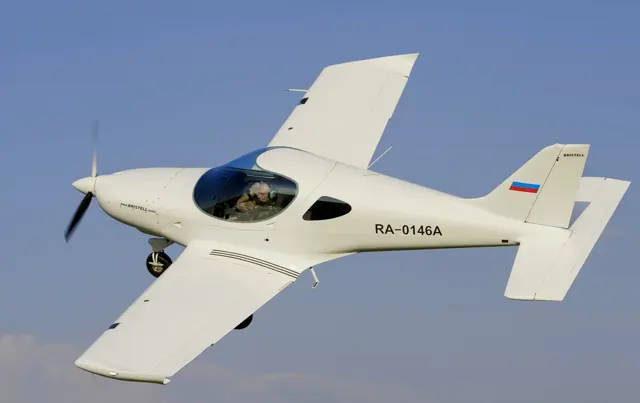
BRM Aero's two-seat B23, represented in MSFS by Airfoillabs.
The H130 utility helicopter, descended from the AS350 and fitted with a Fenestron.
A light turbine helicopter whose land-based Scout and naval Wasp branches served different jobs.
A carbon-fibre aerobatic monoplane family with a dedicated air-racing branch.
A First World War trainer that became a familiar sight in the barnstorming era.
A two-seat Tecnam high-wing aircraft combining composite and metal construction.
The Model 525 CitationJet, the starting point of Cessna's CJ and M2 lineage.
A two-seat composite kit aircraft developed from the Lancair 320.
A side-by-side two-seat sailplane with a retractable powerplant for self-launching.
A long-range fighter whose different engine and canopy developments produced several distinct forms.
The purpose-built Ryan monoplane used by Charles Lindbergh for his 1927 solo Atlantic crossing.
A twin-turboprop regional airliner developed through Swedish and American industrial cooperation.
This is AirframeDB’s first release. More features and aircraft research are planned. Leave your email if you’d like occasional updates.